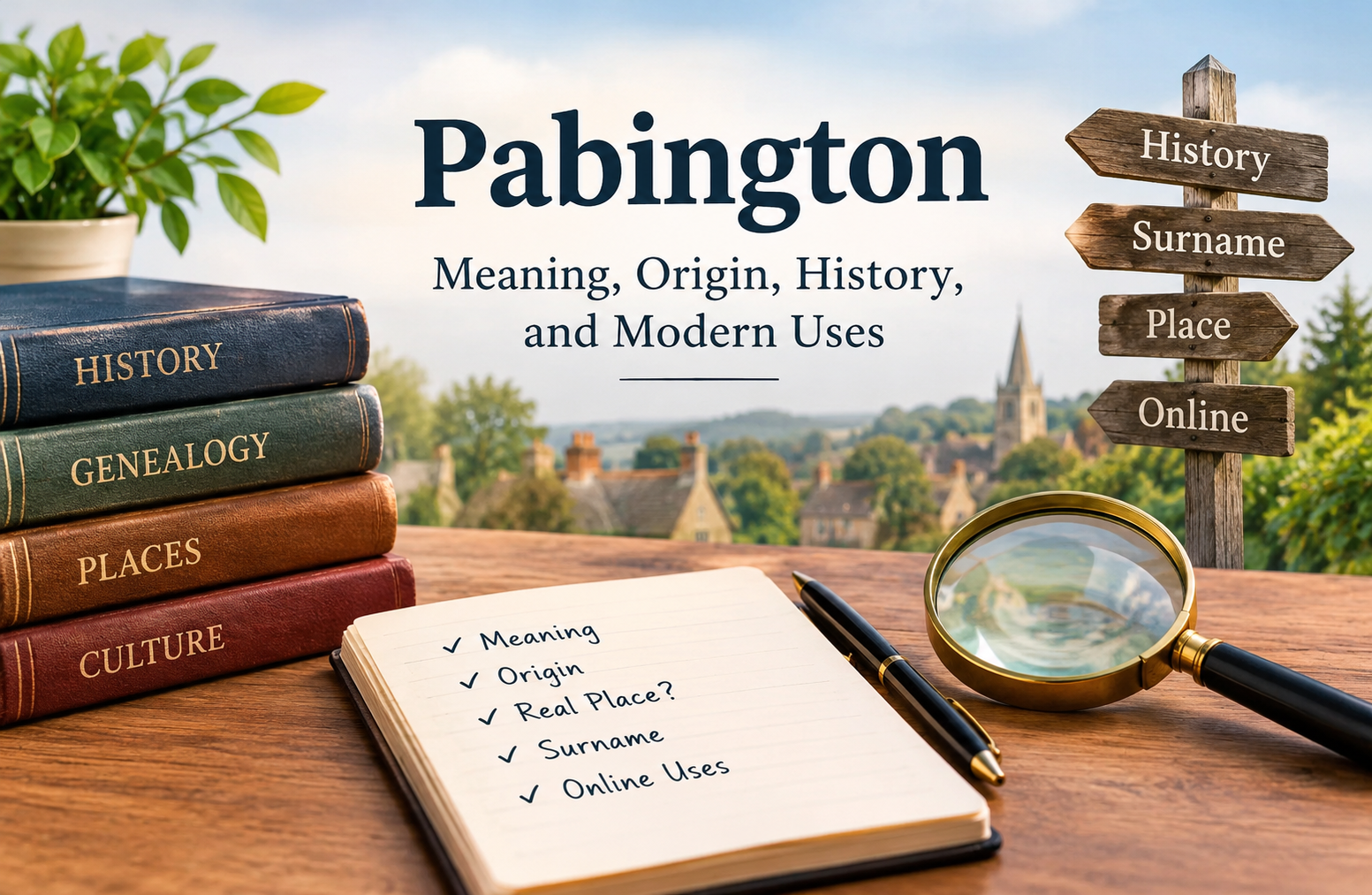
Pabington: Meaning, Origin, History, and Modern Uses
The word Pabington has an unusual quality: it sounds like the name of an established English town, an old family surname, or a fictional place from a book. Yet finding a clear, reliable explanation can be difficult. If you are searching for Pabington, you may want to know what it means, whether it is a real place, where the name originated, and why it appears in online discussions. The most accurate starting point is that the term has no widely accepted modern definition. It may be used as a rare surname, a creative name, a fictional location, or an online search term, depending on the context. Understanding these different possibilities is essential to separating documented information from speculation.
What Is Pabington?
Pabington is an uncommon name whose meaning depends on how and where it is used. Unlike familiar English words with established dictionary definitions, it does not have one universally recognized meaning that explains every appearance of the term.
When people encounter an unfamiliar name, they naturally try to connect it with something they already know. In this case, the spelling resembles traditional English place names and surnames. That resemblance can create the impression that the word must refer to a historic village, a geographical location, or a person with a long family history.
However, a name that sounds familiar is not necessarily an officially recognized place or an established word.
There are several reasonable contexts in which someone might encounter this term:
- A surname: The name may appear in historical family records or genealogy research.
- A fictional location: Writers may use it for an imaginary village, town, estate, or region.
- A creative identity: It could serve as a username, project name, character name, or online identity.
- A brand-style name: Its distinctive spelling may appeal to someone looking for an unusual name for a creative project.
- A search query: People may type it because they have seen it elsewhere, are investigating its meaning, or have confused it with a similar-looking word.
These possibilities should not be treated as equally established facts. Historical records, for example, can demonstrate that a surname was used by a particular family. They do not automatically establish the name as a town or prove its original meaning.
Likewise, seeing the word in a blog post does not prove that it is a popular internet trend, a registered business, or a recognized cultural expression.
The most useful approach is to examine the context in which the term appears and identify what can actually be verified.
What Does Pabington Mean?
There is no single authoritative definition that establishes the meaning of this name in every situation. Its interpretation therefore requires a distinction between documented usage and possible meaning.
If the term appears in a family tree, its meaning is primarily genealogical. If it appears in a story, it may simply identify a fictional setting. Also if someone uses it as a username, it may have personal significance known only to that individual.
This distinction is important because unusual names are often given elaborate explanations online without sufficient historical evidence.
The meaning as a personal name
As a personal or family name, Pabington can identify an individual or a family. In this context, the most useful questions concern spelling, ancestry, geographical distribution, and the earliest records in which the name appears.
A family surname does not always have a meaning that can be translated directly into modern English. Some surnames developed from occupations, personal characteristics, locations, relationships, or older forms of language. Others changed spelling over time as people moved between communities or as records were written by different clerks.
Without reliable historical documentation connecting this particular name to a specific source, it would be misleading to assign it a definite meaning.
The meaning as a fictional name
In fiction, a name does not need an established historical definition to be useful.
An author could use Pabington for a quiet village, an old manor, a railway station, a fictional family, or an imaginary community. Readers might associate it with traditional British settings because its spelling resembles familiar English place names.
That association can influence how a fictional location feels, even when the writer has not based it on a real settlement.
The meaning as an online term
On the internet, names can acquire meaning through repeated use. A word might begin as a username, a joke, a character name, or an invented expression. If other people adopt it, its meaning can gradually expand.
Nevertheless, there is a difference between a term that someone has used online and a term that has become widely established in internet culture.
There is not enough reliable evidence to assign Pabington one universal slang definition or to claim that all online references share the same origin.
For readers trying to understand the term, context is more reliable than a confident but unsupported explanation.
Is Pabington a Real Place?
One of the most common questions about Pabington is whether it refers to a real town or village.
The careful answer is that the available evidence does not establish it as a widely recognized modern town or city. That does not prove that the name has never been used for a small locality, private property, historic estate, or fictional settlement. It means that its status as an established geographical location should not be assumed without a dependable record.
A proper place-name investigation normally involves more than a general internet search. Researchers compare official geographical databases, historical maps, local archives, census documents, and published records to establish whether a location existed and how its name was used.
Why the name sounds like a British town
English place names often contain recognizable endings such as -ton, which can reflect older words associated with settlements, farms, or enclosed places. Examples include Paddington, Kensington, and Islington.
Because Pabington has a similar structure, readers may instinctively picture an English village with old buildings, narrow streets, and a traditional town centre.
This is a linguistic impression, not geographical proof.
Many invented names are designed, intentionally or otherwise, to resemble established place names. They may sound convincing because they follow familiar spelling patterns, even when no corresponding settlement has been identified.
It is therefore reasonable to say that the name has an English-style appearance. It is not reasonable to infer its exact history from that appearance alone.
How to verify a claimed location
If you have encountered a reference to a place called Pabington, use the following process to investigate it.
- Identify the original reference. Record the website, book, map, document, or conversation in which the name appears.
- Check the geographical context. Look for a country, county, nearby town, postcode, or other location detail.
- Consult authoritative records. Depending on the country, these might include national mapping agencies, government geographical databases, historical map collections, or local council records.
- Compare historical spellings. Older documents may use variations that differ from a modern spelling.
- Look for independent confirmation. A location mentioned repeatedly on websites that copy one another is not necessarily verified.
This approach is useful because online articles sometimes repeat claims without providing primary evidence. Repetition can make a claim appear established even when every page ultimately relies on the same unsupported statement.
If the name appears in a fictional story, the search may lead to a different conclusion. In that case, the relevant evidence would be the original book, film, game, or other creative work rather than a geographical database.
The Possible History and Origin of Pabington
The origin of this name is not conclusively established. Understanding its possible history requires separating the documented use of the spelling from theories about how the word may have developed.
A reliable historical explanation should answer three questions:
- When did the name first appear in a verifiable record?
- Where was it used?
- What evidence connects the spelling to an earlier word, family, or location?
Without answers to these questions, an exact origin story would be speculation.
The influence of traditional English naming patterns
The structure of the word resembles names found throughout England and other places influenced by English naming traditions.
Historically, many English place names developed through combinations of words associated with people, settlements, landscapes, religious sites, or local features. Their present-day spellings often reflect centuries of linguistic change.
This history explains why unfamiliar names can sound old even when their actual origins are recent or unknown.
However, the ending of a name cannot establish its entire etymology. A resemblance to a known linguistic pattern is a starting point for research, not a complete explanation.
To establish a genuine connection, researchers would need historical spellings, relevant language evidence, and records showing how the name developed over time.
Could the name have changed over generations?
It is possible for surnames to change as families move between regions or countries. Handwritten records may contain spelling variations, and people sometimes adopt different spellings in official documents.
That general historical pattern does not prove that Pabington evolved from another specific surname.
To investigate a possible variation, researchers should compare actual records rather than rely on visual similarity alone. Relevant documents might include parish registers, census returns, birth and marriage records, wills, immigration documents, and other historical sources.
Dates and locations are particularly important. Two similar surnames may be unrelated, while two spellings that look quite different may belong to the same family line.
What can historical surname records tell us?
Genealogy databases can provide useful starting points for researching rare names. Ancestry, for example, offers resources for exploring surname histories and family records.
Its surname and family history resources can help researchers begin investigating names, although individual claims still need to be checked against the underlying documents.
A surname database may reveal where a name appears in surviving records, how frequently it occurs in a particular collection, or which documents deserve further examination. Its findings should be interpreted within the limits of the available records.
For example, a surname appearing in a historical census establishes that someone with that recorded name was documented in the relevant population at that time. It does not automatically identify the surname’s original inventor or prove that every person with a similar surname shares the same ancestry.
The same caution applies to Pabington. Historical surname usage, if documented in a particular record, is evidence of that usage rather than proof of an elaborate origin story.
Pabington as a Rare Surname
A surname is one plausible context in which this name may appear. Rare surnames can be difficult to investigate because they leave fewer records than common family names.
This creates an interesting research challenge. A researcher may find only a handful of references, yet each record could be important for understanding a family’s history.
The key is to distinguish between finding a name and reconstructing the lives of the people who carried it.
How to research a family with this surname
If you believe Pabington appears in your family history, start with the records closest to your own family and work backward.
Step 1: Begin with known relatives.
Write down the full names, approximate birth dates, marriage dates, death dates, and known locations of the relatives you are researching. Ask family members whether they have letters, certificates, photographs, or family documents that could help.
Step 2: Record every spelling variation.
Do not assume that a surname was spelled consistently throughout a person’s life. Search for plausible variations only when the historical context supports them, and keep each spelling clearly documented.
Step 3: Establish geographical connections.
A name associated with one county or town in a particular generation may appear elsewhere in later records because a family moved. Locations help distinguish people with similar names.
Step 4: Compare multiple records.
A birth record, marriage certificate, census entry, and death record may each provide different details. When dates, family relationships, and locations agree, the identification becomes more convincing.
Step 5: Preserve the evidence.
Record where each fact came from, including the document title, date, archive, and any identifying reference. This makes it easier to revisit uncertain conclusions later.
Common mistakes in surname research
There are several mistakes worth avoiding when investigating an uncommon name.
- Assuming everyone with the same surname is related. A shared surname alone does not prove a common ancestor.
- Treating online family trees as primary evidence. Family trees can contain errors that are copied from one researcher to another.
- Accepting a surname meaning without documentation. A plausible linguistic explanation is not necessarily the correct one.
- Ignoring conflicting dates. Differences in age, birthplace, or family relationships may indicate that two records belong to different people.
- Confusing an early surviving record with the true origin. The oldest document currently available is not necessarily the first time the name was used.
These principles apply to genealogy generally, but they are particularly important when a surname is rare and information is limited.
The strongest account of a family name is built from identifiable records and clearly stated uncertainties, not from a story that simply sounds convincing.
Pabington and the Similar Name Paddington
Another possible source of confusion is the name Paddington.
The spellings are similar enough that a reader might wonder whether Pabington is a variation, a deliberate alternative, or a typing error. That possibility is worth considering, but the two words should not automatically be treated as interchangeable.
Paddington is an established name associated with real places and well-known popular culture. Pabington has no comparably established, universal identity.
Paddington as a geographical name
Paddington is associated with London, England. It is also the name of a major railway station and a wider area with a recognizable geographical and cultural identity.
Someone searching for information about travel, transport, neighbourhoods, or local history may therefore encounter Paddington in many different contexts.
If the original reference to Pabington concerns London, railway travel, accommodation, or a named London landmark, checking whether the intended spelling was Paddington is a sensible first step.
However, a spelling resemblance does not prove that every use of the unfamiliar form is an error.
Paddington Bear and popular culture
Paddington Bear is a fictional bear created by British author Michael Bond. The character first appeared in the book A Bear Called Paddington, published in 1958.
The character’s association with a familiar London location has helped make the name Paddington recognizable to readers and audiences around the world.
This cultural familiarity can influence how people interpret similar-looking names. When a word resembles a name they already know, they may assume that the two are connected.
That assumption should be checked against the original source.
If Pabington appears in a discussion about a children’s book, a film, a bear character, or a London attraction, the intended reference may be Paddington. If it appears in a family record or an independently created fictional story, the context may be entirely different.
How to tell the difference
The simplest way to distinguish the two is to examine the surrounding information.
| Clue | What to investigate |
| A reference to London | Check whether Paddington is the intended place name. |
| A children’s character | Check whether the source concerns Paddington Bear. |
| A family tree | Examine the surname as written in the original record. |
| A fictional story | Identify the author or creator and the work in which the name appears. |
| A username or brand | Check the original account or project rather than assuming a historical meaning. |
This comparison prevents a common research error: replacing an unfamiliar name with a familiar one before confirming what the original source actually says.
Why Is Pabington Appearing in Online Searches?
Unfamiliar words often attract attention because people want to understand something they have encountered elsewhere. A name can be memorable without having a fixed meaning, and repeated exposure can encourage more people to investigate it.
In the case of Pabington, its unclear definition and familiar-looking spelling provide reasonable explanations for why someone might search for it. However, without dependable search-volume data or documented information about its spread, it would be inaccurate to claim that it is a major viral trend or that its popularity has increased by a particular percentage.
Several general factors can explain why an unusual name attracts online interest.
Curiosity about unfamiliar words
People frequently search for names they cannot immediately identify. They may have seen the word in a comment, an article, a username, or a search suggestion.
The resulting questions are straightforward:
- What does the word mean?
- Is it a real place?
- Is it connected to a person or family?
- Is it a fictional name?
- Have I spelled a familiar word incorrectly?
These questions explain the likely informational intent behind a search. A useful article should answer them directly instead of assuming that the reader already knows the background.
Search results can create more curiosity
Search engines help users discover information, but search results also influence what people believe about an unfamiliar term.
Suppose a person finds one page describing a word as a fictional town and another describing it as a surname. If neither page provides convincing evidence, the reader may search again to resolve the contradiction.
This can create a cycle in which uncertainty leads to additional searches and additional online content.
The important distinction is that more pages discussing a word do not necessarily establish its meaning. Several articles may repeat the same unsupported claim, giving it the appearance of consensus.
For readers, the solution is to look for the original evidence behind each explanation.
Social media and creative communities
Social media allows people to introduce unusual names to audiences quickly. A name might appear in a joke, a fictional setting, a gaming community, a short video, or a personal profile.
Other users may then adopt it, change its spelling, or give it a different meaning.
That is how some internet expressions develop over time. However, this general pattern does not establish that Pabington originated on a particular platform or became popular through a specific creator.
A reliable explanation of an online trend should identify the original post, creator, or documented sequence of events when that information is available. Without such evidence, the origin should remain open rather than being presented as a confirmed story.
Practical Uses of Pabington as a Creative Name
Although the historical meaning of Pabington remains uncertain, the word can still be considered as a creative naming option.
An invented name does not need a long history to work well. Its value depends on the purpose for which it is chosen, how easily people can remember it, and whether it creates the right impression.
The spelling of this term may appeal to people who want a name that feels traditional without using a common existing name. Its interpretation, however, will depend on the audience and the surrounding content.
Using it for fiction and storytelling
Writers often need names for places that feel believable but do not refer to real locations.
Pabington could be used as the name of a fictional village, a small town, a family estate, or a setting in a mystery novel.
For example, a writer might create a fictional English village called Pabington, complete with a local railway station, an old library, and a community with a long history. These details would be elements of the author’s fictional world, not established facts about an actual settlement.
The name could also work in a fantasy setting, although its traditional English appearance might create a different atmosphere from a name designed for an entirely imaginary language.
When choosing a fictional name, consider the following factors:
- Tone: Does the name fit the mood of the story?
- Pronunciation: Can readers say it without unnecessary difficulty?
- Memorability: Is it easy to recognize when it appears again?
- Originality: Is it sufficiently distinct from existing characters and places?
- Consistency: Does it fit the naming style of the fictional world?
A name becomes meaningful in fiction through its use. The characters, events, and descriptions surrounding it create the associations that readers eventually attach to it.
Using it for a website or online project
An unusual name may also be considered for a website, publication, community, or digital project.
Its suitability depends on practical factors rather than its novelty alone.
Before adopting the name, check whether it is already associated with an established organization, website, product, or individual. Search for relevant domains, social media handles, business registrations, and trademarks in the markets where the project will operate.
A name that is available as a domain is not automatically available as a trademark. Likewise, an unused social media handle does not establish that a name is legally safe to use.
A sensible naming process includes:
- Searching for existing uses of the exact spelling.
- Checking common spelling variations and similar-sounding names.
- Reviewing domain and username availability.
- Investigating relevant trademark databases.
- Asking potential users whether they can spell and remember the name.
- Confirming that the name fits the project’s purpose and intended audience.
These checks help prevent confusion and reduce the risk of choosing a name that is difficult to distinguish from an existing identity.
Using it as a username
For a personal account or creative profile, a distinctive name can help establish an identity.
However, a username does not need to carry an established historical meaning to be useful. People often choose usernames based on personal preferences, word combinations, fictional references, or the sound of a name.
If you encounter Pabington as a username, the most accurate interpretation is simply that someone has chosen to use that name. Its meaning may be personal, humorous, fictional, or unrelated to any broader online trend.
It is best not to infer someone’s identity, background, or intentions from the username alone.
Challenges and Misconceptions About Pabington
The main challenge when researching this name is the lack of a single, clearly established meaning.
This uncertainty creates opportunities for mistaken assumptions. It also makes careful writing especially important.
Mistaking speculation for history
One common problem with obscure names is that plausible explanations can be mistaken for proven facts.
For example, the word may resemble an English place name, leading someone to suggest that it originated in an old British settlement. Another writer may repeat the explanation without checking its source.
Over time, the suggestion can begin to look like an accepted historical account.
The correct approach is to separate what is known from what is inferred.
A documented surname record is evidence of historical usage. A spelling resemblance is evidence of a possible linguistic association. Neither, by itself, proves the exact origin of the name.
Confusing online visibility with popularity
A term appearing on several websites does not necessarily mean that it has a large audience or widespread recognition.
To establish online popularity, researchers would need evidence such as search-trend data, credible audience measurements, or documented engagement across relevant platforms.
Without those measurements, statements about a sudden rise in popularity should be treated cautiously.
It is more accurate to explain why a term might attract curiosity than to assign it an unsupported popularity ranking.
Treating every use as the same reference
The same spelling can serve different purposes in different contexts.
A family historian may be researching a surname. A novelist may be naming a fictional town. A website owner may be developing a brand. Another user may have intended to type Paddington.
These uses do not need to share one origin.
Before interpreting the word, identify where it appears and what the surrounding material is discussing. This simple step often resolves more confusion than searching for a universal definition.
Limited historical documentation
Rare names can be difficult to research because historical records are incomplete, inaccessible, or inconsistent.
Documents may have been lost, spelling conventions may have changed, and records from different regions may not be searchable in one database.
Consequently, failing to find a name in one source does not prove that it never existed. Equally, finding a single reference does not establish every historical claim associated with it.
A balanced conclusion should reflect the quality and limits of the evidence.
How to Research Pabington Effectively
If you want to establish what the term means in a particular situation, a structured research process can save time and reduce the risk of misinformation.
Step 1: Define the question
Begin by deciding what you want to know.
Are you investigating a surname, looking for a geographical location, checking a possible spelling mistake, or trying to understand an online reference?
Each question requires different evidence. A genealogy database may help with family history, while an official map or local archive is more appropriate for geographical research.
Step 2: Find the earliest available reference
Whenever possible, return to the original source.
If the word appears in an article, check its publication date and references. If it appears in a family document, examine the original spelling. Also if it appears in a social media post, identify the account and the surrounding discussion.
The earliest reference you can locate may provide clues about the intended meaning, even if it does not establish the word’s ultimate origin.
Step 3: Check the source’s reliability
Ask whether the source identifies its evidence.
A trustworthy historical explanation should provide records, dates, geographical context, or references that readers can independently examine.
Be cautious of articles that make detailed claims about an obscure name but offer no supporting documentation. Strong wording does not compensate for weak evidence.
Step 4: Compare independent sources
Look for sources that provide evidence independently rather than merely repeating the same explanation.
For historical questions, primary records are particularly valuable. For current usage, the original website, account, publication, or project may be more informative than secondary summaries.
If reliable sources disagree, identify what each source actually establishes and explain the uncertainty.
Step 5: Reach a proportionate conclusion
Your final conclusion should be no stronger than the available evidence.
If you find a verified historical surname record, you can report the documented usage. If you find no reliable evidence of a recognized settlement, you can explain that its status as a real place remains unverified.
Also if the context is fictional, identify the fictional work rather than inventing a historical background.
This method produces a more dependable answer than trying to force every reference into one explanation.
Frequently Asked Questions About Pabington
1. What is Pabington?
Pabington is an uncommon name without one universally accepted modern definition. Depending on the context, it may refer to a surname, a fictional place, a creative name, or an online identifier.
2. Is Pabington a real town?
There is insufficient reliable evidence to identify Pabington as a widely recognized modern town or city. A specific historical or local use would need to be verified through geographical records or relevant archives.
3. Is Pabington a real surname?
The spelling has been associated with rare historical surname records. To establish a particular family’s history, researchers should examine original documents and confirm the relevant dates, locations, and relationships.
4. What is the origin of Pabington?
Its exact origin has not been conclusively established. The spelling resembles traditional English place names, but that resemblance alone does not prove a specific historical or linguistic origin.
5. Is Pabington the same as Paddington?
No, the spellings are different. Paddington is an established geographical name and is also associated with Paddington Bear. Pabington may appear through a spelling error or as a separate name, so the original context should be checked.
6. Can Pabington be used as a fictional or brand name?
Yes, it can be considered for a fictional setting, creative project, or online identity. Before using it commercially, check existing names, domain availability, relevant trademarks, and possible confusion with established brands.
Conclusion
Pabington is best understood as an uncommon and context-dependent name rather than a word with one clearly established modern meaning. It may appear in surname research, creative writing, online identities, or searches involving similar-looking names.
Its resemblance to traditional English place names helps explain why people may assume it has a long geographical history. However, a familiar spelling pattern is not proof of a real settlement, and the presence of a name in online articles does not establish its origin or popularity.
The most reliable way to understand the term is to examine where it appears, identify the original source, and separate documented facts from possible interpretations. Historical records can help establish surname usage, while geographical archives can clarify whether a claimed location is real. Creative and online uses should be interpreted according to their own contexts.
Ultimately, the most useful explanation is also the most careful one: the meaning of Pabington depends on the specific reference being investigated, and its exact origin remains uncertain without stronger supporting evidence.