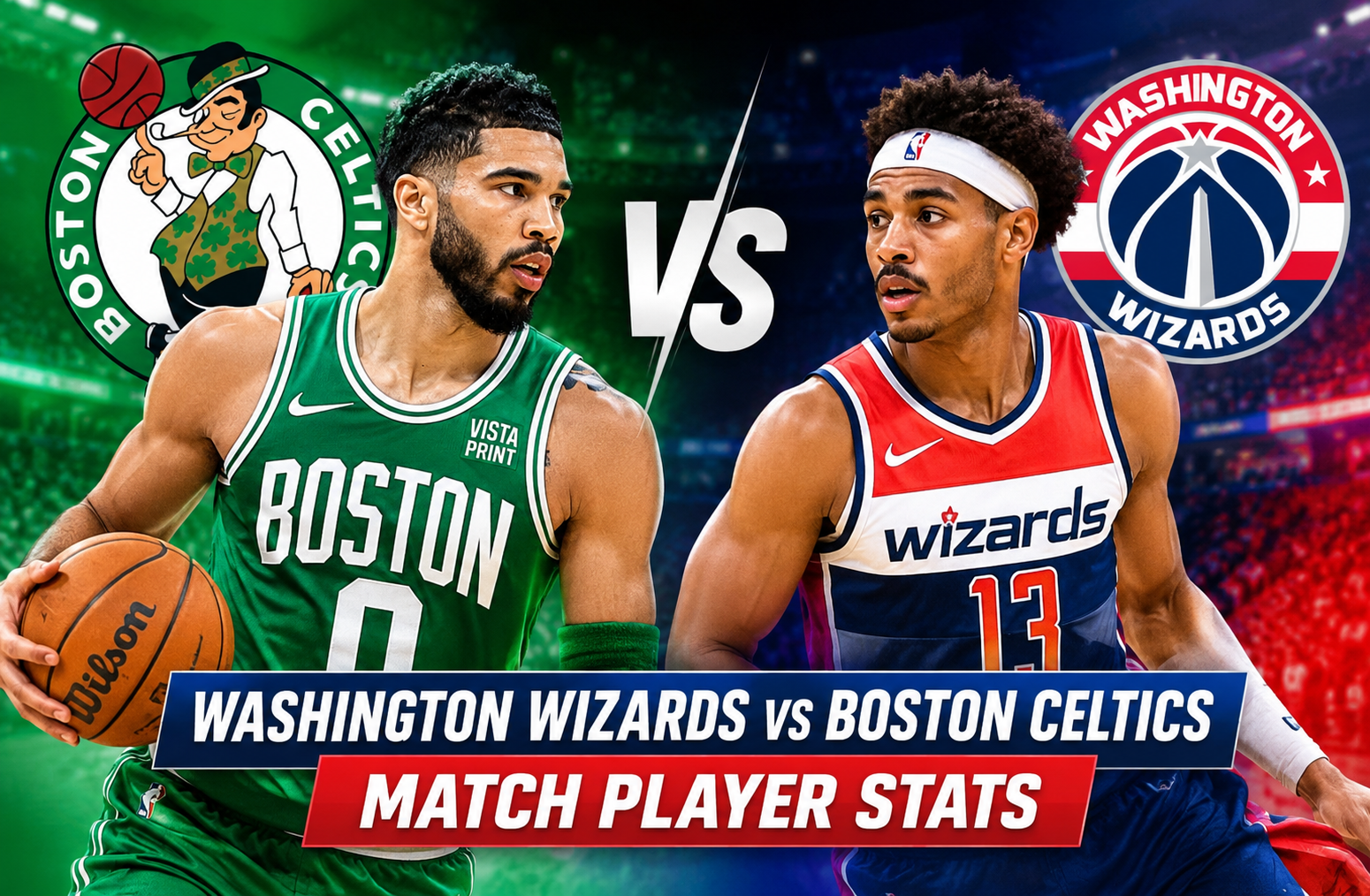
Washington Wizards vs Boston Celtics Match Player Stats
The Washington Wizards vs Boston Celtics match player stats reveal how Boston secured a 111-100 victory through dominant rebounding, efficient inside scoring, and a decisive second-quarter performance on March 14, 2026, at TD Garden. Neemias Queta led the Celtics with 24 points and 10 rebounds, while Jayson Tatum delivered an impressive double-double with 20 points, 14 rebounds, and seven assists. For Washington, Tristan Vukcevic stood out with 22 points, but the Wizards could not recover from Boston’s commanding first-half advantage.
The matchup offered an interesting contrast between Boston’s physical presence in the paint and Washington’s ability to generate three-point opportunities. Both teams finished with 44% field-goal shooting, yet Boston controlled the boards and created additional scoring chances through offensive rebounds. Washington showed greater accuracy from beyond the arc, but its second-quarter offensive struggles ultimately proved too costly.
This complete game breakdown covers the final score, individual player performances, team statistics, quarter-by-quarter results, shooting efficiency, and the most important factors behind Boston’s victory.
Washington Wizards vs Boston Celtics Match Player Stats: Game Overview
The Boston Celtics entered the matchup as the stronger team based on their season record and overall performance. Washington, meanwhile, was attempting to stop an extended losing streak and compete against one of the Eastern Conference’s leading teams.
Boston eventually secured an 11-point victory after establishing control during the second quarter.
Match Information
| Match Detail | Information |
| Matchup | Washington Wizards vs Boston Celtics |
| Date | March 14, 2026 |
| Final Score | Boston Celtics 111-100 Washington Wizards |
| Venue | TD Garden |
| Location | Boston, Massachusetts |
| Attendance | 19,156 |
| Boston Record Before Game | 44-23 |
| Washington Record Before Game | 16-50 |
| Boston Result | Win |
| Washington Result | Loss |
| Season Series | Boston won 3-0 |
The game was played on Saturday night in Boston. The Celtics improved their record to 45-23, while Washington dropped to 16-51 following the defeat.
Boston’s victory also completed its regular-season sweep of Washington, winning all three meetings between the teams during the 2025-26 season.
Final Score
Boston Celtics Calendario NBA Postemporada 2025-26 – ESPN (MX)
Boston Celtics
111
Winner
Washington Wizards Scores, Stats and Highlights – ESPN
Washington Wizards
100
Final score
Winning margin
Boston by 11 points
Largest Boston lead
30 points
Attendance
19,156
Boston’s advantage was not simply the result of making more shots. The Celtics established control through their ability to attack the basket, collect offensive rebounds, and prevent Washington from developing consistent offensive rhythm.
Quarter-by-Quarter Scoring Breakdown
The biggest turning point occurred in the second quarter. Boston scored 35 points while Washington managed only 14, creating a substantial advantage that shaped the remainder of the contest.
| Quarter | Boston Celtics | Washington Wizards |
| First Quarter | 29 | 27 |
| Second Quarter | 35 | 14 |
| Third Quarter | 29 | 31 |
| Fourth Quarter | 18 | 28 |
| Final Score | 111 | 100 |
First Quarter: Boston Takes an Early Lead
The opening quarter was relatively competitive. Washington scored 27 points, keeping the game close against a Boston team that entered with a considerably better season record.
The Celtics finished the opening period with 29 points, establishing a narrow two-point advantage.
Boston’s early offensive approach focused on attacking the paint and getting the basketball to Neemias Queta. His ability to finish close to the basket gave the Celtics an effective scoring option.
Washington remained competitive but struggled to establish the same physical presence around the rim.
Second Quarter: Celtics Create the Decisive Advantage
The second quarter completely changed the direction of the game.
Boston scored 35 points and restricted Washington to just 14. The Celtics produced a 21-point scoring advantage during this period, turning a close contest into a comfortable halftime lead.
Several factors contributed to this performance:
- Boston consistently attacked Washington’s interior defense.
- Neemias Queta continued converting high-percentage opportunities.
- The Celtics generated additional possessions through offensive rebounds.
- Washington struggled to convert its offensive opportunities.
- Boston applied enough defensive pressure to disrupt Washington’s rhythm.
At halftime, the Celtics led 64-41.
This 23-point advantage became the foundation of their eventual victory.
Third Quarter: Washington Shows Signs of Recovery
Washington responded more effectively after halftime.
The Wizards scored 31 points, compared with Boston’s 29. Their improved scoring helped reduce the deficit slightly and demonstrated that they could compete offensively.
However, the third-quarter improvement was not enough to erase the damage from the previous period.
Boston continued to benefit from its rebounding advantage and maintained control of the scoreboard.
Fourth Quarter: Wizards Attempt a Comeback
The final quarter was Washington’s strongest scoring period relative to Boston.
The Wizards produced 28 points, while the Celtics scored 18. Washington managed to reduce the deficit to 12 points during its late push.
However, Boston responded with important baskets from Jayson Tatum and Sam Hauser.
Tatum converted a layup, while Hauser added a three-pointer that helped the Celtics maintain their advantage.
Despite Washington’s improved late-game performance, Boston finished with an 11-point victory.
Boston Celtics Player Stats and Individual Performances
Boston’s victory was built around an effective combination of interior scoring, rebounding, and contributions from several players.
Neemias Queta delivered the standout performance, but Jayson Tatum also played an important role by contributing across multiple statistical categories. Jaylen Brown, Derrick White, and Sam Hauser provided additional scoring support.
Complete Boston Celtics Player Statistics
| Player | PTS | REB | AST | STL | BLK |
| Neemias Queta | 24 | 10 | 3 | 1 | 2 |
| Jayson Tatum | 20 | 14 | 7 | 2 | 0 |
| Jaylen Brown | 16 | 4 | 3 | 1 | 0 |
| Derrick White | 15 | 6 | 5 | 1 | 1 |
| Sam Hauser | 12 | 6 | 2 | 0 | 0 |
| Luka Garza | 15 | 1 | 3 | 0 | 0 |
| Payton Pritchard | 4 | 4 | 4 | 2 | 1 |
| Baylor Scheierman | 3 | 9 | 2 | 1 | 0 |
| Amari Williams | 2 | 1 | 0 | 0 | 0 |
| Ron Harper Jr. | 0 | 0 | 0 | 0 | 0 |
| Hugo González | 0 | 0 | 0 | 0 | 0 |
| Max Shulga | 0 | 0 | 0 | 0 | 0 |
Neemias Queta: Boston’s Leading Scorer
Game-high 24 points
Neemias Queta was the most effective offensive player for Boston. He finished with 24 points, 10 rebounds, three assists, one steal, and two blocks.
His shooting efficiency was particularly impressive.
- Points: 24
- Rebounds: 10
- Assists: 3
- Steals: 1
- Blocks: 2
- Field Goals: 11 of 13
- Field-Goal Percentage: 84.6%
- Free Throws: 2 of 3
Queta converted 11 of his 13 field-goal attempts, demonstrating how effective he was around the basket.
His impact was especially noticeable during the opening half. He scored 22 points before halftime, helping Boston establish its substantial lead.
The most important aspect of his performance was shot selection. Rather than depending on difficult outside attempts, Queta consistently found opportunities near the basket.
His size, positioning, and finishing ability created problems for Washington’s interior defense.
Jayson Tatum: An All-Around Performance
Jayson Tatum recorded one of the most complete performances of the evening.
He finished with 20 points, 14 rebounds, and seven assists, producing a double-double while contributing to Boston’s offense in several different ways.
His individual statistics included:
- Points: 20
- Rebounds: 14
- Assists: 7
- Steals: 2
- Field Goals: 8 of 19
- Three-Pointers: 2 of 9
- Free Throws: 2 of 2
- Playing Time: 32 minutes
Tatum’s 14 rebounds were particularly important because Boston needed to maintain control of the defensive glass and prevent Washington from creating additional scoring opportunities.
His seven assists also demonstrated his ability to contribute as a playmaker.
One interesting detail was his three-point shooting. He converted only two of nine attempts from long range, meaning his overall contribution was not dependent on perimeter scoring.
His rebounding, passing, and ability to score inside helped Boston maintain its advantage.
Jaylen Brown: Important Scoring Support
Jaylen Brown contributed 16 points, four rebounds, and three assists.
Although he did not produce the highest individual numbers, his contribution helped Boston maintain offensive balance.
His shooting performance was:
- Field Goals: 6 of 13
- Three-Pointers: 0 of 5
- Free Throws: 4 of 4
Brown struggled from beyond the three-point line but remained effective through his two-point attempts and free throws.
His ability to attack the basket gave Boston another offensive option alongside Queta and Tatum.
Derrick White: Scoring and Playmaking
Derrick White recorded 15 points, six rebounds, and five assists.
He also made three three-pointers and converted all six of his free-throw attempts.
His statistics showed the importance of his supporting role:
- Points: 15
- Rebounds: 6
- Assists: 5
- Steals: 1
- Blocks: 1
- Three-Pointers: 3 of 8
- Free Throws: 6 of 6
White provided a combination of perimeter shooting and ball movement.
His five assists helped Boston distribute offensive responsibilities instead of relying entirely on individual scoring.
Sam Hauser: Reliable Perimeter Shooting
Sam Hauser finished with 12 points and six rebounds.
He made four three-pointers from 11 attempts, providing useful spacing for Boston’s offense.
His outside shooting helped create additional room for Queta to operate near the basket.
Hauser also contributed defensively by collecting five defensive rebounds.
Luka Garza: Productive Bench Contribution
Luka Garza delivered an efficient performance in limited playing time.
He scored 15 points in approximately 15 minutes, making five of six field-goal attempts.
His performance included:
- Points: 15
- Field Goals: 5 of 6
- Three-Pointers: 2 of 2
- Free Throws: 3 of 4
- Assists: 3
Garza’s scoring efficiency was one of the most interesting supporting contributions of the game.
He provided Boston with another reliable interior scoring option and helped maintain offensive production when the starting players rested.
Boston’s Supporting Players
Payton Pritchard contributed four points and four assists, while Baylor Scheierman recorded three points and nine rebounds.
Scheierman’s nine rebounds were valuable despite his limited scoring contribution.
Amari Williams added two points and one rebound. Ron Harper Jr., Hugo González, and Max Shulga did not record points.
These contributions demonstrate that Boston received production from several different players rather than depending on one scorer.
Washington Wizards Player Stats and Individual Performances
Washington finished the contest with 100 points, but its offensive performance was inconsistent.
The Wizards had some positive individual performances, particularly from Tristan Vukcevic, who led the team with 22 points.
Several other players contributed through scoring, rebounding, and assists. However, Washington struggled to maintain offensive efficiency during the second quarter.
Complete Washington Wizards Player Statistics
| Player | PTS | REB | AST | STL | BLK |
| Bilal Coulibaly | 12 | 4 | 1 | 1 | 2 |
| Trae Young | 11 | 4 | 6 | 0 | 0 |
| Tre Johnson | 7 | 1 | 2 | 0 | 0 |
| Will Riley | 5 | 5 | 3 | 0 | 0 |
| Alex Sarr | 4 | 5 | 0 | 2 | 1 |
| Tristan Vukcevic | 22 | 3 | 1 | 1 | 0 |
| Jamir Watkins | 15 | 6 | 2 | 2 | 0 |
| Jaden Hardy | 12 | 3 | 1 | 1 | 0 |
| Justin Champagnie | 10 | 4 | 1 | 2 | 0 |
| Carlton Carrington | 2 | 3 | 8 | 0 | 1 |
| Anthony Gill | 0 | 0 | 1 | 0 | 0 |
| Sharife Cooper | 0 | 0 | 2 | 0 | 0 |
Tristan Vukcevic: Washington’s Leading Scorer
22 points
Tristan Vukcevic delivered Washington’s strongest individual scoring performance.
He finished with 22 points, three rebounds, and one assist.
His shooting numbers were particularly impressive:
- Points: 22
- Rebounds: 3
- Assists: 1
- Field Goals: 7 of 9
- Three-Pointers: 6 of 7
- Free Throws: 2 of 2
Vukcevic’s 22 points came from highly efficient shooting.
He made six three-pointers, demonstrating his ability to contribute from beyond the arc as well as through two-point opportunities.
His performance was especially important because Washington needed reliable scoring during a game in which several players struggled to find consistency.
However, his individual production could not compensate for the team’s substantial rebounding disadvantage.
Trae Young: Playmaking and Offensive Contribution
Trae Young recorded 11 points and six assists.
His performance included:
- Points: 11
- Rebounds: 4
- Assists: 6
- Field Goals: 5 of 10
- Three-Pointers: 0 of 2
- Free Throws: 1 of 2
Young’s six assists made him one of Washington’s primary playmakers.
His ability to distribute the basketball helped create scoring opportunities for teammates, particularly when Boston applied defensive pressure.
However, Washington needed greater offensive consistency during the second quarter.
Young’s contribution was useful, but it was not enough to prevent Boston from establishing control.
Bilal Coulibaly: Defensive Versatility
Bilal Coulibaly finished with 12 points, four rebounds, one assist, one steal, and two blocks.
His defensive contributions were particularly noteworthy.
The two blocks demonstrated his ability to challenge shots, while his steal provided another defensive contribution.
Coulibaly also contributed offensively with four made field goals and two successful three-point attempts.
His performance showed that he could contribute in several areas, although Washington needed more collective defensive consistency.
Jamir Watkins: Consistent Scoring Support
Jamir Watkins recorded 15 points, six rebounds, and two assists.
He made six of 11 field-goal attempts and converted two of six three-point attempts.
His ability to contribute both inside and outside the perimeter gave Washington another scoring option.
Watkins also collected six rebounds, making his performance more complete than a scoring-only contribution.
Bub Carrington and Washington’s Playmaking
Carlton Carrington, commonly known as Bub Carrington, recorded eight assists, three rebounds, and two points.
His eight assists were the highest total for Washington in this game.
Although his scoring contribution was limited, he played an important role in distributing the basketball.
His passing helped Washington create offensive opportunities, but the team’s overall shooting efficiency and second-quarter performance prevented those opportunities from producing a successful comeback.
Justin Champagnie: Bench Scoring
Justin Champagnie added 10 points and four rebounds.
He made three of six field-goal attempts and converted four of five free throws.
His contribution helped Washington maintain scoring production from its supporting players.
However, Boston’s offensive rebounding and efficient inside scoring continued to create problems for the Wizards.
Alex Sarr: A Difficult Offensive Night
Alex Sarr finished with four points, five rebounds, two steals, and one block.
His shooting performance was challenging.
He converted only one of nine field-goal attempts, including one successful three-pointer from five attempts.
His defensive contributions were more positive, particularly through his two steals and one block.
Nevertheless, Washington needed more scoring from its frontcourt players to compete with Boston’s interior production.
Other Washington Contributors
Tre Johnson scored seven points, while Will Riley contributed five points, five rebounds, and three assists.
Jaden Hardy added 12 points in an efficient performance, converting all five of his field-goal attempts, including two three-pointers.
Anthony Gill and Sharife Cooper did not score, although they recorded one and two assists, respectively.
The difference between individual production and overall team performance was particularly clear for Washington. Several players made useful contributions, but the team could not produce consistent offense across all four quarters.
Team Statistical Comparison: Celtics vs Wizards
Individual performances explain part of the result, but the complete team statistics provide a clearer understanding of why Boston won.
The Celtics dominated the rebounding battle, created more second-chance opportunities, and converted their free throws at a significantly higher rate.
Complete Team Comparison
| Statistical Category | Celtics | Wizards |
| Total Points | 111 | 100 |
| Field Goals | 41/93 | 37/84 |
| Field-Goal Percentage | 44% | 44% |
| Three-Pointers | 12/46 | 15/39 |
| Three-Point Percentage | 26% | 38% |
| Free Throws | 17/19 | 11/17 |
| Free-Throw Percentage | 89% | 65% |
| Total Rebounds | 55 | 38 |
| Offensive Rebounds | 19 | 9 |
| Defensive Rebounds | 36 | 29 |
| Assists | 29 | 28 |
| Turnovers | 14 | 13 |
| Steals | 8 | 9 |
| Blocks | 4 | 4 |
Rebounding: Boston’s Biggest Statistical Advantage
The most significant statistical difference was rebounding.
Boston collected 55 rebounds, while Washington managed only 38.
That created a 17-rebound advantage for the Celtics.
Offensive rebounding was particularly important.
Boston recorded 19 offensive rebounds compared with Washington’s nine.
This difference allowed the Celtics to create additional possessions and increase their opportunities to score.
Offensive rebounds are valuable because they give a team another chance to attack after missing a shot.
For Boston, those additional opportunities helped compensate for its relatively low three-point shooting percentage.
Washington’s inability to secure defensive rebounds also made it harder to stop Boston’s offense.
Three-Point Shooting: Washington Had the Advantage
Washington performed better from beyond the three-point line.
The Wizards converted 15 of 39 attempts, shooting approximately 38%.
Boston made 12 of 46 attempts, finishing at approximately 26%.
This difference shows that Washington was more accurate from long range.
However, better three-point shooting did not guarantee a victory.
Boston compensated through its superior rebounding, interior scoring, and free-throw efficiency.
This matchup demonstrates why evaluating a basketball game through three-point percentage alone can create an incomplete picture.
Free-Throw Efficiency: Boston Converted More Opportunities
Boston converted 17 of 19 free throws, producing an impressive 89% success rate.
Washington made 11 of 17 attempts, finishing at approximately 65%.
The Celtics therefore scored six more points from the free-throw line.
In a game decided by 11 points, that difference was meaningful.
Free throws can become especially important when teams struggle to score consistently from the field.
Boston took better advantage of its opportunities at the line.
Assists: Almost Identical Playmaking Numbers
Boston recorded 29 assists, while Washington finished with 28.
The one-assist difference indicates that both teams generated a similar number of assisted scoring opportunities.
However, the quality and outcome of those opportunities were different.
Boston converted its inside chances more effectively, while Washington experienced a significant scoring decline during the second quarter.
The assist totals therefore do not tell the entire story of offensive performance.
Turnovers: Washington Did Not Lose Through Ball Security Alone
Washington committed 13 turnovers, compared with Boston’s 14.
This is an important detail because the Celtics actually recorded one more turnover.
It would therefore be inaccurate to suggest that Boston won simply because it protected the basketball better.
The decisive factors were rebounding, interior scoring, and the second-quarter scoring difference.
Boston found ways to create additional opportunities even without having a turnover advantage.
Why the Boston Celtics Won the Game
Boston’s victory was the result of several factors working together. Although Washington showed better three-point accuracy, the Celtics controlled important areas of the game that had a greater impact on the final score.
1. Dominant Second-Quarter Performance
The second quarter was the defining period.
Boston outscored Washington 35-14, creating a 21-point advantage in just 12 minutes.
This was not simply a case of Boston making more shots. The Celtics also limited Washington’s offensive production and established control of the game’s tempo.
A team that falls behind by 23 points at halftime must produce a significant comeback to recover.
Washington improved after halftime but could not completely overcome the deficit.
2. Neemias Queta’s Interior Scoring
Queta’s performance was another major reason behind Boston’s success.
His 24 points came on 11-of-13 shooting, representing approximately 85% field-goal accuracy.
He consistently converted opportunities around the basket, putting pressure on Washington’s defensive players.
His 10 rebounds also helped Boston control the interior.
The combination of scoring efficiency and rebounding made him one of the most influential players on the court.
3. Jayson Tatum’s Complete Contribution
Tatum did more than score 20 points.
His 14 rebounds helped Boston control possession, while seven assists demonstrated his ability to create opportunities for teammates.
His two steals also contributed defensively.
Although his three-point shooting was not particularly efficient, his overall performance helped Boston maintain its advantage.
4. Boston’s Offensive Rebounding
The Celtics collected 19 offensive rebounds.
Washington managed only nine.
This 10-rebound difference created additional possessions for Boston and placed further pressure on the Wizards’ defense.
Offensive rebounding also helped Boston maintain control when its outside shots were not falling consistently.
5. Washington’s Inconsistent Scoring
Washington’s biggest problem was its inability to maintain scoring production throughout the game.
The Wizards scored:
- 27 points in the first quarter.
- 14 points in the second quarter.
- 31 points in the third quarter.
- 28 points in the fourth quarter.
Their second-quarter performance was particularly damaging.
Although Washington scored 59 points in the second half, the team had already created a substantial disadvantage that was difficult to overcome.
What the Player Statistics Reveal About Both Teams
Looking beyond the final score provides a more useful understanding of the matchup.
There were several important statistical lessons from this game.
Boston Did Not Need Excellent Three-Point Shooting
The Celtics converted only 12 of 46 three-point attempts.
That is approximately 26%, which is below the level a team would generally want from its perimeter offense.
However, Boston still scored 111 points.
The reason was its ability to generate points through other methods.
Queta’s interior scoring, Garza’s efficient bench contribution, and the team’s offensive rebounding helped compensate for the missed perimeter attempts.
This demonstrates the importance of having multiple offensive options.
Washington’s Three-Point Accuracy Was Not Enough
Washington shot approximately 38% from three-point range.
The Wizards made three more three-pointers than Boston despite attempting seven fewer shots.
That was a positive part of their offensive performance.
However, the team struggled to create enough advantages in other areas.
Its 38 rebounds were significantly lower than Boston’s 55.
The Wizards also converted only 65% of their free throws.
Better perimeter shooting could not overcome those disadvantages.
Boston Received Valuable Bench Production
Luka Garza scored 15 points in limited playing time, while Sam Hauser contributed 12 points.
Their performances helped Boston avoid relying exclusively on its leading scorers.
Washington also received useful contributions from its bench, particularly Vukcevic, who scored 22 points.
However, the difference was how those individual performances combined with the teams’ overall strengths.
Boston’s supporting players contributed to a system that controlled rebounding and interior scoring.
Individual Statistics Must Be Viewed in Context
Points are usually the first statistic basketball fans examine, but they do not explain everything.
For example:
- Queta’s 24 points were supported by exceptional shooting efficiency.
- Tatum’s 20 points came alongside 14 rebounds and seven assists.
- Carrington’s eight assists demonstrated playmaking value despite only two points.
- Scheierman’s nine rebounds showed his contribution beyond scoring.
- Sarr’s two steals and one block provided defensive production despite his difficult shooting performance.
A complete evaluation should consider scoring, efficiency, rebounding, passing, defense, and playing time.
Head-to-Head Record: Celtics vs Wizards in the 2025-26 Season
Boston completed a 3-0 regular-season sweep against Washington during the 2025-26 campaign.
The Celtics won all three meetings, demonstrating consistent superiority in the season series.
| Game | Date | Result |
| First Meeting | November 6, 2025 | Celtics 136-107 Wizards |
| Second Meeting | December 5, 2025 | Celtics 146-101 Wizards |
| Third Meeting | March 14, 2026 | Celtics 111-100 Wizards |
First Meeting: November 6, 2025
Boston opened the season series with a convincing 136-107 victory.
The 29-point winning margin demonstrated the Celtics’ offensive capabilities.
Washington struggled to contain Boston’s scoring throughout the contest.
Second Meeting: December 5, 2025
The Celtics produced another dominant performance, winning 146-101.
Boston scored 146 points, making this the highest-scoring result among the three meetings.
The 45-point winning margin showed how difficult Washington found it to compete against Boston during that matchup.
Third Meeting: March 14, 2026
The final meeting was more competitive than the previous two.
Boston won 111-100, completing the season sweep.
Although Washington produced a stronger late-game performance, the Celtics had already established a decisive advantage during the second quarter.
What the Season Series Tells Us
Boston’s three victories showed a consistent advantage across the season.
The winning margins were different, but the overall outcome remained the same.
The Celtics demonstrated stronger team performance across the three meetings, while Washington struggled to find a way to consistently compete with them.
It is also important to recognize that individual player statistics can change significantly between games. A player who performs well in one matchup may have a different role or shooting performance in another.
For that reason, individual game box scores should be evaluated separately rather than assuming that every player repeated the same performance throughout the season series.
Game Context, Broadcasting and Officials
The March matchup took place at TD Garden in Boston, Massachusetts.
The official NBA game listing identifies the contest as Saturday, March 14, 2026, while some international schedules display March 15 because of time-zone differences.
Additional game information included:
| Detail | Information |
| Arena | TD Garden |
| City | Boston |
| Attendance | 19,156 |
| Broadcasting Networks | MNMT, NBC Sports Boston, NBA TV |
| Referee | Ed Malloy |
| Referee | Rodney Mott |
| Referee | Pat O’Connell |
The attendance figure reflects the reported crowd at TD Garden.
The three officials were responsible for overseeing the contest and applying the NBA’s playing rules.
For readers checking the game from outside the United States, the date difference is worth understanding. A Saturday evening game in Boston can appear as an early Sunday morning event in Pakistan and other Asian countries.
This explains why March 14 and March 15 may both appear in searches related to the same game.
How to Read Basketball Player Statistics Correctly
Understanding a basketball box score makes it easier to evaluate individual performances without relying entirely on the final score.
The following statistics are particularly useful when reviewing an NBA matchup.
Points (PTS)
Points represent the total number of points a player scores.
A player can score through:
- Two-point field goals.
- Three-point field goals.
- Free throws.
Queta’s 24 points made him Boston’s leading scorer, while Vukcevic’s 22 points led Washington.
Rebounds (REB)
Rebounds measure how many missed shots a player recovers.
There are two main types:
- Offensive rebounds: Recovered by the attacking team.
- Defensive rebounds: Recovered by the defending team.
Tatum’s 14 rebounds were the highest individual total in this matchup.
Assists (AST)
An assist is credited when a player passes the ball to a teammate who scores directly from the play, subject to the official scoring rules.
Carrington led Washington with eight assists, while Tatum recorded seven for Boston.
Steals (STL)
Steals measure how often a player legally takes possession of the basketball from the opposition.
Alex Sarr and several other Washington players contributed defensively through this category.
Blocks (BLK)
Blocks measure successful defensive actions that prevent or alter an opponent’s field-goal attempt.
Queta recorded two blocks for Boston, while Coulibaly also finished with two for Washington.
Field-Goal Percentage (FG%)
Field-goal percentage measures shooting accuracy on two-point and three-point field-goal attempts.
The formula is:
\[ FG\%=\frac{\text{Successful Field Goals}}{\text{Field-Goal Attempts}}\times100 \]
Both teams finished at approximately 44%.
Three-Point Percentage (3P%)
This statistic measures the percentage of successful attempts from beyond the three-point line.
Washington’s 38% was considerably higher than Boston’s 26%.
Plus/Minus (+/-)
Plus/minus measures the difference between a team’s scoring and its opponent’s scoring while a particular player is on the court.
It provides context about the team’s overall scoring margin during that player’s minutes, although it does not independently measure individual performance.
For example, Tatum finished at +18, while Queta finished at +14.
A positive number indicates that the player’s team outscored its opponent during his time on the floor.
Turnovers (TO)
A turnover occurs when a team loses possession without completing a scoring attempt that ends in a made basket.
Washington recorded 13 turnovers, while Boston committed 14.
This statistic is useful for understanding ball security, but it should be considered alongside rebounding and shooting efficiency.
Where to Find Official Washington Wizards vs Boston Celtics Box Scores
Readers who want to check individual player statistics should prioritize official league records and reliable basketball databases.
The NBA’s official game record provides information about:
- Individual player points.
- Rebounds and assists.
- Field-goal attempts and percentages.
- Three-point shooting.
- Free throws.
- Steals and blocks.
- Team scoring by quarter.
- Complete game results.
For the original match record and player-by-player figures, consult the official NBA box score for the Celtics vs Wizards game.
Checking the official record is particularly useful when comparing statistics across different sports websites, as some third-party summaries may display incomplete information or different time-zone dates.
Frequently Asked Questions (FAQs)
1. Who won the Washington Wizards vs Boston Celtics game on March 14, 2026?
The Boston Celtics defeated the Washington Wizards 111-100 at TD Garden in Boston. The victory completed Boston’s 3-0 regular-season sweep against Washington in 2025-26.
2. Who was the highest scorer in the Celtics vs Wizards matchup?
Neemias Queta was the highest scorer with 24 points for Boston. Tristan Vukcevic led Washington with 22 points.
3. How many points did Jayson Tatum score against the Washington Wizards?
Jayson Tatum scored 20 points. He also recorded 14 rebounds and seven assists, finishing with a double-double.
4. How many rebounds did the Boston Celtics record?
Boston collected 55 total rebounds, including 19 offensive rebounds and 36 defensive rebounds. Washington finished with 38 total rebounds.
5. How did Tristan Vukcevic perform against Boston?
Tristan Vukcevic scored 22 points, collected three rebounds, and recorded one assist. He made seven of nine field-goal attempts, including six three-pointers from seven attempts.
6. Why did the Boston Celtics defeat the Washington Wizards?
Boston won because of its dominant second-quarter performance, superior rebounding, efficient interior scoring, and better free-throw shooting. The Celtics outscored Washington 35-14 in the second quarter and maintained their advantage until the final buzzer.
Conclusion
The Boston Celtics defeated the Washington Wizards 111-100 in a matchup that highlighted the importance of rebounding, shooting efficiency, and consistent team performance.
Neemias Queta was Boston’s leading scorer with 24 points and 10 rebounds, while Jayson Tatum delivered an impressive all-around performance with 20 points, 14 rebounds, and seven assists. Jaylen Brown, Derrick White, Sam Hauser, and Luka Garza also made valuable contributions.
For Washington, Tristan Vukcevic led the team with 22 points, while Jamir Watkins, Bilal Coulibaly, Trae Young, and other supporting players contributed offensively.
The most decisive moment was Boston’s 35-14 second-quarter advantage. Washington improved its scoring after halftime, but the early deficit proved too difficult to overcome.
The team statistics further explain the result. Boston collected 55 rebounds compared with Washington’s 38 and converted 89% of its free throws. Washington was more accurate from three-point range, but its perimeter advantage was not enough to compensate for Boston’s dominance inside.
Overall, this matchup demonstrated Boston’s ability to win through multiple offensive options and strong interior play. The 111-100 result also completed the Celtics’ 3-0 regular-season sweep against Washington during the 2025-26 NBA season.