Orlando Magic vs Timberwolves Match Player Stats
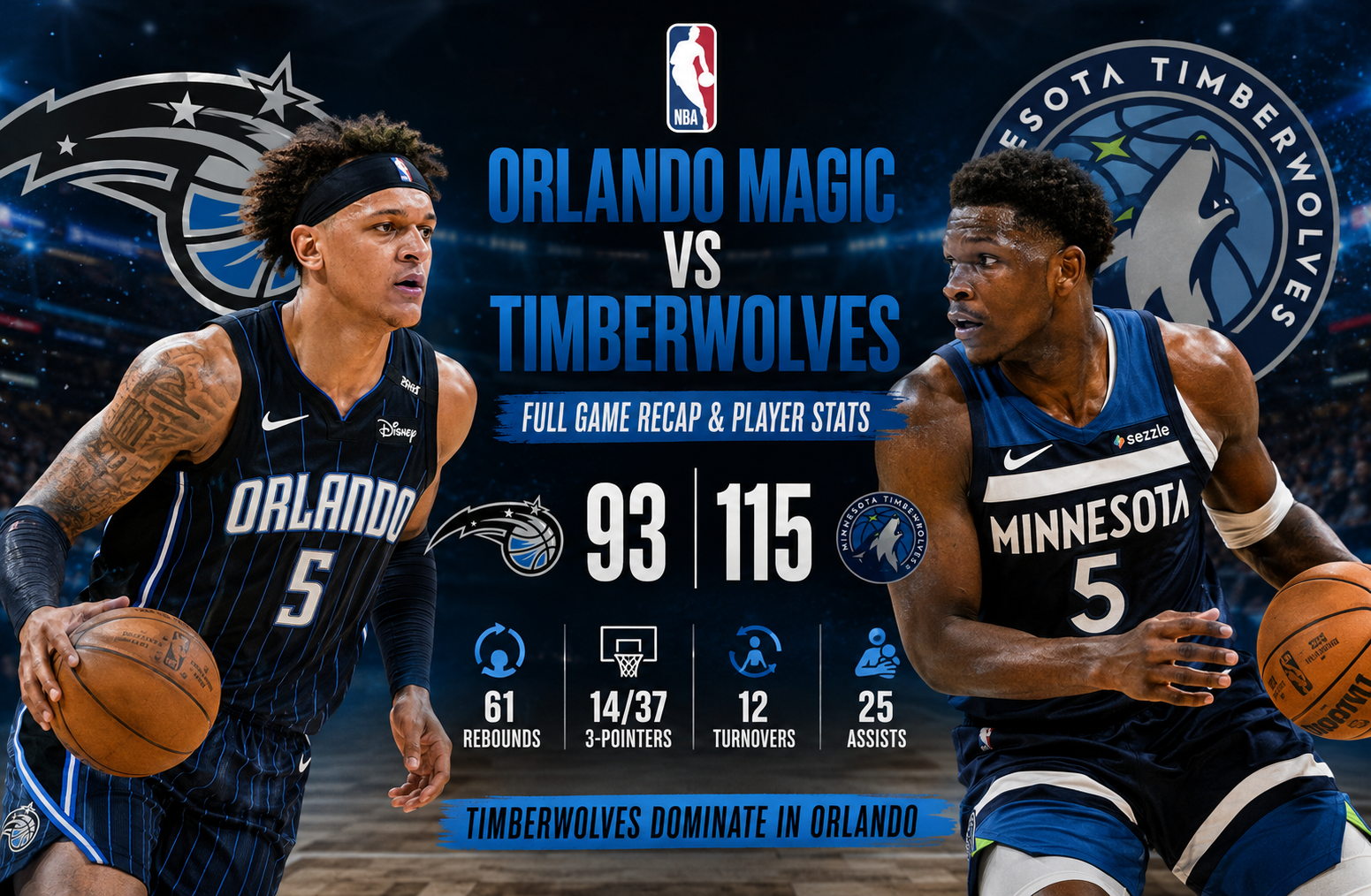
The orlando magic vs timberwolves match player stats from October 23, 2026, reveal how the Minnesota Timberwolves secured a convincing 115-93 victory over the Orlando Magic at Kia Center. Minnesota delivered a strong all-around performance, controlling the rebounding battle, creating better three-point opportunities, and producing a decisive third-quarter run. Although Anthony Edwards did not have his most efficient scoring night, the Timberwolves received important contributions from several players who helped maintain their advantage throughout the contest.
Wendell Carter Jr. was Orlando’s leading scorer, finishing with 20 points and nine rebounds while shooting an outstanding 8-of-9 from the field. Franz Wagner added 18 points, while Paolo Banchero and Jalen Suggs contributed 14 points apiece. However, Orlando struggled to establish consistent offensive momentum, particularly after scoring only 15 points in the third quarter.
Minnesota’s victory was built around teamwork rather than one extraordinary individual scoring performance. Anthony Edwards and Jaden McDaniels both scored 15 points, Rudy Gobert contributed 14 points and nine rebounds, and Ayo Dosunmu delivered an impressive 14-point, nine-assist performance without committing a turnover.
The final result reflected the difference between the teams in several important statistical categories. Minnesota collected 61 rebounds compared with Orlando’s 43, made 14 three-pointers compared with eight for the Magic, and committed four fewer turnovers.
This detailed game analysis examines the final score, individual player performances, team statistics, quarter-by-quarter results, important turning points, and the factors that determined the outcome.
Game Overview: Minnesota Timberwolves vs Orlando Magic
The October 23 meeting between Minnesota and Orlando took place during the 2026-27 NBA regular season. Playing in front of 19,551 spectators at Kia Center, the Timberwolves produced a disciplined road performance and controlled the scoreboard from the opening quarter.
Minnesota established an early advantage and gradually increased its lead. Orlando remained within reach during the first half, but the Timberwolves delivered their strongest stretch after halftime. Their defensive pressure and improved offensive execution created a substantial separation that the Magic could not overcome.
Match Information
| Match Detail | Information |
| Matchup | Orlando Magic vs Minnesota Timberwolves |
| Date | October 23, 2026 |
| Competition | 2026-27 NBA regular season |
| Venue | Kia Center |
| Location | Orlando, Florida |
| Final Score | Minnesota 115, Orlando 93 |
| Winning Team | Minnesota Timberwolves |
| Winning Margin | 22 points |
| Attendance | 19,551 |
| Officials | Josh Tiven, Jason Goldenberg, Jenna Schroeder |
| Minnesota Record | 2-0 |
| Orlando Record | 0-2 |
The Timberwolves demonstrated their ability to win through several different offensive and defensive contributions. Their most important advantage was on the glass, where they collected 18 more rebounds than Orlando.
The result was also notable because Edwards finished with 15 points on 5-of-23 shooting. Minnesota did not depend on its leading offensive star to produce an exceptional scoring performance. Instead, the supporting players helped maintain the team’s offensive balance.
For Orlando, Carter’s efficient shooting and Wagner’s scoring were positive individual performances, but the team needed more consistent production from its perimeter players.
Orlando Magic vs Timberwolves Match Player Stats
The individual box score provides a clearer understanding of how the contest developed. Minnesota had multiple players contributing to scoring, rebounding, and playmaking, while Orlando relied more heavily on a smaller group of offensive contributors.
Minnesota Timberwolves Player Statistics
| Player | MIN | PTS | REB | AST | STL | BLK | FG |
| Anthony Edwards | 33:14 | 15 | 4 | 4 | 4 | 0 | 5-23 |
| Jaden McDaniels | 29:50 | 15 | 6 | 3 | 0 | 2 | 6-14 |
| Rudy Gobert | 29:34 | 14 | 9 | 1 | 0 | 0 | 6-8 |
| Ayo Dosunmu | 26:39 | 14 | 7 | 9 | 1 | 1 | 6-11 |
| Terrence Shannon Jr. | 22:19 | 13 | 4 | 1 | 0 | 1 | 4-6 |
| Jonathan Kuminga | 27:28 | 11 | 8 | 5 | 1 | 0 | 3-7 |
| Trey Lyles | 16:32 | 9 | 6 | 2 | 0 | 0 | 3-6 |
| Bones Hyland | 7:53 | 3 | 1 | 0 | 0 | 0 | 1-2 |
| Jaylen Clark | 3:23 | 0 | 2 | 1 | 0 | 0 | 0-0 |
| Cody Williams | 3:23 | 0 | 0 | 0 | 0 | 0 | 0-0 |
| Isaiah Evans | 1:59 | 0 | 0 | 1 | 0 | 0 | 0-0 |
Minnesota’s statistical distribution shows why the team could maintain its advantage without an unusually productive night from Edwards.
Five Timberwolves players reached double figures, while several others made useful contributions in limited minutes. The team also received valuable playmaking from Dosunmu and Kuminga.
Anthony Edwards: 15 Points and Four Steals
Anthony Edwards finished with 15 points, four rebounds, four assists, and four steals in 33 minutes and 14 seconds.
His shooting numbers were not particularly efficient. He converted five of 23 field-goal attempts and two of nine three-point attempts. His three successful free throws from four attempts helped increase his scoring total.
However, evaluating his performance only through shooting efficiency would overlook his defensive contribution.
Four steals demonstrated his ability to disrupt Orlando’s offensive possessions. He also contributed four assists, giving Minnesota another option for creating scoring opportunities when his own shots were not falling.
Edwards finished with a plus-minus of +19, indicating that Minnesota outscored Orlando by 19 points during his time on the court.
The most important takeaway is that Minnesota did not need Edwards to dominate the scoring column. The team maintained its offensive structure through other players, allowing him to contribute through defense, passing, and transition opportunities.
His performance also highlights an important basketball principle: a player’s overall impact cannot always be understood through points alone.
Jaden McDaniels: Efficient Scoring and Defensive Presence
Jaden McDaniels scored 15 points in 29 minutes and 50 seconds.
He converted six of his 14 field-goal attempts, including two of five from beyond the three-point line. He also made his only free-throw attempt.
His final statistical line included:
- 15 points.
- Six rebounds.
- Three assists.
- Two blocks.
- Six successful field goals.
- Two successful three-pointers.
McDaniels offered Minnesota an important combination of scoring and defensive activity. His two blocks helped protect the interior, while his outside shooting gave the offense another perimeter threat.
Unlike Edwards, McDaniels had a relatively balanced shooting performance. He did not need an unusually high number of attempts to reach 15 points.
His plus-minus of +12 also reflected Minnesota’s positive overall performance during his minutes.
Rudy Gobert: Important Interior Production
Rudy Gobert recorded 14 points and nine rebounds in 29 minutes and 34 seconds.
He made six of eight field-goal attempts and converted two of four free throws. His shooting efficiency helped Minnesota generate reliable points around the basket.
Gobert’s nine rebounds were particularly important because Minnesota dominated the overall rebounding battle.
His contribution was not limited to collecting defensive rebounds. He also secured offensive opportunities that allowed the Timberwolves to maintain pressure around the basket.
Gobert’s presence helped Minnesota control the interior and prevented Orlando from consistently turning missed shots into second-chance scoring opportunities.
Although his individual rebounding total was nine, the combined work of Minnesota’s frontcourt and perimeter players helped the team reach 61 total rebounds.
Ayo Dosunmu: The Playmaking Difference
Ayo Dosunmu produced one of Minnesota’s most complete performances.
He finished with:
- 14 points.
- Seven rebounds.
- Nine assists.
- One steal.
- One block.
- Six field goals made on 11 attempts.
- Zero turnovers.
His nine assists were among the most important individual statistics of the contest.
Dosunmu helped create scoring opportunities for teammates while maintaining excellent ball security. Recording nine assists without a turnover is particularly valuable because it means Minnesota generated significant offensive production without regularly giving possession away.
He also contributed seven rebounds, demonstrating that his influence extended beyond playmaking.
His performance was a major reason Minnesota could maintain offensive balance even when Edwards struggled with his shooting.
Terrence Shannon Jr.: Valuable Bench Scoring
Terrence Shannon Jr. added 13 points in 22 minutes and 19 seconds.
He made four of six field-goal attempts, including two of four three-pointers, and converted three of four free throws.
His shooting efficiency gave Minnesota another productive scoring option.
Shannon’s contribution was important because successful teams need more than their starting lineup to produce consistently. Bench players can change the rhythm of a game by adding energy, creating transition opportunities, and converting open perimeter shots.
His 13 points helped Minnesota maintain its offensive pressure without relying entirely on the primary starters.
Jonathan Kuminga: Balanced Contribution
Jonathan Kuminga finished with 11 points, eight rebounds, and five assists.
He made three of seven field-goal attempts and two of three three-pointers. He also contributed three successful free throws from eight attempts.
His eight rebounds were useful in a game where Minnesota’s overall advantage came largely from controlling possession.
Kuminga also recorded five assists, showing that he contributed to the offense as a secondary playmaker.
His statistical line demonstrates the value of players who can perform several different responsibilities rather than focusing exclusively on scoring.
Other Minnesota Contributors
Trey Lyles recorded nine points and six rebounds, providing additional frontcourt production.
Bones Hyland added three points in limited playing time, while Jaylen Clark, Cody Williams, and Isaiah Evans also appeared briefly.
These contributions were not the main reason Minnesota won, but they helped demonstrate the depth of the team’s rotation.
The overall distribution of points was particularly important. Minnesota had enough contributors to prevent Orlando from focusing its defensive attention on one player.
Orlando Magic Player Statistics
| Player | MIN | PTS | REB | AST | STL | BLK | FG |
| Wendell Carter Jr. | 28:33 | 20 | 9 | 1 | 0 | 2 | 8-9 |
| Franz Wagner | 32:51 | 18 | 6 | 5 | 1 | 0 | 7-14 |
| Paolo Banchero | 26:25 | 14 | 6 | 5 | 1 | 0 | 6-11 |
| Jalen Suggs | 34:09 | 14 | 6 | 6 | 1 | 1 | 6-12 |
| Jase Richardson | 14:19 | 6 | 1 | 3 | 0 | 0 | 2-5 |
| Tristan da Silva | 29:25 | 5 | 3 | 1 | 1 | 0 | 2-9 |
| Desmond Bane | 26:51 | 5 | 2 | 0 | 1 | 0 | 2-11 |
| Goga Bitadze | 12:18 | 1 | 3 | 0 | 0 | 1 | 1-2 |
| Colin Castleton | 3:31 | 7 | 2 | 1 | 0 | 0 | 3-3 |
| Jevon Carter | 13:29 | 0 | 1 | 1 | 2 | 0 | 0-2 |
| Nikola Vučević | 3:38 | 0 | 2 | 0 | 0 | 0 | 0-1 |
| Alex Morales | 3:31 | 0 | 1 | 0 | 0 | 0 | 0-1 |
Orlando’s player statistics reveal a mixture of individual efficiency and team-wide offensive difficulties.
Carter and Wagner provided strong scoring performances, while Banchero and Suggs each contributed 14 points. However, the Magic struggled to convert enough perimeter attempts to challenge Minnesota’s growing advantage.
Wendell Carter Jr.: Orlando’s Leading Scorer
Wendell Carter Jr. was Orlando’s most efficient offensive player.
He scored 20 points in 28 minutes and 33 seconds, converting eight of nine field-goal attempts.
His shooting breakdown included:
- 20 points.
- Nine rebounds.
- One assist.
- Two blocks.
- Eight successful field goals on nine attempts.
- Three three-pointers on four attempts.
- One successful free throw.
His 88.9% field-goal percentage was outstanding.
Carter demonstrated that Orlando could generate efficient scoring opportunities around the basket and from the perimeter. His three successful three-pointers also added an important dimension to his offensive performance.
He collected nine rebounds, giving him a strong overall contribution on both ends of the floor.
Despite his individual success, Carter could not compensate for the difference in total team production.
Orlando needed more consistent scoring from the remaining rotation, particularly from players responsible for creating perimeter offense.
Franz Wagner: Consistent Offensive Production
Franz Wagner finished with 18 points, six rebounds, and five assists.
He converted seven of 14 field-goal attempts and made one of six three-point attempts.
His overall shooting percentage was 50%, showing that he was relatively effective inside the three-point line.
Wagner’s five assists were also important because he helped connect Orlando’s offense and create opportunities for teammates.
However, his outside shooting was less productive. Making only one three-pointer from six attempts limited his ability to stretch Minnesota’s defense consistently.
His plus-minus of -18 reflected the difficulty Orlando experienced while he was on the court.
Paolo Banchero: Productive Before Leaving the Game
Paolo Banchero recorded 14 points, six rebounds, and five assists.
He shot six of 11 from the field, showing reasonable efficiency during his 26 minutes and 25 seconds.
His performance included contributions in several areas:
- 14 points.
- Six rebounds.
- Five assists.
- One steal.
- Six successful field goals.
- Two successful free throws.
Banchero did not play in the fourth quarter because of right ankle soreness, according to the game recap.
His absence reduced Orlando’s available offensive options during the final period.
Although Minnesota had already established a substantial advantage, Banchero’s limited availability was an additional challenge for the Magic.
His five assists demonstrated his importance as a player who can contribute to both scoring and offensive creation.
Jalen Suggs: Playmaking and Ball Movement
Jalen Suggs finished with 14 points, six rebounds, and six assists.
He made six of 12 field-goal attempts and one of four three-point attempts.
Suggs played 34 minutes and nine seconds, making him one of Orlando’s most heavily involved players.
His six assists showed that he was active in creating opportunities for teammates.
However, he also committed three turnovers. Against a team as effective at controlling possession as Minnesota, those lost possessions made it more difficult for Orlando to build offensive momentum.
Suggs contributed in several areas, but the Magic needed greater overall efficiency to remain competitive.
Desmond Bane: Perimeter Shooting Struggles
Desmond Bane scored five points in 26 minutes and 51 seconds.
He converted two of 11 field-goal attempts and one of nine three-point attempts.
His perimeter shooting was a significant problem for Orlando.
Bane is an important type of offensive player because his outside shooting can force opposing defenses to extend beyond the three-point line. When those attempts do not fall, the defense can devote more attention to other offensive threats.
His performance in this game did not provide the perimeter production Orlando needed.
Franz Wagner also struggled from long range, converting just one of six attempts.
Together, the two players made only two of 15 three-point attempts.
Orlando’s Supporting Players
Tristan da Silva recorded five points and three rebounds, while Jase Richardson contributed six points and three assists.
Goga Bitadze added one point and three rebounds.
Colin Castleton scored seven points while converting all three of his field-goal attempts in limited playing time.
Jevon Carter, Nikola Vučević, and Alex Morales also appeared in the game.
Although some of these players produced useful individual contributions, Orlando could not establish the scoring consistency required to challenge Minnesota.
Quarter-by-Quarter Score Analysis
The quarter-by-quarter breakdown explains how Minnesota built its 22-point victory.
| Quarter | Minnesota Timberwolves | Orlando Magic |
| First Quarter | 26 | 20 |
| Second Quarter | 31 | 25 |
| Third Quarter | 29 | 15 |
| Fourth Quarter | 29 | 33 |
| Final | 115 | 93 |
First Quarter: Minnesota Establishes Control
Minnesota opened the contest with a six-point advantage, finishing the first quarter ahead 26-20.
The Timberwolves showed early control through balanced scoring and effective possession management.
Orlando remained competitive, but the Magic could not take the lead.
The six-point difference was not decisive by itself. However, it allowed Minnesota to enter the second quarter with a positive foundation.
Second Quarter: Timberwolves Extend Their Advantage
Minnesota scored 31 points in the second quarter, while Orlando managed 25.
The Timberwolves increased their lead from six to 12 points.
Their offensive production became more consistent, and the team continued to find scoring opportunities through different players.
Orlando scored enough to remain within reach, but the Magic could not reduce the deficit.
At halftime, Minnesota held a 57-45 advantage.
Third Quarter: The Decisive Period
The third quarter was the most important part of the contest.
Minnesota scored 29 points while limiting Orlando to just 15.
This 14-point quarter advantage increased the Timberwolves’ lead from 12 to 26 points.
The game recap also highlighted a decisive Minnesota run during this period.
Orlando struggled to generate efficient offensive possessions, and its perimeter shooting did not provide the necessary support.
Minnesota’s defense helped prevent the Magic from building momentum.
By the end of the third quarter, the score stood at 86-60.
The Timberwolves had created enough separation to make an Orlando comeback extremely difficult.
Fourth Quarter: Orlando Improves, but the Deficit Remains
Orlando performed better in the final quarter, scoring 33 points compared with Minnesota’s 29.
The Magic won the quarter by four points.
However, the improvement came too late to change the overall result.
Minnesota entered the fourth quarter with a 26-point advantage and finished the game with a 22-point victory.
The final period demonstrated that Orlando could still produce points, but the team had already lost control during the previous quarter.
Complete Team Statistics Comparison
The team statistics provide the clearest explanation of Minnesota’s advantage.
| Statistical Category | Minnesota | Orlando |
| Final Points | 115 | 93 |
| Field Goals Made | 42 | 37 |
| Field Goals Attempted | 98 | 84 |
| Field Goal Percentage | 42.9% | 44.0% |
| Three-Pointers Made | 14 | 8 |
| Three-Pointers Attempted | 37 | 39 |
| Three-Point Percentage | 37.8% | 20.5% |
| Free Throws Made | 17 | 11 |
| Free Throws Attempted | 30 | 19 |
| Free-Throw Percentage | 56.7% | 57.9% |
| Total Rebounds | 61 | 43 |
| Offensive Rebounds | 22 | 8 |
| Defensive Rebounds | 39 | 35 |
| Assists | 33 | 23 |
| Steals | 8 | 7 |
| Blocks | 4 | 4 |
| Turnovers | 12 | 16 |
| Personal Fouls | 19 | 26 |
Several categories stand out.
Minnesota did not have the higher overall field-goal percentage. Orlando finished at 44%, compared with 42.9% for the Timberwolves.
However, the difference in three-point shooting was substantial.
Minnesota converted 14 of 37 attempts, while Orlando made only eight of 39.
The rebounding difference was even more significant. Minnesota collected 61 rebounds, compared with Orlando’s 43.
These two advantages helped determine the final result.
Rebounding: Minnesota’s Biggest Statistical Advantage
Minnesota won the rebounding battle by 18.
The Timberwolves collected 22 offensive rebounds and 39 defensive rebounds.
Orlando recorded eight offensive rebounds and 35 defensive rebounds.
This difference had an important effect on possession opportunities.
Offensive rebounds give a team another chance to score after an unsuccessful field-goal attempt. Defensive rebounds prevent the opposing team from extending its possession.
Minnesota’s advantage in both areas made it difficult for Orlando to establish a consistent offensive rhythm.
The Timberwolves also benefited from contributions across the lineup.
Gobert collected nine rebounds, Kuminga recorded eight, Dosunmu added seven, and McDaniels contributed six.
This distribution shows that Minnesota’s rebounding advantage was a collective achievement.
Three-Point Shooting: A Major Difference
Minnesota made 37.8% of its three-point attempts.
Orlando converted just 20.5%.
The Timberwolves made 14 three-pointers, giving them six more successful shots from beyond the arc.
That difference produced an additional 18 points from three-point field goals.
Orlando attempted two more three-pointers than Minnesota but converted considerably fewer.
This was particularly damaging because the Magic needed outside shooting to compensate for Minnesota’s control of the boards.
Wendell Carter Jr. made three of four three-point attempts, but the rest of the team did not provide enough support.
Bane and Wagner combined for only two successful three-pointers from 15 attempts.
The result illustrates why three-point volume alone does not guarantee offensive success. Shot selection and conversion efficiency matter just as much.
Turnovers: Better Possession Management
Minnesota committed 12 turnovers, while Orlando committed 16.
The difference of four turnovers gave the Timberwolves an additional advantage in possession management.
Minnesota’s 33 assists also demonstrated effective ball movement.
Dosunmu was particularly important because he recorded nine assists without a turnover.
Orlando finished with 23 assists, indicating that the team was able to create scoring opportunities but struggled to convert enough of them.
Turnovers become especially costly when a team is already struggling to generate efficient offense.
Free Throws: Similar Efficiency
Neither team was particularly successful at the free-throw line.
Minnesota converted 17 of 30 attempts, producing a percentage of 56.7%.
Orlando made 11 of 19 attempts, finishing at 57.9%.
The percentages were nearly identical.
Minnesota attempted 11 more free throws and made six more.
Although this difference contributed to the final scoring margin, it was not the primary factor behind the victory.
The biggest differences came from rebounding, perimeter shooting, and turnovers.
Five Major Reasons Minnesota Defeated Orlando
The final score reflected several connected advantages rather than one isolated factor.
1. Superior Rebounding
Minnesota collected 61 rebounds, while Orlando finished with 43.
This 18-rebound advantage was one of the most important differences in the game.
The Timberwolves secured additional offensive opportunities and limited Orlando’s second chances.
Their frontcourt players played an important role, but the perimeter players also contributed.
A team that consistently wins the rebounding battle can control the pace and create more opportunities to score.
2. Better Three-Point Conversion
Minnesota made six more three-pointers than Orlando.
The Timberwolves shot 37.8% from beyond the arc, while the Magic managed only 20.5%.
The difference was particularly noticeable among Orlando’s perimeter scorers.
Bane and Wagner struggled to convert outside attempts, limiting the team’s ability to spread the floor.
Minnesota’s more effective perimeter shooting helped maintain its offensive advantage.
3. Balanced Offensive Contributions
Minnesota received double-digit scoring from seven players.
Edwards and McDaniels scored 15 points each, while Gobert and Dosunmu added 14 apiece.
Shannon scored 13, Kuminga contributed 11, and the team also received nine points from Lyles.
This distribution made Minnesota difficult to defend.
Orlando could not simply focus on one scorer because multiple Timberwolves players were capable of creating or finishing offensive possessions.
4. Better Ball Security
Minnesota committed four fewer turnovers.
Dosunmu’s nine assists without a turnover were especially valuable.
His ability to distribute the ball without unnecessarily sacrificing possession helped the Timberwolves maintain offensive consistency.
Orlando had some positive playmaking contributions, but its 16 turnovers created additional challenges.
5. The Dominant Third Quarter
The 29-15 third-quarter score was the turning point.
Minnesota increased its advantage by 14 points during this period.
Orlando’s offensive production dropped, and the team could not respond effectively to the Timberwolves’ defensive pressure.
The 26-point advantage entering the fourth quarter allowed Minnesota to manage the remainder of the game without facing serious pressure.
How Minnesota Won Despite Anthony Edwards’ Shooting Struggles
One of the most interesting aspects of the game was Minnesota’s ability to win comfortably despite Edwards’ inefficient shooting.
He finished with 15 points on 5-of-23 field-goal attempts.
That represents a field-goal percentage of approximately 21.7%.
His three-point shooting was also limited, with two successful attempts from nine.
In many games, a leading scorer performing at that level can create significant problems for the entire team.
However, Minnesota had enough offensive support to avoid becoming dependent on one player.
McDaniels scored 15 points, while Gobert and Dosunmu contributed 14 each.
Shannon and Kuminga also reached double figures.
Dosunmu’s nine assists were especially important because he helped create scoring opportunities without committing turnovers.
Edwards also provided four steals, showing that his defensive contributions remained meaningful even when his shooting was inconsistent.
This game offers a useful example of offensive depth.
A successful team should have different ways to produce points. When its primary scorer struggles, other players need to take advantage of available opportunities.
Minnesota demonstrated that flexibility in Orlando.
Why Wendell Carter Jr.’s Performance Was Not Enough
Wendell Carter Jr. delivered one of the most efficient individual performances of the game.
His 20 points came on just nine field-goal attempts.
He made eight shots, including three three-pointers, and collected nine rebounds.
An 88.9% field-goal percentage is an excellent result.
However, individual shooting efficiency and overall team success are two different measurements.
Carter could not control Minnesota’s rebounding advantage by himself.
Orlando also struggled to receive consistent perimeter production from Bane and Wagner.
The Magic finished with only eight successful three-pointers from 39 attempts.
Their 20.5% conversion rate limited the impact of Carter’s scoring.
Another issue was the third-quarter offensive collapse.
Orlando scored just 15 points during that period, allowing Minnesota to build a 26-point advantage.
Carter’s performance was strong, but basketball is a team sport. One efficient scorer cannot always compensate for weaknesses in multiple statistical categories.
The Importance of Ayo Dosunmu’s Nine Assists
Ayo Dosunmu’s performance deserves special attention because his statistics demonstrate how effective playmaking can influence a game.
He recorded nine assists and zero turnovers.
This combination was particularly valuable for Minnesota.
Assists indicate successful passes that directly create made field goals. Turnovers indicate possessions that end without a successful scoring attempt by the team.
Dosunmu managed to create numerous opportunities without losing possession through a turnover.
His seven rebounds and 14 points added further value.
His performance also reduced the pressure on Edwards to create every offensive opportunity.
Instead of relying on one player to organize the attack, Minnesota received consistent playmaking from another guard.
This helped the Timberwolves maintain offensive balance and contributed to their 33 total assists.
What the Game Reveals About Orlando’s Offensive Problems
Orlando’s 93-point performance reflected several areas that require attention.
The team actually finished with a slightly better overall field-goal percentage than Minnesota.
However, its three-point shooting was significantly weaker.
The Magic attempted 39 three-pointers but converted only eight.
This indicates that the problem was not a lack of perimeter opportunities. The issue was converting those opportunities into points.
Bane’s one successful three-pointer from nine attempts and Wagner’s one from six were important examples.
Another concern was the limited number of offensive rebounds.
Orlando recorded only eight offensive boards compared with Minnesota’s 22.
This meant the Magic had fewer opportunities to recover missed shots and create additional possessions.
The team also committed 16 turnovers.
When a team struggles with outside shooting, offensive rebounds, and ball security, it becomes difficult to maintain scoring consistency.
The third-quarter performance brought these weaknesses together.
Orlando scored only 15 points while Minnesota scored 29.
That period effectively decided the contest.
Head-to-Head Statistical Highlights
The following comparisons summarize the most important individual and team performances.
| Category | Player or Team | Performance |
| Highest Scorer | Wendell Carter Jr. | 20 points |
| Second-Highest Scorer | Franz Wagner | 18 points |
| Minnesota Leading Scorers | Edwards and McDaniels | 15 points each |
| Best Rebounding Total Among Listed Players | Carter and Gobert | 9 each |
| Most Assists | Ayo Dosunmu | 9 |
| Most Steals | Anthony Edwards | 4 |
| Most Blocks Among Listed Players | McDaniels and Carter | 2 each |
| Best Team Rebounding | Minnesota | 61 |
| Best Three-Point Percentage | Minnesota | 37.8% |
| Fewest Turnovers | Minnesota | 12 |
| Largest Lead | Minnesota | 26 points |
| Final Winning Margin | Minnesota | 22 points |
These statistics show that the game had different individual leaders across several categories.
Carter was the leading scorer, but Minnesota controlled the overall statistical comparison.
Dosunmu was the leading playmaker, while Edwards made an important defensive contribution through his four steals.
The Timberwolves’ strength came from combining these individual contributions into a more effective team performance.
Historical and Statistical Context of the Result
The October 23 matchup was an early-season contest in the 2026-27 NBA regular season.
Minnesota improved to 2-0 in the listed game record, while Orlando fell to 0-2.
An early-season result should not be treated as a complete prediction of either team’s future performance. Two games are not enough to establish a reliable long-term trend.
However, the matchup provided useful information about how these teams performed against each other.
Minnesota showed that it could generate scoring from several positions and maintain control of the glass.
Orlando demonstrated that its frontcourt players could produce efficient individual scoring, but the team needed more reliable perimeter shooting.
The 115-93 result also highlighted the importance of maintaining offensive consistency across all four quarters.
A team can perform reasonably well during the first half and still lose control of a contest if its scoring production falls significantly after halftime.
That was the situation for Orlando.
The Magic scored 45 points in the first half but only 15 in the third quarter.
Minnesota took advantage of that decline and established a lead that proved too large to overcome.
Where to Find the Official Match Box Score
For readers who want to examine the complete statistical record, the NBA’s official game page provides the match summary, player box scores, quarter-by-quarter scoring, and additional game information.
The <a href=”https://www.nba.com/game/min-vs-orl-0022600096/box-score“>official NBA box score</a> is the most useful starting point for checking individual player performances and team totals.
The official game information also records the attendance of 19,551 and identifies the three officials who worked the contest.
Using an official box score is important when comparing player statistics because secondary reporting platforms can occasionally display incomplete or differently formatted information.
For serious statistical analysis, readers should distinguish between:
- Points scored.
- Field goals made and attempted.
- Three-pointers made and attempted.
- Rebounds.
- Assists.
- Steals and blocks.
- Turnovers.
- Plus-minus.
These categories measure different aspects of basketball performance. Combining them gives a more complete understanding than relying on the final score alone.
What the Match Means for Both Teams
Minnesota Timberwolves
The victory gave Minnesota a positive start in the listed regular-season record.
The most encouraging element was the team’s ability to win without depending on Edwards to produce an exceptional scoring night.
McDaniels, Gobert, Dosunmu, Shannon, and Kuminga all contributed meaningful production.
The 61 rebounds also demonstrated the team’s ability to compete physically and create additional possessions.
Minnesota’s next listed game was against Toronto.
Maintaining this balanced offensive approach and controlling the defensive glass would be important areas for the Timberwolves to carry forward.
Orlando Magic
Orlando’s loss exposed several areas that required improvement.
The Magic had productive individual performances from Carter, Wagner, Banchero, and Suggs.
However, their perimeter shooting and offensive rebounding were not strong enough to match Minnesota.
Improving three-point efficiency would help Orlando create more space for its interior scorers.
The team also needed to reduce turnovers and produce more consistent offense after halftime.
The Magic’s next listed game was against the New York Knicks.
The early-season record was 0-2, but it would be premature to draw major conclusions about the entire season from those results alone.
Frequently Asked Questions
1. Who won the Orlando Magic vs Minnesota Timberwolves game on October 23, 2026?
The Minnesota Timberwolves defeated the Orlando Magic 115-93 on October 23, 2026. Minnesota won by 22 points at Kia Center in Orlando, Florida.
2. Who was the leading scorer in the match?
Wendell Carter Jr. was the leading scorer with 20 points for Orlando. Franz Wagner followed with 18 points, while Anthony Edwards and Jaden McDaniels each scored 15 for Minnesota.
3. How many points did Anthony Edwards score against Orlando?
Anthony Edwards scored 15 points. He also recorded four rebounds, four assists, and four steals. He made five of 23 field-goal attempts.
4. How did Wendell Carter Jr. perform against the Timberwolves?
Wendell Carter Jr. recorded 20 points and nine rebounds. He made eight of nine field-goal attempts, including three of four three-pointers, making him Orlando’s most efficient scorer.
5. Which team had more rebounds?
Minnesota had 61 total rebounds, while Orlando collected 43. The Timberwolves therefore won the rebounding battle by 18.
6. What was the most important quarter of the game?
The third quarter was the decisive period. Minnesota scored 29 points while Orlando managed only 15, increasing the Timberwolves’ advantage to 26 points entering the fourth quarter.
Conclusion
The October 23, 2026, matchup between the Orlando Magic and Minnesota Timberwolves demonstrated the importance of balanced team basketball. Minnesota secured a convincing 115-93 victory through superior rebounding, more effective three-point shooting, and better possession management.
Wendell Carter Jr. delivered an excellent individual performance for Orlando with 20 points and nine rebounds. Franz Wagner added 18 points, while Paolo Banchero and Jalen Suggs each contributed 14. However, Orlando could not maintain consistent offensive production throughout the contest.
For Minnesota, Anthony Edwards and Jaden McDaniels scored 15 points each, while Rudy Gobert and Ayo Dosunmu contributed 14 apiece. Dosunmu’s nine assists without a turnover were particularly valuable, and the team’s overall depth allowed the Timberwolves to remain productive despite Edwards’ shooting difficulties.
The biggest statistical difference came from rebounding. Minnesota collected 61 boards compared with Orlando’s 43. The Timberwolves also converted 14 three-pointers, while the Magic made only eight. These advantages, combined with a dominant third quarter, created the foundation for Minnesota’s 22-point road victory.
Ultimately, the game showed that individual scoring performances do not always determine the outcome. Orlando had the leading scorer, but Minnesota had the more effective overall team performance. The Timberwolves controlled the important statistical categories and maintained their advantage from the opening quarter to the final buzzer.