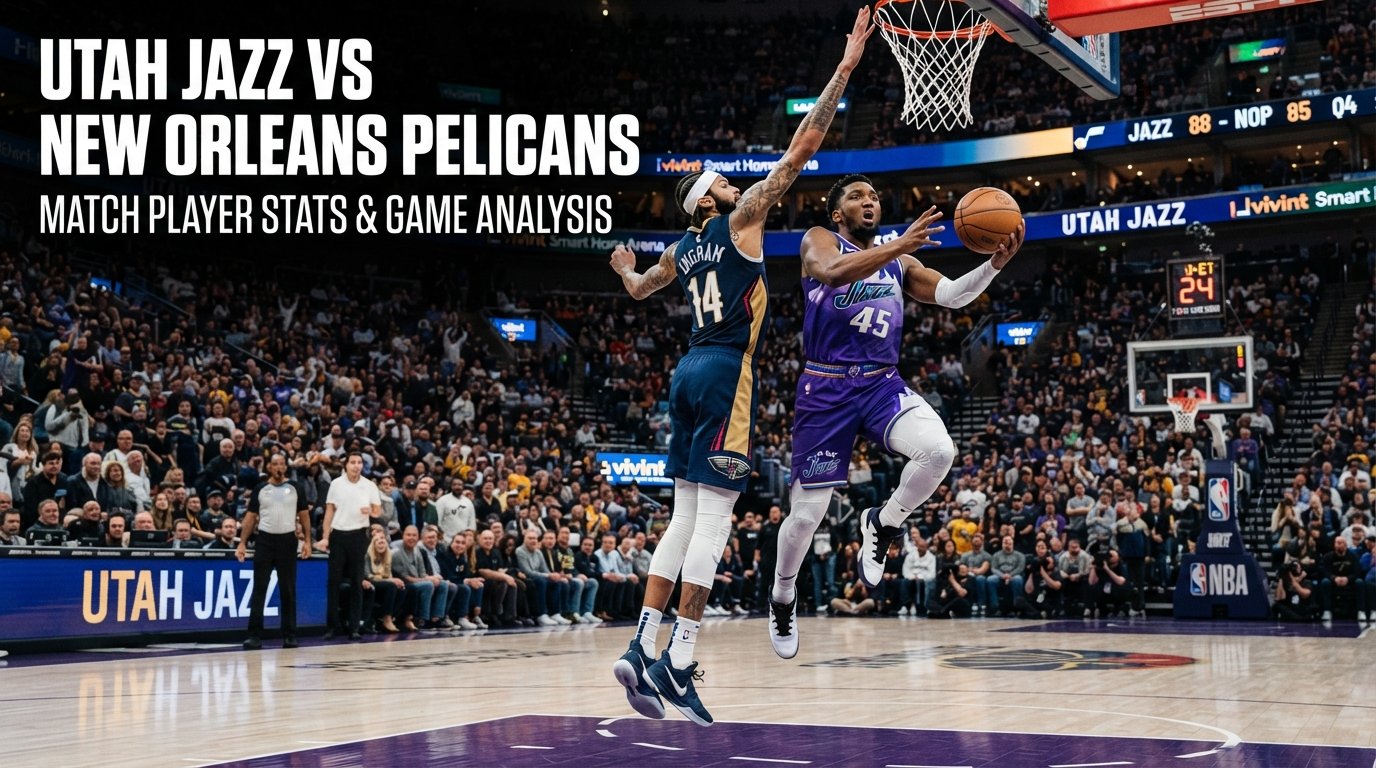
Utah Jazz vs New Orleans Pelicans Match Player Stats
The Utah Jazz vs New Orleans Pelicans match player stats from October 23, 2026, reveal how Utah secured a dramatic 120-119 victory over New Orleans at the Delta Center in Salt Lake City. The closely contested NBA game featured outstanding individual performances, a major third-quarter comeback, impressive defensive contributions, and a decisive finish in the final minute. Jaren Jackson Jr. led the Jazz with 24 points and 10 rebounds, while Zion Williamson paced the Pelicans with 23 points. Keyonte George also played a crucial role by recording 19 points and 10 assists, helping Utah maintain its offensive rhythm when the game became difficult.
Although New Orleans produced a stronger field-goal percentage and generated more steals, Utah found other ways to gain an advantage. The Jazz converted more three-pointers, recorded significantly more assists, collected additional rebounds, and protected the basket with an impressive number of blocks. These differences became especially important during the closing stages, when every possession mattered.
The final result was decided by a single point, making this matchup an excellent example of how individual production, teamwork, shooting efficiency, and defensive execution combine to determine an NBA result.
Utah Jazz vs New Orleans Pelicans Match Player Stats: Final Score and Game Overview
The Jazz entered the contest looking to establish a stronger start to their season, while the Pelicans wanted to build on their offensive potential. Both teams had talented scorers capable of changing the direction of the game, and their performances produced an entertaining contest that remained competitive until the final seconds.
Here are the essential details:
| Game Information | Details |
| Matchup | Utah Jazz vs New Orleans Pelicans |
| Date | October 23, 2026, local game date |
| Final score | Utah Jazz 120, New Orleans Pelicans 119 |
| Venue | Delta Center |
| Location | Salt Lake City, Utah |
| Attendance | 17,867 |
| Competition | NBA regular season |
| Game status | Final |
| Leading Utah scorer | Jaren Jackson Jr. |
| Leading New Orleans scorer | Zion Williamson |
| Leading playmaker | Keyonte George |
The game is listed as October 23 on the NBA schedule, while the official game information also displays October 24 because the contest extended beyond midnight in the local reporting timeline. Both dates refer to the same matchup, not separate games.
Utah’s victory came through a balanced offensive performance rather than dependence on one player. Jackson provided scoring and rim protection, George controlled the distribution of the basketball, and several supporting players contributed valuable points.
New Orleans also received productive performances from its leading players. Williamson attacked the basket efficiently, Saddiq Bey delivered an important scoring contribution, and Dejounte Murray combined scoring with playmaking and defensive pressure.
The final margin reflected how evenly matched the teams were during the most important moments.
Quarter-by-Quarter Scoring Breakdown
The scoring pattern explains why neither team could establish complete control throughout the contest. Utah started strongly, New Orleans responded after halftime, and the Jazz eventually produced the stronger fourth quarter.
| Quarter | New Orleans Pelicans | Utah Jazz |
| First Quarter | 28 | 31 |
| Second Quarter | 24 | 31 |
| Third Quarter | 38 | 24 |
| Fourth Quarter | 29 | 34 |
| Final Score | 119 | 120 |
First Quarter: Utah Establishes an Early Advantage
Utah opened the game with a three-point advantage, finishing the first quarter ahead 31-28. The Jazz used a productive offensive approach to create early scoring opportunities and put pressure on the Pelicans’ defense.
New Orleans remained close by using its physical offensive players and looking for opportunities around the basket. However, Utah found enough scoring options to finish the opening period in front.
The three-point difference was relatively small, but the early advantage helped the Jazz build confidence.
Second Quarter: Jazz Extend Their Lead
The second quarter became an important period for Utah. The Jazz scored another 31 points while limiting New Orleans to 24.
This seven-point quarter advantage increased Utah’s overall lead to 62-52 at halftime.
The ten-point halftime margin gave Utah a useful cushion, although the game was far from decided. The Pelicans still had enough offensive talent to produce a comeback, particularly through Williamson and Murray.
Utah’s early success also demonstrated the importance of balanced scoring. Instead of depending exclusively on Jackson, the team received contributions from its perimeter players and supporting rotation.
Third Quarter: New Orleans Changes the Momentum
The Pelicans produced their strongest offensive period after halftime, scoring 38 points against Utah’s 24.
That 14-point difference completely changed the game.
Dejounte Murray became particularly important during New Orleans’ offensive surge. He scored his first 12 points of the contest during a 31-13 stretch that helped the Pelicans erase Utah’s advantage.
New Orleans also benefited from defensive activity. The team generated steals, disrupted Utah’s offensive rhythm, and created additional opportunities in transition.
By the end of the third quarter, the Pelicans had moved ahead 90-86.
The momentum had shifted, and Utah needed a strong response to avoid losing control of the contest.
Fourth Quarter: Utah Finds a Way to Win
The final period featured another change in momentum. Utah scored 34 points, compared with 29 from New Orleans.
Jaren Jackson Jr. became especially influential during the closing stages. He scored nine of his points in the fourth quarter and contributed an important defensive block against Williamson.
Rookie Darryn Peterson also delivered a decisive contribution by making the go-ahead free throws with approximately 50.5 seconds remaining.
The Pelicans had opportunities to regain the lead, but Utah’s defense prevented them from completing another comeback.
An offensive foul called on Williamson was upheld, and Murray missed a pull-up jumper just before the final buzzer.
Utah escaped with a one-point victory.
Utah Jazz Player Stats and Individual Performances
The Utah Jazz received contributions from multiple players, which proved essential in a game where the opponent had several effective scorers.
Jaren Jackson Jr. led the team in points and rebounds, while Keyonte George provided the most assists. Jaxson Hayes offered valuable interior scoring, and Lauri Markkanen contributed from the perimeter.
Here is a breakdown of the leading Utah performances.
| Utah Jazz Player | Points | Rebounds | Assists |
| Jaren Jackson Jr. | 24 | 10 | 3 |
| Keyonte George | 19 | 1 | 10 |
| Jaxson Hayes | 17 | 5 | 2 |
| Lauri Markkanen | 16 | 6 | 3 |
| Darryn Peterson | 15 | 3 | 1 |
| Brice Sensabaugh | 10 | 3 | 2 |
| Isaiah Collier | 10 | 2 | 7 |
| Ace Bailey | 6 | 7 | 2 |
Jaren Jackson Jr. Leads Utah With 24 Points
Jaren Jackson Jr. delivered the most complete individual performance for the Jazz.
He finished with 24 points, 10 rebounds, and three assists. His double-double demonstrated his value on both ends of the floor.
Jackson’s scoring helped Utah maintain offensive production during important stretches, while his rebounding provided additional possessions and limited some of New Orleans’ second-chance opportunities.
His defensive presence was equally significant.
Jackson recorded three blocks, making it difficult for New Orleans to finish certain attempts near the basket. His fourth-quarter block against Williamson was particularly important because it prevented a potential scoring opportunity during a tense stage of the game.
He also converted eight of his ten free-throw attempts.
The combination of scoring, rebounding, and rim protection made Jackson Utah’s most influential player.
Keyonte George Records 19 Points and 10 Assists
Keyonte George was Utah’s leading playmaker.
He finished with 19 points and 10 assists, giving the Jazz a reliable offensive organizer throughout the matchup.
His ten assists were particularly important when compared with New Orleans’ total of 18 team assists.
George helped Utah create opportunities for different players instead of relying on difficult individual shots. His distribution allowed Jackson, Hayes, Markkanen, and other teammates to become involved.
His performance also demonstrated the importance of having a guard who can contribute as both a scorer and facilitator.
Although George did not lead Utah in rebounds, his ability to control the offensive flow helped the team maintain balance.
Jaxson Hayes Provides Valuable Interior Scoring
Jaxson Hayes contributed 17 points and five rebounds in approximately 26 minutes of action.
His shooting efficiency was one of the most impressive aspects of his performance. Hayes converted seven of his eight field-goal attempts.
That level of efficiency gave Utah another reliable scoring option around the basket.
Hayes also contributed defensively, including an important block on Williamson during the second quarter. That play illustrated his ability to influence the game beyond scoring.
His contribution was especially valuable because Utah needed players who could finish opportunities without requiring a large number of possessions.
Lauri Markkanen Adds Perimeter Production
Lauri Markkanen finished with 16 points, six rebounds, and three assists.
His perimeter shooting helped Utah create space for its interior players. Markkanen converted four three-pointers, giving the Jazz an important scoring advantage from outside.
His ability to stretch the floor made it more difficult for New Orleans to concentrate its defensive attention on Jackson and Hayes.
Markkanen also contributed as a rebounder and secondary playmaker.
Although he was not Utah’s leading scorer, his offensive versatility helped create a more balanced attack.
Darryn Peterson Delivers a Crucial Late Contribution
Darryn Peterson recorded 15 points and three rebounds.
His overall scoring was valuable, but his most important contribution came during the final minute.
Peterson converted the go-ahead free throws with approximately 50.5 seconds remaining, helping Utah take a decisive late advantage.
Making free throws under pressure requires concentration and confidence. His successful attempts were especially important because the final margin was only one point.
The performance highlighted how a young player can influence a close NBA contest without necessarily leading the team in total points.
Brice Sensabaugh and Isaiah Collier Support the Offense
Brice Sensabaugh scored 10 points and collected three rebounds.
His contribution helped Utah maintain scoring depth and reduced the pressure on the starting players.
Isaiah Collier also scored 10 points, while recording two rebounds and seven assists.
Collier’s seven assists were particularly useful because they gave Utah another player capable of creating opportunities for teammates.
Together, these contributions demonstrated the value of having multiple playmakers and scoring options available throughout the rotation.
Ace Bailey Adds Rebounding Support
Ace Bailey finished with six points and seven rebounds.
Although his scoring total was lower than several teammates, his rebounding helped Utah compete on the glass.
His seven rebounds were particularly useful in a contest where possession control mattered. Rebounding is often overlooked when evaluating individual performances, but it can directly influence the number of scoring opportunities a team receives.
Bailey’s contribution helped Utah maintain a more balanced team performance.
New Orleans Pelicans Player Stats and Individual Performances
The New Orleans Pelicans also produced several impressive individual performances.
Zion Williamson led the team in scoring, Saddiq Bey provided an efficient offensive contribution, and Dejounte Murray delivered an important combination of points, rebounds, assists, and steals.
Despite the defeat, New Orleans demonstrated that it had enough offensive quality to challenge Utah throughout the contest.
| New Orleans Pelicans Player | Points | Rebounds | Assists |
| Zion Williamson | 23 | 5 | 2 |
| Saddiq Bey | 20 | 3 | 1 |
| Dejounte Murray | 16 | 6 | 6 |
| Derik Queen | 12 | 7 | 2 |
| Jordan Poole | 12 | 2 | 2 |
| Trey Murphy III | 9 | 6 | 3 |
| Yves Missi | 6 | 1 | 0 |
| Herbert Jones | 3 | 1 | 1 |
Zion Williamson Scores 23 Points
Zion Williamson was New Orleans’ leading scorer.
He finished with 23 points, five rebounds, and two assists. His scoring efficiency was impressive, as he converted eight of his 12 field-goal attempts and seven of eight free throws.
Williamson’s ability to attack the basket created problems for Utah’s defense.
His strength and acceleration allowed him to generate scoring opportunities close to the rim, where he was difficult to contain.
However, Utah’s defensive size became increasingly important during the fourth quarter.
Jackson’s defensive presence and Hayes’ interior protection made some scoring opportunities more difficult.
Williamson still delivered a strong offensive performance, but his team could not convert that production into a victory.
Saddiq Bey Contributes 20 Efficient Points
Saddiq Bey recorded 20 points, three rebounds, and one assist in approximately 22 minutes.
His shooting performance was one of New Orleans’ most productive offensive contributions.
Bey made eight of his 12 field-goal attempts and connected on three of five attempts from three-point range.
His scoring helped the Pelicans remain competitive during important stretches.
One of the most useful aspects of his performance was his efficiency. He did not need an unusually large number of possessions to reach 20 points.
Bey’s ability to contribute from both inside and outside gave New Orleans another offensive option beyond Williamson.
Dejounte Murray Records 16 Points and Six Assists
Dejounte Murray finished with 16 points, six rebounds, six assists, and three steals.
His third-quarter performance helped change the direction of the game.
After a quiet opening half, Murray found his scoring rhythm and contributed to the Pelicans’ offensive surge.
His ability to create opportunities for himself and teammates made him one of New Orleans’ most important players.
Three steals also demonstrated his defensive activity.
Murray’s performance showed why an effective point guard can influence a game through several statistical categories rather than scoring alone.
Derik Queen Provides Interior Production
Derik Queen contributed 12 points, seven rebounds, and two assists.
His seven rebounds tied him for New Orleans’ highest individual total in the supplied player breakdown.
Queen provided a useful interior presence and helped the Pelicans compete physically against Utah’s frontcourt.
His ability to contribute as a scorer and rebounder gave New Orleans additional options around the basket.
Although his performance was productive, Utah’s collective rebounding advantage ultimately helped the Jazz control more possessions.
Jordan Poole Produces 12 Points
Jordan Poole scored 12 points, collected two rebounds, and recorded two assists.
His shooting efficiency was less consistent than that of some of his teammates. He made only one of eight field-goal attempts.
However, Poole converted nine of ten free throws.
Those free throws allowed him to contribute points even when his perimeter shooting was not producing the expected results.
His performance illustrates why field-goal percentage and total scoring should be evaluated together rather than treated as interchangeable measurements.
A player can reach double figures through free throws despite struggling from the field.
Trey Murphy III Adds Rebounding and Playmaking
Trey Murphy III finished with nine points, six rebounds, and three assists.
His scoring contribution was relatively modest, but he remained involved in other parts of the game.
Six rebounds helped New Orleans compete on the glass, while three assists demonstrated his ability to support the offensive system.
Murphy’s versatility is useful because he can contribute without needing to dominate possession.
However, Utah’s ability to limit his scoring output reduced one of New Orleans’ potential perimeter advantages.
Yves Missi and Herbert Jones Complete the Statistical Picture
Yves Missi recorded six points, one rebound, and one block before leaving the game with a left knee injury in the second quarter.
His absence was an important development because New Orleans lost a starting center for the remainder of the contest.
The injury affected the Pelicans’ available frontcourt rotation and placed additional responsibility on their other interior players.
Herbert Jones finished with three points, one rebound, and one assist.
Although his offensive numbers were limited, his defensive role remained part of New Orleans’ overall approach.
These contributions show that a player’s value cannot always be measured through scoring totals alone.
Complete Team Statistical Comparison
The team statistics provide a clearer explanation of how Utah won despite New Orleans shooting a higher percentage from the field.
| Statistical Category | New Orleans Pelicans | Utah Jazz |
| Total Points | 119 | 120 |
| Field Goals | 44/87 | 41/84 |
| Field-Goal Percentage | 51% | 49% |
| Three-Pointers | 8/26 | 13/35 |
| Three-Point Percentage | 31% | 37% |
| Free Throws | 23/27 | 25/33 |
| Free-Throw Percentage | 85% | 76% |
| Total Rebounds | 37 | 42 |
| Assists | 18 | 31 |
| Turnovers | 15 | 18 |
| Steals | 15 | 4 |
| Blocks | 5 | 14 |
| Personal Fouls | 29 | 21 |
These numbers reveal several important differences.
New Orleans was more accurate from the field and at the free-throw line. Utah, however, created advantages through three-point production, passing, rebounding, and rim protection.
The difference between these categories explains why the Jazz could win despite attempting fewer successful field goals.
Three-Point Shooting Gives Utah an Important Advantage
Utah made 13 three-pointers compared with eight from New Orleans.
That difference represents five additional successful shots from beyond the arc.
In scoring terms, those extra three-pointers account for 15 points of production before considering the different number of attempts.
The Jazz attempted 35 three-pointers and converted approximately 37% of them.
New Orleans attempted 26 and converted approximately 31%.
The difference was not simply about shooting more often. Utah also converted a greater proportion of its attempts.
This was one of the most important statistical advantages in the game.
Assists Highlight Utah’s Stronger Ball Movement
Utah recorded 31 assists, while New Orleans finished with 18.
The 13-assist difference was substantial.
Assists help explain how efficiently a team creates scoring opportunities through passing.
Utah’s total suggests that its offense generated many successful shots through player movement and shared possession.
Keyonte George played an important role with 10 assists, while Isaiah Collier added seven.
New Orleans received six assists from Murray, but the team’s overall distribution was less extensive.
This difference was particularly important because Utah did not need one player to create every scoring opportunity.
Rebounding Gives the Jazz More Possession Control
Utah collected 42 rebounds compared with 37 for New Orleans.
The five-rebound advantage helped the Jazz maintain possession and reduce some of the Pelicans’ opportunities.
Jackson’s 10 rebounds were especially important.
New Orleans also had productive rebounders, including Queen, Murphy, and Williamson.
However, Utah’s combined frontcourt contribution helped the team finish ahead in the overall category.
Rebounding becomes especially important in close games because even one additional possession can influence the final result.
Defensive Blocks Become a Major Difference
Utah recorded 14 blocks, compared with five from New Orleans.
That nine-block advantage was one of the most striking defensive statistics.
Jackson and the other Utah defenders made it difficult for New Orleans to finish certain attempts near the basket.
The Jazz’s defensive activity also helped compensate for their lower steal total.
New Orleans generated 15 steals, compared with only four for Utah.
This suggests that the Pelicans were more effective at disrupting ball possession, while Utah had a greater impact on attempts near the rim.
Both defensive approaches created different advantages, but Utah’s shot-blocking production was particularly influential.
Turnovers Remain an Area for Improvement
The Pelicans committed 15 turnovers, while the Jazz recorded 18.
Utah therefore gave away possession three more times.
This is an important detail because the Jazz did not win every statistical category.
New Orleans actually recorded more steals and committed fewer turnovers.
However, Utah’s offensive production in other areas helped overcome that disadvantage.
The result shows why evaluating only turnovers or defensive steals would provide an incomplete explanation of the contest.
Free-Throw Efficiency Favors New Orleans
The Pelicans converted 23 of 27 free throws, giving them an accuracy rate of approximately 85%.
Utah made 25 of 33 attempts, converting approximately 76%.
New Orleans was clearly more accurate from the free-throw line.
However, Utah attempted six more free throws and converted two more overall.
This distinction is important.
A higher percentage does not automatically mean a team scores more points from the line. The number of attempts also matters.
Utah’s additional opportunities helped the Jazz maintain their scoring advantage.
Five Major Reasons Utah Jazz Defeated New Orleans
The final result was influenced by several connected factors rather than one isolated performance.
1. Better Three-Point Production
Utah’s five additional three-pointers created a meaningful scoring advantage.
The Jazz were more effective from outside and used perimeter shooting to complement their interior offense.
2. Stronger Team Playmaking
The 31 assists recorded by Utah demonstrated the value of shared offensive responsibility.
George and Collier helped create opportunities for different players, preventing the Pelicans from concentrating exclusively on one scorer.
3. Greater Rebounding Production
Utah finished with five more rebounds.
Jackson’s double-double helped the Jazz control the glass and maintain important possessions.
4. Superior Rim Protection
The Jazz recorded 14 blocks.
Their interior defense challenged New Orleans’ finishing opportunities and helped protect the lead during important stretches.
5. Better Execution in the Closing Minute
The final minute was decisive.
Peterson converted the go-ahead free throws, Jackson delivered an important defensive contribution, and Utah avoided allowing New Orleans to complete another comeback.
Close games frequently come down to small details, and Utah handled those final possessions more effectively.
What New Orleans Did Well Despite Losing
A one-point defeat should not hide the positive aspects of New Orleans’ performance.
The Pelicans demonstrated several strengths that helped them remain competitive.
Efficient Field-Goal Shooting
New Orleans converted 51% of its field-goal attempts.
That was higher than Utah’s 49%.
Williamson and Bey were particularly productive, combining for 43 points.
Their efficiency helped the Pelicans generate consistent offense even when the Jazz were protecting the rim.
Defensive Pressure
The Pelicans recorded 15 steals.
That total showed their ability to disrupt Utah’s possession and create opportunities through defensive activity.
The team also benefited from Murray’s three steals.
Strong Third-Quarter Response
New Orleans scored 38 points in the third quarter.
Its 31-13 scoring burst helped erase Utah’s earlier advantage and put the Pelicans in control entering the final period.
This response demonstrated the team’s offensive potential.
Productive Bench Contributions
The Pelicans received useful scoring contributions from Bey, Queen, and Poole.
Their performances helped maintain offensive production when the starters needed additional support.
However, the team could not sustain its advantage during the closing stages.
What Utah Can Learn From the Performance
Although Utah won, the statistical breakdown identifies areas that deserve attention.
Reduce Turnovers
The Jazz committed 18 turnovers.
That number created additional opportunities for New Orleans and contributed to the Pelicans’ comeback.
Improving ball security would help Utah protect leads more effectively.
Maintain Defensive Consistency
Utah started strongly but allowed 38 points in the third quarter.
The defensive performance during that period demonstrated how quickly an opponent can change the direction of a game.
The Jazz need to maintain communication, transition defense, and defensive positioning across all four quarters.
Continue Developing Multiple Playmakers
George and Collier combined for 17 assists.
Their contributions demonstrated the benefits of having more than one player capable of organizing the offense.
Maintaining that balance could make Utah more difficult to defend in future matchups.
Protect the Basket Without Giving Away Easy Opportunities
The 14 blocks were impressive, but rim protection requires more than challenging shots.
Defenders must also maintain positioning, avoid unnecessary fouls, and secure rebounds after missed attempts.
Utah’s overall defensive performance showed encouraging potential in this area.
What New Orleans Can Improve After the Defeat
The Pelicans had enough offensive production to win, but several areas could have produced a different outcome.
Improve Offensive Distribution
New Orleans recorded 18 assists.
That figure was significantly below Utah’s 31.
Although individual scoring was effective, better ball movement could create more open opportunities and reduce dependence on difficult attempts.
Maintain Fourth-Quarter Defensive Focus
The Pelicans scored 38 points in the third quarter but allowed Utah to score 34 in the fourth.
Protecting a late lead requires consistent defensive execution.
New Orleans needs to limit open three-pointers, contest interior attempts, and secure rebounds during important possessions.
Find Additional Frontcourt Stability
Missi’s second-quarter injury reduced New Orleans’ available center rotation.
His absence was a significant challenge because Utah had multiple players capable of contributing near the basket.
Maintaining reliable frontcourt depth is important for teams facing strong interior opponents.
Convert Scoring Opportunities Into a Winning Finish
The Pelicans made 51% of their field goals and 85% of their free throws.
Those were productive numbers.
However, shooting efficiency alone was not enough to secure the result.
The team also needed to control possessions, limit Utah’s three-point production, and execute during the final minute.
Key Statistical Lessons From the Matchup
The contest offers several useful lessons for basketball fans who want to understand more than the final score.
First, field-goal percentage does not tell the complete story. New Orleans shot more accurately overall, but Utah made more three-pointers and scored one additional point.
Second, assists provide valuable information about offensive structure. Utah’s 31 assists demonstrated how shared playmaking can create scoring opportunities across a lineup.
Third, defensive statistics should be evaluated together. New Orleans generated more steals, but Utah recorded considerably more blocks.
Fourth, individual scoring leaders do not always determine the outcome. Williamson scored 23 points, while Jackson recorded 24. However, Utah also received strong contributions from George, Hayes, Markkanen, and Peterson.
Finally, close games often depend on execution rather than season-long reputation or individual talent alone. Peterson’s late free throws and Jackson’s defensive contribution were examples of small moments producing a major result.
How to Understand NBA Match Player Statistics
For readers who regularly follow NBA games, understanding the main statistical categories makes it easier to evaluate player performances.
Here are the most useful measurements.
Points
Points measure a player’s direct scoring contribution.
However, points should be considered alongside shooting attempts and efficiency.
A player who scores 20 points on efficient shooting may have a different offensive impact from someone who requires considerably more attempts to reach the same total.
Rebounds
Rebounds measure how often a player recovers the basketball after a missed shot.
Offensive rebounds create additional scoring opportunities, while defensive rebounds help finish possessions.
Jackson’s 10 rebounds were an important part of Utah’s performance.
Assists
Assists measure passes that directly lead to successful field goals.
They help explain how players create scoring opportunities for teammates.
George’s 10 assists showed his importance as Utah’s primary playmaker.
Steals
Steals occur when a defensive player legally takes possession of the ball from the opponent.
They can create transition opportunities and disrupt offensive rhythm.
New Orleans recorded 15 steals, demonstrating its defensive activity.
Blocks
Blocks occur when a defender legally deflects an opponent’s shot attempt.
Utah’s 14 blocks demonstrated its ability to challenge attempts around the basket.
Field-Goal Percentage
Field-goal percentage measures the proportion of successful two-point and three-point field-goal attempts.
It provides a useful measure of shooting accuracy, but it does not account for the different value of two-point and three-point shots.
Three-Point Percentage
Three-point percentage measures accuracy from beyond the three-point line.
It is particularly useful when evaluating perimeter shooters and a team’s offensive spacing.
Turnovers
Turnovers measure lost possessions.
They can result from passing mistakes, offensive fouls, violations, or defensive pressure.
The Jazz committed three more turnovers than the Pelicans, making this a category worth monitoring in future performances.
Historical Significance of the One-Point Victory
The result also carried significance beyond the immediate standings.
According to the official game recap, Utah’s victory ended an eight-game losing streak against New Orleans.
That made the result particularly meaningful for the Jazz.
Winning against a familiar opponent after a difficult run can provide confidence, especially when the game is decided in the final minute.
The matchup also showed how much the teams’ current personnel could influence their competitive approach.
Jackson’s presence gave Utah an important defensive and offensive option. George provided playmaking, and the supporting rotation offered additional scoring depth.
For New Orleans, Williamson remained the central offensive figure, while Murray and Bey provided important complementary production.
The close result suggests that the teams had different strengths but enough talent to create a competitive matchup.
Player Matchups That Decided the Contest
Individual matchups played an important role in determining the result. Several players produced strong statistical performances, but the difference came from how effectively Utah combined its individual strengths.
Jaren Jackson Jr. vs Zion Williamson
The matchup between Jackson and Williamson was one of the most interesting aspects of the game.
Williamson finished with 23 points, while Jackson scored 24.
Both players were important offensive contributors, but their overall responsibilities were different.
Williamson focused on attacking the basket and creating scoring opportunities through his physical strength. Jackson contributed through scoring, rebounding, and defensive protection.
Jackson’s three blocks were particularly important because they helped Utah challenge New Orleans around the rim.
Williamson still produced an efficient shooting performance, but Utah’s defensive approach made his late-game opportunities more difficult.
Keyonte George vs Dejounte Murray
The point guard comparison highlighted two different approaches to offensive organization.
George recorded 19 points and 10 assists, while Murray contributed 16 points, six rebounds, and six assists.
George’s ten assists were a major factor in Utah’s superior team passing numbers.
Murray, meanwhile, provided defensive pressure through three steals and played an important role in the third-quarter comeback.
Both guards contributed beyond scoring, but George’s distribution helped Utah maintain a more balanced offensive structure.
Lauri Markkanen vs Saddiq Bey
Markkanen and Bey both provided valuable perimeter scoring.
Markkanen finished with 16 points, six rebounds, and four made three-pointers.
Bey scored 20 points and made three of five attempts from outside the arc.
Bey produced the higher scoring total, while Markkanen provided a significant contribution to Utah’s three-point advantage.
Their performances demonstrate how different offensive roles can be equally valuable.
Shooting Efficiency: Why the Higher Percentage Did Not Win
One of the most interesting aspects of this contest was the difference between overall shooting accuracy and total scoring production.
New Orleans made 44 of 87 field-goal attempts, while Utah converted 41 of 84.
That gave the Pelicans a field-goal percentage advantage of approximately two percentage points.
At first glance, this might suggest that New Orleans should have had the offensive advantage.
However, basketball scoring is influenced by the value of each successful shot.
A successful three-pointer produces one additional point compared with a successful two-point field goal.
Utah made 13 three-pointers, while New Orleans made only eight.
The Jazz therefore gained a meaningful advantage through perimeter shooting.
Free throws also influenced the final score.
New Orleans converted 23 free throws, while Utah made 25. Although the Pelicans were more accurate, Utah had more attempts.
These numbers explain why the Jazz could finish ahead despite making fewer total field goals.
For a more complete evaluation, shooting percentage should be considered alongside three-point production, free-throw attempts, and total scoring.
Bench Production and Rotation Contributions
Bench contributions can become particularly important when a game features multiple momentum changes.
A team’s starters may establish an early advantage, but reserve players often determine whether that advantage can be maintained.
Utah received valuable production from Jaxson Hayes, Brice Sensabaugh, and Isaiah Collier.
Hayes was particularly effective, scoring 17 points on seven made field goals from eight attempts.
Collier contributed seven assists, helping Utah maintain its offensive organization when George was not the only player creating opportunities.
Sensabaugh added 10 points and gave the Jazz another scoring option.
New Orleans also received useful contributions from its supporting rotation.
Bey scored 20 points, Queen contributed 12, and Poole added another 12.
These performances helped the Pelicans remain competitive despite their defeat.
One important detail is that Missi’s second-quarter injury reduced New Orleans’ frontcourt options. Losing a starting center can affect defensive matchups, rebounding assignments, and the amount of responsibility placed on reserve big men.
This was a relevant development when evaluating the teams’ interior performances.
Understanding the Importance of the Final Minute
The final minute deserves particular attention because it contained several decisive events.
Peterson’s successful free throws gave Utah the advantage with approximately 50.5 seconds remaining.
At that stage, New Orleans needed to respond quickly without making a mistake.
Jackson’s defensive contribution against Williamson helped prevent the Pelicans from finding an easy scoring opportunity.
The officials also upheld a charging foul against Williamson.
Murray then missed a pull-up jumper just before the final buzzer.
These events demonstrate why close basketball games require more than offensive talent.
Players must make good decisions, maintain composure, and execute their responsibilities under pressure.
A missed defensive assignment or an unnecessary turnover could have changed the result.
Utah handled the final sequence more effectively and secured the victory.
Official Game Information and Statistical Verification
The official NBA game record identifies the matchup as New Orleans Pelicans versus Utah Jazz, with New Orleans scoring 119 and Utah scoring 120.
The game took place at the Delta Center in Salt Lake City, with an attendance of 17,867.
The officiating crew consisted of James Capers, Leon Wood, and Ray Acosta.
The game recap also confirms Jackson’s 24-point, 10-rebound performance and Peterson’s decisive free throws.
For readers who want to examine the underlying figures, the official NBA box score provides the individual player statistics and game information.
When comparing player statistics across different sports websites, it is useful to check the official box score because some platforms may display different date conventions, rounding, or statistical summaries.
The distinction between the October 23 local schedule date and the October 24 game-information date is also worth retaining when publishing historical matchup coverage.
Why This Matchup Matters for Future Team Development
Although this was a single regular-season game, the performance offered useful information about both teams.
For Utah, the biggest positive was the ability to win through different offensive contributors.
Jackson provided a reliable scoring and defensive presence. George demonstrated his playmaking ability, while Markkanen and Hayes added important scoring support.
Peterson’s late-game contribution also highlighted the potential value of younger players in pressure situations.
The main concern for Utah was its third-quarter defensive performance. Allowing 38 points after building a ten-point halftime advantage showed that maintaining consistency remains important.
For New Orleans, the game demonstrated the offensive potential of Williamson, Bey, and Murray.
The team also showed an ability to create turnovers and generate momentum through defensive pressure.
However, the difference in assists, three-point production, and blocks identified areas where the Pelicans could improve.
The loss was particularly narrow, so the overall performance should not be viewed as a complete failure. A few better decisions in the fourth quarter could have changed the result.
Frequently Asked Questions
1. Who won the Utah Jazz vs New Orleans Pelicans game in October 2026?
The Utah Jazz defeated the New Orleans Pelicans 120-119. The game took place at the Delta Center in Salt Lake City and was decided during the final minute.
2. Who scored the most points for the Utah Jazz?
Jaren Jackson Jr. led Utah with 24 points. He also collected 10 rebounds and recorded three assists and three blocks.
3. How many points did Zion Williamson score against the Jazz?
Zion Williamson scored 23 points for New Orleans. He also recorded five rebounds and two assists, shooting eight of 12 from the field.
4. Which player recorded the most assists in the game?
Keyonte George recorded the most assists, finishing with 10 for Utah. Dejounte Murray led New Orleans with six assists.
5. How many three-pointers did Utah and New Orleans make?
Utah made 13 three-pointers from 35 attempts, while New Orleans converted eight from 26 attempts. This gave the Jazz an important perimeter-scoring advantage.
6. Where was the Utah Jazz vs New Orleans Pelicans game played?
The game was played at the Delta Center in Salt Lake City, Utah. The official attendance was 17,867.
Conclusion
The Utah Jazz secured a dramatic 120-119 victory over the New Orleans Pelicans through a combination of balanced scoring, effective three-point shooting, strong playmaking, and important defensive contributions.
Jaren Jackson Jr. delivered the leading performance for Utah with 24 points and 10 rebounds, while Keyonte George controlled the offense with 10 assists. Jaxson Hayes, Lauri Markkanen, and Darryn Peterson also made important contributions, particularly during the decisive stages.
For New Orleans, Zion Williamson finished with 23 points, Saddiq Bey added 20, and Dejounte Murray contributed 16 points and six assists. The Pelicans also demonstrated impressive shooting accuracy and defensive activity.
However, Utah’s advantages in three-point production, assists, rebounds, and blocks helped compensate for its lower overall field-goal percentage.
The most important lesson from the contest was the value of balanced team performance. Individual scoring leaders can influence a game, but successful execution across multiple statistical categories often determines the final result.
With only one point separating the teams, the contest provided an excellent example of how small differences in shooting, defensive execution, and late-game decision-making can determine an NBA outcome.