How to Choose a Ceiling Fan That Complements Your Interior Design: Style, Size, and Comfort
A thoughtfully designed room is about more than furniture, paint colors, and decorative accessories. The details that are often treated as purely functional can have just as much influence on the finished space. Ceiling fans are a perfect example. They help circulate air and improve everyday comfort, but because they occupy a prominent position overhead, their appearance can also shape the character of a room.
For years, homeowners often selected ceiling fans based almost entirely on airflow and price. Design was secondary, and many models looked more like practical appliances than intentional parts of an interior. That has changed. Today’s options include understated contemporary designs, traditional fixtures, sculptural forms, and natural finishes that can complement a wide range of decorating styles.
The challenge is finding a fan that performs well without disrupting the room’s visual balance. A beautiful fixture may be disappointing if it is too small for the space, while a powerful model can look oversized if its proportions are wrong.
Whether you are updating a living room, refreshing a bedroom, or planning a complete home makeover, the right ceiling fan should bring together appearance, airflow, lighting, and practical installation requirements. Here is how to make a choice that works on every level.
Why Ceiling Fans Deserve a Place in Interior Design Planning
Ceiling fans are often selected near the end of a renovation, after the furniture, flooring, and lighting have already been decided. This can lead to compromises because the available models may not suit the room’s existing design.
Planning the fan earlier gives you more control over its size, finish, mounting style, and relationship with other fixtures.
A well-chosen ceiling fan can contribute to a room in several ways:
- Visual balance: Its shape and proportions can complement the furniture and architectural features.
- Everyday comfort: Proper airflow helps occupants feel more comfortable in warm conditions.
- Functional lighting: Models with integrated lights can combine two useful fixtures in one.
- Design continuity: Blade finishes and metal details can connect with other materials in the room.
- Practical flexibility: Different mounting options make it possible to accommodate a range of ceiling heights.
The best result comes from treating the fan as part of the overall design rather than an appliance added as an afterthought.
1. Understand the Design Style of Your Room
Before comparing fan specifications, look at the room’s existing visual language. Consider the furniture shapes, materials, colors, and decorative details. These elements can help narrow down which fan designs will feel natural in the space.
Mid-Century Modern Interiors
Mid-century modern design is known for clean geometry, functional forms, organic curves, and an appreciation for natural materials. Furniture often features tapered legs, simple silhouettes, warm wood finishes, and restrained detailing.
A fan with streamlined blades, balanced proportions, and warm wood or understated metal finishes can complement these interiors. Rather than competing with statement furniture, it should reinforce the room’s simple, carefully considered appearance.
A mid century modern ceiling fan can be a particularly useful design reference when you want the overhead fixture to feel connected to the furniture and architectural details below it.
Contemporary and Minimalist Interiors
Contemporary spaces often rely on uncluttered surfaces, neutral colors, and simple shapes. A ceiling fan with a clean silhouette and restrained finish can maintain that atmosphere.
Consider a design that blends with the ceiling or coordinates with the room’s hardware. Avoid overly decorative details if the rest of the interior is intentionally understated.
Farmhouse and Rustic Interiors
Farmhouse and rustic rooms often feature natural textures, visible wood grain, warm colors, and relaxed furniture arrangements. Fans with wood-look blades or complementary metal finishes can fit comfortably into these spaces.
The key is avoiding an overly industrial appearance unless that contrast is intentional. A finish that connects with the dining table, exposed beams, or cabinetry can help create a cohesive look.
Traditional Interiors
Traditional rooms may include detailed wood furniture, classic architectural features, layered textiles, and decorative lighting. A fan with a more classic shape or warm metal finish can complement these elements.
You do not necessarily need an ornate model. Sometimes a simple fan in a compatible finish provides a more balanced result.
2. Choose the Right Fan Size for Your Room
One of the most important decisions is selecting a fan with an appropriate blade span. A fan that is too small may not circulate air effectively throughout the space, while an oversized fixture can dominate the ceiling and feel visually unbalanced.
Blade span refers to the diameter of the circle covered by the rotating blades. It is one of the main measurements to consider when comparing models.
The following ranges provide a general starting point:
| Approximate room size | Suggested fan blade span |
| Up to 75 square feet | 29–36 inches |
| 76–144 square feet | 36–42 inches |
| 144–225 square feet | Around 44 inches |
| 225–400 square feet | 50–54 inches |
| Larger spaces | 56 inches or more, depending on layout |
These are general guidelines rather than universal rules. Manufacturer recommendations, room shape, ceiling height, and furniture arrangement can affect the best choice.
For example, a long living room may not distribute air evenly from a single centrally positioned fan. Depending on its layout, two appropriately sized fans may be more effective than one very large fixture.
Also consider visual scale. A fan should feel proportionate to the room and nearby lighting. In a compact bedroom, a large decorative fixture may overwhelm the ceiling even if it can technically fit.
3. Consider Ceiling Height and Mounting Options
Ceiling height affects both the appearance and performance of a ceiling fan. The fixture needs enough clearance for safe operation while being positioned appropriately to circulate air.
Different mounting styles are designed for different ceiling conditions.
Flush-mount fans: These attach close to the ceiling and are useful where vertical clearance is limited. They can also create a streamlined appearance in rooms where a hanging fixture would feel too low.
Standard downrod mounts: A downrod suspends the fan below the ceiling. This arrangement can help position the blades at a suitable height in rooms with standard or taller ceilings.
Extended downrod mounts: Rooms with high or vaulted ceilings may require a longer downrod to bring the fan closer to the occupied area.
Angled-ceiling mounts: Sloped ceilings may need a compatible mounting system or adapter. Always check the manufacturer’s installation requirements before purchasing.
For many residential installations, keeping the blades at least seven feet above the floor is an important safety guideline. A position around eight to nine feet above the floor is often recommended where ceiling height allows, but the manufacturer’s instructions and applicable local electrical and building requirements should take priority.
4. Look Beyond Appearance: Airflow Matters
A ceiling fan can be an attractive design feature, but its primary purpose is to move air. That means appearance should never be the only consideration.
One useful specification is airflow, commonly measured in cubic feet per minute (CFM). It indicates how much air a fan moves. Comparing airflow figures can help you understand how different models perform, although the highest number is not automatically the best choice for every room.
Other factors also influence performance:
- Blade span: Larger blades can cover a wider area when appropriately designed.
- Blade pitch: The angle of the blades affects how air is moved.
- Motor design: The motor influences speed, efficiency, and operating characteristics.
- Blade balance: Properly balanced blades help reduce unwanted movement and noise.
- Room layout: Furniture, partitions, and architectural features can affect circulation.
It is worth checking the manufacturer’s airflow and efficiency information rather than judging performance by the number of blades or the appearance of the motor housing.
A well-matched fan should provide comfortable circulation without creating an unnecessarily strong breeze or excessive operating noise.
5. Select Blade Finishes That Work with Your Furniture
Blade finishes have a surprisingly large effect on the overall appearance of a ceiling fan. Because the blades extend across the ceiling, their color and material can either blend into the room or become a noticeable design feature.
Wood and wood-look finishes are particularly versatile. They can connect the fan to flooring, furniture, exposed beams, and other natural materials.
Here are a few combinations to consider:
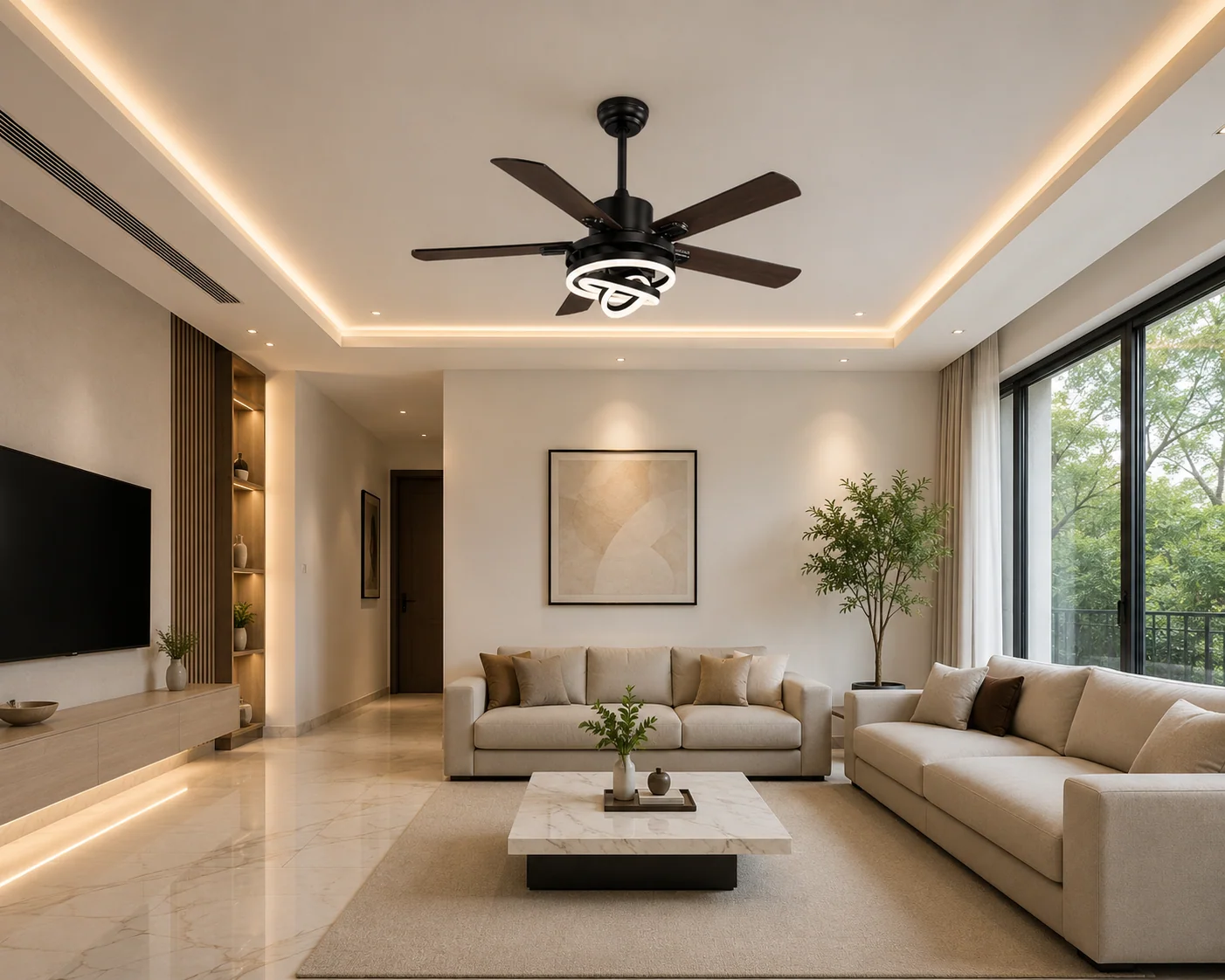
Natural wood with neutral interiors: Light or medium wood finishes pair well with cream walls, beige upholstery, and natural textiles.
Dark blades with contemporary furniture: Deeper finishes can create contrast in rooms with pale ceilings and simple furniture.
Warm wood with mid-century pieces: Coordinating the blade tone with a coffee table, sideboard, or dining furniture can reinforce a consistent design direction.
Metal finishes with modern hardware: A fan’s motor housing can coordinate with cabinet handles, lighting fixtures, door hardware, or other metal details.
You do not have to match every wooden surface exactly. In fact, slightly different wood tones can create more depth. The important thing is to avoid combinations that clash in warmth or undertone.
6. Decide Whether You Need an Integrated Light
Some ceiling fans include built-in lighting, while others are designed primarily for air circulation. Which option makes sense depends on the room’s existing lighting plan.
An integrated light can be useful in a bedroom, family room, or smaller living space where a single fixture needs to perform multiple functions. It can also reduce the need for a separate overhead light.
However, a fan light should not automatically replace every other source of illumination.
A comfortable room usually benefits from layered lighting:
- Ambient lighting provides general illumination.
- Task lighting supports activities such as reading, working, or cooking.
- Accent lighting highlights artwork, architectural features, or decorative objects.
If the fan includes a light, look at its brightness, color temperature, dimming capability, and control options. Integrated LED lighting can be convenient, but it is important to check whether the light source or components can be serviced or replaced.
For a room that already has a statement pendant or chandelier, a fan without an integrated light may be the better visual choice.
7. Use Ceiling Fans to Improve Different Rooms
The ideal ceiling fan can vary depending on the room’s purpose. A bedroom has different comfort requirements from a kitchen or an open-plan living area.
Living Room
The living room is often one of the largest and most frequently used spaces in a home. Choose a fan that complements the main seating arrangement and provides suitable circulation across the occupied area.
In a room with a prominent coffee table, sofa, or architectural feature, consider how the fan will look from different viewpoints. Its finish should connect with the room without competing with other focal points.
Bedroom
In a bedroom, quiet operation and convenient controls may be especially important. A remote or compatible wall control can make it easier to adjust speed without getting out of bed.
The fan should also suit the room’s dimensions and ceiling height. Avoid choosing a large fixture simply because it looks impressive in a product photograph.
Dining Room
A dining room fan needs to work with the table and overhead lighting. Consider whether the fan’s shape and position will visually compete with a pendant light or chandelier.
In some layouts, a fan with an integrated light may be the simplest solution. In others, a separate lighting arrangement will offer more flexibility.
Home Office
Air circulation can make a home office feel more comfortable, particularly during long working hours. Look for a fan that operates smoothly and does not create distracting noise or excessive movement of loose papers.
A restrained design can fit neatly into a workspace without taking attention away from the desk and other essential furniture.
Covered Outdoor Areas
For patios, porches, and other outdoor spaces, the fan must be specifically rated for the conditions where it will be installed. Damp-rated and wet-rated products are not interchangeable, so check the manufacturer’s specifications carefully.
8. Think About Energy Efficiency and Operating Costs
A ceiling fan can improve perceived comfort by moving air across the skin, helping occupants feel cooler. It does not lower the actual air temperature of a room in the way an air conditioner does.
This distinction matters because fans are most useful when people are present. Switching a fan off when a room is empty avoids using electricity without providing a comfort benefit.
When comparing models, consider:
- Airflow performance relative to electricity consumption.
- Motor efficiency and available speed settings.
- Energy-efficiency certifications where applicable.
- LED lighting options.
- Controls that make adjustment convenient.
- Whether the fan can reverse direction, if seasonal circulation is useful.
Some fans are designed to reverse their direction of rotation. In warmer weather, the usual setting creates a downward breeze. In cooler conditions, a reverse setting may help circulate warm air that collects near the ceiling. Follow the manufacturer’s instructions for the appropriate seasonal setting.
9. Avoid Common Ceiling Fan Buying Mistakes
Even a well-designed room can be let down by a poorly selected or installed fan. A few common mistakes are easy to avoid with some preparation.
Choosing by appearance alone: A beautiful fan may be unsuitable if its size, airflow, or motor performance does not meet the room’s needs.
Ignoring measurements: Always check blade span, overall fixture height, ceiling height, and wall clearance before ordering.
Overlooking the mounting system: Low ceilings, vaulted ceilings, and sloped surfaces may require specific mounting options.
Assuming more blades means better airflow: Blade count alone does not determine performance. Motor design, blade shape, pitch, and span also matter.
Forgetting about noise: A fan that sounds distracting at higher speeds may be frustrating in a bedroom or workspace.
Treating installation as an afterthought: The ceiling electrical box must be suitable for supporting a fan, and the wiring and mounting must follow the manufacturer’s instructions and local requirements. Use a qualified electrician when needed.
Avoiding these mistakes makes it easier to choose a fixture that delivers both the look and performance you expect.
10. Create a Cohesive Look with the Details Around the Fan
A ceiling fan does not need to match every item in the room, but it should feel connected to the overall design.
One way to achieve this is by repeating a material or finish in a few carefully chosen places. For example, wood-look blades can relate to a sideboard or coffee table, while a metal motor finish can echo the hardware on nearby furniture.
Lighting, wall colors, and textiles can also help establish continuity. A warm wood finish often works naturally with cream, tan, muted green, and earthy shades. Darker finishes can create a more dramatic effect when balanced with lighter walls and upholstery.
Think about the ceiling as part of the room rather than an empty surface. Beams, recessed lighting, ceiling height, and the position of other fixtures all affect how a fan will look once installed.
The goal is not to make the fan disappear or turn it into the room’s main attraction. It is to choose a fixture that looks as though it belongs there.
Frequently Asked Questions
What makes a ceiling fan suitable for a mid-century modern home?
A streamlined silhouette, balanced proportions, simple blade shapes, and finishes that complement natural wood and understated metal details can work particularly well. The overall design should support the room’s clean geometry rather than introduce unnecessary ornamentation.
What size ceiling fan do I need for my room?
The appropriate size depends mainly on room area, layout, and ceiling height. Smaller rooms often suit fans with blade spans around 29–42 inches, while larger living spaces may require 50–60 inches or more. Always check the manufacturer’s room-size recommendations.
Are wooden ceiling fan blades a good choice?
Wood and wood-look blades can add natural warmth and complement many interior styles. Their suitability depends on the specific product, construction, finish, and intended environment. For humid or outdoor locations, check that the fan and blades are rated for those conditions.
Should a ceiling fan have a light?
Not necessarily. A fan with an integrated light can be convenient when overhead illumination is needed, but a fan without a light may be a better choice if the room already has sufficient lighting or a decorative pendant fixture.
Can a ceiling fan make a room cooler?
A ceiling fan circulates air and creates a breeze that can make people feel cooler. It does not actually reduce the room’s air temperature, so it is most useful when people are in the space.
How high should a ceiling fan be installed?
For many residential applications, the blades should be at least seven feet above the floor. Around eight to nine feet is often a useful target when the ceiling allows, but the manufacturer’s installation guidance and local safety requirements should always be followed.
Do ceiling fans work in rooms with high ceilings?
Yes. Rooms with high ceilings can use an appropriately sized fan with a suitable downrod to position the blades at an effective height. The correct downrod length depends on the ceiling height and fan design.
Final Thoughts
A ceiling fan should contribute to the comfort of a room without feeling disconnected from its design. Choosing the right one means considering more than its appearance: room size, ceiling height, airflow, mounting options, lighting, and operating noise all play an important role.
When these practical details are considered alongside the room’s furniture, materials, and color palette, a ceiling fan can become a natural part of the interior rather than an afterthought.
Whether your home leans toward mid-century modern simplicity, contemporary minimalism, rustic warmth, or traditional character, the best choice is one that combines dependable performance with a design that feels right for the space. Take time to compare specifications, measure carefully, and think about how the fixture will look and function every day.