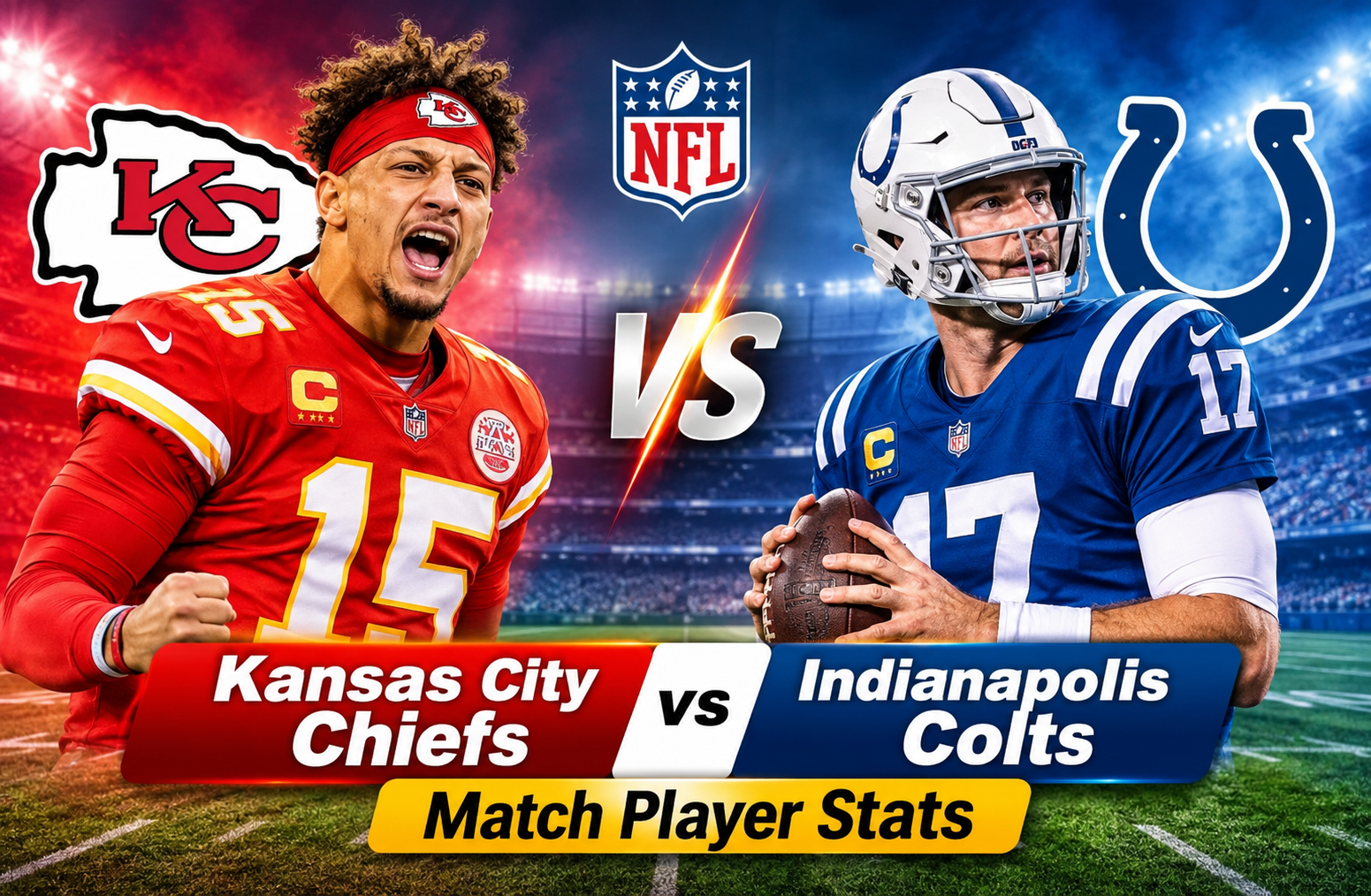
Colts vs Kansas City Chiefs Match Player Stats
The colts vs kansas city chiefs match player stats tell the story of a dramatic NFL contest that ended with the Kansas City Chiefs defeating the Indianapolis Colts 33-30 in overtime on September 21, 2026. Played at GEHA Field at Arrowhead Stadium, the game featured outstanding quarterback play from Patrick Mahomes, an impressive rushing performance by Jonathan Taylor, and a late comeback effort from Indianapolis that pushed the contest beyond regulation.
The Chiefs entered the matchup with a 1-0 record according to the supplied game data, while Indianapolis was looking to recover from a difficult opening to its season. Kansas City eventually secured its second victory, improving to 2-0, but the result was far from comfortable. The Colts scored 20 points in the first half, struggled to produce points in the third quarter, and then fought back to force overtime.
Mahomes delivered one of the strongest individual performances of the game, completing 32 of 47 passes for 382 yards and three touchdowns without throwing an interception. On the Indianapolis side, Daniel Jones completed 22 of 31 passes for 210 yards, one touchdown, and one interception. Jonathan Taylor added two rushing touchdowns, while Travis Kelce led Kansas City’s receivers with 101 yards and a touchdown.
This matchup was decided by more than one outstanding player. Kansas City generated 523 total yards, controlled possession for longer, and produced a more effective passing attack. Indianapolis remained competitive through its rushing game, defensive effort, and reliable kicking from Spencer Shrader.
The following breakdown examines the individual performances, team statistics, scoring sequence, defensive contributions, and important lessons from this overtime thriller.
Match at a glance
File:Indianapolis Colts logo.svg – Wikimedia Commons
Indianapolis Colts
30
Lost in OT
VS
33-30
Kansas City Chiefs News – NFL | FOX Sports
Kansas City Chiefs
33
Won in OT
Date
September 20, 2026 (Kansas City local date)
Venue
GEHA Field at Arrowhead Stadium
Competition
NFL, Week 2
Game status
Final, overtime
Some listings show September 21 because of time-zone differences.
Sunday Night Football
Arrowhead Stadium • Kansas City, MO
Colts
0-2
30
Final
Sep 21
33
Chiefs
2-0
OverviewTeam StatsPlayer StatsPlay-By-Play
| Team | Q1 | Q2 | Q3 | Q4 | OT | T |
| https://persistent.oaistatic.com/sonic/logos/nfl/82cf9565-6eb9-4f01-bdbd-5aa0d472fcd9/h250-max-resize.png
IND |
7 | 13 | 0 | 7 | 3 | 30 |
| https://persistent.oaistatic.com/sonic/logos/nfl/6680d28d-d4d2-49f6-aace-5292d3ec02c2/h250-max-resize.png
KC |
10 | 7 | 7 | 3 | 6 | 33 |
Colts vs Chiefs Match Player Stats: 2026 Game Review
Game Overview: Indianapolis Colts vs Kansas City Chiefs
The Indianapolis Colts and Kansas City Chiefs produced an exciting contest in Week 2 of the 2026 NFL regular season. Kansas City secured a 33-30 overtime victory after both teams exchanged scoring drives throughout regulation and continued their battle into the extra period.
The Chiefs finished the game with a 2-0 record, while Indianapolis dropped to 0-2. Although Kansas City won, the Colts demonstrated that they could challenge a strong opponent through their rushing attack, defensive pressure, and ability to respond when trailing.
The final score does not fully explain the difference between these teams. Kansas City generated significantly more offensive production, particularly through its passing game. Indianapolis, however, found ways to stay competitive by giving Jonathan Taylor a major role and converting important scoring opportunities.
Here are the key details:
| Match Detail | Information |
| Matchup | Indianapolis Colts vs Kansas City Chiefs |
| Date | September 20, 2026, Kansas City local time |
| Competition | NFL Regular Season, Week 2 |
| Venue | GEHA Field at Arrowhead Stadium |
| Final Score | Chiefs 33, Colts 30 |
| Game Status | Final, Overtime |
| Colts Record | 0-2 |
| Chiefs Record | 2-0 |
| Colts Head Coach | Shane Steichen |
| Chiefs Head Coach | Andy Reid |
The game was an important early-season test for both organizations. Kansas City showed its offensive depth and ability to finish a close contest. Indianapolis showed resilience but struggled to match the Chiefs’ overall yardage and passing efficiency.
Colts vs Kansas City Chiefs Match Player Stats
The individual performances reveal why Kansas City eventually won. Patrick Mahomes led the Chiefs with 382 passing yards and three touchdowns. Kenneth Walker III supplied a productive ground game, while Travis Kelce delivered another major receiving performance.
Indianapolis received its strongest offensive contributions from Daniel Jones and Jonathan Taylor. Jones completed 22 of 31 passes, while Taylor recorded 92 rushing yards and two touchdowns.
Quarterback Passing Statistics
Quarterback production was one of the biggest differences in this matchup. Mahomes completed more passes, produced considerably more passing yards, and avoided interceptions.
| Passing Statistics | Daniel Jones | Patrick Mahomes |
| Team | Colts | Chiefs |
| Completions | 22 | 32 |
| Attempts | 31 | 47 |
| Completion Percentage | 71.0% | 68.1% |
| Passing Yards | 210 | 382 |
| Yards Per Attempt | 6.8 | 8.1 |
| Passing Touchdowns | 1 | 3 |
| Interceptions | 1 | 0 |
| Passer Rating | 86.8 | 114.0 |
| QBR | 70.7 | 82.9 |
Patrick Mahomes: The Difference-Maker
Mahomes completed 32 of 47 passes for 382 yards and three touchdowns. He averaged 8.1 yards per attempt and finished without an interception.
His performance gave Kansas City a consistent offensive advantage. The Chiefs could attack different areas of the field rather than depending entirely on short passes or rushing attempts.
The most important aspect of his performance was his ability to create scoring opportunities. Three passing touchdowns gave Kansas City an effective way to turn offensive possessions into points.
Mahomes also distributed the football to several receivers. Kelce, Tyquan Thornton, Rashee Rice, Xavier Worthy, and other targets all contributed to the passing attack.
His 114.0 passer rating reflected a productive afternoon. More importantly, he protected the football while completing enough high-value throws to keep the Chiefs moving.
One interesting detail is that Mahomes’ 382 passing yards came from 47 attempts. That workload shows how frequently Kansas City relied on his arm to advance the offense.
The Chiefs did not need him to produce a perfect completion percentage. Instead, they benefited from his ability to generate substantial yardage and finish drives with touchdowns.
Daniel Jones: A Competitive Performance
Daniel Jones completed 22 of 31 passes for 210 yards, one touchdown, and one interception.
His completion percentage of approximately 71% was higher than Mahomes’ 68.1%. This indicates that Jones completed a greater share of his attempts, but completion percentage alone does not measure total quarterback production.
Jones averaged 6.8 yards per attempt. Mahomes averaged 8.1, which created a substantial difference in passing output.
The interception was another important factor. Kansas City finished without a turnover through interceptions or fumbles, while Indianapolis gave the Chiefs an additional defensive opportunity.
Jones still played an important role in keeping Indianapolis competitive. His ability to complete short and intermediate passes helped the Colts maintain offensive rhythm.
His touchdown connection with Tyler Warren also gave Indianapolis an early scoring advantage.
The main difference was explosive production. Jones moved the offense effectively at times, but Kansas City created more passing yardage and touchdown opportunities.
Rushing Player Statistics
The rushing battle offered a different picture from the passing comparison. Kansas City finished with 152 team rushing yards, while Indianapolis recorded 119.
However, Jonathan Taylor was one of the most effective individual runners on the field.
| Rushing Statistics | Jonathan Taylor | Kenneth Walker III |
| Team | Colts | Chiefs |
| Carries | 24 | 24 |
| Rushing Yards | 92 | 117 |
| Average | 3.8 | 4.9 |
| Rushing Touchdowns | 2 | 0 |
| Longest Run | 24 yards | 19 yards |
Jonathan Taylor: Indianapolis’ Main Scoring Weapon
Taylor carried the football 24 times and gained 92 yards. He averaged 3.8 yards per carry and scored two rushing touchdowns.
His performance was particularly valuable because Indianapolis needed a reliable offensive option against Kansas City’s defense.
Taylor scored a 24-yard rushing touchdown in the second quarter. The play helped Indianapolis establish a lead and demonstrated his ability to turn a running opportunity into a major scoring moment.
He also scored from five yards in the fourth quarter. That touchdown helped the Colts reach 27 points and keep the game tied at the end of regulation.
Although his average was below Walker’s, Taylor had a major impact on the scoreboard.
His two touchdowns accounted for 12 points before extra points were included. Without his scoring contribution, Indianapolis would have faced a much more difficult challenge.
Taylor’s workload also showed the coaching staff’s confidence in the running game. Giving him 24 carries allowed the Colts to maintain a balanced approach rather than relying entirely on Jones.
Kenneth Walker III: Consistent Production for Kansas City
Walker also received 24 rushing attempts, but he finished with 117 yards.
His 4.9-yard average was higher than Taylor’s 3.8. He also recorded a longest run of 19 yards.
Walker did not score a rushing touchdown, but his contribution was important for Kansas City’s offensive balance.
His ability to generate positive yardage helped prevent Indianapolis from focusing exclusively on Mahomes and the passing game.
Walker also contributed as a receiver, adding six catches for 61 yards according to the individual receiving statistics. That made him useful in both phases of the offense.
His combined rushing and receiving production gave Kansas City another reliable option when the defense attempted to limit its primary receivers.
The difference between Walker and Taylor was not simply the total rushing yardage. Taylor was more productive as a scorer, while Walker delivered more yardage and a higher rushing average.
Receiving Player Statistics
The receiving comparison highlights the strength of Kansas City’s passing attack.
Travis Kelce led all players in receiving yards, while Tyquan Thornton and Rashee Rice also made significant contributions.
Indianapolis depended heavily on Josh Downs and Laquon Treadwell to produce receiving yardage.
| Receiving Statistics | Player | Receptions | Yards | Average | Touchdowns |
| Colts | Josh Downs | 7 | 72 | 10.3 | 0 |
| Colts | Laquon Treadwell | 3 | 61 | 20.3 | 0 |
| Colts | Tyler Warren | 6 | 21 | 3.5 | 1 |
| Chiefs | Travis Kelce | 9 | 101 | 11.2 | 1 |
| Chiefs | Tyquan Thornton | 4 | 86 | 21.5 | 0 |
| Chiefs | Rashee Rice | 4 | 83 | 20.8 | 0 |
| Chiefs | Kenneth Walker III | 6 | 61 | 10.2 | 0 |
| Chiefs | Xavier Worthy | 5 | 25 | 5.0 | 1 |
| Chiefs | Jalen Royals | 2 | 6 | 3.0 | 1 |
Travis Kelce: Kansas City’s Leading Receiver
Kelce caught nine passes for 101 yards and one touchdown.
He received 11 targets, which demonstrates how important he was to the Chiefs’ passing strategy.
His 11.2 yards per reception gave Kansas City a dependable option in the middle of the field. Kelce’s ability to find space and provide a reliable target helped Mahomes maintain offensive momentum.
He also scored a 13-yard touchdown in the first quarter.
That early scoring connection gave Kansas City an important response after Indianapolis opened the game with a touchdown.
Kelce’s performance was valuable for another reason: he helped the Chiefs move the chains without requiring every offensive play to become a deep attempt.
Nine receptions also gave Mahomes a consistent target throughout the contest.
Tyquan Thornton: Explosive Receiving Contribution
Thornton finished with four receptions for 86 yards.
His average of 21.5 yards per reception was the highest among the leading Kansas City receivers.
He also recorded a 45-yard reception, showing his ability to stretch the field.
Thornton’s performance added an important dimension to the Chiefs’ passing game. While Kelce offered a reliable intermediate target, Thornton provided a vertical threat.
This combination made it harder for Indianapolis to concentrate its defensive coverage on one receiver.
Rashee Rice: Another Important Offensive Option
Rice caught four passes for 83 yards.
He averaged 20.8 yards per reception and recorded a longest reception of 31 yards.
Although he did not score a touchdown, his production helped Kansas City maintain its offensive efficiency.
The presence of Rice and Thornton meant that Mahomes could attack different defensive matchups.
This receiving depth was one of the reasons Kansas City finished with substantially more passing yards than Indianapolis.
Josh Downs: Indianapolis’ Leading Receiver
Downs led the Colts with seven receptions for 72 yards.
He averaged 10.3 yards per catch and recorded a longest reception of 20 yards.
His seven catches provided Jones with a dependable option throughout the game.
Downs was important in maintaining offensive consistency, especially when Indianapolis needed to move the ball through the air.
He did not record a touchdown, but his contribution helped Indianapolis sustain drives.
Laquon Treadwell: Efficient Use of Opportunities
Treadwell caught three passes for 61 yards.
His average of 20.3 yards per reception was impressive, particularly considering his limited number of catches.
His longest reception covered 48 yards, making him one of Indianapolis’ most explosive receiving threats.
This performance showed that the Colts could create big passing plays even when their overall passing production remained below Kansas City’s.
Complete Team Offensive Statistics
Individual performances become more meaningful when examined alongside the team totals.
Kansas City finished with a significant advantage in total offensive yardage. The Chiefs also had more passing yards, more rushing yards, and more total receptions.
| Team Statistics | Indianapolis Colts | Kansas City Chiefs |
| Passing Yards | 210 | 382 |
| Rushing Yards | 119 | 152 |
| Total Offensive Yards | 329 | 523 |
| Passing Touchdowns | 1 | 3 |
| Rushing Touchdowns | 2 | 0 |
| Total Touchdowns | 3 | 3 |
| Rushing Attempts | 32 | 29 |
| Team Receptions | 22 | 32 |
| Team Completion Percentage | 71.0% | 68.1% |
| Interceptions Thrown | 1 | 0 |
| Fumbles | 0 | 0 |
| Time of Possession | 33:00 | 37:00 |
Passing Offense
Kansas City’s passing offense produced 382 yards in the player statistics, compared with Indianapolis’ 210.
That difference of 172 yards was a major part of the result.
The Chiefs also produced three passing touchdowns, while the Colts recorded one.
Kansas City had more opportunities to attack downfield and spread the football among its receiving options.
Indianapolis was more dependent on Taylor’s rushing production and shorter passing opportunities.
The Colts were not ineffective in every passing situation. Jones completed 22 of 31 attempts, which was a solid completion rate. However, the difference in average yards per attempt reduced the overall impact of those completions.
Rushing Offense
Indianapolis recorded 119 rushing yards on 32 attempts.
Kansas City gained 152 yards on 29 attempts.
The Chiefs averaged 5.2 yards per team rushing attempt, while the Colts averaged 3.7.
This gave Kansas City a more efficient ground attack, even though Taylor was one of the game’s leading individual scorers.
The Chiefs also benefited from contributions outside Walker’s primary rushing workload.
Total Offensive Production
Kansas City’s 523 total yards compared with Indianapolis’ 329.
The 194-yard difference is one of the most revealing numbers in this game.
Kansas City generated more offensive production, but Indianapolis still scored 30 points.
That difference demonstrates why total yardage should not be treated as the only measure of a team’s performance.
The Colts were effective at converting important opportunities into points, especially through Taylor’s two rushing touchdowns and Shrader’s field goals.
Kansas City, however, produced enough offensive volume to overcome Indianapolis’ scoring efficiency.
Time of Possession
Kansas City controlled the football for approximately 37 minutes, while Indianapolis held possession for 33 minutes.
The four-minute difference was meaningful because it allowed the Chiefs to maintain a more consistent offensive rhythm.
Longer possessions can also limit the opposing team’s opportunities to attack.
However, possession time alone does not determine the result. The Colts still managed to score 30 points despite having the football for less time.
Defensive Player Statistics
Defense played an important role in the game, even though both offenses produced considerable scoring.
Indianapolis recorded more total tackles and generated two sacks. Kansas City recorded more tackles for loss and one interception.
| Defensive Category | Indianapolis Colts | Kansas City Chiefs |
| Total Tackles | 93 | 77 |
| Solo Tackles | 43 | 37 |
| Sacks | 2 | 0 |
| Tackles for Loss | 4 | 6 |
| Pass Deflections | 4 | 5 |
| Quarterback Hits | 4 | 4 |
| Interceptions | 0 | 1 |
| Forced Fumbles | 0 | 0 |
Colts Defensive Performance
The Indianapolis defense recorded 93 total tackles and 43 solo tackles.
Akeem Davis-Gaither led the team with 14 total tackles, including seven solo tackles.
His performance reflected the amount of defensive work required to contain Kansas City’s offense.
The Colts also recorded two sacks and four tackles for loss.
Those numbers suggest that Indianapolis had some success disrupting plays behind the line of scrimmage.
However, the defense struggled to consistently prevent Mahomes from producing significant passing yardage.
Kansas City still finished with 382 passing yards and three passing touchdowns.
The Colts did not record an interception, meaning they were unable to create the kind of turnover that could have significantly changed the momentum.
Chiefs Defensive Performance
Nick Bolton led Kansas City with 13 total tackles and six solo tackles.
The Chiefs recorded 77 total tackles, six tackles for loss, and five pass deflections.
They also produced one interception through Kristian Fulton.
Although Kansas City did not record a sack in the supplied team defensive summary, the defense still made an important contribution by limiting Indianapolis to 329 total offensive yards.
The interception was particularly valuable because it gave the Chiefs a turnover advantage.
Kansas City’s defense also prevented Indianapolis from producing points in the third quarter.
That scoreless period helped the Chiefs maintain their advantage before the Colts recovered in the fourth quarter.
Akeem Davis-Gaither vs Nick Bolton
The two leading tacklers played different roles in their respective defensive systems.
Davis-Gaither finished with 14 tackles, while Bolton recorded 13.
Davis-Gaither led the game in total tackles, but Bolton’s team benefited from creating an interception and producing more tackles for loss.
This illustrates why tackle totals should be considered alongside other defensive statistics.
A high tackle count can indicate strong involvement, but it does not automatically mean that a player controlled the entire defensive matchup.
Special Teams Player Statistics
Special teams had a direct influence on the final score.
Both kickers converted important field goals and extra points. Kansas City eventually secured the victory through Harrison Butker’s final overtime field goal.
Kicking Statistics
| Kicking Category | Spencer Shrader | Harrison Butker |
| Team | Colts | Chiefs |
| Field Goals Made | 3 | 4 |
| Field Goals Attempted | 3 | 5 |
| Field Goal Percentage | 100% | 80% |
| Longest Field Goal | 49 yards | 46 yards |
| Extra Points Made | 3 | 3 |
| Extra Points Attempted | 3 | 3 |
| Total Points | 12 | 15 |
Spencer Shrader
Shrader converted all three of his field goal attempts.
He made attempts from 42, 49, and 38 yards, according to the scoring sequence.
His reliability helped Indianapolis remain competitive.
The 38-yard field goal in overtime was especially important because it tied the game at 30-30.
Shrader finished with 12 points, including three field goals and three extra points.
His perfect field goal record was one of the positive individual performances for Indianapolis.
Harrison Butker
Butker converted four of five field goal attempts and all three extra points.
He finished with 15 points.
His field goals included successful attempts from 46, 28, 31, and 40 yards.
The final 40-yard field goal secured the 33-30 overtime victory.
Butker’s performance showed the importance of dependable kicking in a close NFL contest.
Even when offensive drives fail to reach the end zone, a reliable kicker can keep a team within reach of victory.
Punting Statistics
| Punting Category | Rigoberto Sanchez | Matt Araiza |
| Team | Colts | Chiefs |
| Punts | 2 | 2 |
| Total Punt Yards | 86 | 109 |
| Average | 43.0 | 54.5 |
| Inside the 20 | 2 | 2 |
| Longest Punt | 45 yards | 69 yards |
Araiza averaged 54.5 yards per punt, compared with Sanchez’s 43.0.
Both punters placed two punts inside the opponent’s 20-yard line.
Araiza’s 69-yard longest punt was a notable contribution to Kansas City’s field-position performance.
Kick and Punt Returns
| Return Category | Colts | Chiefs |
| Kick Returns | 6 | 6 |
| Kick Return Yards | 160 | 167 |
| Average Per Return | 26.7 | 27.8 |
| Longest Kick Return | 38 yards | 34 yards |
| Punt Returns | 0 | 2 |
| Punt Return Yards | 0 | 8 |
| Average Punt Return | 0.0 | 4.0 |
Kansas City held a small advantage in total kick return yardage.
Indianapolis produced the longest kick return at 38 yards, while Kansas City finished with 167 total kick return yards.
The Chiefs also recorded two punt returns for eight yards.
Neither team recorded a major return touchdown, but special teams helped both offenses manage field position.
Quarter-by-Quarter Scoring Breakdown
The scoring sequence shows how the game changed from an early offensive exchange into a dramatic overtime finish.
| Quarter | Colts | Chiefs |
| First Quarter | 7 | 10 |
| Second Quarter | 13 | 7 |
| Third Quarter | 0 | 7 |
| Fourth Quarter | 7 | 3 |
| Overtime | 3 | 6 |
| Final | 30 | 33 |
First Quarter: Both Teams Find Their Rhythm
Indianapolis opened the scoring with a touchdown pass from Daniel Jones to Tyler Warren.
Spencer Shrader converted the extra point, giving the Colts a 7-0 advantage.
Kansas City responded through Harrison Butker’s 46-yard field goal.
Mahomes then connected with Travis Kelce for a 13-yard touchdown.
The Chiefs finished the opening quarter with a 10-7 lead.
The first quarter established the offensive pattern of the game. Indianapolis showed that it could score through the passing game, while Kansas City responded with a combination of kicking and quarterback-receiver execution.
Second Quarter: Indianapolis Takes Control
The Colts had their strongest scoring quarter in the second period.
Shrader converted field goals from 42 and 49 yards, helping Indianapolis move ahead.
Kansas City responded with a touchdown pass from Mahomes to Xavier Worthy.
However, Jonathan Taylor produced another major moment with a 24-yard rushing touchdown.
The Colts entered halftime with a 20-17 advantage.
This was an important period because Indianapolis demonstrated that its offense could score through multiple methods.
Taylor’s rushing touchdown also forced Kansas City to respect the ground game.
Third Quarter: Kansas City Regains Momentum
The Chiefs were the only team to score in the third quarter.
Mahomes connected with Jalen Royals for a one-yard touchdown.
That scoring drive gave Kansas City a 24-20 lead.
Indianapolis failed to score during the period.
The third quarter was an important turning point because the Colts lost the scoring momentum they had built before halftime.
Kansas City’s defense also did a better job limiting Indianapolis’ opportunities.
Fourth Quarter: The Colts Force Overtime
Kansas City increased its advantage with a 28-yard field goal from Butker.
The Chiefs moved ahead 27-20.
Indianapolis needed a touchdown to tie the game, and Taylor delivered.
His five-yard rushing touchdown brought the score to 27-27.
Neither team managed to establish a winning advantage before regulation ended.
The Colts’ ability to respond after falling behind showed considerable resilience.
Overtime: Butker Delivers the Winning Points
The extra period began with another Kansas City scoring opportunity.
Butker converted a 31-yard field goal to give the Chiefs a 30-27 advantage.
Indianapolis answered through Shrader, who made a 38-yard field goal to tie the game at 30-30.
The contest remained undecided until Kansas City created one more scoring opportunity.
Butker converted a 40-yard field goal at the end of the overtime period.
The kick secured the Chiefs’ 33-30 victory.
The final sequence highlighted the value of field-goal accuracy and offensive execution in a close contest.
Five Major Factors Behind the Chiefs’ Victory
The final score was close, but several statistical advantages helped Kansas City secure the win.
1. Patrick Mahomes Produced More Passing Yardage
The biggest offensive difference was the quarterback production.
Mahomes generated 382 passing yards, while Jones recorded 210.
That 172-yard difference allowed Kansas City to create more offensive opportunities.
The Chiefs also recorded three passing touchdowns without an interception.
Mahomes’ ability to distribute the football helped prevent Indianapolis from concentrating entirely on one receiver.
2. Kansas City Had a More Productive Overall Offense
Kansas City finished with 523 total offensive yards.
Indianapolis recorded 329.
The Chiefs’ 194-yard advantage was substantial.
They were more productive through the air and also generated more rushing yardage.
This combination gave Kansas City more ways to advance the football.
3. The Chiefs Avoided Interceptions
Turnovers can decide close NFL games.
Kansas City did not throw an interception, while Daniel Jones threw one.
Neither team recorded a fumble in the supplied statistics.
This meant that Kansas City finished with the better turnover margin.
Avoiding mistakes helped the Chiefs protect their scoring opportunities.
4. Kansas City Maintained a Third-Quarter Advantage
Indianapolis failed to score in the third quarter.
Kansas City scored seven points during that period.
This shift was important because it allowed the Chiefs to regain control after trailing at halftime.
The Colts recovered in the fourth quarter, but the third-quarter scoring advantage helped Kansas City remain competitive.
5. Harrison Butker Finished the Game
A close contest often depends on special teams.
Butker converted four field goals, including the decisive 40-yard attempt in overtime.
His 15 points were the highest individual kicking total in the game.
Without his successful kicks, Kansas City would have needed additional offensive touchdowns to reach the same final score.
Why the Colts Lost Despite Jonathan Taylor’s Two Touchdowns
Indianapolis had several positive performances, but the team could not match Kansas City’s overall offensive output.
Taylor’s two rushing touchdowns were a major strength.
However, the Colts produced only 210 passing yards compared with Kansas City’s 382.
The difference made it harder for Indianapolis to maintain scoring pressure throughout the contest.
The Colts also failed to score in the third quarter.
That allowed Kansas City to move ahead and force Indianapolis to respond in the fourth.
The interception thrown by Jones was another disadvantage.
Although the Colts did not lose a fumble, the interception gave Kansas City an important opportunity.
Indianapolis also generated only 329 total yards.
A team can win with fewer yards if it performs well in critical situations, but the Colts needed more consistent offensive production to overcome the Chiefs.
Another important factor was the passing touchdown difference.
Indianapolis scored one passing touchdown, while Kansas City scored three.
Taylor helped close that gap through rushing touchdowns, but Kansas City’s passing attack ultimately produced more points.
What the Statistics Reveal About Both Teams
The numbers provide useful information beyond the final score.
Kansas City Chiefs: Offensive Balance and Passing Depth
The Chiefs showed that their offense could operate through multiple players.
Mahomes was the primary engine, but he received valuable support from Kelce, Thornton, Rice, Walker, and Worthy.
The variety of receiving options made the offense more difficult to defend.
Walker also produced 117 rushing yards, helping Kansas City avoid becoming completely dependent on passing plays.
The Chiefs’ biggest strength was their ability to generate consistent yardage through both offensive phases.
Their defense did not record a sack in the supplied team statistics, but the unit contributed an interception and prevented Indianapolis from scoring in the third quarter.
Indianapolis Colts: Strong Rushing Production but Limited Passing Output
The Colts had an effective scoring option in Taylor.
His two touchdowns demonstrated his importance to the offensive system.
Jones also completed more than 70% of his passes, which was a positive sign.
However, the overall passing production was not enough to match Mahomes.
The Colts also needed more explosive contributions from their receiving group.
Downs and Treadwell produced useful yardage, but the team finished with fewer total passing yards.
Defensively, Indianapolis created two sacks and recorded more total tackles.
Still, those efforts did not consistently stop Kansas City’s passing attack.
Important Statistical Discrepancy in the Box Score
One detail deserves attention when interpreting this matchup.
The supplied ESPN-derived data and other available game summaries show Patrick Mahomes with 382 passing yards and Kansas City with 382 receiving yards. However, one team passing summary lists 371 passing yards for the Chiefs.
These figures should not be combined or treated as identical without checking the original statistical record.
For this player-by-player analysis, the 382-yard figure is used because it matches Mahomes’ individual passing line and the receiving total.
The 371-yard figure is relevant when discussing the separate team summary.
There is also a date difference across some listings. The game appears as September 20 in Kansas City’s local time and September 21 in certain UTC-based listings.
Readers comparing different score providers should keep these details in mind.
Historical and Tactical Importance of the Matchup
The Colts and Chiefs have a history of competitive NFL meetings.
Their matchups have often attracted attention because they feature different offensive approaches and contrasting team strengths.
Indianapolis has traditionally relied on physical football, effective running backs, and strong defensive play.
Kansas City has become widely associated with an explosive passing attack and creative offensive schemes.
This game reflected those different strengths.
Indianapolis used Taylor to create scoring opportunities and maintain pressure on the Chiefs.
Kansas City relied more heavily on Mahomes’ passing production, supported by an effective rushing contribution from Walker.
The result demonstrated how different offensive styles can produce a close score even when the overall yardage difference is substantial.
From a tactical perspective, the Colts needed to limit Mahomes’ explosive passing plays. Their defensive pressure created some disruption, but the Chiefs continued to find open receivers.
Kansas City, meanwhile, needed to respect Taylor’s rushing ability. Although Taylor scored twice, the Chiefs generated enough passing offense to overcome his production.
The matchup also highlighted the importance of situational football.
Kansas City did not need to dominate every quarter. It needed to produce enough points in the right moments and execute during overtime.
Indianapolis did many things well, but its inability to score in the third quarter created additional pressure.
How to Read NFL Match Player Statistics Correctly
A box score contains many numbers, but not every statistic carries the same meaning.
Understanding the relationship between individual and team production helps readers form a more accurate picture of a game.
Passing Yards and Completion Percentage
Passing yards measure the distance gained through completed passes.
Completion percentage shows how frequently a quarterback completes his attempts.
Neither statistic should be evaluated alone.
Jones had a higher completion percentage than Mahomes, but Mahomes generated substantially more passing yards.
This shows why yards per attempt and touchdown production are also useful measurements.
Rushing Average and Touchdowns
Rushing average measures how many yards a player gains per carry.
Taylor averaged 3.8 yards, while Walker averaged 4.9.
However, Taylor scored two touchdowns, while Walker did not score a rushing touchdown.
This means Walker was more productive in total rushing yardage, but Taylor had a greater direct impact on the scoreboard through rushing touchdowns.
Receiving Yards and Receptions
Receptions show how many passes a receiver catches.
Receiving yards measure the total distance gained through those catches.
Kelce caught nine passes for 101 yards, while Thornton caught four for 86.
Kelce had greater volume and total yardage, while Thornton generated more yards per reception.
Both performances were valuable in different ways.
Defensive Tackles and Turnovers
Tackles measure defensive involvement.
Interceptions and forced fumbles can create changes in possession.
Davis-Gaither led the game with 14 tackles, but Kansas City recorded the only interception.
A complete defensive evaluation should consider tackles, sacks, pass deflections, turnovers, and the ability to limit scoring.
Special Teams and Field Position
Kicking and punting statistics are important because they influence scoring and field position.
Butker and Shrader both made important kicks.
Araiza’s longer punts also helped Kansas City gain a field-position advantage.
These contributions may receive less attention than passing touchdowns, but they can be decisive in close games.
Reliable Sources for Match Statistics
Accurate football analysis depends on using dependable statistical records.
The original ESPN game record is identified by Game ID 401872945. Readers can use it to compare player statistics, team totals, and scoring information.
A useful independent reference is the Pro Football Reference box score for the Indianapolis Colts vs Kansas City Chiefs game.
When comparing statistics from different providers, readers should check whether the figures refer to individual player totals, team totals, or a separate statistical summary.
This is especially important when a passing-yard discrepancy appears in the data.
Frequently Asked Questions
1. Who won the Colts vs Kansas City Chiefs game in 2026?
The Kansas City Chiefs defeated the Indianapolis Colts 33-30 in overtime on September 20, 2026, at GEHA Field at Arrowhead Stadium.
2. How many passing yards did Patrick Mahomes record against the Colts?
Patrick Mahomes completed 32 of 47 passes for 382 yards and three touchdowns. He did not throw an interception.
3. How did Daniel Jones perform against Kansas City?
Daniel Jones completed 22 of 31 passes for 210 yards, one touchdown, and one interception. He finished with an 86.8 passer rating.
4. How many rushing touchdowns did Jonathan Taylor score?
Jonathan Taylor scored two rushing touchdowns on 24 carries. He finished with 92 rushing yards and an average of 3.8 yards per carry.
5. Who was the leading receiver in the game?
Travis Kelce led all receivers with nine receptions for 101 yards and one touchdown. Tyquan Thornton followed with 86 receiving yards for Kansas City.
6. Who kicked the winning field goal in overtime?
Harrison Butker kicked the winning 40-yard field goal at the end of overtime, giving Kansas City a 33-30 victory.
Conclusion
The Indianapolis Colts and Kansas City Chiefs delivered a competitive 33-30 contest that required overtime to determine the winner. Kansas City secured its second victory of the season through a powerful passing performance, a productive rushing contribution, and reliable special teams.
Patrick Mahomes was the standout quarterback, finishing with 382 passing yards and three touchdowns without an interception. Travis Kelce led the receiving group with 101 yards, while Kenneth Walker III contributed 117 rushing yards.
Indianapolis also had impressive individual performances. Daniel Jones completed 22 passes for 210 yards, and Jonathan Taylor scored two rushing touchdowns while gaining 92 yards. Josh Downs and Laquon Treadwell provided useful receiving contributions, and Spencer Shrader converted all three of his field goal attempts.
The biggest statistical difference was total offensive production. Kansas City recorded 523 total yards compared with Indianapolis’ 329. The Chiefs also held an advantage in passing touchdowns, rushing efficiency, and time of possession.
Despite those differences, the Colts remained competitive and forced overtime. Harrison Butker’s final 40-yard field goal ultimately decided the contest.
The match demonstrated the importance of quarterback efficiency, offensive balance, defensive turnovers, and special teams execution. Individual statistics explain the performances, while the team numbers reveal why Kansas City left Arrowhead Stadium with the victory.