Blooket Code: How to Join Games and Play Online
A blooket code is a game access code that allows students to join a live classroom game on Blooket, an educational platform that combines quizzes, interactive challenges, and game-based learning. Teachers can host activities, share a join code with students, and use quiz questions to make lessons more engaging. Whether you are a student looking for a way to enter a game or a teacher planning an interactive classroom activity, understanding how these codes work can save time and prevent common joining problems.
Blooket has become a popular option for classrooms because it turns ordinary question-and-answer activities into competitive games. Instead of simply completing a worksheet, students can answer questions while participating in different game modes. However, joining successfully depends on using the correct website, entering a valid code, and making sure the host’s game is still available.
This guide explains how to find and use a game code, why some codes stop working, what students should know before joining, and how teachers can create a smoother learning experience. It also covers privacy, classroom rules, common technical issues, and practical ways to get more educational value from the platform.
What Is a Blooket Code?
A Blooket code is a temporary access code associated with a hosted game session. It helps connect players to a particular activity without requiring the host to send every participant a separate invitation link.
For example, a teacher might prepare a vocabulary quiz and start a live session for the class. Once the session is available, students receive the joining information from the teacher. They can then enter the code on Blooket’s joining page, provide a nickname if prompted, and follow the instructions displayed on the screen.
The important distinction is that a code generally provides access to a specific session, not unlimited access to every game on the platform.
A code may stop working when the session ends, the host closes the game, or the session is otherwise no longer available. A code found in an old online post may therefore be useless, even if it was valid when originally shared.
How the joining process works
The process usually involves three participants or elements:
- The host: Usually a teacher or another person who starts the game and controls the session.
- The players: Students or other participants who enter the session using the provided joining information.
- The game session: The active quiz or learning activity that connects the host and players.
When these elements are in place, players can participate in the activity according to the selected game mode and the host’s settings.
A key point is that the access code and the quiz itself are not necessarily the same thing. A question set may exist in Blooket’s library, while the code is used to enter a particular hosted session based on that content.
This distinction explains why finding a quiz online does not automatically give someone access to a live game.
How to Join a Live Game Using a Blooket Code
Joining a live session is straightforward when you have the correct code from the host. You do not need to search for a random number online or download special software to enter a standard game.
Follow these steps to get started.
Step 1: Open the official joining page
Open your web browser and visit Blooket’s official game joining page.
Make sure the address belongs to Blooket. Avoid websites that ask for unrelated downloads, personal information, or payment simply to enter a classroom game.
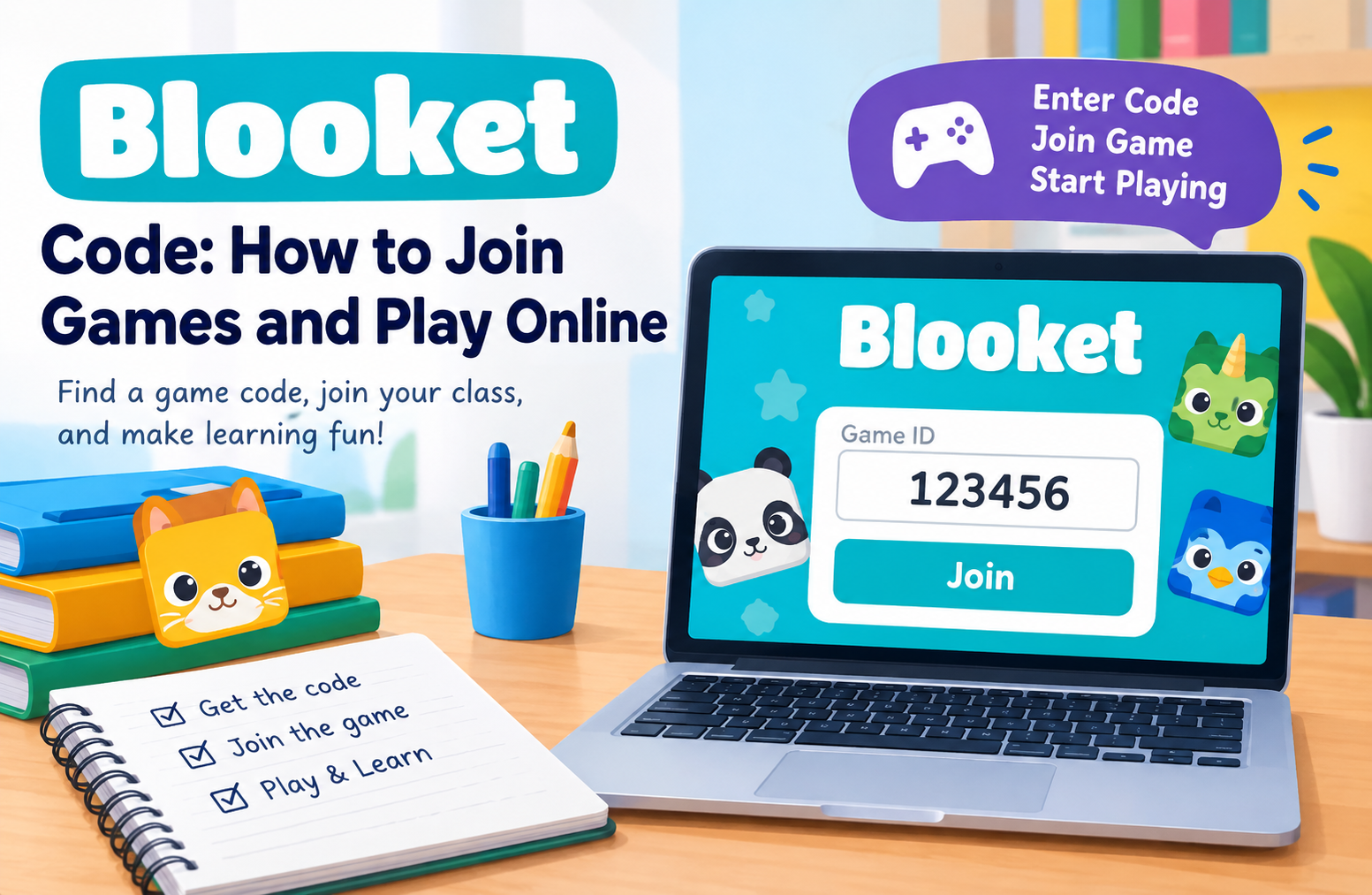
Step 2: Enter the game ID
Your teacher or game host should provide the current session code. Type the digits into the Game ID field.
Check the number carefully before submitting it. A single incorrect digit can prevent you from entering the correct session.
Do not assume that a code shared in an old video, forum post, or social media comment will still work. Game access depends on the status of the specific session.
Step 3: Enter your nickname
Depending on the host’s settings, you may be asked to choose a nickname. Use a name that follows your teacher’s instructions and classroom rules.
Some hosts enable randomly generated player names. In that case, the platform assigns a name instead of allowing players to choose one freely.
For classroom activities, a recognizable nickname can help the teacher identify participants and understand the final results.
Step 4: Choose your Blook
A Blook is a character used within the platform. You may be able to select one while waiting for the game to begin.
This selection adds a personal element to the experience, but it is separate from the educational questions themselves.
Step 5: Wait for the host to start
After joining, remain on the waiting screen until the host begins the session. Entering the correct code does not necessarily mean the game starts immediately.
The teacher may be waiting for other students, checking the participant list, or adjusting the session settings.
If you cannot enter, check the troubleshooting section below before repeatedly submitting the same code.
Where Can You Find a Working Blooket Code?
People searching for a game code often expect to find a public list of numbers that can be used at any time. In practice, live-session codes are different from permanent links to websites or question sets.
A code is useful when it corresponds to an active session that you are allowed to join.
1. Ask your teacher or game host
For a classroom activity, the teacher is usually the most reliable source of joining information.
The host can provide the current code, a QR code, or a direct joining link. These alternatives are particularly useful when students have difficulty typing numbers correctly.
If the game is about to begin, ask the host to display the code clearly or share it through the class’s approved communication system.
2. Check your classroom platform
Teachers sometimes share joining instructions through a learning management system, an online classroom, or a class announcement.
Check the latest message rather than relying on an old screenshot. A new session may use different joining information even when the teacher has selected the same question set.
3. Use a shared joining link
If the host provides a direct link, you can usually open it instead of manually entering the code.
This is convenient for remote lessons because students can follow the link from the classroom platform or message where it was shared.
Always check that the destination is the genuine Blooket website before entering information.
4. Scan the host’s QR code
Some live sessions provide a QR code that students can scan using a compatible device camera.
The QR code serves as another way to reach the joining page or session. It does not make an inactive game available again.
If scanning does not work, ask the host to display the code in a readable format or provide the direct joining link.
5. Understand the limits of public code lists
Websites and social media accounts sometimes advertise collections of active game codes. These claims need to be treated carefully.
There is no reason to assume that a list of numbers is current simply because it is labeled “working,” “active,” or “updated.”
A reliable code must correspond to a real session that is still open. Random numbers cannot be expected to provide access to a teacher’s private classroom activity.
Public lists may also omit essential information, such as when a session was created, who is hosting it, and whether new players are permitted.
The most useful approach is to obtain joining details from the person who organized the game.
Why Do Some Game Codes Stop Working?
One of the most common frustrations is entering a code that appears correct but does not open the expected game.
The problem is not always the student’s device. It may be related to the session itself, the host’s settings, or an error in the code.
Understanding the possible causes makes troubleshooting faster.
The host has ended the game
A live code is associated with a particular session. Once that session ends, the same code should not be expected to work for a future game.
Even if the teacher uses the same quiz again, a newly hosted session may have different joining information.
What to do: Ask the host whether the current game is still running. If it has ended, request the new code when another session becomes available.
The code was entered incorrectly
Typing errors are simple but common, especially when students are joining quickly on small screens.
A digit may be missing, duplicated, or confused with another number. Copying a code from a blurry screenshot can create the same problem.
What to do: Compare the entered code with the host’s current display. Clear the field and enter the code again carefully.
The host has not opened the session
A teacher may have selected a question set without completing the steps needed to start a live session.
In that situation, the quiz exists, but students may not yet have a usable code.
What to do: Wait for the teacher to finish setting up the activity and share the joining information.
Late joining is disabled
Some sessions allow students to enter after gameplay has begun, while others restrict late arrivals.
If you miss the initial joining window, the game may not accept additional participants under the host’s selected settings.
What to do: Ask whether late joining is enabled. If it is not, the teacher may need to arrange another round or provide an alternative activity.
The browser has a temporary problem
An unstable internet connection, outdated browser, blocked script, or temporary website issue can interrupt the joining process.
The symptoms may include a page that does not load, a button that does not respond, or a screen that remains blank.
What to do: Try these steps in order:
- Refresh the joining page.
- Check whether other websites load normally.
- Re-enter the current code.
- Close unnecessary tabs that may be slowing down the device.
- Try a supported, updated browser.
- Ask the teacher whether other students are experiencing the same issue.
If several students have the same problem at the same time, the issue may not be limited to one device.
The session has reached a participation limit
Hosted games can have participation limits determined by the platform and the host’s account or plan. The precise limit should be checked against current platform information rather than assumed from an old tutorial.
A session that has reached its allowed capacity may not accept another player.
What to do: Tell the host that you cannot join. The host can check the session and determine whether another round or a different arrangement is necessary.
Blooket Codes vs. Question Set Links
A frequent source of confusion is the difference between joining a live game and finding a quiz to play.
These are related activities, but they serve different purposes.
| Feature | Live game code | Question set link |
| Main purpose | Enter a hosted session | Open a collection of questions |
| Usually provided by | The live host | A teacher or question-set creator |
| Requires an active live session | Generally, yes | Not necessarily |
| Main use | Participate with other players | Review, explore, or prepare an activity |
| Works as a permanent game invitation | No | It may remain available while the set is accessible |
A question set contains the material used to build an activity. It may cover vocabulary, mathematics, science, history, languages, or another subject.
A live code, by comparison, helps players enter a particular hosted activity.
For example, a teacher might use the same science question set on Monday and Friday. The content could remain unchanged, but each live session would have its own joining process.
This distinction matters because searching for the name of a quiz may help you find the educational material, but it does not automatically connect you to a live classroom.
What Is Blooket and How Does It Work?
Blooket is a web-based educational platform that combines question sets with game-style activities. Teachers can select existing questions or create their own, choose a suitable mode, and host a session for students.
The platform is designed to make practice more interactive. Instead of answering a series of questions on a worksheet alone, learners respond within a game environment that may include competition, goals, rewards, or strategic decisions.
The central educational component remains the question set. Game mechanics determine how players interact with that content.
Question sets
Question sets are collections of questions and answers that form the foundation of activities.
A teacher can search for a set that matches a lesson or create one for a particular class. The quality of these questions has a direct effect on how useful the game becomes.
For example, a vocabulary set with clear definitions and well-designed answer choices may help students review new words. A poorly prepared set containing ambiguous questions can create confusion, even if the game itself is entertaining.
Game modes
Different modes introduce different objectives and gameplay mechanics. Depending on the available options, students may answer questions while racing, collecting resources, defending a structure, or competing against other players.
The choice of mode should support the learning goal rather than distract from it.
A fast-paced activity may suit a short review session. A mode involving more decisions may work better when the teacher has time to explain the rules and discuss the results afterward.
Availability can change, so teachers should consult the platform when planning a particular activity.
Player characters
Blooks are the characters used in the Blooket experience. They give players a way to personalize their participation.
For many students, collecting or selecting characters adds enjoyment. However, the educational value comes from answering questions, practicing skills, and reviewing mistakes, not simply from collecting characters.
Teachers can keep the focus on learning by explaining the purpose of the activity before gameplay begins.
Results and feedback
Depending on the activity and reporting options, teachers may review performance information after a session.
This can help identify questions that students found difficult and topics that need additional instruction.
A score should not be treated as a complete measure of understanding. Some players answer correctly because they know the material, while others may benefit from guessing, repeated exposure, or luck within the game mechanics.
The best results come from combining game performance with discussion, independent practice, and other forms of assessment.
Benefits of Using Blooket for Learning
Interactive quizzes can offer several practical benefits when they are used with a clear educational purpose.
The important point is not that every game automatically improves learning. Rather, a well-designed activity can create useful opportunities for practice, feedback, and participation.
1. More engaging revision
Traditional revision often involves reading notes, completing worksheets, or answering questions individually.
A game can introduce variety into that routine. Students may be more willing to participate when questions are part of an activity with a clear objective and immediate progress.
This can be especially useful for short revision sessions before a test.
However, engagement is not the same as mastery. A student can enjoy a game without remembering the material afterward, so teachers should include a review stage.
2. Repeated practice
Students often need to encounter information more than once before they can recall it confidently.
Question-based activities create opportunities to revisit definitions, facts, formulas, and concepts.
For example, a language teacher might use a question set to review irregular verbs. After the game, students could write their own sentences using the same verbs to check whether they can apply the knowledge independently.
The second step turns recognition into more meaningful practice.
3. Immediate opportunities to notice mistakes
When a student selects an incorrect answer, the question can reveal a misunderstanding that might otherwise remain hidden.
Teachers can use these moments to explain the correct answer and identify common errors.
Suppose many students confuse two mathematical formulas. A game can expose the pattern quickly, allowing the teacher to pause and explain the difference.
This is more useful than simply celebrating the highest score and moving on.
4. Flexible subject coverage
The platform can be used with many types of questions, including:
- Vocabulary and spelling
- Mathematics facts and concepts
- Science terminology
- Historical dates and events
- Geography and place names
- Language grammar
- Reading comprehension
- General knowledge
The effectiveness depends on the quality and suitability of the questions, not just the subject label.
5. Participation in a shared activity
A hosted game gives a class a common activity with a clear beginning and end.
This can help teachers organize a lesson and encourage participation from students who may be less interested in ordinary revision exercises.
Nevertheless, competition can make some learners uncomfortable. Teachers should avoid treating a game leaderboard as a complete picture of ability or effort.
6. A useful change of pace
A short quiz game can break up a longer lesson and provide a different way to revisit earlier material.
The activity should fit naturally into the lesson rather than replace explanation, discussion, or deeper practice.
For instance, a teacher might begin with direct instruction, run a short game to review the main ideas, and finish with an independent question that requires students to explain their reasoning.
That sequence gives the game a clear role within the lesson.
Challenges and Limitations to Understand
Although the platform offers useful features, teachers and students should understand its limitations.
Competition can distract from learning
Some students become focused on finishing first or earning a high score. They may guess quickly rather than read each question carefully.
A teacher can reduce this problem by emphasizing accuracy, asking students to explain selected answers, and discussing difficult questions after the session.
Game results do not tell the whole story
A leaderboard shows performance within a particular activity. It does not necessarily reveal whether a student can explain a concept, solve a new problem, or remember the material a week later.
Teachers should use the results as one source of information rather than as the sole basis for judging understanding.
Devices and connectivity can create barriers
Not every student has the same device, internet speed, or access to an unrestricted browser.
A student may know the answers but struggle to participate because a page loads slowly or the device responds poorly.
Whenever possible, teachers should have an alternative way for students to complete the learning task. This ensures that technical access does not become confused with academic ability.
Question quality matters
A game built around weak questions may produce little educational value.
Questions should be accurate, age-appropriate, and connected to the lesson. Answer choices should be clear enough to test knowledge rather than trick students through confusing wording.
Teachers should review a question set before using it, especially when it was created by another user.
Time management is important
Game activities can take longer than expected when students need help joining, the host explains the rules, or the class discusses results.
Teachers can reduce delays by testing the joining process, choosing the mode in advance, and explaining expectations before sharing the code.
A brief, purposeful activity is often more effective than a long session that leaves little time for reflection.
How Teachers Can Host a Blooket Game
Teachers who want students to join with a code need to prepare the activity before sharing the joining information.
A little preparation can prevent delays and make the session more useful.
Step 1: Choose or create a question set
Start by identifying the learning objective.
Ask what students should know or be able to do by the end of the activity. The answer will help determine which questions belong in the set.
For example:
- A mathematics review might focus on multiplication, fractions, or equations.
- A science activity might cover vocabulary, processes, or key concepts.
- An English lesson might review punctuation, verb tenses, or word meanings.
- A history quiz might test dates, people, and the causes of major events.
Choose questions that match the students’ current level. If every question is too easy, the game offers little challenge. If the questions are too difficult, students may become frustrated or rely on guessing.
Step 2: Select an appropriate game mode
Different modes suit different classroom situations.
Consider the time available, the complexity of the lesson, and how comfortable students are with competitive activities.
For a quick revision session, choose a mode that students can understand without a long explanation. For a more involved activity, allow enough time to explain the rules before gameplay begins.
The mode should support the learning objective instead of becoming the main objective itself.
Step 3: Configure the session
Review the available host settings before launching the activity.
Depending on the options provided, you may be able to adjust the time or goal, control nickname generation, and decide whether late arrivals can join.
These choices influence how smoothly the session runs.
For example, automatically generated nicknames can help when a teacher wants to limit inappropriate names. Allowing late joining can help students who experience a brief connection problem, although it may not be suitable for every game.
Step 4: Start the session and share the code
Once the host launches the game, share the displayed joining information with students.
You can provide the code, a QR code, or a direct joining link, depending on the available options.
Give students enough time to enter. Check that the expected participants appear in the lobby before starting the activity.
If someone cannot join, confirm that they have the correct code and that the session remains open.
Step 5: Review the learning afterward
The session should not end educationally when the game finishes.
Use the activity as a starting point for a short review. Ask which questions were difficult, explain common errors, and invite students to describe how they reached an answer.
You can also use missed questions to plan a follow-up exercise.
This final stage is important because the real purpose is to improve understanding, not merely to complete a game.
Practical Ways Students Can Get More Value From the Platform
Students can also take steps to make their participation more useful.
Read every question carefully
It can be tempting to answer as quickly as possible, particularly when the game includes a timer.
However, speed without accuracy may reinforce mistakes. Read the entire question and consider the available answers before choosing.
If the question is unfamiliar, use the result as an opportunity to identify something you need to review.
Treat incorrect answers as feedback
Getting a question wrong is not necessarily a failure. It can show you exactly where your understanding needs work.
After the activity, revisit difficult questions and explain the correct answers in your own words.
If you are studying vocabulary, create example sentences. If you are studying mathematics, solve a similar problem without looking at the answer. If you are reviewing science, explain the concept to another person.
These steps help turn a short game into a more complete learning experience.
Follow the classroom rules
Use an appropriate nickname, avoid disrupting other players, and follow the host’s instructions.
Do not attempt to enter a private classroom session without permission. A joining code is intended to connect participants to a particular activity, not to provide unrestricted access to someone else’s lesson.
If you accidentally leave the game, ask the host whether you can rejoin rather than repeatedly trying unrelated codes.
Review the topic after playing
A strong study routine combines different methods.
After the game, spend a few minutes reviewing the questions you found difficult. Then test yourself again without the game interface.
If you can explain the answer and apply it to a new example, you have stronger evidence of understanding than a high score alone provides.
Privacy and Online Safety When Using Game Codes
Because students may use the platform in classrooms and other shared environments, privacy should be part of the joining process.
A few simple precautions can make participation safer.
Use the official website. Enter joining information through the genuine platform rather than an unfamiliar website claiming to provide special access.
Avoid unnecessary personal details. A classroom nickname should follow the teacher’s instructions without revealing sensitive information such as a home address, password, or private contact details.
Do not share private session information publicly. If a teacher gives a code for a specific class, treat it as classroom joining information rather than posting it on unrelated public forums.
Be cautious with third-party downloads. A normal joining process should not require you to install an unknown file or browser extension. Leave suspicious pages rather than providing information they do not need.
Follow school policies. Teachers and students should follow applicable school rules, account requirements, and age-related restrictions.
According to Blooket’s published student guidance, a student account is not required to join a standard live game. An account may be needed for additional account-based features. Requirements for creating accounts are different from requirements for entering a hosted session, so students should follow the platform’s current instructions.
Privacy also matters when teachers review performance. Game results can help guide instruction, but they should be handled appropriately and should not be used to embarrass students who need additional support.
Can You Play Without a Live Joining Code?
Yes, Blooket offers ways to use question sets without entering a live classroom session.
The available method depends on whether the activity is a homework assignment or an independent solo game.
Homework assignments
A teacher may assign an activity that students complete independently. In that case, students typically use the homework link or other joining instructions provided by the teacher rather than relying on a live-session code.
The assignment can be completed according to the teacher’s settings and deadline.
This option is useful when students are working at different times or when the teacher wants them to practice outside the classroom.
Solo games
Students can also explore question sets and use supported solo modes where available.
This can be helpful for independent revision because learners can practice at their own pace without waiting for a host to start a live session.
To get started, find an accessible question set, open it, select the available solo option, and choose a suitable game mode.
The exact options may vary according to the set and the platform’s current features.
Which method should you choose?
Choose a live game when the teacher wants the class to participate together. Use a homework assignment when an activity needs to be completed independently. Consider solo play when you want to review a topic on your own.
The best method depends on the purpose of the exercise, not simply on which option is easiest to access.
How to Use the Official Help Resources
If you have checked the code, refreshed the page, and confirmed that the host is still running the game, the next step is to consult the platform’s own instructions.
Blooket maintains guidance explaining how players join hosted games, use alternative joining methods, and follow the host’s settings.
The official help material is more reliable than an old third-party post because it comes from the service responsible for the joining process.
When reading help instructions, check whether they refer to the same type of activity you are trying to access. Live sessions, homework assignments, and independent games do not necessarily use identical steps.
If the problem continues, explain the issue to the host and describe what appears on your screen. Mention whether the page loads, whether the code is accepted, and whether an error message appears. Specific information makes troubleshooting more efficient.
Common Mistakes to Avoid
A few recurring mistakes can make joining more difficult than it needs to be.
- Using an old code: A previously valid session code may no longer be active.
- Opening the wrong website: Use the official joining page instead of a site that merely discusses the platform.
- Confusing a quiz with a live session: A question set does not automatically provide access to an ongoing hosted game.
- Ignoring the host’s instructions: Nickname rules and late-joining settings can affect participation.
- Assuming every error is a device problem: The session may have ended, reached a limit, or stopped accepting players.
- Installing unnecessary software: Standard browser-based participation should not require downloading an unfamiliar program.
- Focusing only on scores: Reviewing mistakes is an important part of learning.
- Sharing private information: Keep personal details and classroom access information appropriately protected.
The simplest approach is to obtain the current joining details from the host, use the official website, and check the session status before attempting more complicated fixes.
Frequently Asked Questions
1. What is a Blooket code?
A Blooket code is a session ID used to join a live hosted game. Players enter the code on the official joining page or use another joining method provided by the host.
2. How do I join a game with a Blooket code?
Open the official Blooket joining page, enter the current code supplied by the host, and follow the on-screen instructions. You may need to enter a nickname and select a character before the game begins.
3. Can I join without creating an account?
Yes. According to Blooket’s official student guidance, an account is not required to join a standard live game. An account may be necessary for certain additional features.
4. Why is my game code not working?
The code may have been entered incorrectly, the host may have ended the session, or the game may no longer accept new players. Recheck the code and ask the host whether the session is still available.
5. Can I find working game codes online?
You may encounter codes posted online, but their availability cannot be assumed. A live code is tied to a particular session and may stop working when that session ends. The host is the most reliable source of current joining information.
6. Can I play without a live game code?
Yes. Depending on the available options, you can complete a teacher-assigned homework activity or play a supported solo game using an accessible question set. These activities follow a different process from joining a live session.
Conclusion
A blooket code provides a simple way to join an active educational game, making it easier for students to participate in interactive classroom activities. The process usually involves opening the official joining page, entering the current code, choosing a nickname when required, and waiting for the host to begin.
The most important thing to remember is that a live-session code is not a permanent invitation. If a code fails, check for typing mistakes, confirm that the host has not ended the session, and ask whether late joining is permitted. Using the official website and following the host’s instructions can prevent many common problems.
Beyond joining games, Blooket can support revision, classroom participation, and independent practice. Its educational value depends on the quality of the questions, the suitability of the game mode, and the time spent reviewing mistakes afterward. When used thoughtfully, interactive quizzes can complement traditional teaching methods and make practice more engaging without replacing deeper learning.