KZ43X9NNJM65: Meaning, Uses, Safety, and Digital Context
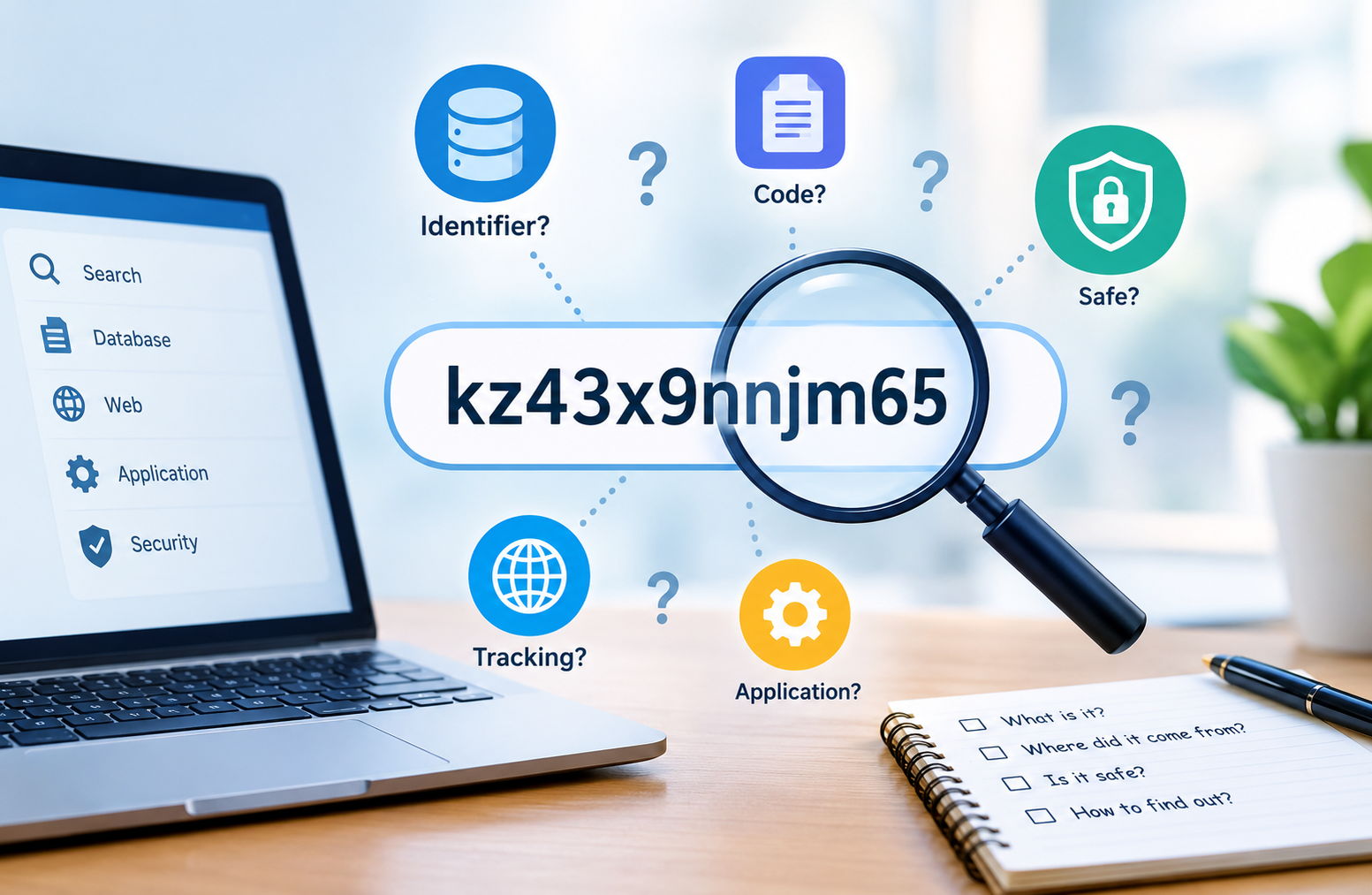
The term kz43x9nnjm65 may look like a random combination of letters and numbers, but its unusual format raises several reasonable questions. Is it a digital identifier, a software reference, a tracking code, or something else entirely? Understanding its possible purpose requires looking beyond the characters themselves and examining how similar strings work in modern digital systems. Although the exact origin and function of this particular sequence have not been independently verified, its structure provides a useful starting point for understanding alphanumeric identifiers, their practical applications, and the precautions users should take when encountering unfamiliar codes online.
This guide explains what the string may represent, how similar codes are used in real-world environments, how to investigate its origin, and how to distinguish an ordinary technical reference from a potentially suspicious link or message. Rather than assigning an unsupported meaning to an unfamiliar sequence, the goal is to establish what can reasonably be concluded, what remains uncertain, and which steps can help you find reliable answers.
What Is KZ43X9NNJM65?
The string kz43x9nnjm65 is a 12-character alphanumeric sequence containing lowercase letters and numbers. It does not appear to be an ordinary English word, a recognizable product name, or a widely established technical term with an independently confirmed definition.
Its format resembles identifiers commonly used by websites, software applications, databases, testing environments, and digital services. These systems frequently generate compact strings to distinguish one record, request, session, or resource from another.
However, resemblance alone does not establish purpose. Without information about the system that created this particular sequence, it would be inaccurate to claim that it belongs to a specific application, company, database, or security system.
Understanding the Structure
The sequence contains letters and digits arranged without an obvious linguistic pattern. This structure is common in technical identifiers because software does not always need descriptive names to distinguish individual objects.
For example, a database might assign a record an identifier such as ab27cd91. Another system might use a longer value to reference a transaction or temporary operation.
These examples illustrate a general principle: an identifier can be useful without being meaningful to a human reader.
Several characteristics of the target string are directly observable:
- Character type: It combines lowercase letters and digits.
- Length: It contains 12 characters.
- Readability: It does not communicate an obvious meaning in ordinary English.
- Context dependence: Its intended purpose cannot be determined from the characters alone.
- Potential applications: It resembles formats used for record references, internal labels, testing values, and other software-generated strings.
One important distinction is that an alphanumeric sequence is not automatically random, encrypted, unique, or secure. Those properties depend on how the value was generated and how the system uses it.
Is It a Word, Code, or Identifier?
These categories can overlap, but they describe different things.
A word generally communicates meaning through a language. A code may represent a category, instruction, reference, or other value according to an established system. An identifier distinguishes one object or record from another.
The sequence could serve as an identifier if a particular platform assigns that function to it. It could also be a manually created label, a test value, a shortened reference, or an arbitrary string.
At present, there is insufficient verified evidence to identify it conclusively as any one of these.
The most accurate interpretation is therefore straightforward: kz43x9nnjm65 is an identifiable alphanumeric string whose specific purpose depends on the context in which it appears.
Why Are People Searching for KZ43X9NNJM65?
Unfamiliar technical strings often attract attention because they appear meaningful without explaining themselves. A person might encounter one in a browser address, an application notification, a copied message, a website article, or a technical log.
When the surrounding information is missing, searching for the exact sequence becomes a natural way to investigate it.
Several situations can explain this kind of search behavior.
1. An Unexpected Code Appears Online
A user may notice the sequence while browsing a website or opening a shared link. Because it does not resemble normal text, the user may wonder whether it identifies a page, a product, or a particular online service.
The first step is to inspect the surrounding information. A string appearing after a descriptive URL path may serve a different purpose from one included in an error message or account notification.
2. A Website or Application Displays a Reference
Applications sometimes expose internal values when displaying errors, processing requests, or retrieving records. These values may help technical support teams locate a specific event.
For example, an error message might contain a reference number that allows a support agent to search application logs. The reference does not necessarily explain the cause of the problem, but it can help locate the relevant event.
This is a plausible explanation for an unfamiliar alphanumeric sequence, not a verified account of where this particular string originated.
3. A Message Creates Uncertainty
An unexpected code in an email or text message may lead someone to question whether the message is genuine.
In this situation, the message’s source and requested action matter more than the appearance of the code. A reference value does not prove that a message is legitimate, and an unusual sequence does not prove that it is malicious.
Users should evaluate the sender, destination website, message content, and requested information before taking action.
4. Search Results Provide Conflicting Explanations
Different websites may describe an unfamiliar string as a unique identifier, a tracking value, a technology concept, or a security-related code.
Such descriptions are not necessarily independent confirmation. Several pages may repeat the same assumption without providing documentation from the organization or system responsible for the string.
A reliable investigation separates three things:
- What the characters visibly contain.
- What general technical practices make possible.
- What credible evidence establishes about this exact value.
This distinction is essential when researching obscure digital terms.
How Alphanumeric Identifiers Work in Digital Systems
To understand the possible role of an unfamiliar string, it helps to examine the wider technology behind identifiers.
Digital systems process enormous numbers of records, requests, files, and interactions. They need dependable ways to refer to individual items without relying exclusively on descriptive names.
A customer support system, for instance, might store thousands of requests about similar problems. A unique ticket reference helps staff retrieve the correct conversation without searching only by the customer’s description.
The same general idea applies to inventory systems, web applications, analytics platforms, and software development tools.
Database Record Identification
Databases store information in organized structures. Each record often has a primary key or another reference value that distinguishes it from other records.
Consider a simple inventory database containing three products:
| Product | Internal identifier |
| Wireless keyboard | ITEM-104 |
| Computer mouse | ITEM-105 |
| USB hub | ITEM-106 |
The identifiers do not describe every product feature. Their main purpose is to let the system refer to the correct record.
A different database might use letters and numbers instead of descriptive prefixes. The format depends on the system’s design requirements.
A string such as kz43x9nnjm65 could theoretically serve as a record reference in a system that assigns it that meaning. However, no particular database association can be confirmed from its appearance alone.
Web Addresses and Resource References
Web applications frequently include identifiers in URLs.
For example, a fictional website might use:
example.com/orders/AB120045
The final segment could identify a particular order. When the application receives the request, its backend can use the reference to locate the relevant information.
Other URLs contain campaign parameters, content slugs, temporary values, or tracking references. Their meanings depend on the website’s implementation.
If you encounter an unfamiliar sequence in a URL, examine the full address rather than interpreting the string in isolation. The domain, path, query parameters, and surrounding page can provide useful clues.
Do not assume that a URL is trustworthy simply because it contains a reference that looks technical.
Session Management
Websites often need to distinguish one browsing session from another. Session identifiers help servers associate requests with the appropriate session state.
Depending on the application, session state may relate to a signed-in account, a shopping cart, or other temporary information.
Session identifiers require careful protection because some can function as bearer credentials. Anyone who obtains a valid session token may be able to impersonate a session if the system lacks appropriate safeguards.
This does not mean that the sequence discussed in this article is a session token. There is no verified evidence establishing that function.
For a practical technical reference, the OWASP Session Management Cheat Sheet explains how applications should generate, transmit, protect, and manage session identifiers.
Software Testing and Development
Developers frequently create temporary values for testing features, checking database operations, reproducing bugs, or distinguishing experimental records.
A test environment might contain synthetic usernames, placeholder order numbers, sample event identifiers, or generated strings.
These values may resemble production identifiers even when they have no relationship to real customers or live systems.
A sequence found in a development log could therefore be a test artifact rather than a reference to a deployed feature. The surrounding repository, configuration, test data, and documentation would be needed to determine its role.
Logging and Error Tracking
When software encounters an unexpected condition, it may generate an error reference or correlation identifier.
A correlation identifier can help engineers connect related events across different services. For example, a request passing through an application server and a payment service may be easier to investigate when both systems record a shared reference.
This is particularly useful in systems that process many requests simultaneously.
However, a reference number alone does not reveal the cause of an error. Investigators need supporting evidence such as timestamps, log entries, request details, and the system’s documented behavior.
Potential Uses of KZ43X9NNJM65
The exact function of this sequence remains unverified, but several established technical practices help explain what a string with this structure could represent.
It is important to treat these as possible uses of similar strings, not confirmed capabilities of the specific sequence.
1. Identifying a Digital Record
A system could assign an alphanumeric value to a customer record, document, product, transaction, or support request.
This approach can reduce confusion when different records share similar descriptions.
A useful identifier should be generated and managed according to the system’s requirements. For example, a business might need predictable references for internal workflows, while a public-facing resource may benefit from opaque identifiers that reveal less information about internal records.
2. Referencing a Request or Event
Applications sometimes attach identifiers to requests or events so that developers can locate related information later.
This can help investigate failed operations, delayed responses, or unexpected application behavior.
If the sequence appeared alongside a timestamp or error description, the technical team responsible for that system might be able to determine whether it corresponds to a logged event.
Without access to the relevant logs or documentation, its meaning remains uncertain.
3. Organizing Files and Digital Assets
File management systems may assign identifiers to uploaded documents, media assets, or stored objects.
An identifier can remain stable even when a file’s displayed title changes. This makes it useful when multiple users upload files with similar names.
For example, two documents named report.pdf could receive different internal references. The reference helps the application distinguish the underlying objects.
Again, the same principle applies generally. It does not establish that the target string identifies a particular file.
4. Supporting Development Workflows
Development teams may use generated strings to test database lookups, API responses, caching behavior, and record creation.
A test value can help engineers verify whether a system handles unusual input correctly.
If a developer discovers the sequence inside a source repository, searching for exact occurrences may reveal the relevant function, configuration entry, or test case.
The meaning should be established from the surrounding code rather than inferred from the value’s format.
5. Representing a Marketing or Analytics Reference
Analytics tools can use identifiers to associate activity with campaigns, events, or content.
For example, a tracking parameter may indicate which campaign directed a visitor to a page. Some systems use readable labels, while others rely on compact values.
A random-looking sequence in a URL may therefore be an internal analytics reference, but that conclusion requires evidence from the site’s URL structure or documentation.
6. Acting as a Temporary Reference
Some applications generate temporary identifiers when users initiate a process. The value may help connect steps in a workflow or retrieve a pending operation.
Temporary references can have expiration rules or limited permissions, depending on their design.
It is important to distinguish a harmless reference from a sensitive access token. Some values merely identify a record, while others authorize access to it.
The appearance of letters and numbers does not tell you which category applies.
Benefits of Well-Designed Alphanumeric Identifiers
When implemented appropriately, identifiers provide practical advantages to organizations, developers, and everyday users.
Better Record Organization
A stable identifier allows software to retrieve a specific record without depending on a descriptive title.
This is especially useful when names change, records contain similar information, or multiple departments share data.
For example, changing a product’s display name does not necessarily require changing its internal identifier.
Fewer Accidental Conflicts
Systems must avoid assigning the same identifier to unrelated records when uniqueness is required.
Generated identifiers can reduce accidental duplication when their design and allocation process are appropriate for the scale of the application.
The level of collision risk depends on the generation method, identifier length, character set, and number of values produced.
A short, predictable sequence does not automatically provide strong uniqueness guarantees.
Easier Troubleshooting
An identifier recorded in an error message can help technical support locate the relevant event.
Instead of asking a user to describe every detail of a failed request, a support team may be able to search for the associated reference.
This is particularly useful when the system processes many requests or when the same issue affects multiple components.
Improved Integration Between Systems
Different software services often need to exchange information.
Shared identifiers can help connect related records without requiring every service to store all the same information.
For example, an order management service and a delivery service might use a common order reference to coordinate updates.
Good integration also requires clear ownership, appropriate permissions, and consistent handling of identifiers across systems.
More Flexible Internal Design
An opaque identifier does not need to change whenever a record’s descriptive information changes.
This can make software maintenance easier and reduce unnecessary dependencies between the record’s identity and its visible name.
However, opaque values also make manual troubleshooting harder when documentation and search tools are inadequate. The right design balances technical reliability with operational usability.
Limitations and Challenges
Alphanumeric identifiers are useful, but their benefits depend on thoughtful implementation.
An Identifier May Be Difficult to Interpret
A value without descriptive meaning can be confusing to users and support staff.
When a code appears without an explanation, people may not know whether they should save it, enter it into a website, share it with support, or ignore it.
Systems should provide meaningful labels and instructions wherever users need to interact with identifiers.
Duplicate Values Can Still Occur
A random-looking identifier is not automatically unique.
Depending on the generation method, two independently generated values may collide. Poorly designed systems may also introduce duplicates through faulty allocation logic or data migration errors.
Organizations should select an identifier strategy that matches their requirements and enforce uniqueness where necessary.
Exposure Can Create Security Risks
Some identifiers are safe to display publicly. Others reveal internal information or provide access to protected resources.
The distinction is critical.
A record number should not be treated as an authorization mechanism unless the system has been deliberately designed and secured around that approach. Access controls should verify permissions independently.
Likewise, sensitive session tokens and temporary access credentials should not be exposed in public logs, screenshots, or shared URLs.
Codes Can Be Used in Misleading Messages
Scammers sometimes include technical-looking references in emails, text messages, or fake notifications to make their claims appear legitimate.
A message might contain a reference number and claim that an account will be suspended unless the recipient follows a link.
The reference itself provides no proof that the message came from a legitimate organization.
Users should verify unexpected account warnings through the organization’s official website or application rather than relying on the supplied link.
Poor Documentation Makes Investigation Difficult
An internal identifier is only useful when authorized users can connect it to the correct system or record.
If documentation does not explain how references are generated, where they are stored, or how they should be searched, troubleshooting becomes slower.
Technical teams should document the purpose of important identifiers and explain which values are safe to share.
Is KZ43X9NNJM65 Safe?
The string alone is not enough to determine whether the situation in which it appears is safe.
An alphanumeric sequence is simply a collection of characters. It does not independently prove that a device is infected, an account is compromised, or a website is legitimate.
The surrounding circumstances provide the important evidence.
When It May Be Harmless
The sequence may be an ordinary technical reference if it appears in a known application’s diagnostic log, a documented testing environment, or an expected transaction record.
Even then, users should consider whether the value contains sensitive information before sharing it publicly.
When You Should Be Cautious
Investigate further if the code appears alongside any of the following:
- An unexpected message requesting a password or verification code.
- A link to a domain that differs from the organization’s official domain.
- A demand for payment, cryptocurrency, or personal information.
- A claim that your device is infected without evidence.
- An unsolicited download or browser redirect.
- A request to disable security software or grant remote access.
- A threat of immediate account closure intended to pressure you into acting.
None of these warning signs proves that the sequence itself is malicious. They indicate that the surrounding interaction deserves closer examination.
What If the Code Appears in a Suspicious Link?
Do not click the link merely to discover what the sequence means.
Instead, follow these steps:
- Inspect the sender and the complete destination address without opening the link.
- Check whether the domain matches the official website you normally use.
- Open the organization’s website independently by typing its known address or using its official application.
- Check account notifications through that trusted channel.
- If the message concerns an important account, contact the organization’s verified support team.
- If you already entered credentials on a suspicious page, change the affected password through the legitimate website and review available account security settings.
If a link contains a sensitive token, avoid posting the complete URL in public forums. Sharing it could expose access to a resource or reveal private information.
How to Investigate the Origin of KZ43X9NNJM65
The most reliable way to determine what a particular identifier means is to trace it back to the system that produced it.
The following process is useful for ordinary users, website administrators, and developers.
Step 1: Record Where You Found It
Begin by noting the location in which the sequence appeared.
Was it displayed in a browser address bar, included in an email, printed on a document, shown in an application, or recorded in a software log?
Also record the approximate time, the surrounding text, and the action that occurred immediately before it appeared.
Avoid collecting unnecessary personal information. If you take a screenshot, remove account details, private messages, and other sensitive data before sharing it.
Step 2: Identify the Source
Determine which website, application, organization, or device produced the information.
If the source is an email, inspect the sender and message context. If it is a website, note the domain. If it is an application, identify the application and the screen where the value appeared.
The source often provides more useful evidence than the string itself.
Step 3: Search for the Exact Value in Authorized Systems
If you manage the relevant software or database, search for the exact sequence in appropriate locations.
Possible places include:
- Application logs.
- Source code repositories.
- Database records.
- Configuration files.
- Test fixtures and sample data.
- Error tracking systems.
- Internal documentation.
Use only systems and records you are authorized to access.
For a developer, searching the repository for the exact string may reveal whether it is a hardcoded constant, a test value, or a reference generated elsewhere.
For an ordinary user, the equivalent step is to search the original message or application documentation rather than guessing at the code’s meaning.
Step 4: Examine Nearby Information
A matching search result is useful only if its context is relevant.
For example, a code appearing in a test file may have a different purpose from the same code appearing in a live request log.
Look for associated timestamps, record types, function names, error descriptions, and documented workflows.
Do not conclude that two occurrences refer to the same event merely because their characters match.
Step 5: Check the Generation Method
If the value belongs to a system you administer, inspect the code or documentation that generates it.
Determine whether it is produced by a random number generator, a database sequence, a hash, a UUID-related process, or a custom algorithm.
These methods have different properties. A hash, for example, is not necessarily a random identifier, and a random-looking value is not necessarily cryptographically secure.
The generation method helps establish whether the system’s claims about uniqueness or security are justified.
Step 6: Verify the Explanation
Prefer evidence from the responsible application’s official documentation, its source code, or an authorized technical support team.
An online article that merely describes the string as a digital identifier does not establish that interpretation as fact.
If no authoritative evidence exists, record the finding as unresolved rather than inventing a definite explanation.
Step 7: Take Action Based on the Evidence
The appropriate response depends on the source and function.
A harmless diagnostic reference may simply need to be recorded for support. A duplicate database key may require investigation by a developer. An exposed session credential may need immediate revocation.
Avoid taking disruptive action based solely on the appearance of an unfamiliar string.
How Developers Should Handle Similar Identifiers
Developers working with generated strings should consider several practical design principles.
Choose an Appropriate Identifier Strategy
Different systems require different approaches.
A relational database may use an integer key, a UUID, or another stable identifier. A public resource may use an opaque value. A temporary authentication workflow may require a securely generated, short-lived token.
The design should reflect the intended purpose rather than choosing a format simply because it looks complex.
Separate Identification From Authorization
Knowing an object’s identifier should not automatically grant permission to access it.
Applications should check the authenticated user’s permissions whenever protected records are requested. This helps prevent unauthorized access even when a record reference becomes known.
Avoid Exposing Sensitive Values in Logs
Logs can be copied into support tickets, monitoring dashboards, and external diagnostic tools.
Before recording an identifier, determine whether it contains a credential or could provide access to a protected resource.
Sensitive tokens should generally be excluded, masked, or handled through a carefully designed logging process.
Document Important References
A useful technical reference should explain:
- What object or event it identifies.
- Which system generates it.
- Whether it is permanent or temporary.
- Whether it contains sensitive information.
- Where authorized staff can look it up.
- What to do when it is missing, duplicated, or invalid.
This documentation helps developers and support teams work efficiently without relying on assumptions.
Test for Failure Cases
Identifier handling should be tested for duplicate values, missing references, invalid characters, unexpected input, and incorrect permissions.
Applications should also handle malformed identifiers without exposing internal system details to unauthorized users.
These practices are more important than whether an identifier looks sophisticated.
Common Misconceptions About KZ43X9NNJM65
Unfamiliar strings often encourage speculation. Several assumptions should be avoided.
Misconception 1: It Must Be an Encrypted Message
Not necessarily. Encryption transforms information according to a cryptographic process, while an identifier may simply label a record.
The character sequence alone does not reveal whether encryption has been used.
Misconception 2: It Is Automatically a Password
A password is a credential used to authenticate a user or process. An alphanumeric string could be used as a password, but its appearance does not establish that role.
Do not enter the sequence into login forms or other fields unless a trusted service explicitly requires it and the request is legitimate.
Misconception 3: It Proves a Device Has Been Hacked
There is no basis for drawing that conclusion from the string alone.
Security investigations require evidence such as suspicious account activity, unauthorized changes, malicious processes, or confirmed security alerts.
Misconception 4: Every Occurrence Has the Same Meaning
The same sequence can appear independently in different contexts. It might be copied into a document, reused in a test, or generated by an unrelated system.
A match between two strings does not automatically establish a shared origin.
Misconception 5: A Random-Looking Code Is Secure
Complex appearance is not a substitute for sound security design.
A secure token requires appropriate generation, sufficient unpredictability, correct storage, suitable expiration rules when applicable, and careful access control.
The system’s implementation determines these properties.
The Difference Between an Identifier, a Token, and a Hash
These terms are often used interchangeably in casual discussions, but their technical meanings differ.
| Term | Primary purpose | Important distinction |
| Identifier | Distinguishes a record, object, or event | May be public or private |
| Access token | Represents authorization or delegated access | May grant access to protected resources |
| Session identifier | Connects requests to a session | Can be sensitive if possession enables session access |
| Hash | Produces a fixed-length digest from input data | Is generally used for integrity checks, indexing, or related purposes, depending on the algorithm |
| Password | Helps authenticate a user or process | Must be handled using appropriate credential security practices |
| Tracking parameter | Associates activity with a campaign or event | May be used for analytics or attribution |
A single string format can resemble several of these categories. The correct classification depends on the implementation and the role assigned to the value.
For this reason, the target sequence should not be described as a password, access token, encrypted message, or tracking code without supporting evidence.
Real-World Example: Investigating an Unknown Reference
Imagine that a website displays the following message:
“Your request could not be completed. Reference: kz43x9nnjm65.”
The user wants to understand what happened.
The reference could help the website’s support team locate a failed request, but the message alone does not explain the underlying problem.
A sensible investigation would proceed as follows:
- Confirm that the message appeared on the expected website.
- Record the error text and approximate time.
- Check whether the action can be repeated safely.
- Search the website’s official help documentation for the error.
- Contact verified support and provide the reference if requested.
- Avoid sharing passwords, authentication codes, or unnecessary private information.
Now consider a different situation: the same sequence appears in an unexpected email asking the recipient to log in immediately.
The appropriate response changes. The user should independently verify the account status rather than trust the email’s link.
These examples show why context is more valuable than speculation. The same format can appear in situations requiring very different responses.
What Information Would Confirm Its Meaning?
A definitive explanation would require evidence that connects the sequence to a specific source.
Useful evidence could include:
- Official documentation naming the sequence.
- A system record showing the value and its assigned purpose.
- Source code that generates or consumes it.
- An authenticated support response from the responsible organization.
- A verified technical specification describing the relevant identifier format.
Evidence should directly support the proposed explanation.
For example, finding the string in an application’s session-management code might support the conclusion that the application uses it as a session reference. Finding it only in an unrelated article would not provide the same level of confirmation.
If the sequence cannot be traced to an authoritative source, its exact meaning should remain open.
This is not a failure to investigate. It is a necessary distinction between a plausible interpretation and a verified fact.
Best Practices for Everyday Users
You do not need advanced technical knowledge to handle unfamiliar digital codes responsibly.
Follow these practical guidelines:
- Check the source first. Identify the website, application, or sender associated with the sequence.
- Avoid assumptions. Do not infer that the string is dangerous or trustworthy based on its appearance.
- Protect sensitive information. Treat unexpected codes as potentially private until their purpose is known.
- Verify unexpected requests independently. Use official websites and applications instead of untrusted message links.
- Keep useful context. Record the error message, timestamp, and application involved when seeking support.
- Share selectively. Provide reference values to authorized support staff when needed, but avoid posting complete sensitive URLs or credentials publicly.
- Seek authoritative confirmation. Prefer documentation from the system responsible for the value.
These steps provide a practical way to investigate unfamiliar strings without creating unnecessary security risks.
Frequently Asked Questions
1. What does kz43x9nnjm65 mean?
Its exact meaning has not been independently verified. The string resembles an alphanumeric identifier, but its purpose depends on the system that created or uses it.
2. Is kz43x9nnjm65 a real technology?
There is insufficient verified evidence to identify it as a specific technology, software product, or established technical framework. Its format is consistent with strings commonly used in digital systems.
3. Is kz43x9nnjm65 dangerous?
The characters alone do not establish a security threat. Assess the website, message, application, or activity associated with the string before deciding whether further action is necessary.
4. Can kz43x9nnjm65 be decoded?
Not from the characters alone. Determining its purpose requires information about its source, generation method, or documented use. There is no verified evidence that it represents an encrypted message.
5. Where might I encounter this type of code?
Similar alphanumeric strings appear in database records, URLs, application logs, testing environments, transaction references, and analytics systems. These are general examples, not confirmed locations for this specific sequence.
6. How can I find out who created it?
Start with the website, application, document, or message where you found it. Search relevant authorized records and official documentation, or contact the responsible service’s verified support team. Without a traceable source, its creator may remain unknown.
Conclusion
KZ43X9NNJM65 is an unusual alphanumeric sequence that can be examined using the same principles applied to other unfamiliar digital references. Its structure resembles identifiers used in databases, web applications, software testing, analytics, and technical troubleshooting. However, these similarities do not establish its actual origin or function.
The most useful approach is to investigate the context in which the string appears, identify the system responsible for it, and seek evidence from reliable documentation or authorized records. This method helps distinguish an ordinary reference from a sensitive credential or a code associated with a suspicious interaction.
Above all, an unfamiliar sequence should not be treated as proof of a particular technology, a security incident, or a hidden message. A careful, evidence-based explanation is more reliable than a confident claim that cannot be verified.