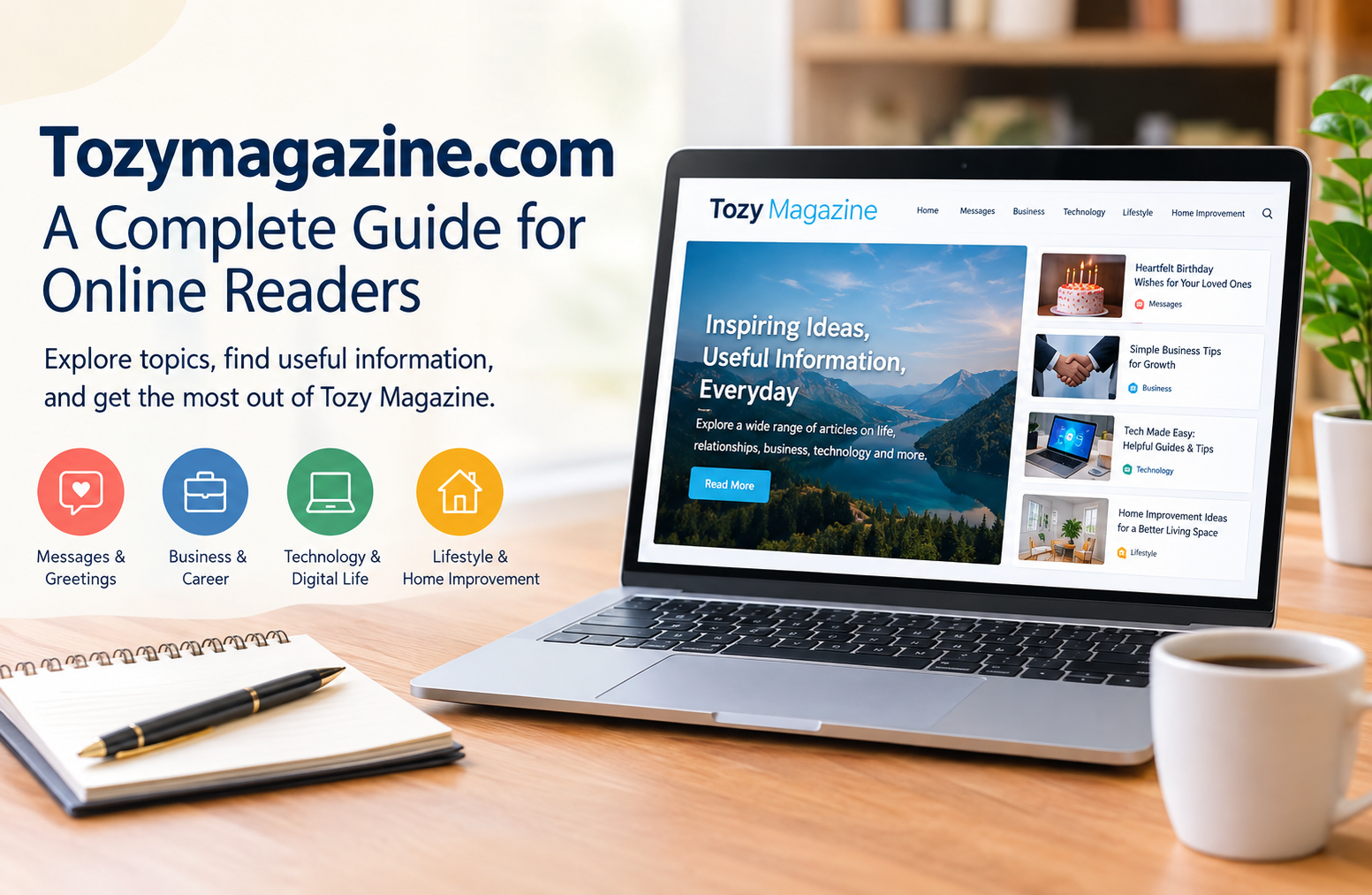
Tozymagazine.com: A Complete Guide for Online Readers
When people search for tozymagazine.com, they may want to understand what the website publishes, what kind of information it offers, and whether it is useful for everyday reading. Tozy Magazine is an online publication that features content ranging from birthday wishes and anniversary messages to business, technology, lifestyle, home improvement, and other informational subjects. Understanding its purpose, content categories, strengths, and limitations helps readers decide how to use the platform and when they should verify information through more specialized sources.
What Is Tozymagazine.com?
Tozymagazine.com is the website address associated with Tozy Magazine, a digital publication that presents articles for people looking for information, ideas, explanations, and practical guidance. Unlike a traditional print magazine, it publishes individual web articles that readers can access through a browser.
The website’s identity combines two broad content approaches. One focuses on personal communication, including greetings, wishes, and messages for meaningful occasions. The other covers general-interest topics that help readers explore everyday questions about business, technology, lifestyle, and other areas.
This combination gives the publication a wider potential audience than a website dedicated to a single subject. Someone looking for an anniversary message may have different needs from a reader researching a business topic, but both may appreciate accessible writing and clearly organized information.
However, a broad range of topics also creates an important consideration: not every subject requires the same level of expertise. A collection of birthday wishes can be evaluated mainly on relevance, originality, and tone. An article about financial decisions, health, legal rights, or technical security requires stronger evidence, current information, and, where appropriate, professional review.
For that reason, the best way to understand the platform is to look at its content, intended audience, usefulness, and editorial limitations rather than assuming that every article serves the same purpose.
How Tozy Magazine Has Developed as an Online Publication
The internet has changed how people discover written information. Readers no longer need to purchase a printed publication or wait for a particular issue to find an answer. They can search for a specific question and open an article that addresses it.
Digital magazines have adapted to this behavior by organizing content around individual topics. This approach allows a publication to serve readers who arrive through search engines, social media, shared links, and direct visits.
Tozy Magazine reflects this broader digital publishing model. Its website has an established focus on messages and wishes for personal occasions, while its visible article listings also include subjects such as business, technology, home improvement, and consumer-related information.
The result is a publication that can serve different reading needs. Some visitors may want a ready-to-use message for a card. Others may want a simple explanation of a subject they have not encountered before.
This development also illustrates a challenge faced by many general-interest websites. Expanding into more categories can increase the range of questions a publication addresses, but it can make its editorial identity less obvious. Readers need clear categories, informative titles, identifiable authors, and reliable references to understand what each article offers.
A website becomes more useful when its growth is supported by consistent editorial standards. Publishing in more categories should not mean lowering the standard of research or presenting every topic as equally straightforward.
What Content Can Readers Find on Tozy Magazine?
The content available on a digital publication can change over time. Articles are added, categories are reorganized, and older material may be updated or replaced. Readers should therefore treat the following areas as a guide to the publication’s general content rather than a permanent inventory of every article.
1. Birthday Wishes and Personal Messages
Birthday messages are useful when someone wants to express affection, appreciation, humor, or encouragement but cannot immediately find the right words.
A good collection of birthday wishes may offer several styles, such as:
- Short messages for text conversations.
- Warm wishes for family members.
- Friendly greetings for colleagues.
- Funny messages for close friends.
- Thoughtful messages for people who live far away.
- Respectful greetings for professional relationships.
The main advantage of this type of content is convenience. Instead of writing every message from scratch, readers can review examples and adapt the wording to their relationship with the recipient.
However, personalization makes a significant difference. A message copied word for word may sound generic, especially when the occasion is important. Adding a shared memory, a specific compliment, or a sincere expression of appreciation makes the final message more meaningful.
For example, a simple birthday greeting can become more personal by mentioning a quality the recipient is known for or a positive experience the two people share.
2. Marriage and Wedding Messages
Marriage-related content can help people communicate during weddings, engagements, anniversaries, and other relationship milestones.
The appropriate message depends on the occasion and the relationship between the sender and recipient. A greeting for a close friend may be playful and informal, while a message for a senior colleague or distant relative may require a more respectful tone.
Useful wedding messages generally communicate happiness, support, and good wishes without becoming unnecessarily elaborate. Readers may also look for wording that suits a card, a social media post, a private message, or a short speech.
The practical value of these collections lies in giving people a starting point. They can select a suitable sentiment and adapt it rather than searching through dozens of unrelated examples.
Readers should also consider cultural expectations and personal preferences. A message that feels appropriate in one family or community may not suit another. Simple, sincere wording is often a safer choice than language that makes assumptions about the couple’s beliefs or future plans.
3. Anniversary Greetings and Relationship Content
Anniversary messages often require a different tone from ordinary congratulations. They may celebrate a marriage, a long-term relationship, a friendship, or an important professional milestone.
A useful collection can include romantic wording, lighthearted greetings, short messages, and more reflective expressions. The most appropriate choice depends on the people involved and the nature of the occasion.
Readers can improve these messages by making them specific. Mentioning a shared experience or acknowledging the time and effort invested in a relationship usually creates a stronger message than relying on general statements.
Anniversary content may also help people who struggle to express their feelings in writing. It provides examples of how to communicate appreciation without requiring every reader to be a confident writer.
Still, examples should be treated as adaptable material rather than finished expressions that work equally well for everyone. Personal context remains essential.
4. Thank-You Messages and Expressions of Appreciation
Thank-you messages are useful in personal, educational, and professional situations. Someone may need to thank a friend for practical help, a teacher for guidance, a colleague for support, or a customer for their business.
Effective expressions of gratitude usually explain what the person did and why it mattered. This makes the message more sincere than a vague statement of thanks.
For instance, thanking a colleague for staying late to help complete a project communicates more than simply saying that the person is helpful. It identifies the action and acknowledges its value.
A reader can use examples as a framework, then adjust the tone to match the relationship. Professional messages may benefit from concise language, while a personal note can include more warmth and detail.
The strongest thank-you messages are specific, proportionate, and genuine. They do not need complicated wording to communicate appreciation.
5. Business and Workplace Information
Business content can help readers understand everyday professional questions, organizational challenges, and commercial concepts.
Depending on the articles available, readers may encounter discussions of customer service, business operations, marketing, financial management, productivity, or company growth.
This type of material is most useful when it translates a complicated subject into practical steps. An article about cash flow, for example, should explain the difference between money entering a business and money leaving it, then show why the timing of those movements matters.
Likewise, a useful article about customer service should move beyond broad advice such as being polite. It should explain how businesses can respond to complaints, communicate realistic timelines, gather feedback, and measure whether changes improve customer experiences.
Readers should distinguish between general business education and advice tailored to a particular company. The right decision depends on factors such as operating costs, local regulations, available resources, customer expectations, and market conditions.
A general article can introduce a concept, but it cannot replace a detailed assessment of an individual business.
6. Technology and Digital Topics
Technology changes quickly, which makes accessible explanations valuable for readers who want to understand new tools, digital services, networking, software, and online systems.
A technology article may explain how a tool works, what a technical term means, or which factors to consider when solving a common problem.
Good explanatory writing should define unfamiliar terms before using them repeatedly. It should also distinguish between a possible cause and a confirmed diagnosis.
For example, a slow internet connection may result from wireless interference, an overloaded network, a faulty router, an internet service provider problem, or an issue with an individual device. Simply recommending a faster subscription without investigating these possibilities may waste money.
Technology content is most helpful when it offers a logical troubleshooting process, explains the limits of each solution, and identifies when professional assistance may be necessary.
Because software interfaces, security recommendations, and technical specifications change, readers should check publication dates and compare important instructions with current documentation from the relevant manufacturer or service provider.
7. Lifestyle, Home Improvement, and Consumer Information
Lifestyle and home improvement articles address practical decisions that people face at home and in daily life.
Topics may include organizing living spaces, choosing household products, maintaining equipment, improving comfort, and understanding common consumer problems.
The quality of such guidance depends on its specificity. Advice about home maintenance should explain what a reader can safely inspect, what warning signs matter, and when a qualified professional should handle the problem.
For consumer decisions, useful articles should identify the factors that affect value rather than focusing only on the purchase price. Durability, maintenance, warranties, operating costs, compatibility, and availability of replacement parts may all influence the long-term cost of ownership.
Readers should also be cautious when an article makes strong product claims without explaining how those claims were established. A recommendation is more convincing when it describes the criteria used, acknowledges trade-offs, and distinguishes evidence from personal preference.
Who Can Benefit From This Digital Magazine?
A general-interest publication is not equally useful for every reader. Its value depends on the question being asked and the depth of information required.
Casual Readers
People who enjoy exploring different subjects may appreciate having several categories in one place. They can move from personal messages to lifestyle topics without needing to search for a separate specialist website for every simple question.
This convenience is particularly valuable when the reader wants an introduction rather than an exhaustive technical explanation.
People Looking for Message Ideas
Readers who find writing difficult may benefit from examples of birthday greetings, wedding wishes, anniversary notes, and thank-you messages.
These collections can reduce the time needed to begin writing. The reader can then adapt the language to suit the recipient, relationship, and occasion.
Students and General Learners
Students and lifelong learners often begin researching a topic by looking for a clear definition or a straightforward explanation.
A general-interest article can provide background knowledge and introduce important terms. It can also help readers identify the questions they need to investigate further.
However, an introductory explanation should not automatically be treated as an academic source. Students should consult original research, textbooks, official documentation, and other sources appropriate to their assignment.
Small Business Owners
Small business owners may find introductory articles useful when exploring marketing, customer service, cash flow, and daily operations.
Such material can provide a checklist of considerations or introduce a method that deserves further investigation.
Its value is greatest when the owner uses the information to ask better questions, compare alternatives, and examine the needs of their own organization.
Readers Exploring Unfamiliar Subjects
A general publication can also help people discover subjects they did not initially intend to research.
A reader who arrives for a lifestyle article may become interested in a related technology or business topic. This kind of discovery can make online reading more engaging.
The important distinction is between discovering a subject and fully understanding it. Readers should recognize when a brief introduction is sufficient and when the subject requires deeper research.
How to Evaluate the Quality of an Article
The usefulness of an online publication depends not only on its topic selection but also on the accuracy, clarity, and transparency of individual articles.
The following method helps readers assess an article before relying on its information.
Check the Author and Publication Date
Look for a clear author byline and a publication or update date.
An identifiable author makes it easier to understand who is responsible for the article. Relevant qualifications or a history of writing on the subject can provide additional context.
The date matters because information can become outdated. A basic explanation of a timeless concept may remain useful for years, while instructions involving current software, government policies, market conditions, or legal requirements may need frequent review.
A recent date alone does not prove accuracy, just as an older date does not automatically make an article incorrect. The subject determines how much freshness matters.
Look for Evidence Behind Important Claims
Reliable articles explain how readers can verify significant claims.
Depending on the subject, useful evidence may include government publications, research papers, official product documentation, recognized professional standards, or statements from qualified experts.
A claim that a product has a particular specification should be checked against its manufacturer documentation. A claim about a legal requirement should be compared with the relevant jurisdiction’s official rules.
If an article makes a precise statistical claim without identifying where the number came from, treat it cautiously until the source can be established.
Distinguish Facts From Opinions
Articles often combine established facts with recommendations, interpretations, and personal judgments.
There is nothing inherently wrong with offering an opinion, but readers should be able to recognize it as such.
For example, describing a particular writing style as friendly is an editorial judgment. Claiming that a treatment is clinically effective is a factual claim that requires appropriate evidence.
Clear writing helps readers understand this difference.
Consider Whether the Advice Fits Your Situation
Even accurate information may not apply to every reader.
A business strategy that works for a large company may be impractical for a small local operation. A home maintenance recommendation may depend on the building’s age and construction. A legal explanation may apply only to a particular location.
Before acting on advice, identify the assumptions behind it and consider whether those assumptions match your circumstances.
Compare High-Impact Claims With Primary Sources
For matters involving health, money, legal rights, safety, or cybersecurity, a general article should be treated as a starting point.
Primary sources and qualified professionals are especially important when a mistake could have serious consequences.
Readers can also consult Google’s guidance on creating helpful, reliable, people-first content to understand why useful information, clear purpose, and trustworthy presentation matter in online publishing.
Is Tozymagazine.com Reliable and Safe to Use?
Reliability is not a single yes-or-no property. It has several dimensions, and each should be considered separately.
Website Accessibility and Technical Security
A website that loads in a browser is accessible, but accessibility alone does not establish editorial reliability.
Likewise, HTTPS helps encrypt information exchanged between a browser and a website. It does not prove that every published statement is accurate or that the publisher has professional expertise in every subject.
Readers should avoid assuming that a technically functioning website is automatically trustworthy in all respects.
Before entering sensitive information, check the domain carefully, review the privacy policy, and consider whether the requested information is necessary. Be particularly cautious if a page asks for payment details, account credentials, identity documents, or other personal information without a clear reason.
Editorial Reliability
Editorial reliability concerns the quality of the information itself.
Readers should look for clear explanations, identifiable authors, appropriate references, consistent terminology, and a reasonable distinction between evidence and opinion.
An article about a simple social occasion may require little formal sourcing. An article about medical treatment, investment risk, or legal rights should meet a much higher evidentiary standard.
It is more accurate to evaluate each article according to its subject and evidence than to assume that every page on a multi-topic publication has the same level of authority.
Transparency and Accountability
A publication becomes easier to evaluate when it explains who runs it, how readers can contact the publisher, and how editorial corrections are handled.
An About page can explain the publication’s purpose. A Contact page gives readers a way to report errors or ask questions. An editorial policy can clarify how sources are selected and how corrections are made.
The presence of these pages does not guarantee accuracy, but meaningful transparency makes accountability easier.
Readers should also distinguish between an identifiable writer and a verified subject-matter expert. A byline establishes attribution, while expertise requires relevant evidence of knowledge or experience.
Advertising and Commercial Interests
Commercial relationships can influence how online information is presented.
A product review may include affiliate links, a sponsored article may be funded by a business, and a service guide may direct readers toward a commercial provider.
These arrangements are not automatically improper. The key questions are whether the relationship is disclosed and whether the information remains useful and fair.
Readers should be cautious when an article makes unusually strong claims, ignores obvious drawbacks, or pushes a purchase without explaining the reasoning behind its recommendation.
A balanced article helps readers understand both benefits and limitations.
Benefits of Using a Multi-Topic Online Publication
A broad publication can be useful when readers understand what it does well and where additional research is necessary.
Convenience and Accessibility
Readers can access individual articles without needing to purchase a print issue. This makes digital publishing convenient for quick questions and casual research.
Well-organized pages also allow readers to scan headings, identify relevant sections, and return to useful information when needed.
A Wide Range of Topics
A multi-topic publication can introduce readers to subjects outside their usual interests.
This is useful for general learning, idea generation, and discovering new areas for research. It may also help readers connect ideas across different parts of everyday life.
However, breadth should not be confused with depth. A wide content library is valuable when individual articles still answer their specific questions thoroughly.
Practical Writing Support
Collections of messages and greetings can reduce the effort involved in everyday communication.
Readers can compare different tones, choose wording that suits their relationship, and personalize the result. This is a straightforward use case where convenience can be more important than extensive research.
An Introduction to New Subjects
Short explanatory articles can help readers build basic familiarity with unfamiliar terms and concepts.
A useful introduction should leave the reader with a clearer understanding of the subject, not merely a collection of broad statements. It should also indicate when the answer depends on personal circumstances, professional judgment, or changing information.
Challenges and Limitations Readers Should Understand
A responsible assessment should consider the disadvantages of broad online publishing as well as its benefits.
Uneven Expertise Across Categories
A single publication may cover subjects that require very different skills.
Writing a greeting message requires language judgment and an understanding of social context. Explaining an advanced technical problem may require practical testing, detailed documentation, and specialized knowledge.
The presence of both subjects on the same website does not establish that they have been researched using equivalent methods.
Readers should assess expertise at the article level, particularly when a topic involves significant risk.
Keeping Information Current
Some content remains useful for long periods. Other information becomes outdated quickly.
A collection of anniversary messages may require little maintenance. A guide to cybersecurity, tax rules, financial products, or software settings may become inaccurate when circumstances change.
Publishers should review time-sensitive content and clearly explain when information was last checked. Readers should independently verify requirements that may have changed since publication.
Balancing Breadth With Editorial Focus
Publishing across many categories creates organizational challenges.
If the website’s navigation does not clearly distinguish its topics, readers may struggle to find related material or understand the publication’s main purpose.
Consistent category names, relevant internal links, clear authorship, and a coherent editorial policy can make a broad publication easier to navigate.
Distinguishing Useful Guidance From Generic Advice
Broad statements can sound helpful while providing little practical value.
Advice such as improving communication, managing money carefully, or choosing reliable products needs explanation to become actionable.
A stronger article identifies the problem, explains the underlying factors, offers realistic options, and discusses limitations. Readers benefit when guidance is specific enough to apply but careful enough to avoid promising results that cannot be guaranteed.
How to Get More Value From Tozy Magazine
Readers can improve their experience by approaching each article with a clear purpose.
Step 1: Define Your Question
Before opening an article, identify what you want to learn or accomplish.
Are you looking for a message to send, a definition to understand, a technical problem to investigate, or background information for a larger decision?
A specific question makes it easier to determine whether the article actually meets your needs.
Step 2: Choose the Relevant Category
Start with the subject most closely related to your question.
For example, a reader looking for a wedding greeting should focus on marriage-related content rather than browse unrelated business articles. Someone researching a technical issue should look for an explanation that addresses the actual symptoms or system involved.
This approach reduces unnecessary reading and makes the experience more efficient.
Step 3: Scan the Headings
Headings reveal how an article is organized and whether it covers the information you need.
Look for sections that define key terms, explain the process, compare options, or discuss limitations.
If the article promises a detailed answer but contains only broad introductions and repeated statements, it may not provide enough depth for your purpose.
Step 4: Check the Supporting Evidence
Look at the sources behind important claims.
For low-risk topics, a clear and relevant explanation may be enough. For higher-risk topics, seek direct evidence from appropriate primary sources or recognized specialists.
Do not treat confidence, polished language, or a professional-looking page as substitutes for evidence.
Step 5: Adapt the Information to Your Situation
Use general guidance as a framework rather than assuming it fits every circumstance.
A sample message should reflect the relationship between the sender and recipient. A business recommendation should account for available resources and operating conditions. A technical instruction should match the device or software version being used.
Adaptation is often what turns general information into something genuinely useful.
Step 6: Verify Before Making Important Decisions
When a decision has significant consequences, take the additional step of checking the relevant official source or consulting a qualified professional.
This is especially important for legal, medical, financial, and safety-related questions.
The objective is not to distrust everything published online. It is to match the level of verification to the level of risk.
What Makes an Online Article Genuinely Helpful?
A useful article is more than a page containing a target phrase and several headings. It should help a reader accomplish a real task or understand a subject more accurately.
Several qualities make a difference.
It Answers the Main Question Early
Readers should not have to move through several paragraphs of background before discovering the basic answer.
A clear introduction establishes the subject, identifies the reader’s likely concern, and explains what the article will cover.
Supporting detail can follow, but the main purpose should remain obvious.
It Provides Specific, Actionable Information
Practical detail distinguishes useful content from generic commentary.
An article about choosing a product should explain relevant selection criteria. A guide to solving a problem should present a logical sequence of checks. A message collection should offer meaningful variations rather than repeating the same sentence with minor changes.
The best level of detail depends on the topic and the reader’s goal.
It Acknowledges Uncertainty
Trustworthy writing does not pretend that every question has a universal answer.
When evidence is incomplete, circumstances vary, or a claim cannot be verified, the article should state that limitation clearly.
Acknowledging uncertainty helps readers distinguish established information from interpretation and prevents unnecessary overconfidence.
It Respects the Reader’s Time
Concise paragraphs, descriptive headings, and relevant examples make content easier to use.
Long articles can be valuable when a subject requires depth, but length alone is not evidence of quality. Every section should add information, explain a distinction, answer a question, or help the reader make sense of the subject.
Repeated introductions and unnecessary summaries weaken the experience.
It Demonstrates Editorial Responsibility
Readers benefit when writers identify reliable sources, distinguish opinions from facts, and correct meaningful errors.
For specialist subjects, editorial responsibility may also involve expert review and clear explanations of the author’s relevant qualifications.
These practices make it easier to evaluate information and understand how much confidence to place in a particular article.
Tozymagazine.com and the Importance of Responsible Digital Publishing
Online publications operate in an environment where readers have many competing sources of information. A website cannot rely on a broad topic range or frequent publishing alone to establish long-term value.
The stronger approach is to make each article useful for a clearly defined audience.
For a greeting collection, this means providing natural language, meaningful variety, and options suited to different relationships. For a technology guide, it means explaining the process accurately, using current information, and identifying potential causes rather than presenting guesses as facts. For a business article, it means describing practical considerations and acknowledging that different organizations face different constraints.
A responsible publishing process also considers how content is maintained. Articles that depend on changing information should be reviewed when circumstances warrant it. Readers should be able to identify the author, understand the purpose of the page, and find sources for significant factual claims.
Search visibility may help readers discover a useful article, but discoverability and usefulness are not the same thing. A page that attracts clicks but fails to answer the question creates a poor experience. A page that answers the question clearly, accurately, and proportionately offers more lasting value.
For readers, this means focusing on the quality of the information rather than judging a publication solely by its appearance, topic count, or position in search results.
For publishers, it means making editorial standards part of the writing process instead of treating them as an afterthought.
Frequently Asked Questions
1. What is tozymagazine.com?
Tozymagazine.com is the website associated with Tozy Magazine, an online publication featuring personal messages and greetings alongside a wider range of general-interest articles.
2. What topics does Tozy Magazine cover?
Its content includes birthday wishes, marriage messages, anniversary greetings, thank-you messages, and informational subjects such as business, technology, lifestyle, and home improvement. Available categories can change over time.
3. Is Tozy Magazine useful for everyday readers?
It can be useful for readers seeking message ideas, introductory explanations, or general information. The value of each article depends on its relevance, accuracy, depth, and supporting evidence.
4. Can readers rely on every article published on the website?
Readers should not assume that every article has the same level of authority. Important medical, financial, legal, technical, and safety-related claims should be checked against appropriate official sources or qualified experts.
5. How can readers evaluate an article’s reliability?
Check the author’s identity, publication date, evidence, relevant qualifications, and links to trustworthy sources. Compare important claims with primary documentation, especially when information may have changed.
6. Is Tozy Magazine a traditional print magazine?
It is primarily a web-based publication that presents individual articles online rather than relying on a conventional printed-issue format.
Conclusion
Tozymagazine.com represents a broad approach to online publishing, combining personal communication resources with general-interest information. Its content can help readers find suitable greetings, explore unfamiliar subjects, and develop a basic understanding of everyday questions.
The most useful way to approach the website is to match each article to a specific need. Message collections can provide a convenient starting point for personal writing, while informational articles can introduce concepts and suggest areas for further research.
At the same time, a wide range of subjects requires careful evaluation. Readers should consider the author’s expertise, the freshness of the information, the evidence supporting important claims, and the consequences of acting on the advice. For high-impact decisions, primary sources and qualified professionals remain essential.
Ultimately, the value of any digital publication depends on how effectively it serves its readers. Clear explanations, relevant detail, responsible sourcing, and honest acknowledgment of limitations are more meaningful measures of quality than the number of articles published or the breadth of categories offered.