Fentomagazine com: A Complete Guide for Online Readers
When people search for fentomagazine com, they usually want to understand what the website offers, what topics it covers, and whether it is worth exploring. Fento Magazine is an online publishing platform that presents articles and resources related to digital culture, social media conversations, entertainment, public opinion, and other areas of general interest. Its broader content also includes subjects such as technology, business, lifestyle, and practical information. Understanding how the website is organized, what readers can expect, and how to assess the information it publishes can help visitors decide whether it meets their needs.
The internet gives readers access to an enormous amount of information, but finding useful content is not always easy. Some websites specialize in a single subject, while others bring different topics together under one digital publication. Fento Magazine belongs to the second category. Its mix of online culture, commentary, and general-interest articles makes it relevant to readers who enjoy discovering new ideas without visiting several separate websites.
However, understanding a digital magazine involves more than looking at its name or homepage. Readers should consider its editorial focus, the usefulness of its articles, the quality of its information, and the reliability of its sources. This guide explores those points in detail to help readers make an informed decision about the platform.
What Is Fentomagazine com?
Fentomagazine com is the website of Fento Magazine, an online publication that explores digital conversations and publishes articles across multiple subject areas. The publication describes its central idea around the influence of words, comments, opinions, and public discussions on how people understand events and interact with one another.
Unlike a traditional print magazine, an online publication can update its content regularly and organize articles into categories that readers can access whenever they want. Visitors can discover individual stories through search engines, browse available categories, or follow topics that match their interests.
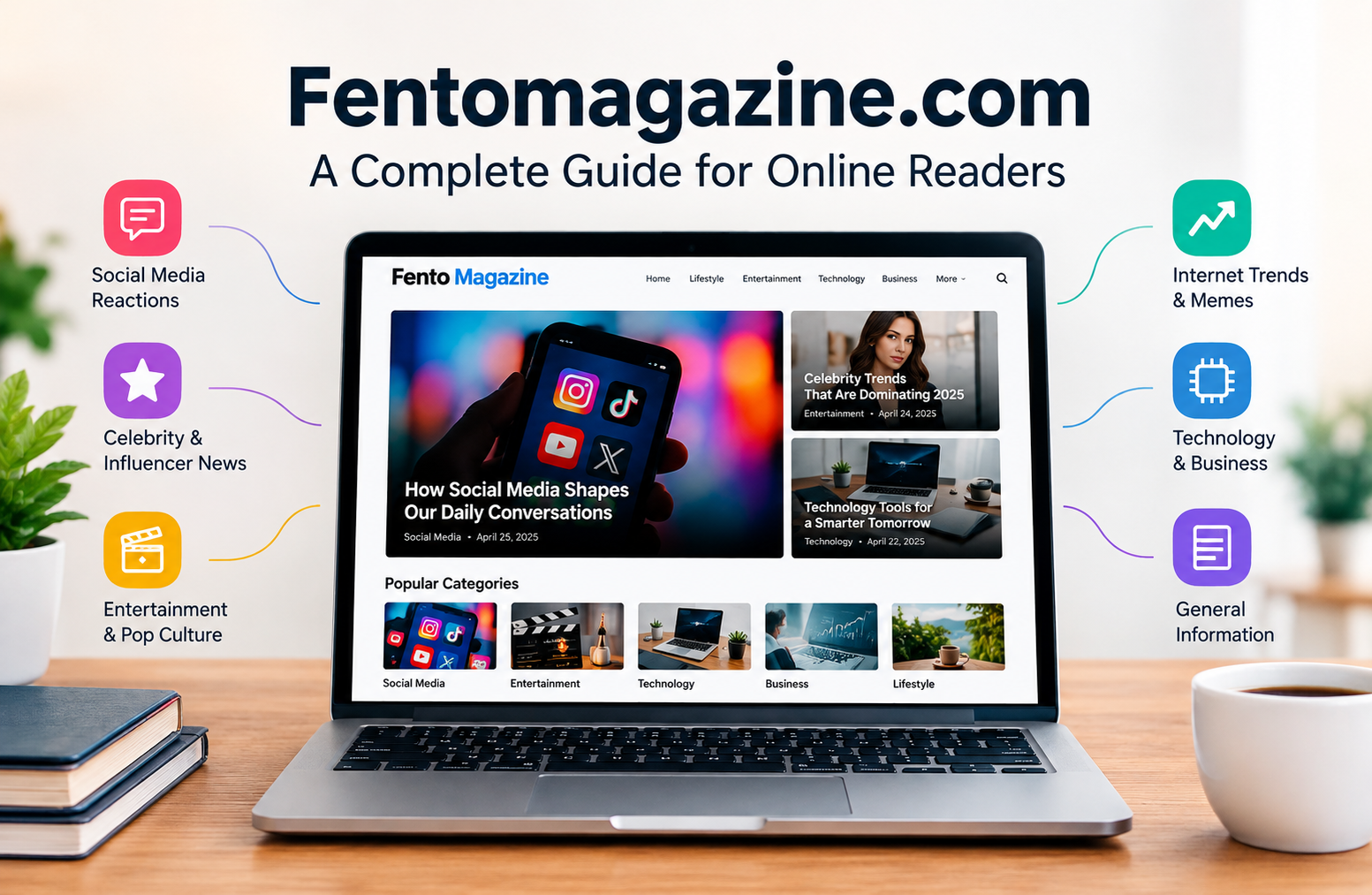
Fento Magazine’s stated editorial interests include social media reactions, celebrity and influencer commentary, political opinions, entertainment, internet trends, memes, and public discussions. Its broader collection of published material also includes general informational content.
This combination gives the website several potential uses. A reader might visit to explore an internet trend, learn about a public figure, read an explanatory article, or discover information about a subject outside their usual interests.
It is important, however, to distinguish the website’s stated mission from the content available in any particular article. A publication can cover many subjects, but the quality and authority of each article still depend on its sources, research, accuracy, and editorial approach.
For readers, the most useful starting point is to understand what the website offers and then evaluate individual pages according to the information they need.
What Does Fento Magazine Cover?
The range of topics is an important part of understanding the publication. Instead of concentrating exclusively on one specialist field, the website connects digital culture with broader areas of interest.
1. Social Media Reactions and Online Discussions
Social media has changed how people respond to news, entertainment, public figures, and everyday events. A single post can generate thousands of replies, while a short comment can influence how other users interpret a situation.
Fento Magazine identifies social media reactions and public conversations among its editorial interests. This subject can be useful for readers who want to understand why particular discussions attract attention and how online audiences express their views.
When exploring this type of content, it helps to separate three different things:
- What happened in the original event.
- What people said about the event.
- What conclusions can reasonably be drawn from those reactions.
These distinctions matter because online conversations rarely represent every person’s opinion. A discussion may be shaped by the platform’s audience, the timing of a post, the people who participate, and the way content is distributed.
A large number of comments does not automatically mean that a particular viewpoint represents the wider public. Responsible interpretation requires context rather than relying on popularity alone.
2. Celebrity and Influencer Commentary
Public figures often generate online discussions about their professional work, personal statements, public appearances, and interactions with their audiences.
Articles about celebrities and influencers can help readers understand why a person is receiving attention, what has been reported, and how audiences are responding.
However, readers should pay attention to the difference between confirmed information and speculation. Public interest in someone’s personal life does not make every circulating claim reliable.
A useful article should identify the subject clearly, provide relevant background, and avoid presenting rumors as established facts. When a story involves a quotation, readers benefit from knowing where it originally appeared and whether the wording has been taken out of context.
This approach makes celebrity commentary more informative and less dependent on sensational headlines.
3. Entertainment and Pop Culture
Entertainment is another natural area for a digital magazine. Movies, music, television, online creators, and fan communities frequently produce discussions that extend beyond the original work.
Readers may be interested in an entertainment article because they want background information, an explanation of a trend, or insight into why a particular subject has become popular.
Pop culture content can also provide a broader view of changing audience preferences. For example, a discussion about a popular film may reveal how viewers interpret its themes, characters, or ending.
Nevertheless, an article should distinguish personal interpretation from verifiable facts. A review can express an opinion, while a factual article should support claims about release dates, credits, awards, and other details with suitable evidence.
4. Internet Trends, Memes, and Digital Culture
Memes and viral trends are now important parts of online communication. They can communicate humor, criticism, frustration, or shared experiences in only a few words or images.
Fento Magazine’s stated interest in internet trends and memes fits this broader digital environment.
Understanding a meme often requires knowledge of its original context. A joke that makes sense within one online community may be confusing or misleading when shared elsewhere.
Readers can benefit from explanations that identify where a trend originated, what its message means, and how different communities interpret it.
It is also useful to remember that viral content can change rapidly. A trend may disappear within days, and an explanation written much later may no longer reflect how people originally used it.
5. Technology and General Information
The website’s broader publishing approach extends beyond social media and entertainment. Its available content includes technology and other informational subjects.
Technology articles can help readers understand digital tools, software, online services, and changes in the way people work or communicate. General-interest articles may address practical questions across different industries.
The usefulness of such material depends on the subject and the evidence supporting it. A basic introduction to a familiar concept may require less specialized sourcing than an article about cybersecurity, medical decisions, legal responsibilities, or financial products.
Readers should therefore evaluate each article on its own merits instead of assuming that a publication has equal expertise in every field it covers.
Why Are People Searching for Fentomagazine com?
People search for a website for different reasons. Some want to identify an unfamiliar domain, while others want to understand its purpose or decide whether its content deserves their attention.
The likely reasons for this search include the following.
Understanding the Website’s Purpose
A person may encounter the domain through a search result, a shared link, or an online discussion. Before exploring further, they may want a clear explanation of what the publication does.
In this situation, the most important questions are straightforward:
- What type of website is it?
- What subjects does it cover?
- Who is its intended audience?
- Does it provide the type of information the visitor needs?
Answering these questions helps readers decide whether to continue browsing.
Finding Articles on Specific Topics
Another visitor may already know the publication’s name but want to find information about a particular subject.
A broad digital magazine can be useful for discovery because it brings different categories together. However, a visitor looking for a highly technical answer may need to consult a specialist publication or primary source as well.
The best approach is to use general-interest content to understand a subject, then seek more authoritative evidence when a decision requires precision.
Assessing Credibility and Reliability
Readers increasingly need to distinguish reliable information from unsupported claims. An unfamiliar website naturally raises questions about its editorial practices and the quality of its articles.
A publication’s appearance, professional layout, or confident writing style cannot establish that every statement is correct.
A more useful assessment examines whether articles identify their sources, distinguish facts from opinions, provide dates when relevant, and correct mistakes when they occur.
These checks are especially important when an article concerns a decision that could affect someone’s money, health, safety, or legal position.
Exploring Digital Culture
Some readers are interested in how internet discussions shape modern communication. They may want to explore reactions to public events, celebrity conversations, viral jokes, or changing social media habits.
For these visitors, the publication’s focus on online commentary may be a reason to explore its articles.
The key is to approach public reactions as material for understanding a conversation, not as automatic proof that the most popular opinion is correct.
Key Features and Potential Benefits
The value of a digital magazine depends on how well it helps readers accomplish their goals. Fento Magazine’s broad editorial approach offers several potential benefits, although the experience may vary from one article to another.
A Range of Topics in One Place
One practical advantage of a multi-topic publication is convenience. Readers can move between different areas of interest without starting a new search for every subject.
For example, someone reading about an internet trend may also discover related articles about entertainment or technology.
This arrangement supports casual browsing and helps readers encounter topics they might not have searched for independently.
However, convenience should not replace source evaluation. Finding an article in one place does not mean that every claim within it has been independently verified.
Accessible Reading for a Broad Audience
Digital magazines generally aim to make information available to readers with different levels of background knowledge.
Clear headings, short paragraphs, familiar language, and logical explanations can make complex subjects easier to understand.
Readers benefit most when an article explains unfamiliar terms, supplies enough context to understand the subject, and avoids unnecessary technical language.
These are useful standards to apply when assessing the readability of any article on the website.
A Starting Point for Further Research
An introductory article can help readers identify the main questions surrounding a topic. It may introduce relevant terminology, explain the background, or point toward issues that deserve closer attention.
For example, an article about an online controversy might help a reader identify the original statement, the major responses, and the points of disagreement.
The next step is to verify important claims through original statements, official records, research publications, or other appropriate sources.
Used this way, a digital magazine can support learning without becoming the only source of information.
Opportunities to Understand Public Opinion
Online comments provide insight into how people express agreement, disagreement, humor, and frustration.
A thoughtful discussion of public reactions can help readers understand how the same event may be interpreted differently by different groups.
Yet there is an important limitation: comments are evidence of what particular participants expressed, not necessarily a representative measurement of public opinion.
A strong analysis explains this limitation instead of treating an active comment section as a scientific survey.
Convenient Access Across Devices
A website can be accessed from a desktop computer, laptop, tablet, or smartphone, provided the site and device are compatible.
This flexibility allows readers to explore articles at different times and in different settings.
The actual experience depends on page performance, layout, readability, accessibility, and the behavior of any advertisements or third-party features. Visitors should judge these factors during their own use rather than assuming that every device will deliver an identical experience.
How to Use Fentomagazine com Effectively
A little planning can make browsing more useful. Instead of opening pages without a clear purpose, readers can follow a simple process.
Step 1: Identify What You Want to Learn
Before browsing, decide what you are looking for.
Your goal might be to understand an online trend, discover background information about a public figure, explore a technology topic, or read a general-interest article.
A clear question helps you recognize whether a page actually answers your needs.
For example, if you want to understand a viral controversy, you may need the original statement, the surrounding context, and an explanation of the responses. An article that only repeats the most popular reactions may not provide enough information.
Step 2: Explore the Relevant Category
Start with the category most closely connected to your question. Look for headings and article titles that clearly describe the subject.
Read the introduction to determine whether the page addresses your topic. If it focuses on a different question, move on rather than assuming the full article will provide the information you need.
This simple habit saves time and reduces the chance of confusing related but different subjects.
Step 3: Check the Publication Date
The publication date matters whenever information can change.
An article about a historical event may remain useful for years, while information about software, public policies, current affairs, or online services can become outdated much faster.
Look for an original publication date and any visible update date. If the information concerns a current situation, check whether the details still match the latest official information.
A recent date alone does not guarantee accuracy, but an old date can signal the need for additional verification.
Step 4: Examine the Evidence
Pay attention to how the article supports its statements.
Useful indicators include named sources, links to original documents, direct quotations with context, relevant research, and clear distinctions between established facts and interpretation.
Be more cautious when an article makes a strong claim without explaining how it was established.
When a statement is important, search for the original source rather than relying only on a summary of what someone else reported.
Step 5: Compare Important Claims
For claims that could affect a meaningful decision, compare the article with an authoritative source.
Depending on the subject, that might mean an official government website, a research institution, a professional regulator, a product manufacturer, or an original public statement.
Independent confirmation is particularly useful when several websites repeat the same claim. Multiple articles may all rely on one original source, so repetition does not necessarily amount to independent verification.
Step 6: Decide Whether the Article Has Answered Your Question
After reading, ask whether you can explain the subject more accurately than before.
A useful article should provide relevant information, answer its central question, and clarify important limitations. If essential details remain missing, continue researching.
The purpose of reading is not simply to finish a page. It is to gain an accurate understanding of the subject.
Is Fentomagazine com Reliable?
Reliability should be assessed through evidence rather than appearance or assumptions about a website’s name.
Fento Magazine has a publicly accessible About Us page describing its editorial mission and areas of interest. Its disclaimer also states that the website provides information for general purposes and does not guarantee that all content is accurate, complete, or current.
Readers can review the publication’s own description and policies through its About Us page.
These pages help explain how the website presents itself, but they do not independently establish the accuracy of every article.
A balanced assessment considers several factors.
Transparency About Sources
Reliable informational writing should make it possible to identify where important claims originated.
For example, an article discussing a public announcement should ideally link to the announcement or identify the organization that made it.
An article discussing scientific findings should provide enough information for readers to locate the underlying research when appropriate.
Missing sources do not automatically prove that an article is false. However, they make important claims more difficult to verify.
Accuracy and Context
A statement can be technically correct but still create a misleading impression when essential context is omitted.
This is common in discussions of viral comments, celebrity statements, and public controversies. A short quotation may leave out the sentence that explains what the speaker meant.
Readers should look for the original wording and the surrounding circumstances before accepting a strong interpretation.
Author Expertise
The author’s background matters most when the article requires specialized knowledge.
A general introduction to internet culture may not require the same credentials as a detailed discussion of medical treatment, tax law, or financial risk.
When a subject has significant consequences, look for relevant professional qualifications, transparent sourcing, and confirmation from recognized authorities.
A confident tone should never substitute for demonstrated expertise.
Editorial Accountability
A trustworthy publication should provide clear ways to identify its publisher, contact its editorial team, and understand its policies.
Correction practices are also important. Mistakes can happen in any publication, but the way they are handled can reveal whether accuracy is taken seriously.
Readers should distinguish the existence of contact information or editorial policies from proof that a website consistently follows them.
Overall Assessment
Fento Magazine may serve as a useful place to discover topics and explore general-interest content. However, its suitability as a source depends on the specific article and the purpose for which the information will be used.
For casual reading, an introductory overview may be sufficient. For important factual decisions, readers should independently confirm the relevant claims.
This is a practical standard for evaluating any broad online publication, not an accusation that the website is unreliable.
Advantages and Limitations of a Multi-Topic Digital Magazine
A website covering several subjects can be useful, but its broad focus also creates challenges. Understanding both sides helps readers decide how to use the platform effectively.
Advantages
- Content discovery
Readers can discover subjects outside their usual interests. A person who arrives to read about social media may find an article about technology, business, or a cultural trend.
- Flexible reading
Online articles are available without the fixed schedule of a traditional print publication. Visitors can read individual pieces when convenient and return to topics that interest them.
- Different perspectives
Articles about public reactions and cultural discussions can introduce readers to different viewpoints. This can encourage thoughtful consideration of why people disagree and how opinions develop.
- Accessible introductions
General-interest articles can help beginners understand a topic before moving to more specialized sources. Clear explanations are particularly useful when readers are unfamiliar with the subject.
- Opportunities for further learning
An article can introduce questions that readers may want to investigate in greater depth. When the content provides reliable references, it can also help them locate original information.
Limitations
- Uneven subject expertise
A publication that covers many subjects may not offer the same depth in every field. Readers should check whether an article demonstrates the knowledge required for its particular topic.
- Changing information
Online content can become outdated. Technology, business conditions, public policies, and current events may change after an article is published.
- The risk of confusing opinions with facts
Commentary and public reactions are not the same as verified reporting. Readers should recognize whether an article presents established information, personal interpretation, or a mixture of both.
- Limited evidence in some articles
An article may explain a subject in accessible language without providing enough references to verify every claim. This matters more when the information could influence an important decision.
- Broad coverage can make navigation harder
A multi-topic website may contain articles that appeal to very different audiences. Visitors may need to use categories, search functions, or relevant headings to find the most useful material.
The best way to handle these limitations is to match the source to the task. Use general-interest content for discovery and introductory learning, then consult specialist or primary sources whenever accuracy and depth are essential.
Fentomagazine com and the Changing Nature of Online Communication
One of the more interesting aspects of a publication focused on digital conversations is the subject itself. The internet has made communication faster, more public, and easier to share across communities.
A comment that once would have remained within a small group can now be copied, quoted, and discussed worldwide. A short reaction can become a headline, while a humorous phrase can develop into a widely recognized meme.
These changes create opportunities for learning, but they also make context increasingly important.
Why Online Comments Matter
Comments can reveal how people respond emotionally to an event or idea. They may show agreement, skepticism, humor, confusion, or criticism.
When examined carefully, such responses can help explain why a topic attracts attention and which aspects of a story generate disagreement.
However, a comment section is not a complete picture of public opinion. People who post frequently may differ from those who read silently, and platform algorithms can affect which comments receive visibility.
For this reason, a responsible analysis should avoid treating a handful of highly visible reactions as proof of what everyone thinks.
How Viral Discussions Develop
Viral discussions often grow through a combination of emotional reactions, repetition, social sharing, and the perceived relevance of a topic.
A post may spread because it is funny, surprising, controversial, or easy to understand. As more people encounter it, additional commentary can give the original content new meanings.
During this process, details may be lost. A joke may be interpreted literally, a quotation may be shortened, or an unverified claim may be repeated until it appears familiar.
Readers can protect themselves against these problems by returning to the original source, checking the date, and considering whether a claim is supported by evidence.
The Difference Between Engagement and Accuracy
Online engagement measures how people interact with content. Depending on the platform, this may include views, comments, reactions, or shares.
Accuracy concerns whether the information is correct and presented in an appropriate context.
These are different measurements. A post can receive widespread attention because it is entertaining or provocative, even when its claims are inaccurate.
A useful digital publication should help readers understand this difference rather than suggesting that popularity establishes truth.
Who Can Benefit From Reading Fento Magazine?
The website’s broad subject coverage means that different types of readers may find different uses for it.
Casual Readers
People who enjoy discovering interesting stories across several subjects may appreciate a publication that brings diverse topics together.
They can browse for entertainment, explore cultural discussions, and find introductory information about subjects they have not encountered before.
For this audience, readability, clear organization, and relevant article summaries are particularly important.
Social Media Users
People who spend time on social platforms may be interested in discussions about public reactions, internet trends, memes, and influencer culture.
Articles in these areas can provide context for online conversations and help readers understand why a topic has become popular.
The most useful approach is to treat commentary as an opportunity to examine different viewpoints rather than a replacement for original evidence.
Students and Independent Learners
Students and independent learners may use general-interest articles to identify unfamiliar concepts or develop questions for further research.
For example, an introductory article can help someone understand the basic vocabulary of a technology subject before consulting more detailed documentation.
However, students should check assignment requirements and use original academic or primary sources when required. A general online article may help explain a concept, but it should not automatically be treated as a scholarly reference.
Professionals and Business Readers
Professionals may find general-interest content useful for keeping up with broad digital trends or discovering subjects relevant to their work.
Yet industry-specific decisions require more detailed evidence. Business strategy, compliance, investment, and technical implementation should be informed by sources appropriate to the decision.
A general article can help identify an issue, but it may not provide the depth needed to act on it.
People Researching an Unfamiliar Website
Visitors who have never encountered the publication can use this guide as a starting point for understanding its purpose and potential uses.
They should then visit the website directly, examine the relevant category, and assess the individual article they intend to read.
This process is more useful than relying solely on third-party descriptions or assuming that every page follows the same editorial standard.
Practical Tips for Evaluating Articles
A simple checklist can make online research more consistent. The following questions are useful when reading any informational article.
Check the Main Claim
Identify the central statement the article wants you to understand. Ask whether it is a fact, an interpretation, a prediction, or an opinion.
These categories require different types of support. A factual claim should be verifiable, while an opinion should be understood as a viewpoint rather than an established conclusion.
Look for Original Sources
When an article reports a statement, statistic, or announcement, look for the original source whenever possible.
An official document is generally more useful for confirming what an organization announced than an article that merely summarizes the announcement.
For research findings, examine the study itself when it is available and relevant to your question.
Consider the Date and Context
Check when the article was published and whether the subject has changed since then.
For online controversies, also consider when the original event occurred. A reaction posted months later may reflect a different discussion from the one taking place at the time.
Notice Missing Information
Ask whether the article explains the important details needed to understand the issue.
For instance, a story about a public disagreement may need to explain what happened before the disagreement, what each side actually said, and which details remain uncertain.
Missing information does not necessarily mean an article is wrong, but it may mean that the article is incomplete.
Avoid Relying on a Single Source for High-Stakes Questions
For important decisions, compare information with independent, authoritative sources.
Medical questions may require guidance from qualified healthcare professionals and recognized medical institutions. Legal questions may require official legislation or qualified legal advice. Financial decisions may require regulatory information and professional guidance suited to the circumstances.
The appropriate source depends on the subject, and no general-interest website should be assumed to replace specialist advice.
Privacy and Safe Browsing Considerations
Evaluating a website also involves considering how you interact with it.
Reading a public article is different from submitting personal information, creating an account, downloading a file, or following an unfamiliar third-party link. Each action may involve different risks.
The following practices can help readers browse more safely.
Keep personal information private. Avoid submitting sensitive details unless there is a clear reason and you understand how the information will be used.
Review browser warnings. Do not ignore security warnings simply because a page appears professional or familiar.
Be cautious with downloads. An article does not need to be downloaded software or an executable file to be useful. Avoid opening unexpected files, particularly those from unknown sources.
Check external destinations. Before following a link, consider whether the destination is relevant and whether the domain appears consistent with the organization being referenced.
Review privacy information when submitting data. If a website asks for information through a form or other feature, check its privacy policy and understand the purpose of the request.
Use current browser security features. Keeping your browser updated and using its built-in protections can reduce exposure to common web threats.
These precautions are general online safety practices. They should not be interpreted as evidence that Fento Magazine has a particular security problem.
How Fento Magazine Fits Into a Responsible Research Routine
A useful way to approach a broad digital publication is to think of it as one part of a larger information process.
First, use an introductory article to understand the subject and identify the main questions. Second, determine which claims need verification. Third, locate primary or authoritative sources that can answer those questions. Finally, compare the evidence and make sure the conclusion follows from the available information.
Consider a simple example involving a viral social media statement.
You might begin with an article explaining the discussion. Next, locate the original post or recording. Then, check the date and surrounding context. If the article makes claims about public opinion, look for reliable research rather than assuming that comments represent everyone.
This approach is useful because it separates the explanation of a discussion from proof of the claims within it.
The same process works for technology articles, business topics, entertainment reporting, and general information. The specific sources will change, but the underlying principle remains the same: use accessible explanations to build understanding and stronger evidence to verify important claims.
It also encourages readers to recognize uncertainty. Sometimes a source cannot establish exactly what happened, or the available information supports several interpretations. A careful reader should acknowledge those limits rather than accepting the most confident explanation.
How to Decide Whether the Website Is Right for You
Whether the publication meets your needs depends on what you expect from it.
If you want to explore online culture, discover general-interest topics, or find an accessible introduction to an unfamiliar subject, a multi-topic magazine may be a useful starting point.
If you need detailed technical instructions, scientific evidence, professional guidance, or confirmation of a sensitive claim, you should look for sources that directly address those requirements.
Use the following questions to make your decision:
- Does the article address the question you originally had?
- Is the information presented clearly and in sufficient detail?
- Can you identify the sources behind important claims?
- Is the article current enough for the subject?
- Does it distinguish evidence from interpretation?
- Can you verify consequential information independently?
If the answers are satisfactory, the article may be useful for your purpose. If important questions remain unresolved, continue researching rather than relying on an incomplete explanation.
This method avoids two common mistakes: dismissing a publication simply because it covers several subjects, and trusting everything it publishes simply because the website looks professional.
A fair assessment examines the actual content, its evidence, and the role it can reasonably play in your research.
The Future of Digital Magazines and Online Commentary
Digital magazines operate in an environment where readers expect information to be accessible, relevant, and easy to navigate. At the same time, the volume of online content makes trust and editorial quality increasingly important.
Public conversations will continue to evolve as social platforms, communication tools, and online communities change. Readers will need to distinguish original information from commentary, understand how trends develop, and recognize when a popular claim lacks sufficient evidence.
Publications that explain context, acknowledge uncertainty, and provide meaningful information can help readers navigate this environment more effectively.
For multi-topic websites, maintaining that standard across different subject areas is especially important. An article about a cultural trend and an article about a technical issue may need different research methods, but both should be clear about what is known and how that information can be checked.
Readers also have a role to play. Thoughtful browsing, source verification, and careful interpretation help create a healthier relationship with online information.
The goal is not to distrust every article. It is to develop the judgment needed to recognize what an article can establish, what it leaves unanswered, and when further research is necessary.
Frequently Asked Questions About Fentomagazine com
1. What is fentomagazine com?
Fentomagazine com is the website of Fento Magazine, an online publication that covers digital conversations, social media reactions, entertainment, internet trends, and broader informational topics.
2. What type of content can readers find on Fento Magazine?
Readers can explore articles about online culture, celebrity commentary, public opinion, memes, entertainment, technology, business, and other general-interest subjects. The exact content available may change as the website publishes new articles.
3. Is fentomagazine com a news website?
It is best understood as a digital publication with a broad range of editorial topics and an interest in online conversations. Readers should evaluate individual articles to determine whether they provide news reporting, commentary, background information, or another type of content.
4. Is fentomagazine com a reliable source of information?
Reliability depends on the article, its evidence, its publication date, and the author’s expertise. Readers should check important claims against original documents or other authoritative sources, especially when the information could affect a significant decision.
5. Can I use Fento Magazine for research?
The website may help readers discover topics and develop a basic understanding of unfamiliar subjects. For academic work or important decisions, use appropriate primary sources, specialist publications, and recognized authorities to verify relevant information.
6. How can I evaluate articles on Fento Magazine?
Check the article’s purpose, date, author information, supporting evidence, and context. Look for links to original sources and distinguish factual statements from opinions. If an important claim cannot be verified, seek additional evidence before relying on it.
Conclusion
Fentomagazine com is an online publication that brings together digital culture, social media discussions, entertainment, and a broader selection of general-interest topics. Its emphasis on comments, reactions, and public conversations offers a way to explore how people respond to events and ideas across the internet.
The website may be useful for casual reading, discovering unfamiliar subjects, and finding introductory explanations. Its broad coverage can also help readers identify questions worth exploring in greater detail.
However, a publication’s range of topics does not guarantee equal expertise across every subject. Readers should consider the evidence behind individual articles, check publication dates, distinguish opinion from fact, and verify important information through suitable authoritative sources.
The most effective approach is to use digital magazines as part of a balanced information routine. Read with a clear purpose, examine the context, and investigate claims that require stronger evidence. This makes it easier to benefit from online content while avoiding common misunderstandings.
Ultimately, the value of Fento Magazine depends on the information you need and the quality of the particular article you choose to read. An informed reader does not judge a website by its name or appearance alone, but by how well its content answers a question and how reliably its claims can be supported.