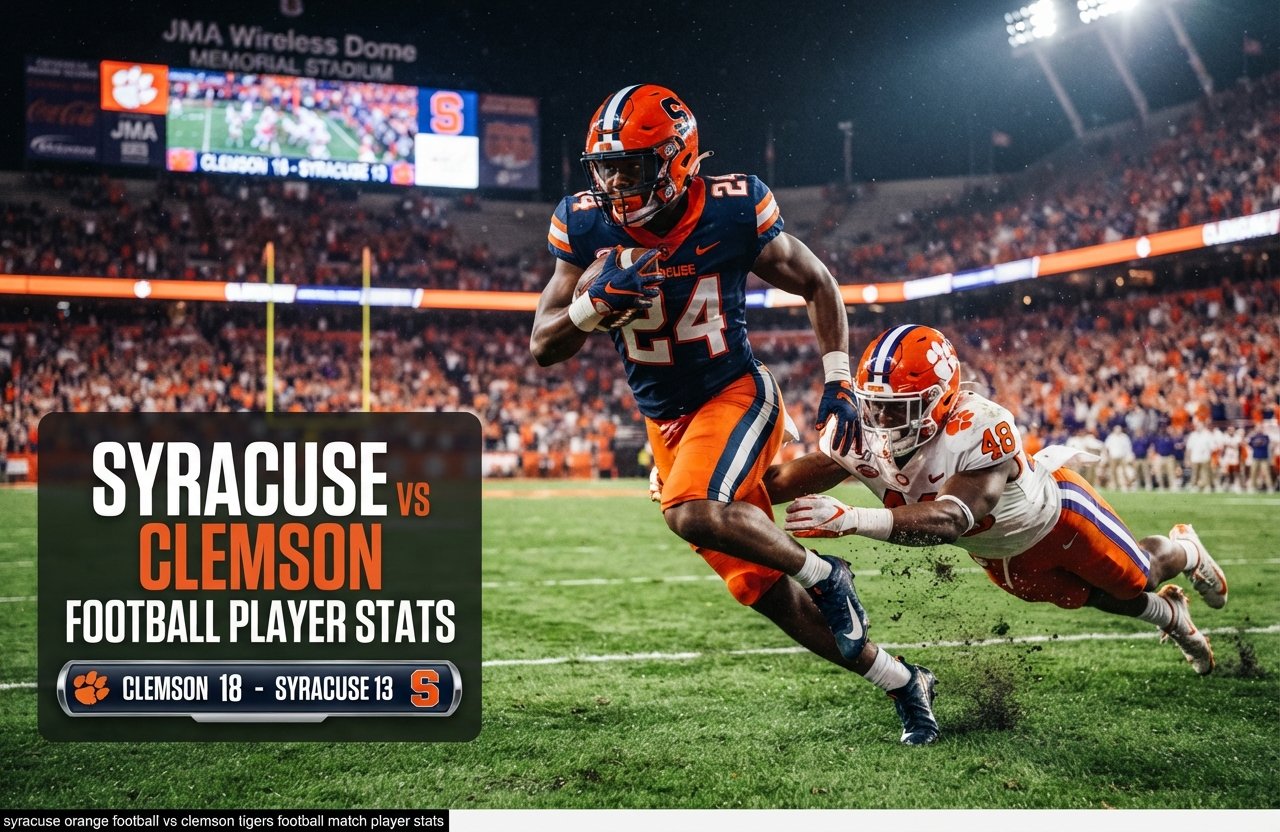
Syracuse Orange Football vs Clemson Tigers Football Match Player Stats
The Syracuse Orange football vs Clemson Tigers football match player stats reveal how Syracuse secured an impressive 34-21 victory over Clemson on September 20, 2025. Despite producing more passing yards, the Clemson Tigers could not overcome Syracuse’s balanced offensive performance, costly turnovers, and defensive pressure. Steve Angeli delivered an important performance through the air, Yasin Willis controlled much of the rushing attack, and Johntay Cook II emerged as Syracuse’s leading receiver. On the other side, Cade Klubnik threw for 363 yards and three touchdowns, but an interception and a lost fumble contributed to Clemson’s defeat.
The matchup provided an interesting example of why total yardage does not always determine the winner in college football. Clemson generated more passing production and recorded more sacks, yet Syracuse made better use of its opportunities and maintained control during the most important stages of the game. This detailed breakdown examines the final score, individual player performances, offensive and defensive statistics, turnovers, special teams, and the factors that ultimately decided the contest.
Syracuse vs Clemson Football Match Overview
The September 20, 2025, meeting between the Syracuse Orange and Clemson Tigers ended with Syracuse earning a 13-point victory. The Orange finished with 34 points, while Clemson managed 21.
The result was particularly significant because Syracuse entered the matchup with a 2-1 overall record and improved to 3-1 after the victory. The team also opened its ACC conference record at 1-0. Clemson, meanwhile, fell to 1-3 overall and 0-2 in conference play.
Both programs produced important offensive performances, but their approaches were different. Syracuse combined its passing game with a productive rushing attack, while Clemson relied more heavily on its passing offense.
| Match Detail | Information |
| Teams | Syracuse Orange vs Clemson Tigers |
| Date | September 20, 2025 |
| Competition | NCAA College Football |
| Conference | Atlantic Coast Conference (ACC) |
| Final Score | Syracuse 34, Clemson 21 |
| Winning Team | Syracuse Orange |
| Winning Margin | 13 points |
| Syracuse Record After Game | 3-1 |
| Clemson Record After Game | 1-3 |
| Halftime Score | Syracuse 24, Clemson 14 |
The most important difference was Syracuse’s ability to produce points in multiple ways. The Orange recorded three passing touchdowns, one rushing touchdown, and two successful field goals.
Clemson also recorded three passing touchdowns, but its offense failed to establish a comparable rushing scoring threat. The Tigers finished without a rushing touchdown or a successful field goal.
This difference in scoring efficiency played an important role in the final result.
Syracuse Orange Football vs Clemson Tigers Football Match Player Stats
The individual performances explain why Syracuse won even though Clemson accumulated more passing yards. Both teams had productive players, but their contributions affected the game in different ways.
The most notable performances included:
- Steve Angeli: 245 passing yards and two touchdown passes.
- Cade Klubnik: 363 passing yards and three touchdowns.
- Yasin Willis: 94 rushing yards on 18 carries.
- Adam Randall: 130 rushing yards on 16 carries.
- Johntay Cook II: 113 receiving yards on six receptions.
- T.J. Moore: 92 receiving yards on eight receptions.
- Justus Ross-Simmons: Two receiving touchdowns for Syracuse.
- Bryant Wesco Jr.: Two receiving touchdowns for Clemson.
These numbers highlight the different strengths of the two offenses. Clemson had greater passing volume, while Syracuse received important contributions from its quarterback, running backs, receivers, and kicker.
Syracuse Orange Passing Stats
Syracuse used two quarterbacks during the contest: Steve Angeli and Rickie Collins. Angeli handled most of the passing workload and provided the foundation for the Orange’s offensive performance.
Steve Angeli Passing Performance
Steve Angeli (#9)
| Passing Statistic | Performance |
| Completions | 18 |
| Attempts | 31 |
| Completion Percentage | 58.1% |
| Passing Yards | 245 |
| Passing Touchdowns | 2 |
| Interceptions | 0 |
Angeli completed 18 of his 31 attempts and recorded two touchdown passes without throwing an interception. His performance was important because Syracuse needed a quarterback who could distribute the football and take advantage of Clemson’s defensive coverage.
His first touchdown came during the opening quarter when he connected with Justus Ross-Simmons for a 12-yard score. The play gave Syracuse an early advantage and established the passing game as an important part of its offensive approach.
Angeli also found Darrell Gill Jr. for a 22-yard touchdown during the second quarter. That scoring play extended Syracuse’s lead to 24-7 and placed additional pressure on Clemson.
His ability to avoid interceptions was another important factor. Clemson’s defense recorded four sacks, but Angeli still managed to produce two passing touchdowns and maintain possession of the football without throwing an interception.
Rickie Collins Passing Performance
Rickie Collins (#10)
| Passing Statistic | Performance |
| Completions | 3 |
| Attempts | 8 |
| Completion Percentage | 37.5% |
| Passing Yards | 34 |
| Passing Touchdowns | 1 |
| Interceptions | 0 |
Rickie Collins contributed another important passing touchdown despite receiving fewer opportunities than Angeli.
His most significant contribution came during the third quarter. Collins connected with Ross-Simmons for an 18-yard touchdown, extending Syracuse’s advantage to 34-14.
This score was especially valuable because it came after Clemson had lost possession of the football. Syracuse immediately took advantage of the opportunity and converted it into seven points.
Collins demonstrated that Syracuse could receive production from more than one quarterback. His touchdown also helped the Orange maintain their scoring momentum during a crucial period.
Syracuse Team Passing Analysis
| Category | Syracuse |
| Total Completions | 21 |
| Passing Attempts | 39 |
| Passing Yards | 279 |
| Passing Touchdowns | 3 |
| Interceptions | 0 |
Syracuse’s passing performance was built around efficient scoring opportunities rather than a high volume of attempts.
Angeli provided most of the production, while Collins delivered an important touchdown in the third quarter. Together, they helped the Orange record three passing scores without committing an interception.
The absence of interceptions was particularly important against a Clemson offense that produced significant yardage. Protecting possession allowed Syracuse to maintain its advantage and avoid giving the Tigers additional opportunities.
Clemson Tigers Passing Stats
Clemson relied heavily on quarterback Cade Klubnik to generate offensive production. He attempted 60 passes and completed 37, finishing with 363 passing yards and three touchdowns.
Although Klubnik produced more passing yards than Syracuse’s entire passing unit, his performance was not enough to secure a victory.
Cade Klubnik Passing Performance
Cade Klubnik (#2)
| Passing Statistic | Performance |
| Completions | 37 |
| Attempts | 60 |
| Completion Percentage | 61.7% |
| Passing Yards | 363 |
| Passing Touchdowns | 3 |
| Interceptions | 1 |
Klubnik completed 37 of his 60 passing attempts, demonstrating how heavily Clemson depended on its passing offense.
He connected with Bryant Wesco Jr. for a 38-yard touchdown during the first quarter. The play helped Clemson respond after Syracuse had scored the opening 10 points.
His second touchdown pass went to Adam Randall during the second quarter. Randall caught a six-yard pass to reduce Syracuse’s advantage to 24-14 before halftime.
Klubnik’s third touchdown also involved Wesco. Their nine-yard connection during the fourth quarter reduced the deficit to 34-21.
Despite these scoring contributions, Clemson struggled to turn its passing production into a comeback. The offense faced a significant challenge after entering halftime 10 points behind and allowing Syracuse to score again during the third quarter.
The interception was also an important negative statistic. While Klubnik completed numerous passes, losing possession at a critical stage made Clemson’s recovery more difficult.
Clemson Team Passing Analysis
| Category | Clemson |
| Total Completions | 37 |
| Passing Attempts | 61 |
| Passing Yards | 363 |
| Passing Touchdowns | 3 |
| Interceptions | 1 |
Clemson finished with 84 more passing yards than Syracuse’s reported total of 279 yards.
However, the difference in passing yardage did not translate into a better scoreboard result. Syracuse made better use of its offensive balance, while Clemson’s passing-heavy approach required more attempts to generate its production.
The comparison also shows why completion totals and passing yards should not be evaluated independently. Touchdowns, turnovers, rushing production, and the ability to convert possessions into points all influence the final result.
Syracuse Orange Rushing Stats
Syracuse’s rushing attack provided balance to its offense and prevented Clemson from focusing exclusively on defending the pass.
Yasin Willis was the team’s leading rusher, while Will Nixon contributed the only rushing touchdown for the Orange.
Yasin Willis Rushing Performance
Yasin Willis
| Rushing Statistic | Performance |
| Carries | 18 |
| Rushing Yards | 94 |
| Average Per Carry | 5.2 |
| Touchdowns | 0 |
| Longest Run | 32 yards |
Willis delivered one of Syracuse’s most important individual performances. His 94 rushing yards provided consistent ground production and helped the team maintain offensive balance.
His longest run covered 32 yards, demonstrating his ability to gain significant yardage when the offensive line created running space.
Willis also helped Syracuse control the pace of its offensive possessions. His involvement reduced the pressure on Angeli to complete every important play through the air.
Although he did not score a rushing touchdown, his contribution was valuable throughout the contest.
Will Nixon Rushing Performance
Will Nixon
| Rushing Statistic | Performance |
| Carries | 10 |
| Rushing Yards | 46 |
| Average Per Carry | 4.6 |
| Touchdowns | 1 |
| Longest Run | 12 yards |
Nixon made a direct contribution to Syracuse’s scoreboard advantage.
His nine-yard rushing touchdown during the second quarter extended the Orange’s lead to 17-7. It was an important scoring play because Syracuse was already applying pressure through its passing offense.
Nixon’s 46 rushing yards also provided additional support behind Willis. Having two productive running backs helped Syracuse avoid becoming too dependent on one player.
Other Syracuse Rushing Contributions
| Player | Carries | Yards |
| Yasin Willis | 18 | 94 |
| Will Nixon | 10 | 46 |
| Johntay Cook II | 1 | 18 |
| Steve Angeli | 4 | 5 |
| Darrell Gill Jr. | 1 | 1 |
| Rickie Collins | 1 | -2 |
The rushing production was spread across several players. Cook II added an 18-yard contribution on the ground, while the quarterbacks and other offensive players also participated in the rushing attack.
Syracuse’s ability to use different players helped create more options for its offensive play-calling.
Syracuse Rushing Analysis
The most important aspect of Syracuse’s rushing performance was its balance.
Willis supplied the largest share of the yardage, while Nixon converted a rushing opportunity into a touchdown. This combination gave Syracuse a reliable ground presence alongside its passing production.
The running game also helped the Orange avoid depending entirely on long passing plays. Against a defense that recorded four sacks, maintaining a credible rushing threat was an important part of the offensive strategy.
Clemson Tigers Rushing Stats
Clemson also produced a strong individual rushing performance, particularly through Adam Randall.
However, the Tigers struggled to turn their rushing yardage into touchdowns. Randall was productive between the tackles and on longer runs, but Clemson finished without a rushing score.
Adam Randall Rushing Performance
Adam Randall
| Rushing Statistic | Performance |
| Carries | 16 |
| Rushing Yards | 130 |
| Average Per Carry | 8.1 |
| Touchdowns | 0 |
| Longest Run | 39 yards |
Randall was Clemson’s leading rusher and one of the most productive offensive players in the game.
His 130 rushing yards were 36 more than Willis recorded for Syracuse. He also produced the longest individual rushing play among the listed leading running backs, with a 39-yard run.
Randall’s performance demonstrated that Clemson could create opportunities on the ground even while relying heavily on Klubnik’s passing.
His contribution was not limited to rushing. He also recorded seven receptions for 44 yards and a receiving touchdown.
This gave Randall 174 combined rushing and receiving yards from scrimmage, making him an important part of Clemson’s offensive production.
Other Clemson Rushing Contributions
| Player | Carries | Rushing Yards |
| Adam Randall | 16 | 130 |
| Tyler Brown | 1 | 7 |
| Peter Woods | 1 | 2 |
| Cade Klubnik | 4 | 1 |
Clemson received limited rushing contributions from its other listed players.
Klubnik recorded four carries for one yard, while Brown and Woods added small contributions. The offense did not receive the same level of combined rushing support that Syracuse generated through its different ball carriers.
Clemson Rushing Analysis
Randall’s performance was a major positive for Clemson, but individual rushing success did not solve the team’s overall scoring problem.
The Tigers finished with no rushing touchdowns. Their scoring production came entirely through the passing game.
This made Clemson’s offense more dependent on Klubnik and his receivers. When Syracuse created defensive pressure or forced a turnover, Clemson had fewer alternative scoring options.
The comparison between Randall and Willis shows that both teams had productive lead running backs, but Syracuse received more balanced offensive production from its supporting players.
Syracuse Orange Receiving Stats
Syracuse’s receiving unit played a major role in the victory. Johntay Cook II led the team in receiving yardage, while Justus Ross-Simmons delivered two touchdown receptions.
Darrell Gill Jr. also made an important contribution with a receiving touchdown.
Johntay Cook II Receiving Performance
Johntay Cook II
| Receiving Statistic | Performance |
| Receptions | 6 |
| Receiving Yards | 113 |
| Average Per Reception | 18.8 |
| Touchdowns | 0 |
| Longest Reception | 59 yards |
Cook was Syracuse’s leading receiver in terms of total yardage.
His six receptions produced 113 yards, including a 59-yard reception. That long gain demonstrated his ability to create explosive plays and move the offense quickly downfield.
Cook’s contribution was important because Clemson had to account for his ability to generate significant yardage whenever he received an opportunity.
Although he did not record a touchdown, his production helped Syracuse create scoring opportunities for other players.
Justus Ross-Simmons Receiving Performance
Justus Ross-Simmons
| Receiving Statistic | Performance |
| Receptions | 5 |
| Receiving Yards | 53 |
| Average Per Reception | 10.6 |
| Touchdowns | 2 |
| Longest Reception | 18 yards |
Ross-Simmons was Syracuse’s leading touchdown receiver.
He caught five passes for 53 yards and scored twice. His first touchdown came on a 12-yard reception from Angeli during the opening quarter.
His second touchdown came during the third quarter when Collins connected with him for an 18-yard score.
These two receptions were especially important because they helped Syracuse establish an early advantage and then extend it after halftime.
Ross-Simmons demonstrated that receiving production is not measured only by total yardage. His ability to convert important opportunities into touchdowns made him one of the most influential players in the game.
Darrell Gill Jr. Receiving Performance
Darrell Gill Jr.
| Receiving Statistic | Performance |
| Receptions | 2 |
| Receiving Yards | 41 |
| Average Per Reception | 20.5 |
| Touchdowns | 1 |
| Longest Reception | 22 yards |
Gill recorded two receptions for 41 yards.
His most important contribution was a 22-yard touchdown reception from Angeli in the second quarter. That score increased Syracuse’s advantage to 24-7.
Gill’s production was particularly useful because Syracuse received touchdown contributions from multiple receivers instead of relying on a single passing target.
Other Syracuse Receiving Performances
| Player | Receptions | Receiving Yards | Touchdowns |
| Johntay Cook II | 6 | 113 | 0 |
| Justus Ross-Simmons | 5 | 53 | 2 |
| Dan Villari | 4 | 41 | 0 |
| Darrell Gill Jr. | 2 | 41 | 1 |
| Will Nixon | 3 | 24 | 0 |
| Yasin Willis | 1 | 7 | 0 |
Syracuse received useful contributions from its wider receiving group.
Villari recorded four receptions for 41 yards, while Nixon added 24 receiving yards. These contributions gave the Orange additional passing options and helped distribute the offensive workload.
Syracuse Receiving Analysis
Syracuse’s receiving performance was effective because different players fulfilled different roles.
- Cook created explosive yardage.
- Ross-Simmons converted two opportunities into touchdowns.
- Gill produced another touchdown.
- Villari contributed consistent short and intermediate receptions.
- Nixon provided additional support through the passing game.
This distribution made the Orange more difficult to defend. Clemson had to account for multiple receivers, which helped Syracuse maintain offensive flexibility.
Clemson Tigers Receiving Stats
Clemson’s receiving unit produced significant yardage and three touchdown receptions.
T.J. Moore led the team in receiving yards, while Bryant Wesco Jr. was the leading touchdown receiver.
Adam Randall also played an important role as a receiving option.
T.J. Moore Receiving Performance
T.J. Moore
| Receiving Statistic | Performance |
| Receptions | 8 |
| Receiving Yards | 92 |
| Average Per Reception | 11.5 |
| Touchdowns | 0 |
| Longest Reception | 20 yards |
Moore was Clemson’s leading receiver by yardage.
His eight receptions produced 92 yards, making him one of Klubnik’s most frequently targeted players.
His ability to make multiple catches helped Clemson move the football and sustain offensive possessions.
Although Moore did not record a touchdown, his contribution was important to the passing production that allowed Clemson to finish with 363 passing yards.
Bryant Wesco Jr. Receiving Performance
Bryant Wesco Jr.
| Receiving Statistic | Performance |
| Receptions | 6 |
| Receiving Yards | 79 |
| Average Per Reception | 13.2 |
| Touchdowns | 2 |
| Longest Reception | 38 yards |
Wesco was Clemson’s most important scoring receiver.
He recorded six receptions for 79 yards and two touchdowns. His first touchdown came on a 38-yard reception during the opening quarter.
His second touchdown came during the fourth quarter on a nine-yard pass from Klubnik.
These scoring plays demonstrated his ability to create opportunities in both longer and shorter passing situations.
Wesco was one of the few Clemson players who consistently turned offensive opportunities into direct scoreboard production.
Adam Randall Receiving Performance
Adam Randall
| Receiving Statistic | Performance |
| Receptions | 7 |
| Receiving Yards | 44 |
| Touchdowns | 1 |
| Longest Reception | 15 yards |
Randall was productive in both the rushing and receiving departments.
His six-yard touchdown reception during the second quarter reduced Syracuse’s lead to 24-14.
His ability to contribute in multiple offensive roles gave Clemson another way to create mismatches against the Syracuse defense.
Other Clemson Receiving Performances
| Player | Receptions | Receiving Yards | Touchdowns |
| T.J. Moore | 8 | 92 | 0 |
| Bryant Wesco Jr. | 6 | 79 | 2 |
| Antonio Williams | 5 | 49 | 0 |
| Adam Randall | 7 | 44 | 1 |
| Tyler Brown | 3 | 33 | 0 |
| Tristan Smith | 2 | 26 | 0 |
| Christian Bentancur | 2 | 15 | 0 |
| Josh Sapp | 1 | 13 | 0 |
| Olsen Patt-Henry | 2 | 8 | 0 |
| David Eziomume | 1 | 4 | 0 |
Clemson Receiving Analysis
Clemson’s receiving group delivered strong overall production.
Moore provided the largest receiving yardage total, Wesco converted two opportunities into touchdowns, and Randall contributed as both a runner and receiver.
The problem was not an inability to gain passing yards. Clemson generated substantial yardage through its receivers but struggled to overcome its early deficit and the defensive pressure applied by Syracuse.
The receiving statistics also show why Clemson remained competitive despite its difficult start. Its passing offense continued to produce scoring opportunities, but the team could not complete the comeback.
Syracuse vs Clemson Defensive Player Stats
Defense was another important part of this matchup.
Both teams recorded 71 total tackles, but Clemson produced more sacks and tackles for loss. Syracuse, however, created the more important turnover opportunities.
The difference between defensive activity and defensive impact is important when evaluating this game. Clemson’s defenders recorded more negative-yardage plays, but Syracuse’s defense made a crucial interception and helped protect its lead.
Syracuse Defensive Performance
Syracuse recorded the following defensive numbers:
| Defensive Category | Syracuse |
| Total Tackles | 71 |
| Solo Tackles | 39 |
| Sacks | 1 |
| Tackles for Loss | 3 |
| Interceptions | 1 |
Several Syracuse defenders contributed to the team’s defensive performance.
Devin Grant
- Total tackles: 9
- Solo tackles: 6
- Tackles for loss: 2
Grant led the listed Syracuse defenders in total tackles and played an important role in limiting Clemson’s offensive movement.
Braheem Long Jr.
- Total tackles: 8
- Solo tackles: 3
- Sacks: 1
Long provided Syracuse with its listed sack and contributed to the defensive pressure against Klubnik.
Antoine Deslauriers
- Total tackles: 8
- Solo tackles: 3
Deslauriers helped the Orange maintain defensive involvement against Clemson’s rushing and passing attacks.
Cornell Perry
- Total tackles: 7
- Solo tackles: 6
Perry recorded seven tackles and made six solo stops.
Demetres Samuel Jr.
- Total tackles: 6
- Solo tackles: 5
Samuel also contributed to Syracuse’s defensive activity.
Davien Kerr
- Total tackles: 3
- Interceptions: 1
- Interception return: 14 yards
Kerr’s interception was particularly important because it gave Syracuse another opportunity to disrupt Clemson’s passing offense.
The interception also demonstrated how one defensive play can have a greater effect on the final result than several routine tackles.
Clemson Defensive Performance
Clemson also produced an active defensive performance.
| Defensive Category | Clemson |
| Total Tackles | 71 |
| Solo Tackles | 41 |
| Sacks | 4 |
| Tackles for Loss | 6 |
| Interceptions | 0 |
The Tigers generated more sacks and tackles for loss than Syracuse, but they could not prevent the Orange from scoring 34 points.
Important individual defensive contributions included:
Wade Woodaz
- Total tackles: 10
- Solo tackles: 4
Woodaz led Clemson in tackles and was an important presence in the defensive unit.
Sammy Brown
- Total tackles: 8
- Solo tackles: 4
- Tackles for loss: 0.5
Brown contributed eight tackles and helped Clemson limit some of Syracuse’s offensive plays.
Avieon Terrell
– Total tackles: 6
Terrell recorded six tackles and contributed to the team’s defensive effort.
Ashton Hampton
- Total tackles: 5
- Solo tackles: 4
Hampton recorded five tackles, including four solo stops.
Jahiem Lawson
- Total tackles: 4
- Sacks: 1
- Tackles for loss: 2
Lawson was one of Clemson’s important defensive contributors. His two tackles for loss demonstrated his ability to disrupt offensive plays behind the line of scrimmage.
T.J. Parker
- Total tackles: 3
- Sacks: 1
Parker contributed a sack and helped Clemson generate pressure.
Stephiylan Green
- Total tackles: 2
- Sacks: 1
Green also recorded a sack during the matchup.
Cade Denhoff
- Total tackles: 2
- Sacks: 1
Denhoff added another sack to Clemson’s defensive production.
Defensive Comparison
| Category | Syracuse | Clemson |
| Total Tackles | 71 | 71 |
| Solo Tackles | 39 | 41 |
| Sacks | 1 | 4 |
| Tackles for Loss | 3 | 6 |
| Interceptions | 1 | 0 |
Clemson clearly generated more direct backfield pressure. However, Syracuse’s interception and ability to prevent Clemson from scoring during the third quarter were significant advantages.
The defensive comparison illustrates why sacks alone cannot determine which defense performed better. Turnovers, scoring prevention, and the timing of important plays must also be considered.
Turnovers, Interceptions, and Fumbles
Turnovers were among the most important statistical differences between the teams.
Syracuse finished with no interceptions thrown, while Clemson recorded one interception thrown. Clemson also lost a fumble during the contest.
| Turnover Category | Syracuse | Clemson |
| Interceptions Thrown | 0 | 1 |
| Interceptions Recorded | 1 | 0 |
| Fumbles | 0 | 2 |
| Fumbles Lost | 0 | 1 |
| Fumble Recoveries | 1 | 0 |
Davien Kerr recorded Syracuse’s interception and returned the football for 14 yards.
The interception was important because it interrupted Clemson’s passing rhythm and prevented the Tigers from maintaining uninterrupted offensive momentum.
Clemson also experienced a costly fumble situation involving Adam Randall. The Tigers recorded two fumbles and lost one.
The lost fumble became particularly significant during the third quarter. Syracuse recovered possession and converted the opportunity into a touchdown through a pass from Collins to Ross-Simmons.
That score increased the Orange’s lead to 34-14.
The turnover comparison provides a clear explanation of how Syracuse benefited from protecting the football while taking advantage of Clemson’s mistakes.
Special Teams Performance
Special teams also contributed to the final result.
Syracuse received a perfect kicking performance from Tripp Woody, while Clemson’s Nolan Hauser converted all three extra-point attempts.
Punting and return statistics also influenced field position during the contest.
Syracuse Kicking Stats
Tripp Woody
| Kicking Category | Performance |
| Field Goals Made | 2 |
| Field Goal Attempts | 2 |
| Field Goal Percentage | 100% |
| Longest Field Goal | 49 yards |
| Extra Points Made | 4 |
| Extra Point Attempts | 4 |
| Total Points | 10 |
Woody was one of Syracuse’s important contributors.
He converted both field-goal attempts, including a 49-yard kick during the third quarter. That field goal increased Syracuse’s advantage to 27-14.
He also converted all four extra-point attempts.
His perfect performance provided 10 points and ensured that Syracuse received full value from its successful scoring opportunities.
Clemson Kicking Stats
Nolan Hauser
| Kicking Category | Performance |
| Field Goals Made | 0 |
| Field Goal Attempts | 0 |
| Extra Points Made | 3 |
| Extra Point Attempts | 3 |
| Total Points | 3 |
Hauser converted all three extra-point attempts.
Clemson did not attempt a field goal during the game. Its three touchdowns accounted for all 21 points.
The difference in field-goal production was important because Syracuse received six points from successful field goals, while Clemson did not have a comparable scoring contribution from that category.
Punting Statistics
| Punting Category | Syracuse | Clemson |
| Punter | Jack Stonehouse | Jack Smith |
| Punts | 6 | 4 |
| Punt Yards | 268 | 164 |
| Longest Punt | 56 yards | 45 yards |
| Touchbacks | 1 | 1 |
| Punts Inside 20 | 4 | 2 |
Syracuse’s Jack Stonehouse recorded six punts for 268 yards. His longest punt covered 56 yards, and four punts finished inside the opponent’s 20-yard line.
Steve Angeli also recorded one punt for 37 yards, bringing Syracuse’s reported team total to seven punts for 305 yards.
Clemson’s Jack Smith recorded four punts for 164 yards.
The punting numbers show that Syracuse had more punting activity and produced greater total punting yardage. However, punt totals should be understood alongside offensive possession and field position rather than treated as a direct measure of overall superiority.
Kick Return and Punt Return Stats
| Return Category | Player | Returns | Yards |
| Syracuse Kick Return | Tylik Hill | 1 | 26 |
| Clemson Kick Return | Adam Randall | 2 | 53 |
| Syracuse Punt Return | Davien Kerr | 1 | 1 |
| Clemson Punt Return | Bryant Wesco Jr. | 1 | 0 |
Neither team recorded a return touchdown.
Randall led the listed kick-return production with 53 yards across two returns, while Hill recorded a 26-yard return for Syracuse.
These plays provided additional field-position opportunities, although the most important special teams contribution came from Woody’s accurate kicking.
Quarter-by-Quarter Scoring Breakdown
The scoring pattern explains how Syracuse established control and why Clemson struggled to recover.
Final Score: Syracuse 34, Clemson 21
| Quarter | Syracuse | Clemson |
| First Quarter | 10 | 7 |
| Second Quarter | 14 | 7 |
| Third Quarter | 10 | 0 |
| Fourth Quarter | 0 | 7 |
| Final Score | 34 | 21 |
First Quarter: Syracuse Establishes an Early Lead
Syracuse started the game with an effective offensive drive.
Steve Angeli connected with Justus Ross-Simmons for a 12-yard touchdown, giving the Orange their first seven points.
Tripp Woody later converted a 23-yard field goal to extend the advantage to 10-0.
Clemson responded with a 38-yard touchdown reception by Bryant Wesco Jr. from Cade Klubnik.
The first quarter ended with Syracuse leading 10-7.
The early scoring showed that both teams could produce offensive plays, but Syracuse had already established a three-point advantage.
Second Quarter: Syracuse Extends Its Advantage
Syracuse continued its offensive production during the second quarter.
Will Nixon scored a nine-yard rushing touchdown, increasing the lead to 17-7.
Angeli then connected with Darrell Gill Jr. for a 22-yard touchdown. The successful extra point made the score 24-7.
Clemson responded before halftime when Klubnik connected with Randall for a six-yard touchdown reception.
The Tigers reduced the deficit to 24-14, giving themselves an opportunity to recover during the second half.
However, Syracuse still entered the break with a 10-point advantage.
Third Quarter: Syracuse Creates Separation
The third quarter was one of the most important periods of the game.
Syracuse added another 10 points while Clemson failed to score.
Woody converted a 49-yard field goal, increasing the Orange’s advantage to 27-14.
Later, Clemson lost a fumble, and Syracuse recovered possession. Collins then connected with Ross-Simmons for an 18-yard touchdown.
The score moved to 34-14.
Syracuse’s ability to score twice while keeping Clemson off the scoreboard created a significant advantage entering the final quarter.
Fourth Quarter: Clemson Fails to Complete the Comeback
Clemson attempted to reduce the deficit during the fourth quarter.
Klubnik connected with Wesco for a nine-yard touchdown, making the score 34-21.
However, Syracuse maintained its advantage for the remainder of the game.
Clemson could not generate enough additional scoring opportunities to close the 13-point gap.
The Orange completed the contest with a 34-21 victory.
Complete Team Statistical Comparison
The overall statistics provide a broader understanding of the matchup.
| Statistical Category | Syracuse | Clemson |
| Final Points | 34 | 21 |
| Passing Completions | 21 | 37 |
| Passing Attempts | 39 | 61 |
| Passing Yards | 279 | 363 |
| Passing Touchdowns | 3 | 3 |
| Interceptions Thrown | 0 | 1 |
| Rushing Attempts | 38 | 22 |
| Rushing Yards | 154 | 140 |
| Rushing Touchdowns | 1 | 0 |
| Receptions | 21 | 37 |
| Receiving Yards | 279 | 363 |
| Receiving Touchdowns | 3 | 3 |
| Total Tackles | 71 | 71 |
| Solo Tackles | 39 | 41 |
| Sacks | 1 | 4 |
| Tackles for Loss | 3 | 6 |
| Interceptions Recorded | 1 | 0 |
| Fumbles Lost | 0 | 1 |
| Field Goals Made | 2 | 0 |
| Extra Points Made | 4 | 3 |
Note: These are the supplied box-score figures. Individual and team totals can differ slightly across statistical displays because of reporting conventions and rounding. For the most reliable publication record, consult the official Syracuse game box score.
Passing Production
Clemson recorded more passing yards than Syracuse.
Klubnik produced 363 yards, compared with the 279 yards listed for the Orange. Clemson also completed more passes and attempted significantly more throws.
However, Syracuse finished with the same number of passing touchdowns and no interceptions.
This difference suggests that the Orange made more effective use of their passing opportunities without needing the same volume of attempts.
Rushing Production
Syracuse recorded greater rushing production in the supplied team comparison.
Willis led the Orange with 94 yards, while Randall produced 130 yards for Clemson.
Although Randall had the strongest individual rushing total, Syracuse received additional contributions from Nixon and other players.
The Orange also recorded a rushing touchdown, while Clemson failed to score on the ground.
Defensive Production
Clemson recorded four sacks compared with Syracuse’s one.
The Tigers also produced six tackles for loss, twice Syracuse’s three.
However, Syracuse recorded the only interception and benefited from Clemson’s lost fumble.
The comparison highlights the difference between generating defensive pressure and creating game-changing turnovers.
Special Teams Production
Syracuse had the advantage in field-goal production.
Woody converted both attempts, including a 49-yard kick, and finished with 10 total points.
Clemson did not attempt a field goal.
This difference contributed six points to Syracuse’s final score and helped the Orange maintain their advantage.
Five Major Factors Behind Syracuse’s Victory
The final score was the result of several important performances rather than one isolated statistic.
1. Syracuse Established an Early Scoring Advantage
Syracuse scored 10 points before Clemson had completed its first scoring response.
This early start placed the Tigers under pressure and forced them to spend much of the game trying to reduce the deficit.
An early advantage also allowed Syracuse to maintain flexibility in its offensive approach.
The Orange could continue running the football while using passing plays to create additional scoring opportunities.
2. Steve Angeli Protected the Football
Angeli’s two touchdown passes and zero interceptions were important.
Clemson produced significant defensive pressure, but Angeli avoided giving the Tigers an interception.
Protecting possession is especially valuable against an opponent with a productive passing offense.
Syracuse did not need to win the passing-yardage comparison to win the game. It needed to avoid costly mistakes and convert opportunities into points.
3. Syracuse Had a More Balanced Offensive Attack
Syracuse produced contributions through both the passing and rushing games.
Willis supplied 94 rushing yards, Nixon scored on the ground, and multiple receivers contributed to the passing offense.
Clemson, by comparison, depended more heavily on Klubnik’s passing production.
Randall delivered an excellent rushing performance, but the Tigers did not record a rushing touchdown.
Syracuse’s ability to create scoring opportunities through different offensive approaches made its attack more balanced.
4. Turnovers Changed the Momentum
Syracuse recorded an interception and benefited from a Clemson fumble recovery opportunity.
The third-quarter fumble was particularly important because Syracuse converted the possession into a touchdown.
That score extended the lead to 34-14 and made Clemson’s comeback considerably more difficult.
Turnovers can change the direction of a football game because they affect both possession and scoring opportunities.
5. Tripp Woody Delivered a Perfect Kicking Performance
Woody converted both field goals and all four extra points.
His 49-yard field goal during the third quarter was particularly valuable.
It increased Syracuse’s lead and ensured that the Orange continued to receive points even when an offensive possession did not finish with a touchdown.
Reliable kicking helped Syracuse maximize its scoring opportunities.
Why Clemson Lost Despite Having More Passing Yards
One of the most interesting aspects of this matchup was the difference between offensive yardage and the final score.
Clemson recorded 363 passing yards, while Syracuse’s reported passing total was 279 yards. Klubnik also threw three touchdown passes.
On paper, these numbers suggest a productive passing performance.
However, football games are decided by points rather than total yardage.
There are several reasons Clemson’s passing advantage did not translate into a victory.
First, Clemson entered halftime behind.
Syracuse established a 24-14 advantage before the break. This forced Clemson to play from behind and increased the importance of its passing game.
Second, Syracuse protected possession.
Angeli and Collins did not throw an interception. Clemson, on the other hand, recorded an interception thrown and lost a fumble.
Third, Clemson lacked rushing touchdowns.
Randall produced 130 rushing yards, but the Tigers did not score a rushing touchdown.
Fourth, Syracuse scored during the third quarter.
Clemson failed to score in that period, while Syracuse added 10 points.
Finally, Syracuse converted important scoring opportunities.
The Orange received touchdowns from Ross-Simmons, Gill, and Nixon, alongside two successful field goals.
Clemson’s passing production was impressive, but Syracuse’s overall execution was more effective in determining the outcome.
Most Valuable Players From the Game
Several players produced performances that deserve attention when reviewing the matchup.
| Player | Team | Main Contribution |
| Steve Angeli | Syracuse | 245 passing yards, 2 TDs |
| Cade Klubnik | Clemson | 363 passing yards, 3 TDs |
| Yasin Willis | Syracuse | 94 rushing yards |
| Adam Randall | Clemson | 130 rushing yards |
| Johntay Cook II | Syracuse | 113 receiving yards |
| T.J. Moore | Clemson | 92 receiving yards |
| Justus Ross-Simmons | Syracuse | 2 receiving TDs |
| Bryant Wesco Jr. | Clemson | 2 receiving TDs |
| Tripp Woody | Syracuse | 10 kicking points |
| Davien Kerr | Syracuse | 1 interception |
Steve Angeli: Syracuse’s Passing Leader
Angeli was important because he managed the passing offense without throwing an interception.
His two touchdowns helped establish the early lead and extend Syracuse’s advantage during the second quarter.
Adam Randall: Clemson’s Most Productive All-Around Player
Randall produced 130 rushing yards and 44 receiving yards, along with one receiving touchdown.
His 174 combined rushing and receiving yards made him one of Clemson’s most productive offensive players.
Justus Ross-Simmons: Syracuse’s Leading Touchdown Receiver
Ross-Simmons caught two touchdown passes from different quarterbacks.
His ability to score in both the first and third quarters made him a major contributor to Syracuse’s victory.
Cade Klubnik: Clemson’s Passing Leader
Klubnik completed 37 passes for 363 yards and three touchdowns.
Despite the defeat, he delivered a substantial passing performance and remained Clemson’s primary offensive playmaker.
Tripp Woody: A Reliable Special Teams Contributor
Woody scored 10 points through his two field goals and four extra points.
His accuracy helped Syracuse turn offensive possessions into points throughout the contest.
What the Statistics Reveal About Both Teams
The statistical comparison provides several useful lessons about the performance of Syracuse and Clemson.
Syracuse Demonstrated Offensive Balance
Syracuse did not depend on a single player or offensive method.
Angeli handled the majority of the passing work, Willis contributed on the ground, and Cook and Ross-Simmons provided important receiving production.
This balance helped the Orange maintain offensive flexibility.
Clemson Demonstrated Passing Strength
Clemson’s 363 passing yards showed the ability of its quarterback and receivers to generate significant offensive production.
Klubnik completed 37 passes, while Moore and Wesco contributed important receiving performances.
However, the passing game needed greater support from other areas to overcome Syracuse’s lead.
Syracuse Benefited From Better Turnover Management
Syracuse avoided throwing interceptions and benefited from defensive takeaways.
Clemson’s lost fumble and interception made it more difficult to maintain offensive momentum.
Special Teams Provided Additional Scoring Value
Woody’s perfect kicking performance was another important difference.
His two successful field goals provided six points that Clemson did not match through field-goal attempts.
Defensive Timing Was More Important Than Raw Sack Numbers
Clemson recorded four sacks, but Syracuse created the more important turnover opportunities.
The Orange also kept Clemson scoreless during the third quarter, which allowed them to extend their advantage.
These factors demonstrate why evaluating a team’s performance requires more than looking at individual statistical leaders.
Official Box Score and Match Records
Readers who want to verify individual player performances, scoring plays, and game statistics can consult the official Syracuse University Athletics record.
The official Syracuse vs Clemson football box score includes the game date, final result, quarter-by-quarter scoring, player statistics, and play-by-play information.
The official record is particularly useful when comparing individual performances or checking a specific scoring sequence.
Frequently Asked Questions
1. Who won the Syracuse Orange vs Clemson Tigers football game in 2025?
The Syracuse Orange defeated the Clemson Tigers 34-21 on September 20, 2025, at Memorial Stadium in Clemson, South Carolina.
2. What were Steve Angeli’s stats against Clemson?
Steve Angeli completed 18 of 31 passing attempts for 245 yards and two touchdowns. He did not throw an interception.
3. How many passing yards did Cade Klubnik record against Syracuse?
Cade Klubnik recorded 363 passing yards, completing 37 of 60 attempts. He threw three touchdown passes and one interception.
4. Who was the leading rusher in the Syracuse vs Clemson game?
Adam Randall was the leading individual rusher with 130 yards on 16 carries. Syracuse’s Yasin Willis led the Orange with 94 rushing yards.
5. Who recorded the most receiving yards for Syracuse?
Johntay Cook II led Syracuse with 113 receiving yards on six receptions. His longest reception covered 59 yards.
6. How many touchdowns did Justus Ross-Simmons score?
Justus Ross-Simmons recorded two receiving touchdowns. He caught one touchdown pass from Steve Angeli and another from Rickie Collins.
Conclusion
The Syracuse Orange defeated the Clemson Tigers 34-21 on September 20, 2025, through a combination of balanced offensive production, effective scoring opportunities, and important defensive plays.
Steve Angeli delivered 245 passing yards and two touchdowns without an interception, while Rickie Collins added another passing score. Yasin Willis contributed 94 rushing yards, Johntay Cook II led Syracuse’s receivers with 113 yards, and Justus Ross-Simmons recorded two touchdown receptions.
Clemson also produced several impressive individual performances. Cade Klubnik threw for 363 yards and three touchdowns, Adam Randall rushed for 130 yards, and T.J. Moore recorded 92 receiving yards. Bryant Wesco Jr. added two touchdown receptions.
However, Syracuse’s advantage in offensive balance, turnover management, and special teams production proved decisive. The Orange scored in the first three quarters, held Clemson scoreless in the third, and maintained their lead until the final whistle.
The most important lesson from this matchup is that passing yardage, rushing production, defensive pressure, and individual achievements must be evaluated together. Clemson won several statistical categories, but Syracuse performed better in the areas that directly influenced the scoreboard.
The Syracuse Orange football vs Clemson Tigers football match player stats provide a clear picture of how the Orange secured an important ACC victory despite facing a productive Clemson passing offense.