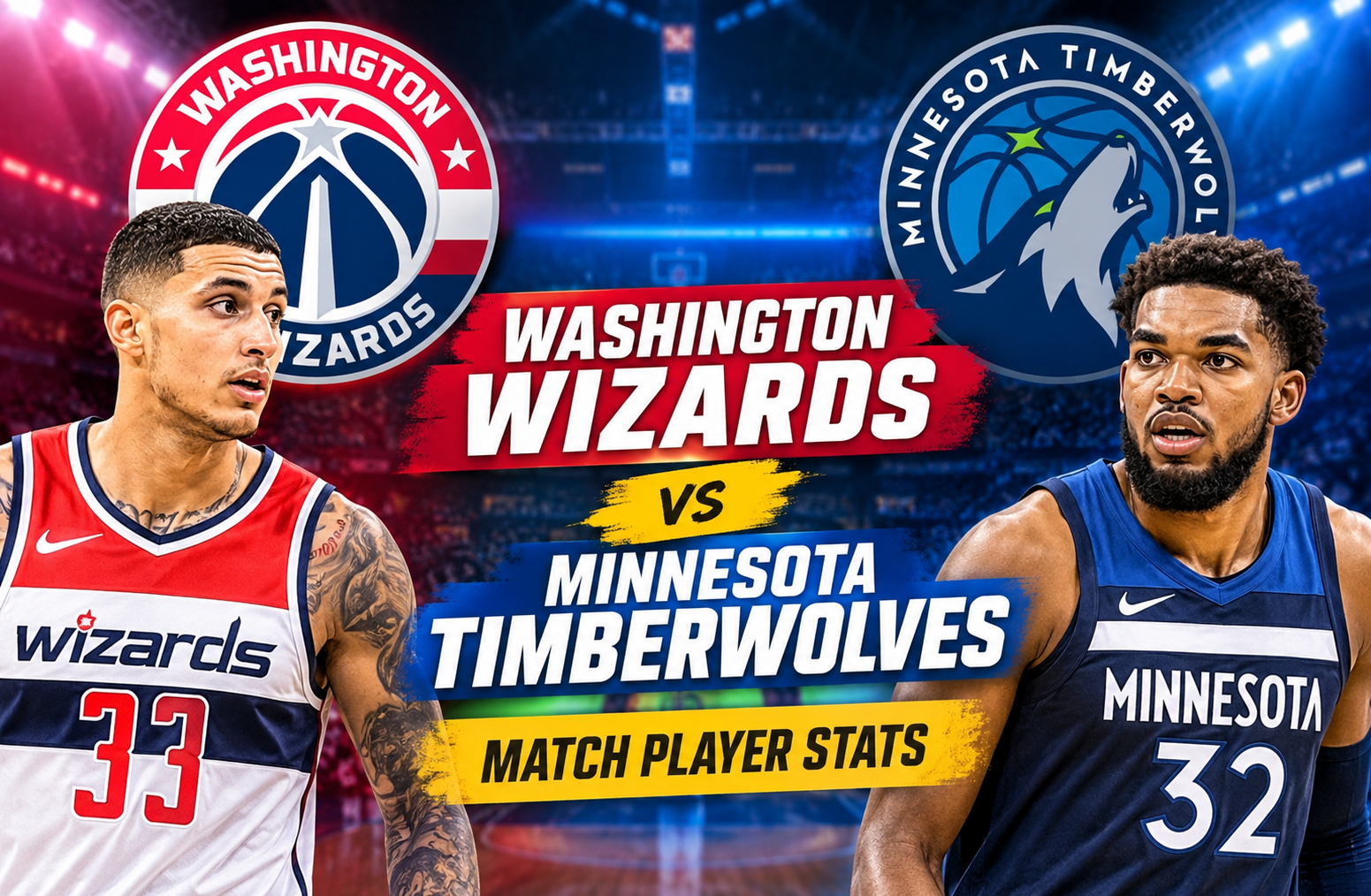
Washington Wizards vs Timberwolves Match Player Stats
The washington wizards vs timberwolves match player stats from February 2, 2025, reveal how Washington secured a memorable 105-103 road victory against Minnesota at Target Center. In a closely contested NBA regular-season matchup, Kyle Kuzma delivered an outstanding offensive performance, finishing with 31 points, while Jordan Poole and Bilal Coulibaly provided valuable scoring support. Minnesota received impressive contributions from Jaden McDaniels and Rudy Gobert, but its inability to match Washington’s three-point efficiency ultimately proved costly.
The two-point result was particularly significant for Washington because the team entered the contest following a difficult losing stretch. The victory ended a 16-game losing streak and demonstrated how efficient perimeter shooting, timely scoring, and contributions from multiple players could change the outcome of a challenging road game.
Minnesota also had several strong individual performances. McDaniels recorded 23 points and 12 rebounds, while Gobert controlled the interior with 16 points and 16 rebounds. Mike Conley contributed 16 points and five assists, helping the Timberwolves maintain offensive balance.
Although Minnesota finished with more rebounds and assists, Washington converted its opportunities more efficiently. The Wizards shot approximately 46% from the field and 45% from three-point range, creating an important advantage against a Minnesota team that struggled from beyond the arc.
This breakdown examines the final score, individual performances, team statistics, shooting efficiency, tactical differences, and the most important lessons from the matchup.
Washington Wizards vs Timberwolves Match Player Stats: Game Overview
The February 2 matchup featured two teams with different objectives and contrasting circumstances. Washington needed a positive result after an extended period of disappointing performances, while Minnesota wanted to protect its home court and continue building momentum.
The Wizards ultimately achieved their objective through efficient shooting and important contributions from their leading players.
Washington Wizards Scores, Stats and Highlights – ESPN
WASHINGTON
105
WINNER
VS
FINAL
105-103
MINNESOTA
103
HOME TEAM
Date
February 2, 2025
Venue
Target Center
Location
Minneapolis, Minnesota
Competition
NBA Regular Season
Leading scorer
Kyle Kuzma, 31 points
Leading rebounder
Rudy Gobert, 16 rebounds
The NBA’s official game listing identifies the contest as February 1 in Minneapolis local game scheduling, corresponding to February 2 in the supplied reporting date and UTC-based listings.
Final Score by Quarter
The game remained competitive throughout all four quarters. Neither team managed to establish a decisive advantage, and the final period created additional pressure as Minnesota attempted to complete a comeback.
| Quarter | Washington | Minnesota |
| First | 27 | 26 |
| Second | 31 | 31 |
| Third | 25 | 20 |
| Fourth | 22 | 26 |
| Final | 105 | 103 |
Washington’s strongest advantage came during the third quarter, when it outscored Minnesota by five points.
The Wizards carried that advantage into the final period. Minnesota responded with a stronger fourth-quarter performance, scoring 26 points compared with Washington’s 22, but the comeback was not enough to change the result.
The scoring distribution highlights an important aspect of the game: Washington did not need to dominate every quarter. Instead, the team built a small advantage during the middle portions of the contest and managed to preserve it.
Washington Wizards Player Stats and Individual Performances
Washington’s victory was built around several productive individual performances. Kyle Kuzma was the clear offensive leader, but the supporting cast also played an important role.
The Wizards received contributions from their backcourt, forwards, and center position. This balance prevented Minnesota from focusing exclusively on one offensive threat.
Kyle Kuzma Leads Washington With 31 Points
Oklahoma City Thunder v Washington Wizards
Kyle Kuzma
31 PTS
8 rebounds in the supplied game summary
Washington’s leading scorer
Kyle Kuzma delivered the most influential offensive performance of the night. His 31 points gave Washington a reliable scoring foundation and helped the team remain competitive throughout the contest.
He also converted five three-point attempts, demonstrating his ability to score from different areas of the court.
Kuzma’s shooting efficiency was particularly impressive. He finished with 13 successful field goals on 24 attempts, including five made three-pointers on 10 attempts.
His ability to create scoring opportunities was important because Minnesota had several capable defensive players.
Kuzma also produced a significant second-quarter scoring stretch. According to the game recap, he scored 16 consecutive points for Washington during that period.
That contribution helped the Wizards maintain offensive momentum when they needed an individual player to take responsibility.
His performance demonstrated three important strengths:
- Scoring consistency: Kuzma repeatedly created opportunities and converted difficult attempts.
- Perimeter shooting: Five successful three-pointers stretched Minnesota’s defensive coverage.
- Offensive responsibility: His scoring helped Washington avoid depending entirely on its other players.
Kuzma’s 31-point performance was the defining individual contribution of the game.
Jordan Poole Adds 19 Important Points
Minnesota Timberwolves v Washington Wizards
Jordan Poole
19 PTS
4 rebounds and 3 assists
Jordan Poole provided another important scoring option for Washington.
His 19 points gave the Wizards additional offensive production and reduced the pressure on Kuzma to generate every important basket.
Poole’s presence was especially useful because Washington needed players capable of creating shots independently.
He finished with four successful three-pointers, giving the Wizards another perimeter threat.
His scoring also helped Washington maintain offensive flexibility. Minnesota could not concentrate all its defensive attention on Kuzma without creating opportunities for Poole.
Poole’s contribution was therefore about more than his total points. His ability to create offensive pressure helped Washington maintain a balanced attack.
Bilal Coulibaly Contributes 14 Points and Five Assists
Minnesota Timberwolves v Washington Wizards
Bilal Coulibaly
14 PTS
5 assists and 4 rebounds
Bilal Coulibaly delivered a productive all-around performance.
His 14 points gave Washington another double-digit scorer, while his five assists demonstrated his ability to contribute beyond individual scoring.
Coulibaly’s performance was important because the Wizards needed offensive contributions from players outside their primary scoring options.
His passing helped connect different parts of the offense and created additional opportunities for teammates.
He also contributed defensively, giving Washington useful activity on both ends of the floor.
For a young player, this type of performance illustrates the value of versatility. Scoring, passing, and defensive involvement can all influence a close NBA game.
Jonas Valanciunas Records a Double-Double
NBA Trade Rumors: Latest on Jonas Valančiūnas, Malcolm Brogdon, Jordan Clarkson, More
Jonas Valanciunas
13 PTS
10 rebounds and 2 assists
Double-double
Jonas Valanciunas supplied Washington with an important interior presence.
His 13 points and 10 rebounds produced a double-double, giving the Wizards valuable production around the basket.
Valanciunas was particularly useful against Minnesota’s physical frontcourt.
The Timberwolves had Rudy Gobert, one of the most influential interior defenders and rebounders in the league. Valanciunas helped Washington maintain a presence in the paint and compete physically.
His contribution became especially important during the fourth quarter.
The game recap identifies Valanciunas as a major contributor during a decisive 9-0 Washington scoring run. With the Wizards trailing 93-91, he scored five points during that stretch, helping Washington establish a 99-93 advantage.
That sequence illustrated why his contribution was important beyond the final statistical totals.
Other Washington Players
Washington also received useful production from its supporting players.
| Player | Points | Rebounds | Assists |
| Corey Kispert | 8 | 4 | 1 |
| Richaun Holmes | 6 | 3 | 3 |
| Malcolm Brogdon | 3 | 5 | 4 |
| Kyshawn George | 11 | 6 | 2 |
These contributions helped Washington maintain its offensive structure.
Kyshawn George was particularly useful as another scoring option, finishing with 11 points and six rebounds.
Malcolm Brogdon contributed five rebounds and four assists, offering additional experience and playmaking.
Richaun Holmes provided six points, three rebounds, and three assists.
Although these performances received less attention than Kuzma’s scoring, they helped create the team balance required to win a close road game.
Minnesota Timberwolves Player Stats and Individual Performances
Minnesota had several strong individual performances, particularly from its frontcourt.
The Timberwolves finished with more rebounds and assists than Washington. However, their shooting efficiency was not sufficient to overcome the Wizards’ perimeter advantage.
Jaden McDaniels Leads Minnesota With 23 Points
Jaden McDaniels
23 PTS
12 rebounds and 4 assists
Minnesota’s leading scorer
Jaden McDaniels was Minnesota’s most productive scorer.
He finished with 23 points and 12 rebounds, recording a double-double that demonstrated his importance on both ends of the court.
His scoring provided Minnesota with a dependable offensive option, particularly when the team needed to respond to Washington’s runs.
McDaniels also contributed four assists, demonstrating that his performance extended beyond scoring and rebounding.
His 23 points made him the leading scorer for Minnesota, but his efforts were not enough to secure the victory.
One notable aspect of his performance was his ability to contribute across multiple statistical categories.
A player who can score, rebound, and facilitate offensive possessions offers significant value, particularly in a competitive matchup.
Rudy Gobert Controls the Rebounding Battle
Rudy Gobert is quietly falling apart for the Timberwolves
Rudy Gobert
16 REB
16 points and 4 assists
Game-high rebounds
Rudy Gobert produced one of the strongest interior performances of the matchup.
His 16 points and 16 rebounds gave Minnesota an important advantage around the basket.
Gobert’s rebounding was particularly valuable because Washington had to compete against his size, positioning, and ability to secure defensive possessions.
His offensive production also provided Minnesota with another reliable scoring option.
However, his individual success did not translate into a team victory.
The Wizards were able to remain efficient from three-point range, which limited the overall impact of Minnesota’s advantage inside the paint.
Gobert’s performance demonstrates an important basketball principle: dominating one statistical category does not automatically guarantee victory.
A team must also convert its scoring opportunities and prevent opponents from exploiting other areas of the game.
Mike Conley Provides 16 Points and Five Assists
The Timberwolves’ Bench is a Glaring Problem Tim Connelly Must Fix
Mike Conley
16 PTS
3 rebounds and 5 assists
Mike Conley delivered a balanced performance as Minnesota’s experienced playmaker.
He scored 16 points and recorded five assists, helping the Timberwolves organize their offensive possessions.
His experience was important in a game where Minnesota needed to manage pressure and find consistent scoring opportunities.
Conley also contributed perimeter shooting, making two three-pointers.
His five assists helped Minnesota finish with 29 total assists, three more than Washington.
However, Minnesota needed greater shooting efficiency to turn its ball movement into a decisive advantage.
Nickeil Alexander-Walker Adds 14 Points
Minnesota Timberwolves v Washington Wizards
Nickeil Alexander-Walker
14 PTS
3 rebounds and 5 assists
Nickeil Alexander-Walker contributed 14 points and five assists.
His scoring provided Minnesota with another option outside its leading frontcourt players.
He also attempted several perimeter shots, helping maintain the Timberwolves’ offensive spacing.
However, Minnesota’s three-point shooting difficulties reduced the overall value of its perimeter opportunities.
Alexander-Walker’s final contribution included an important late-game moment. Minnesota had an opportunity to tie the contest with a final three-point attempt, but the shot did not fall.
That missed opportunity allowed Washington to preserve its narrow advantage.
Other Minnesota Contributions
Minnesota received additional scoring support from its rotation.
| Player | Points | Rebounds | Assists |
| Naz Reid | 8 | 3 | 0 |
| Jaden McDaniels | 23 | 12 | 4 |
| Rudy Gobert | 16 | 16 | 4 |
| Mike Conley | 16 | 3 | 5 |
| Nickeil Alexander-Walker | 14 | 3 | 5 |
The supporting rotation helped Minnesota maintain offensive activity, but the team’s overall shooting percentage remained a major concern.
The Timberwolves needed better perimeter conversion to complement their interior production.
Complete Team Statistics Comparison
The team statistics provide a clearer explanation of why Washington won despite Minnesota’s advantages in several traditional categories.
Washington was more efficient from the field and significantly more accurate from three-point range.
| Statistical Category | Washington | Minnesota |
| Final Score | 105 | 103 |
| Field Goal Percentage | 45.8% | 40.9% |
| Three-Point Percentage | 45.5% | 30.0% |
| Free Throw Percentage | 82.4% | 83.3% |
| Rebounds (player totals) | 44 | 47 |
| Assists | 26 | 29 |
| Steals | 7 | 10 |
| Blocks | 6 | 3 |
| Turnovers | 16 | 14 |
Note: The rebound figures above refer to the player-rebound totals in the supplied comparison. Official box-score team totals can differ when team rebounds are included.
Field Goal Efficiency
Washington’s 45.8% field goal percentage was considerably better than Minnesota’s 40.9%.
That difference suggests the Wizards converted a greater proportion of their attempts into successful baskets.
In a game decided by only two points, shooting efficiency becomes especially important.
Minnesota generated opportunities through ball movement and rebounding, but it did not convert enough attempts to build a comfortable scoring advantage.
Washington’s ability to finish possessions helped maintain its position throughout the game.
Three-Point Shooting Made the Difference
Three-point shooting percentage
Washington had a 15.5 percentage-point advantage.
The biggest statistical difference came from three-point shooting.
Washington converted approximately 45.5% of its attempts from beyond the arc, compared with Minnesota’s 30%.
That represents a 15.5 percentage-point difference.
This was one of the clearest reasons Washington managed to win despite Minnesota’s advantages in rebounding and assists.
Three-point shooting is particularly valuable because every successful attempt produces three points instead of two.
Washington’s 15 successful three-pointers generated 45 points from beyond the arc.
Minnesota made 12 three-pointers, producing 36 points.
The nine-point difference in total three-point scoring was significant in a contest decided by just two points.
Rebounding Advantage Belonged to Minnesota
Minnesota recorded 47 player rebounds compared with Washington’s 44 in the supplied statistics.
Gobert was the biggest contributor, collecting 16 rebounds.
McDaniels also played an important role with 12 rebounds.
Washington’s Valanciunas finished with 10 rebounds, providing a useful response against Minnesota’s physical frontcourt.
Although Minnesota won the rebounding comparison, it could not fully convert that advantage into additional points.
This illustrates why rebounds should always be considered alongside shooting efficiency and overall offensive production.
Assists Show Minnesota’s Ball Movement
Minnesota finished with 29 assists, while Washington recorded 26.
The difference suggests that the Timberwolves generated slightly more assisted scoring opportunities.
Conley and Alexander-Walker were particularly important in this area.
However, additional assists do not automatically produce a better offensive result.
A team must still convert the opportunities created by passing.
Minnesota’s 40.9% field goal percentage and 30% three-point percentage show that its ball movement did not translate into enough successful shots.
Turnovers and Defensive Activity
Minnesota recorded 14 turnovers compared with Washington’s 16.
The Timberwolves also finished with more steals, recording 10 compared with Washington’s seven.
These numbers indicate that Minnesota was competitive in generating defensive activity and protecting possession.
However, Washington’s shooting advantage outweighed the two-turnover difference.
The Wizards were able to score efficiently enough to survive Minnesota’s defensive pressure.
Why Washington Wizards Defeated Minnesota Timberwolves
Washington’s victory was not the result of a single statistical advantage.
Several factors combined to produce the final result.
1. Kyle Kuzma’s Offensive Leadership
Kuzma’s 31 points gave Washington the scoring production it needed.
His ability to score from the perimeter and inside the arc created difficulties for Minnesota’s defense.
He also delivered an important scoring stretch during the second quarter.
Without that offensive contribution, Washington would have faced greater pressure to find points from its supporting players.
2. Superior Three-Point Accuracy
Washington’s 45.5% three-point shooting was a major advantage.
The Wizards made 15 three-pointers, while Minnesota converted 12.
This difference helped Washington compensate for Minnesota’s stronger rebounding and assist numbers.
The lesson is straightforward: efficient perimeter shooting can change the outcome of a closely contested game.
3. Valanciunas Made Important Contributions
Valanciunas recorded a double-double and contributed during a decisive scoring run.
His five points during Washington’s 9-0 run helped the Wizards move from a 93-91 deficit to a 99-93 advantage.
That sequence was especially important because Minnesota was attempting to take control of the game late.
4. Washington Maintained Its Advantage Under Pressure
Minnesota did not give up when Washington established its advantage.
The Timberwolves scored 26 points in the fourth quarter and reduced the deficit.
However, Washington maintained enough control to finish ahead.
The Wizards did not need a perfect final quarter. They simply needed to protect their lead and make Minnesota work for every remaining scoring opportunity.
5. Minnesota Could Not Match Washington’s Shooting Efficiency
Minnesota’s 40.9% field goal percentage was a major obstacle.
Its three-point shooting was even more problematic.
The Timberwolves produced several excellent individual performances, but the team’s overall shooting efficiency was insufficient.
This difference ultimately separated the teams.
Key Moments That Influenced the Game
The final score tells only part of the story. Several important sequences explain how Washington managed to secure the victory.
Kuzma’s Second-Quarter Scoring Run
Kuzma scored 16 consecutive points for Washington during the second quarter.
This stretch demonstrated his offensive importance and helped the Wizards establish a productive scoring rhythm.
It also prevented Minnesota from gaining control during a period when Washington needed consistent production.
Washington’s Third-Quarter Advantage
Washington outscored Minnesota 25-20 during the third quarter.
Although five points may appear modest, it was important in a game that finished with a two-point margin.
The Wizards entered the fourth quarter with a useful advantage.
Valanciunas Helps Produce a 9-0 Run
One of the most important sequences occurred late in the fourth quarter.
Washington was trailing 93-91 when Valanciunas contributed five points during a 9-0 run.
The sequence helped Washington establish a 99-93 advantage with 3:52 remaining.
That stretch shifted the pressure onto Minnesota.
Minnesota’s Late Comeback Attempt
The Timberwolves continued fighting and reduced Washington’s advantage.
Mike Conley’s three free throws brought the score to 105-103 with 15.1 seconds remaining.
Minnesota then had another opportunity to tie the game.
However, Alexander-Walker’s potential game-tying three-point attempt missed, and Washington secured the rebound to preserve its victory.
Tactical Analysis: What the Statistics Reveal
Looking beyond the final score helps explain the different approaches used by both teams.
Washington’s Perimeter-Oriented Offense
Washington benefited from its ability to generate points through perimeter shooting.
Kuzma and Poole were important parts of this approach.
Their combined production created pressure on Minnesota’s defense and prevented the Timberwolves from concentrating entirely on the interior.
The Wizards also benefited from contributions by Coulibaly and George.
This distribution made their offense less predictable.
Minnesota’s Interior Strength
Minnesota’s biggest advantage came from its frontcourt.
Gobert’s 16 rebounds and McDaniels’ 12 rebounds gave the Timberwolves a strong presence around the basket.
Their contributions helped Minnesota finish ahead in the rebound comparison.
However, interior strength alone was not enough.
The Timberwolves needed more accurate perimeter shooting to create a balanced offensive attack.
The Importance of Shot Selection
The difference between 45.5% and 30% three-point shooting highlights the importance of shot conversion.
Washington made better use of its perimeter opportunities.
Minnesota created scoring chances but did not convert them at a comparable rate.
This is particularly important when evaluating games with narrow margins.
A few additional successful three-point attempts could have changed the final result.
Offensive Balance Versus Individual Production
Both teams had strong individual performers.
Washington’s Kuzma led the scoring, while Minnesota received significant production from McDaniels and Gobert.
However, Washington’s supporting cast provided sufficient scoring to complement its leading player.
That balance helped the Wizards maintain their advantage.
Minnesota also had several contributors, but its overall shooting performance prevented those efforts from producing a winning result.
Player Comparison: Washington vs Minnesota
The leading players from both teams provide an interesting comparison.
| Category | Washington Player | Statistics | Minnesota Player | Statistics |
| Leading scorer | Kyle Kuzma | 31 PTS | Jaden McDaniels | 23 PTS |
| Leading rebounder | Jonas Valanciunas | 10 REB | Rudy Gobert | 16 REB |
| Playmaking contributor | Bilal Coulibaly | 5 AST | Mike Conley | 5 AST |
| Secondary scorer | Jordan Poole | 19 PTS | Mike Conley | 16 PTS |
| All-around contributor | Bilal Coulibaly | 14 PTS, 5 AST | Jaden McDaniels | 23 PTS, 12 REB |
This comparison shows that the two teams received their strongest contributions from different areas.
Washington benefited from perimeter scoring and Kuzma’s offensive production.
Minnesota relied heavily on its frontcourt, particularly McDaniels and Gobert.
Both approaches produced competitive basketball, but Washington’s shooting efficiency created the decisive advantage.
What This Result Meant for Both Teams
The outcome had different implications for Washington and Minnesota.
Washington Ended a Difficult Losing Streak
The victory was particularly important for the Wizards because it ended a 16-game losing streak.
A road win against a competitive opponent provided a positive result during a difficult period.
It also demonstrated that Washington could compete when its leading players and supporting rotation produced efficient performances.
Kuzma’s scoring, Poole’s contribution, and Valanciunas’ interior production all played important roles.
Minnesota Missed an Opportunity at Home
Minnesota entered the game with a stronger position in the Western Conference standings.
However, the Timberwolves could not protect their home court.
The loss also ended a five-game winning streak.
The result highlighted an important weakness: even when a team controls the rebounding battle and produces more assists, inefficient shooting can still lead to defeat.
The Season Series Finished Even
The two teams finished their regular-season series tied 1-1.
This result meant neither team secured a season-series advantage.
Their meetings demonstrated how different playing styles could create competitive matchups.
Washington relied on perimeter scoring in this game, while Minnesota generated considerable production from its interior players.
Understanding Match Player Statistics Correctly
For readers following NBA games, understanding individual and team statistics is essential.
A box score provides useful information, but interpreting the numbers correctly makes the analysis more meaningful.
Here are some important statistics from this matchup and what they reveal.
Points
Points measure a player’s total scoring contribution.
Kuzma’s 31 points made him the leading scorer, while McDaniels led Minnesota with 23.
Points are useful for identifying offensive leaders, but they do not explain shooting efficiency by themselves.
Rebounds
Rebounds measure how many missed shots a player recovers.
Offensive rebounds provide additional scoring opportunities, while defensive rebounds help a team finish the opponent’s possession.
Gobert’s 16 rebounds made him the leading rebounder in this matchup.
Assists
An assist is credited when a pass directly leads to a successful field goal under the official scoring rules.
Conley and Coulibaly both recorded five assists.
These numbers help identify players who contribute to team offense through passing and playmaking.
Field Goal Percentage
Field goal percentage measures the proportion of successful field goals.
It is calculated by dividing made field goals by attempted field goals and multiplying by 100.
Washington’s 45.8% figure was better than Minnesota’s 40.9%.
Three-Point Percentage
Three-point percentage measures how accurately a player or team converts shots from beyond the three-point line.
Washington’s 45.5% performance was one of the most important statistical advantages in this matchup.
Turnovers
A turnover occurs when a team loses possession without completing a successful field goal attempt that continues the possession.
Minnesota committed 14 turnovers, while Washington recorded 16.
This category favored the Timberwolves, although the difference was not large enough to overcome their shooting disadvantage.
Frequently Asked Questions
1. Who won the Washington Wizards vs Minnesota Timberwolves game on February 2, 2025?
The Washington Wizards defeated the Minnesota Timberwolves 105-103 at Target Center in Minneapolis. Washington secured the two-point road victory through efficient shooting and strong performances from its leading players.
2. Who scored the most points in the matchup?
Kyle Kuzma was the leading scorer with 31 points for Washington. He also made five three-pointers and recorded eight rebounds in the supplied game summary.
3. How many points did Jaden McDaniels score against Washington?
Jaden McDaniels scored 23 points and collected 12 rebounds for Minnesota. His performance made him the Timberwolves’ leading scorer.
4. How many rebounds did Rudy Gobert record?
Rudy Gobert recorded 16 rebounds and 16 points. He led all players in rebounds during the matchup.
5. Which team had better three-point shooting?
Washington had better three-point shooting, converting approximately 45.5% of its attempts compared with Minnesota’s 30%. This difference was a major factor in the Wizards’ victory.
6. What was the regular-season series result between the two teams?
Washington and Minnesota finished their two-game regular-season series tied 1-1. Neither team secured an overall series advantage.
Conclusion
The February 2, 2025, matchup between Washington and Minnesota demonstrated how shooting efficiency and timely individual performances can determine the outcome of a close NBA contest.
Washington secured a 105-103 victory despite finishing behind Minnesota in rebounds and assists. Kyle Kuzma led the Wizards with 31 points, Jordan Poole contributed 19, and Bilal Coulibaly added 14 points and five assists. Jonas Valanciunas also delivered an important double-double with 13 points and 10 rebounds.
Minnesota received outstanding performances from Jaden McDaniels and Rudy Gobert. McDaniels recorded 23 points and 12 rebounds, while Gobert finished with 16 points and 16 rebounds. Mike Conley and Nickeil Alexander-Walker also provided valuable offensive support.
The most important statistical difference was three-point shooting. Washington converted 45.5% of its attempts, compared with Minnesota’s 30%. That advantage helped the Wizards overcome Minnesota’s stronger rebounding and assist numbers.
Valanciunas’ contribution during the decisive fourth-quarter scoring run also played an important role. Washington established a six-point advantage late in the contest and managed to protect its lead against Minnesota’s comeback attempt.
Ultimately, the washington wizards vs timberwolves match player stats show that Washington’s offensive efficiency, Kuzma’s scoring leadership, and contributions from its supporting players were decisive. The result ended Washington’s 16-game losing streak, while Minnesota missed an opportunity to extend its winning run at home.