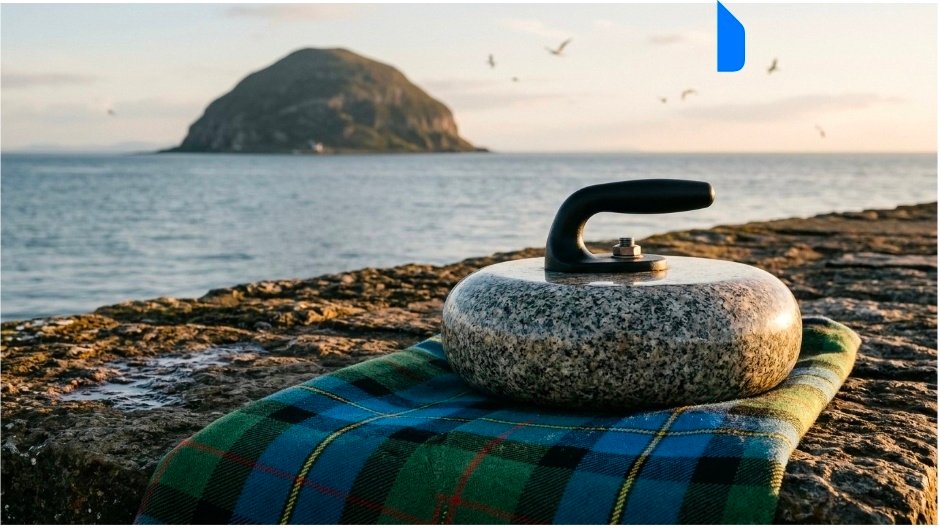
The Kennedys’ Rock: Ailsa Craig, the Granite Every Curler Knows, and the Kennedy Tartan
Ten miles off the Ayrshire coast, where the Firth of Clyde opens towards Ireland, a single dome of rock rises more than a thousand feet out of the sea. It is known as Paddy’s Milestone, because it stands roughly halfway between Belfast and Glasgow. Birdwatchers know it for its gannets. And curlers, from Scotland to Manitoba to Japan, know it as the island that supplies the granite for Olympic curling stones.
The island belongs to the head of the Kennedys, and has given its name to his title, Marquess of Ailsa. That makes Ailsa Craig, in a sense, the most widely travelled piece of Kennedy property there is, and a good place to begin the story of the Kennedy tartan, the green and blue cloth of a family that has looked out at the rock from the Carrick shore for more than six hundred years.
The rock
Ailsa Craig is the plug of an ancient volcano, about two miles round, made almost entirely of a fine-grained granite that geologists call microgranite. It has a nineteenth-century lighthouse that no longer needs a keeper, the ruins of a small tower house, and no people at all. What it does have is birds, above all a large colony of gannets, which wardens protect by trapping rats so that boats from the mainland cannot bring them back.
The Kennedys of Carrick, the upland south of Ayrshire, rose to be the most powerful family in the south-west of Scotland. In 1509 their chief became the first Earl of Cassillis. They built castles all along the coast that faces the rock, at Dunure and at Culzean among others, and in 1831 the twelfth earl was raised to a marquessate and took his new title from the island. The Kennedy crest is a dolphin, and the family motto, Avise la fin, tells its bearers to consider the end.
Blue Hone and Common Green
Curling is a Scottish game, played on frozen lochs and ponds since at least the sixteenth century with whatever heavy, smooth stones the rivers supplied. As it grew into an organised sport, players learned that not every rock would do. A curling stone has to survive being driven into other stones at speed, over and over, in freezing damp, without chipping or splitting, and it has to run true across the ice.
Ailsa Craig granite does all of that. Since 1851 a firm in Mauchline, inland in Ayrshire, has turned it into curling stones, and today Kays of Scotland holds the only licence to take granite from the island. It uses two kinds. Ailsa Craig Common Green, which falls from the cliffs of its own accord and is gathered from the rockfall, makes up the body of the stone, including the striking band round the middle that takes the impact. Blue Hone, which the firm says can be found nowhere else in the world, forms the running surface underneath. It is almost waterproof, so meltwater cannot soak in, freeze and flake it away.
A Highland cloth for a Lowland family
As Lowlanders, the Kennedys wore no tartan of their own before the 1800s, and the one they wear now has a Highland story behind it. It was first recorded in 1847 in The Clans of the Scottish Highlands, the celebrated picture book by the painter R. R. McIan and the antiquary James Logan. One account says it was the cloth of the Kennedys of Lochaber, a northern branch of the name who followed Cameron of Lochiel, and that the Kennedys of Carrick took it up in the eighteenth century to show their Jacobite sympathies. That may be tradition rather than history, but the cloth itself is real enough.
It is a green tartan with a wide blue band running through it, the blue broken by narrow black stripes, and fine lines of red and yellow give the surface a lively, restless look. According to the archives, the same thread count, with its yellow-on-green line changed to red, is sold as King Edward VII. In Modern colours the green is deep and the blue dark, and it looks very handsome indeed on a curling rink, where everything else is white.
Manitoba, a week in January
Ross Kennedy is fifty-eight, manages a grain elevator in a prairie town in southern Manitoba, and skips a rink at a curling club that turns a hundred this winter. Canada is the biggest market in the world for Scottish curling stones, and Ross will tell anyone who stands still long enough that the running surfaces on the club’s stones came from a Kennedy island. The centenary bonspiel ends with a dinner, a piper and a toast to the founders, and the members have been asked to dress for it.
He has never owned a kilt. His grandfather, who came out from Ayrshire, had one, and it vanished with the rest of the old man’s things decades ago. When Ross went looking for a replacement, he discovered that the thing he had pictured, a kilt bought off a rail in a size, was not how it is done.
He ordered from Scottish Kilt, which makes scottish kilts for men to each customer’s own measurements, every one cut and sewn individually, in thousands of tartans. The instructions were simple and exact: the waist measured at the navel, because a kilt sits higher than trousers; the hips at their widest; and the drop from waistline to mid-knee. His wife measured him in the kitchen. He chose the Kennedy tartan in Modern colours, pleated to the sett so that the pattern runs unbroken round the back, with a plain leather sporran and a pair of green hose.
When the parcel arrives, three weeks before the bonspiel, he puts the kilt on in the bedroom and walks through to the kitchen. His wife looks him up and down and observes that it is the first time in thirty years of marriage she has seen his knees in January.
The harvest
The granite does not leave Ailsa Craig often. Common Green is gathered as boulders of six to ten tons that have come down from the cliffs on their own, and Kays can go years between harvests. Blue Hone has to be taken from the rock face itself: engineers drill into the cliff and use a gas charge to split the stone along its natural cracks, in blocks of under two tons. The boulders go by boat to Girvan harbour, where they are cut into rough discs that the trade calls cheeses, and the cheeses go on to Mauchline to be shaped, ground and polished into stones of about forty-two pounds, or nineteen kilograms.
Kays supplied stones for the first Winter Olympics in 1924 and has supplied them since curling returned as a medal sport in 1998. The stones used at Turin in 2006 were the first made entirely from Ailsa Craig granite, and the firm made every stone for the Milan Cortina Games in 2026. It turns out between 1,800 and 2,000 stones a year, and Canada is its biggest customer.
The property that matters most is one nobody sees. Good curling granite is slightly elastic, so that a stone can take the shock of a collision and give the energy back without cracking, game after game, for decades. That is why clubs pay for it. A single stone with a Blue Hone insert costs several hundred pounds, and a full set of sixteen runs to about £12,000: a great deal of money for a small prairie club, for stones that should outlast everyone who buys them.
Centenary night
On the night, after three days of curling, the members file into the hall behind a piper who has driven down from Winnipeg. Ross, in green and blue with the fine red and yellow lines, is the only man in the room wearing a kilt, and is told so roughly once a minute.
The walls are hung with photographs of the club’s rinks going back to the 1920s: men in flat caps and women in long coats, standing behind rows of stones on outdoor ice, squinting at a camera in a cold that nobody in the picture seems to notice. Some of the stones in those photographs are still in use.
The club president, a retired schoolteacher who has curled at the club for forty years, stops beside him.
“Kennedy tartan?”
“Kennedy. My grandfather was from Ayrshire.”
“And you know where the stones come from.”
“Ailsa Craig, off the Ayrshire coast.” He grins. “Belongs to the chief of the Kennedys.”
“So what you’re telling me,” she says, “is that for a hundred years this club has been throwing your family’s rocks.”
“I wouldn’t put it like that,” says Ross. “But I wouldn’t stop you.”
When the toasts come round, he proposes the last one himself. He keeps it short, because the piper is waiting and the bar is open. To the founders, he says, and to the rock. By the end of the evening three members have asked him where to order Scottish kilts for men, and one of them already has his phone out.
Consider the end
The rock in the Firth of Clyde has watched the Kennedys of Carrick for centuries from across the water, and lent its name to their chief. Its granite, gathered from rockfall and split from the cliffs, has gone round the world in a form no Kennedy earl could have imagined, sliding across the ice of the Olympics and of small-town rinks on the prairie.
The tartan has northern roots, in a branch of the name that followed Lochiel, and a painter and an antiquary first put it on paper in 1847. Deep green and dark blue, threaded with red and yellow, it looks very well on a skip from Manitoba on the night his club turns a hundred, standing in a hall full of curling stones cut from the Kennedys’ island.