Miami Heat vs Oklahoma City Thunder Match Player Stats
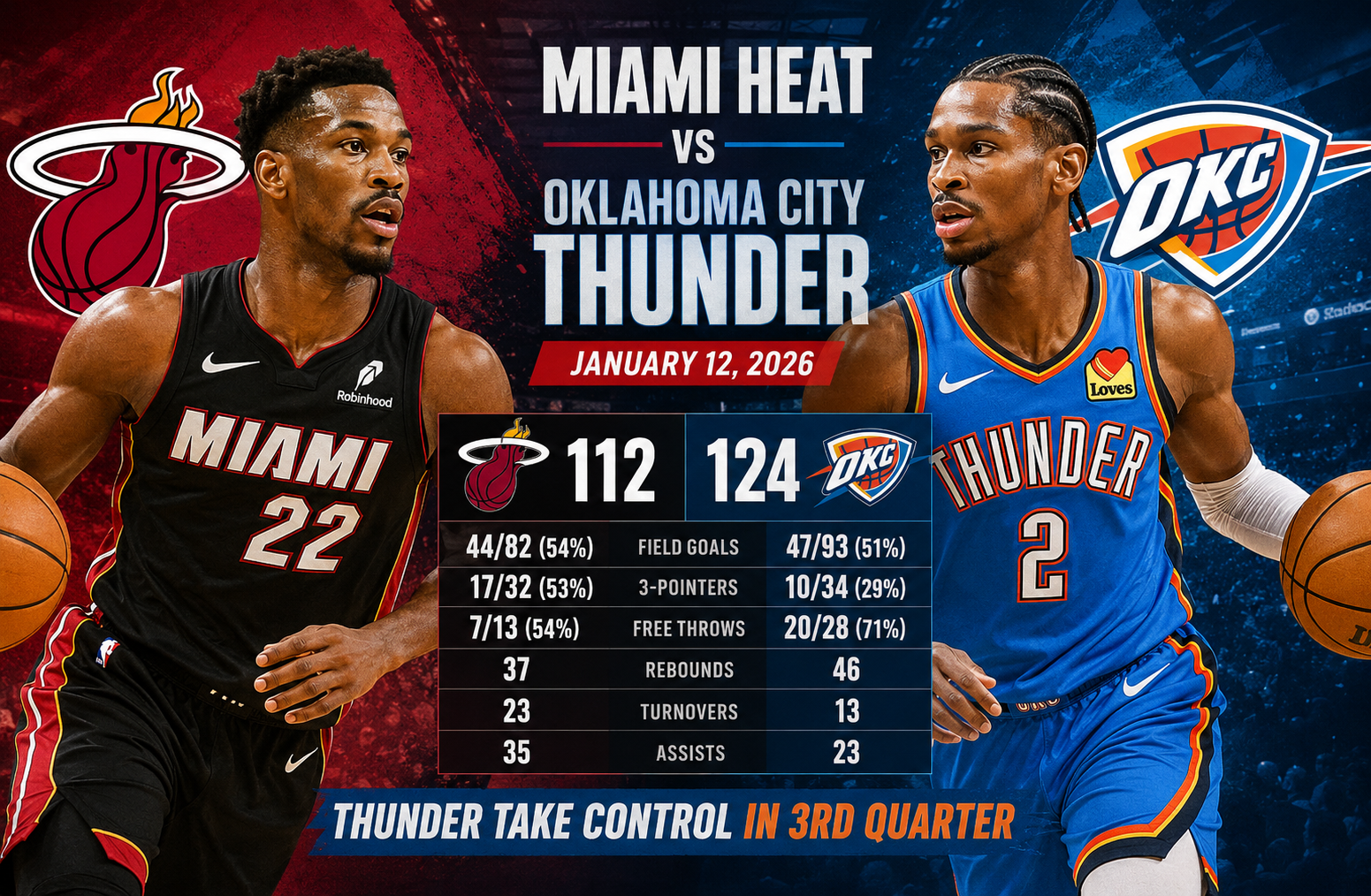
The miami heat vs oklahoma city thunder match player stats from January 12, 2026, tell the story of a competitive NBA matchup that changed dramatically after halftime. The Oklahoma City Thunder defeated the Miami Heat 124-112 at Paycom Center, overcoming a five-point halftime deficit with a powerful third-quarter performance. Shai Gilgeous-Alexander led Oklahoma City with 29 points and eight assists, while Chet Holmgren delivered a double-double with 16 points and 10 rebounds.
Miami entered the contest with excellent perimeter shooting and an impressive first-half offensive display. The Heat finished with 17 three-pointers on 53% shooting from beyond the arc, compared with Oklahoma City’s 10 three-pointers at 29%. However, the Thunder found other ways to control the game. They collected nine more rebounds, committed 10 fewer turnovers, and made 13 more free throws. These differences helped Oklahoma City turn a difficult matchup into a 12-point victory.
This game offers an interesting example of how basketball outcomes depend on more than shooting percentages. Miami was more accurate from the field and beyond the three-point line, but Oklahoma City created additional possessions, protected the basketball, and generated consistent scoring opportunities. Individual performances from Gilgeous-Alexander, Holmgren, Jalen Williams, Andrew Wiggins, and Davion Mitchell shaped the contest.
This breakdown examines the final score, individual player performances, team statistics, quarter-by-quarter action, important turning points, and the statistical factors that explain Oklahoma City’s victory.
Miami Heat vs Oklahoma City Thunder Match Player Stats: Game Overview
NBA regular-season matchup | January 12, 2026
Guida ai Miami Heat 2025-2026 | Dunkest
Miami Heat
112
Away team
Oklahoma City Thunder – Get the Latest Thunder Scores, Schedule & News
Oklahoma City Thunder
124
Winner
| Game information | Details |
| Date | January 12, 2026 |
| Venue | Paycom Center |
| Location | Oklahoma City, Oklahoma |
| Attendance | 18,203 |
| Final result | Thunder won by 12 |
| Miami record entering game | 20-19 |
| Oklahoma City record entering game | 33-7 |
| Match officials | James Capers, Matt Myers, Justin Van Duyne |
The final result reflected Oklahoma City’s ability to adjust during the game. Miami initially looked comfortable offensively, but the Thunder gradually increased their defensive pressure and improved their control of possessions.
The difference was especially noticeable after halftime. Oklahoma City scored 39 points in the third quarter, creating the separation that Miami struggled to overcome during the final period.
Quarter-by-Quarter Score
| Quarter | Miami Heat | OKC Thunder |
| First | 34 | 32 |
| Second | 25 | 22 |
| Third | 26 | 39 |
| Fourth | 27 | 31 |
| Final | 112 | 124 |
Miami won the first two quarters and entered halftime leading 59-54. Oklahoma City then outscored the Heat 39-26 in the third quarter.
That 13-point difference completely changed the game’s direction. The Thunder carried their momentum into the fourth quarter and maintained enough offensive production to protect their advantage.
Complete Miami Heat Player Statistics
Miami had several productive offensive performances despite losing the game. Andrew Wiggins led the starting lineup with 23 points, while Tyler Herro and Pelle Larsson also reached double figures.
Davion Mitchell contributed 13 points and a team-high 10 assists. His passing helped Miami create scoring opportunities, although the team’s overall turnover total limited the value of that offensive production.
Miami Heat Player Stats Table
| Player | Points | Rebounds | Assists |
| Andrew Wiggins | 23 | 5 | 3 |
| Tyler Herro | 19 | 2 | 3 |
| Pelle Larsson | 16 | 3 | 3 |
| Davion Mitchell | 13 | Not specified | 10 |
| Nikola Jovic | 13 | 4 | Not specified |
| Bam Adebayo | 6 | 14 | 4 |
The table includes the player figures available in the supplied game statistics. Unspecified figures are intentionally not estimated.
Andrew Wiggins Leads Miami With 23 Points
Andrew Wiggins was Miami’s leading scorer among the starters, finishing with 23 points, five rebounds, and three assists.
His scoring was important because Miami needed reliable offensive production against a Thunder team capable of creating defensive pressure. Wiggins provided a consistent scoring option and helped the Heat remain competitive throughout the contest.
His performance also demonstrated Miami’s ability to generate points from multiple players rather than depending entirely on one offensive star.
However, individual scoring was not enough to compensate for Miami’s possession problems. Even with Wiggins producing 23 points, the Heat struggled to maintain control of the basketball.
Tyler Herro Contributes 19 Points
Tyler Herro finished with 19 points, two rebounds, and three assists.
Herro’s perimeter scoring was particularly valuable in a game where Miami made 17 three-pointers. His offensive contribution helped the Heat establish an early advantage and remain dangerous from the outside.
One important detail from this matchup is that Miami did not lose because it lacked shooting ability. The team converted 53% of its three-point attempts, an excellent result.
The bigger problem was sustaining offensive efficiency without giving Oklahoma City additional possessions through turnovers.
Pelle Larsson Adds 16 Points
Pelle Larsson contributed 16 points, three rebounds, and three assists.
His scoring provided another useful option in Miami’s offensive rotation. When several players contribute double-digit points, opposing defenses cannot concentrate entirely on one scorer.
Larsson’s performance was also valuable because Miami needed contributions from its supporting players to challenge Oklahoma City’s balanced lineup.
Although he produced an effective scoring performance, the Heat needed stronger overall execution to turn those individual contributions into a victory.
Davion Mitchell Records 10 Assists
Davion Mitchell finished with 13 points and a team-high 10 assists.
His passing was one of Miami’s most important statistical contributions. Reaching double-digit assists indicates that he played a significant role in creating scoring opportunities for teammates.
Mitchell’s performance also provides an interesting contrast with Oklahoma City’s offensive distribution. Miami recorded 35 assists, while the Thunder finished with 23.
That difference suggests Miami was effective at creating assisted scoring opportunities. However, its 23 turnovers significantly reduced the benefits of that ball movement.
Nikola Jovic Provides Additional Scoring
Nikola Jovic recorded 13 points and four rebounds.
His contribution helped Miami maintain offensive balance. Having multiple players capable of scoring in double figures is important against a defensive team that can apply pressure across different positions.
Jovic’s production was part of a broader team effort that allowed Miami to score 112 points despite losing by 12.
The challenge was that the Heat could not consistently convert their offensive possessions into points without mistakes.
Bam Adebayo Controls the Rebounding Battle
Bam Adebayo finished with six points, 14 rebounds, and four assists.
His 14 rebounds were especially important because he helped Miami compete on the glass against Oklahoma City’s taller frontcourt.
However, his shooting performance was less effective. Adebayo converted three of his 10 field-goal attempts, limiting his scoring contribution.
His performance demonstrates why player statistics should be evaluated in context. A player can make a meaningful contribution through rebounding and passing even when his scoring numbers are relatively low.
Adebayo’s work on the boards helped Miami stay competitive, but the team needed more efficient interior scoring to match Oklahoma City’s overall production.
Oklahoma City Thunder Player Statistics
Oklahoma City’s victory was a team effort supported by strong individual performances. Shai Gilgeous-Alexander led the scoring, but Chet Holmgren, Jalen Williams, and the Thunder’s bench also played important roles.
The most impressive aspect of Oklahoma City’s performance was its ability to score efficiently in different ways. The team did not depend on three-point shooting. Instead, it attacked the basket, converted free throws, collected offensive rebounds, and capitalized on Miami’s mistakes.
Oklahoma City Thunder Player Stats Table
| Player | Points | Rebounds | Assists | Plus/Minus |
| Shai Gilgeous-Alexander | 29 | 5 | 8 | +8 |
| Jalen Williams | 18 | 4 | 4 | +4 |
| Chet Holmgren | 16 | 10 | 2 | +9 |
| Ajay Mitchell | 16 | 4 | 1 | +22 |
| Isaiah Joe | 11 | 3 | 1 | +16 |
| Aaron Wiggins | 11 | 2 | 2 | +5 |
| Jaylin Williams | 9 | 5 | 1 | +8 |
These numbers highlight the Thunder’s scoring depth. Four players scored at least 16 points, while three additional contributors reached double figures or came close.
Shai Gilgeous-Alexander Delivers a Game-High 29 Points
Shai Gilgeous-Alexander produced the most influential individual performance of the night.
He finished with:
- 29 points
- Five rebounds
- Eight assists
- 10-of-19 field-goal shooting
- Two three-pointers
- Seven made free throws on nine attempts
- One steal
- One block
- Plus/minus rating of +8
Gilgeous-Alexander was effective because he combined scoring with playmaking. His eight assists helped create opportunities for teammates, while his ability to attack the basket placed additional pressure on Miami’s defense.
His shooting numbers were also impressive. Making 10 of 19 field-goal attempts gave him a conversion rate of approximately 52.6%.
One particularly important detail was his performance in the third quarter. He scored 16 points during that period, helping Oklahoma City establish control.
According to the official NBA game recap, Gilgeous-Alexander missed his first five shots before making 10 of his next 14 attempts. This adjustment demonstrates how a strong scorer can recover from a difficult start without allowing early misses to affect the rest of his performance.
His three-pointer during Oklahoma City’s decisive 15-0 run was another major moment.
The significance of his performance was not limited to scoring. He forced Miami to pay attention to his drives, which created opportunities for other Oklahoma City players.
Chet Holmgren Records a Double-Double
Chet Holmgren finished with 16 points, 10 rebounds, two assists, and three blocks.
His performance was important on both ends of the floor.
Holmgren’s 10 rebounds gave Oklahoma City additional control in the paint. His three blocks also provided valuable rim protection, making it more difficult for Miami to finish around the basket.
His shooting numbers were equally useful:
- Seven made field goals
- 13 field-goal attempts
- One three-pointer
- 16 total points
- 10 total rebounds
Holmgren’s double-double was one of the clearest examples of Oklahoma City’s interior advantage.
His presence also allowed the Thunder to maintain pressure around the basket without relying entirely on perimeter defense.
Miami’s Bam Adebayo collected 14 rebounds, but Holmgren’s combination of scoring, rebounding, and shot-blocking provided a more balanced overall contribution.
Jalen Williams Adds 18 Points
Jalen Williams finished with 18 points, four rebounds, four assists, and two steals.
He was one of Oklahoma City’s most efficient offensive contributors, converting nine of his 13 field-goal attempts.
That represents a field-goal percentage of approximately 69.2%.
Williams did not need an unusually high number of attempts to make an impact. His ability to convert scoring opportunities helped the Thunder maintain offensive pressure.
His two steals also contributed to Oklahoma City’s defensive activity.
The important takeaway is that the Thunder had multiple players capable of creating offense. Miami could not focus exclusively on Gilgeous-Alexander because Williams and Holmgren were also producing consistently.
Ajay Mitchell Provides an Important Bench Performance
Ajay Mitchell scored 16 points in approximately 27 minutes.
He also recorded four rebounds and one assist, finishing with a remarkable +22 plus/minus rating.
His scoring was important because Oklahoma City received meaningful production beyond its leading starters.
A strong bench performance can change the direction of an NBA game, especially when the starting lineup needs rest or an opponent begins to build momentum.
Mitchell’s contribution helped maintain Oklahoma City’s offensive activity during important stretches.
His plus/minus rating was the highest among the listed Thunder contributors, showing that Oklahoma City performed particularly well during his minutes.
However, plus/minus should not be interpreted as an individual measure of responsibility for the final result. It reflects the team’s scoring margin while a player is on the court.
Isaiah Joe Adds Perimeter Scoring
Isaiah Joe contributed 11 points and three three-pointers.
His outside shooting was useful because Oklahoma City needed different ways to attack Miami’s defense.
Although the Thunder made only 10 of their 34 three-point attempts, Joe helped provide some of that perimeter production.
His ability to make outside shots also created more space for Gilgeous-Alexander and the other players attacking the basket.
Aaron Wiggins Contributes 11 Points
Aaron Wiggins recorded 11 points, two rebounds, and two assists.
He provided additional scoring depth and helped Oklahoma City avoid depending on its primary players for every offensive possession.
His contribution was particularly useful in a matchup where the Thunder needed several players to respond to Miami’s perimeter shooting.
Jaylin Williams Returns With a Useful Contribution
Jaylin Williams recorded nine points, five rebounds, and one assist.
His contribution was valuable in the frontcourt rotation.
He also returned after missing time with heel bursitis, according to the official game recap.
His five rebounds helped Oklahoma City maintain its advantage on the glass, while his scoring added another dimension to the team’s bench production.
Complete Team Statistics Comparison
The overall team numbers explain why Oklahoma City won despite Miami’s superior shooting percentages.
The Heat were more accurate from the field and beyond the three-point line. However, the Thunder generated more scoring opportunities through rebounding, free throws, and turnovers.
Miami Heat vs Oklahoma City Thunder Team Stats
| Statistical Category | Miami Heat | Oklahoma City |
| Final Score | 112 | 124 |
| Field Goals Made | 44 | 47 |
| Field Goals Attempted | 82 | 93 |
| Field-Goal Percentage | 54% | 51% |
| Three-Pointers Made | 17 | 10 |
| Three-Point Attempts | 32 | 34 |
| Three-Point Percentage | 53% | 29% |
| Free Throws Made | 7 | 20 |
| Free-Throw Attempts | 13 | 28 |
| Free-Throw Percentage | 54% | 71% |
| Total Rebounds | 37 | 46 |
| Assists | 35 | 23 |
| Turnovers | 23 | 13 |
| Steals | 9 | 12 |
| Blocks | 4 | 5 |
The most important figures are not necessarily the shooting percentages.
Oklahoma City attempted 11 more field goals than Miami and collected nine additional rebounds. It also made 13 more free throws.
These advantages helped the Thunder overcome their lower three-point percentage.
Field-Goal Efficiency: Miami Shoots More Accurately
Miami converted 44 of 82 field-goal attempts, while Oklahoma City made 47 of 93.
The Heat finished at approximately 53.7%, compared with Oklahoma City’s 50.5%.
At first glance, this suggests Miami had the more efficient shooting performance.
However, field-goal percentage does not account for every possession or scoring opportunity.
Oklahoma City attempted more shots because it collected additional rebounds and benefited from Miami’s turnovers.
The Thunder therefore had more opportunities to score even though their overall conversion rate was lower.
This is an important distinction when evaluating NBA team performances.
Three-Point Shooting: Miami Holds a Clear Advantage
Miami’s biggest statistical advantage came from the three-point line.
The Heat made 17 of 32 attempts, producing a 53.1% success rate.
Oklahoma City converted 10 of 34 attempts, finishing at approximately 29.4%.
That represents a difference of seven made three-pointers.
Miami therefore scored 21 more points than Oklahoma City from beyond the arc.
This was an impressive offensive achievement, particularly against a team with strong defensive capabilities.
However, the Thunder found ways to compensate for their outside shooting struggles.
They scored more points inside the paint, generated more second-chance opportunities, and reached the free-throw line more frequently.
Free-Throw Shooting: Oklahoma City Creates a Major Advantage
Oklahoma City made 20 of 28 free throws, while Miami converted seven of 13.
The Thunder therefore scored 13 more points from the free-throw line.
This difference was significant because it allowed Oklahoma City to continue scoring even when its perimeter shooting was inconsistent.
Free throws also help a team maintain offensive rhythm and put additional pressure on opposing players.
Miami did not generate the same number of opportunities.
The result was a substantial scoring advantage for Oklahoma City in an area that can be overlooked when attention is focused mainly on three-point shooting.
Rebounding: The Thunder Control the Glass
Oklahoma City collected 46 rebounds compared with Miami’s 37.
That nine-rebound advantage helped the Thunder gain more control over possessions.
Rebounding is important because it determines which team gets another opportunity after a missed shot.
Offensive rebounds can create second-chance points, while defensive rebounds prevent opponents from extending possessions.
The official NBA box score also recorded 14 offensive rebounds for Oklahoma City compared with five for Miami.
This is particularly important because the Thunder converted 10 of 14 offensive-rebound opportunities into 26 second-chance points.
Miami scored only one second-chance point.
That difference was one of the strongest explanations for the final result.
Turnovers: Miami’s Biggest Statistical Problem
Miami committed 23 turnovers, while Oklahoma City committed only 13.
The 10-turnover difference was one of the most damaging aspects of the Heat’s performance.
Oklahoma City scored 39 points off Miami’s turnovers.
That is an enormous contribution in a game decided by 12 points.
In simple terms, Miami gave the Thunder repeated opportunities to score without needing to create a traditional half-court possession.
Oklahoma City’s defensive pressure also produced 12 steals.
The Thunder were effective at disrupting Miami’s offensive rhythm and turning defensive stops into scoring opportunities.
Assists: Miami Shows Better Ball Movement
Miami recorded 35 assists, while Oklahoma City finished with 23.
This was one area where the Heat clearly outperformed the Thunder.
The assist total suggests Miami generated plenty of scoring opportunities through passing and coordinated offensive movement.
Davion Mitchell’s 10 assists played an important role in that production.
However, the higher assist total did not translate into a victory because Miami’s turnover problems reduced its overall possession efficiency.
A team can move the basketball effectively and still struggle if it gives away too many possessions.
That is exactly what happened in this matchup.
Defensive Production: Oklahoma City Creates More Pressure
Oklahoma City recorded:
- 12 steals
- Five blocks
- 13 turnovers committed
Miami recorded:
- Nine steals
- Four blocks
- 23 turnovers committed
The Thunder’s defensive activity helped change the game’s momentum.
Their ability to disrupt passes and pressure ball handlers made Miami’s offensive possessions less reliable.
Holmgren’s rim protection also helped limit Miami’s ability to finish inside.
Although Miami shot well, Oklahoma City’s defensive performance created enough mistakes to offset that advantage.
Why Oklahoma City Won Despite Miami’s Better Shooting
The result becomes easier to understand when the major statistical differences are considered together.
Miami had a clear advantage in shooting accuracy, but Oklahoma City won the possession battle.
This is the central lesson from the matchup.
Basketball games are not decided by one percentage or one player’s scoring total. Teams must also create opportunities, protect the ball, rebound missed shots, and convert free throws.
Oklahoma City performed better in several of those areas.
1. The Thunder Generated More Shot Opportunities
Oklahoma City attempted 93 field goals compared with Miami’s 82.
That 11-attempt advantage gave the Thunder additional chances to score.
Even with a lower field-goal percentage, more attempts helped Oklahoma City finish with 47 made field goals.
The extra attempts were connected to its superior rebounding and ability to force turnovers.
2. Oklahoma City Dominated Second-Chance Scoring
The Thunder recorded 14 offensive rebounds.
Miami collected only five.
Oklahoma City turned those extra possessions into 26 second-chance points, while Miami produced just one.
This was an especially important difference.
A missed shot does not always end an offensive possession. Teams that rebound effectively can turn unsuccessful attempts into additional scoring opportunities.
The Thunder repeatedly benefited from this advantage.
3. Turnovers Created Easy Scoring Opportunities
Miami’s 23 turnovers allowed Oklahoma City to score 39 points off those mistakes.
The Heat could not afford to lose that many possessions against a team with Oklahoma City’s offensive quality.
The Thunder did not need to rely entirely on difficult half-court shots. They could use defensive pressure to create opportunities in transition and attack before Miami’s defense was fully organized.
4. The Thunder Attacked the Paint
Oklahoma City scored 66 points in the paint, compared with Miami’s 52.
This 14-point advantage was another important factor.
The Thunder’s ability to attack inside helped compensate for their poor three-point shooting.
Holmgren’s interior presence, combined with Gilgeous-Alexander’s driving ability, gave Oklahoma City multiple ways to score near the basket.
5. Free Throws Helped Maintain the Lead
Oklahoma City’s 20 made free throws provided an additional scoring advantage.
The Heat made only seven.
This difference mattered because free throws allowed the Thunder to keep adding points without needing to make difficult shots from the field.
Taken together, the advantages in rebounds, turnovers, second-chance scoring, points in the paint, and free throws explain how Oklahoma City won.
The Third Quarter: The Turning Point of the Game
The third quarter was the most important period of the matchup.
Miami entered halftime with a 59-54 advantage. The Heat had won both opening quarters and appeared to have established a comfortable offensive rhythm.
However, Oklahoma City completely changed the situation after the break.
How the Thunder Changed the Momentum
Oklahoma City scored 39 points in the third quarter, while Miami managed only 26.
The Thunder outscored the Heat by 13 points during those 12 minutes.
Several factors contributed to this turnaround:
- Gilgeous-Alexander became more aggressive offensively.
- Oklahoma City improved its ability to attack the basket.
- Miami struggled to protect the basketball.
- The Thunder generated additional scoring opportunities through offensive rebounds.
- Oklahoma City’s defensive pressure made it harder for Miami to maintain its earlier rhythm.
One of the most significant sequences was a 15-0 Oklahoma City run.
That stretch allowed the Thunder to move from a competitive position into a commanding lead.
Gilgeous-Alexander scored 16 points in the third quarter and made a three-pointer during the decisive run.
The moment was important because Miami had previously controlled much of the game. Oklahoma City demonstrated that it could respond to adversity without depending entirely on outside shooting.
Why Miami Could Not Recover
Miami entered the fourth quarter trailing 93-85.
The Heat still had enough time to make a comeback, but Oklahoma City continued scoring effectively.
The Thunder added 31 points in the final quarter, compared with Miami’s 27.
That four-point difference extended the advantage rather than allowing Miami to close the gap.
Miami’s offensive production remained respectable, but its defensive execution was not strong enough to stop Oklahoma City consistently.
The Heat also needed to reduce turnovers and generate more reliable scoring opportunities.
The final result was a 124-112 victory for Oklahoma City.
Important Individual Matchup Comparisons
Looking beyond the overall team numbers provides a better understanding of how the leading players influenced the result.
Shai Gilgeous-Alexander vs Miami’s Leading Scorers
Gilgeous-Alexander finished with 29 points, making him the highest scorer in the game.
Andrew Wiggins led Miami with 23 points.
| Category | Shai Gilgeous-Alexander | Andrew Wiggins |
| Points | 29 | 23 |
| Rebounds | 5 | 5 |
| Assists | 8 | 3 |
| Field Goals Made | 10 | 8 |
| Field Goals Attempted | 19 | 16 |
| Three-Pointers Made | 2 | 7 |
| Plus/Minus | +8 | -14 |
Wiggins was particularly effective from three-point range, making seven of his 10 attempts.
However, Gilgeous-Alexander offered a more complete scoring and playmaking performance.
He scored six more points and recorded five additional assists.
The comparison highlights two different offensive approaches. Wiggins provided valuable perimeter shooting, while Gilgeous-Alexander created pressure through scoring, driving, and passing.
Chet Holmgren vs Bam Adebayo
The frontcourt matchup was another important part of the contest.
| Category | Chet Holmgren | Bam Adebayo |
| Points | 16 | 6 |
| Rebounds | 10 | 14 |
| Assists | 2 | 4 |
| Blocks | 3 | 1 |
| Field Goals Made | 7 | 3 |
| Field-Goal Attempts | 13 | 10 |
Adebayo won the individual rebounding comparison with 14 boards.
However, Holmgren had a stronger overall scoring contribution and recorded more blocks.
This difference is important because both players influence the game in different ways.
Adebayo’s rebounding helped Miami remain competitive, while Holmgren’s combination of interior scoring and rim protection helped Oklahoma City control the paint.
Jalen Williams vs Miami’s Supporting Scorers
Jalen Williams contributed 18 points on nine-of-13 shooting.
Miami’s Pelle Larsson scored 16 points, while Nikola Jovic also reached 13 points.
Williams’ efficiency was particularly valuable.
He scored more than Larsson while attempting fewer shots than many high-volume offensive players typically require.
His performance also demonstrated the benefit of Oklahoma City’s balanced offensive structure.
When Gilgeous-Alexander attracted defensive attention, Williams could take advantage of opportunities created elsewhere.
Bench Production and Rotation Impact
Bench production was another meaningful difference between the teams.
Oklahoma City received valuable contributions from Ajay Mitchell, Isaiah Joe, Aaron Wiggins, and Jaylin Williams.
Together, these players helped maintain offensive production outside the primary starting lineup.
Oklahoma City’s Bench Contributions
| Player | Points | Rebounds | Assists |
| Ajay Mitchell | 16 | 4 | 1 |
| Isaiah Joe | 11 | 3 | 1 |
| Aaron Wiggins | 11 | 2 | 2 |
| Jaylin Williams | 9 | 5 | 1 |
Ajay Mitchell’s 16 points were especially important.
He gave Oklahoma City another scoring option and finished with a +22 plus/minus rating.
Isaiah Joe’s three three-pointers also helped provide outside shooting.
Aaron Wiggins contributed another 11 points, while Jaylin Williams offered frontcourt support.
The combined contribution helped Oklahoma City maintain its offensive rhythm throughout the game.
Miami’s Rotation Challenges
Miami received strong scoring performances from its starting players, but the team needed better overall possession management.
Its 23 turnovers created additional pressure on the rotation.
The absence of Norman Powell was also part of the game’s availability context. He was listed as unavailable because of lower-back soreness.
It would be inaccurate to claim that his absence alone caused the defeat. However, missing an offensive contributor can affect a team’s rotation options and scoring distribution.
Miami needed its available players to execute more consistently, particularly when Oklahoma City increased its defensive intensity.
What the Statistics Reveal About Both Teams
The matchup provides several useful lessons about the strengths and weaknesses of both teams.
What Oklahoma City Did Well
Offensive balance: Seven listed Thunder contributors scored at least nine points. This made the offense less predictable and reduced its dependence on one player.
Rebounding: Oklahoma City’s 46 rebounds provided additional possessions and helped control the interior.
Defensive pressure: Twelve steals and 13 opponent turnovers reflected an effective defensive performance.
Interior scoring: The Thunder scored 66 points in the paint, demonstrating that they could attack successfully without relying on three-point shooting.
Free throws: Making 20 free throws helped Oklahoma City maintain its scoring advantage.
What Miami Did Well
Three-point shooting: The Heat converted 17 three-pointers at a 53% rate.
Ball movement: Miami’s 35 assists demonstrated strong passing and the ability to create opportunities for teammates.
Individual scoring: Andrew Wiggins, Tyler Herro, and Pelle Larsson all delivered productive offensive performances.
Rebounding contribution: Bam Adebayo’s 14 rebounds helped Miami compete against Oklahoma City’s frontcourt.
What Miami Needs to Improve
The biggest improvement area is ball security.
Twenty-three turnovers are difficult to overcome against a team that can convert mistakes into immediate scoring opportunities.
Miami also needed more production from inside the paint.
Although its perimeter shooting was excellent, Oklahoma City scored 14 more points in the paint.
Improving interior scoring and reducing careless possessions would help the Heat become more difficult to defend in similar matchups.
What Oklahoma City Can Take From This Performance
The Thunder demonstrated that strong offense does not always require excellent three-point shooting.
Their ability to attack the paint, secure rebounds, and generate free throws allowed them to win despite converting fewer three-pointers.
However, making only 10 of 34 attempts from beyond the arc is still an area worth monitoring.
A team cannot always expect to compensate for poor perimeter shooting through offensive rebounds and opponent turnovers.
The Thunder’s balanced approach was effective here, but improving outside shooting would make the offense even more difficult to defend.
Historical and Season-Series Context
The matchup was important for both teams because of their different positions entering the game.
Miami arrived with a 20-19 overall record and a 7-13 road record.
Oklahoma City entered with a 33-7 record and a 19-3 home record.
Those figures highlighted the Thunder’s stronger position entering the contest, particularly at home.
Oklahoma City’s victory improved its advantage in the season series to 1-0, according to the matchup information supplied for this game.
A second meeting was listed for January 18, 2026, in Miami. The supplied season-series information records that game as another Oklahoma City victory, 122-120.
The second result adds further context to the matchup between these teams.
However, the January 12 game remains particularly interesting because of the way Oklahoma City overcame Miami’s first-half advantage.
It was not simply a case of the stronger team leading from beginning to end. The Thunder had to respond to an opponent that was shooting exceptionally well.
That response makes the third-quarter performance one of the most important elements of the game.
Game Details, Availability and Official Statistics
For readers checking individual figures, the official NBA box score is the most useful reference because it includes player minutes, field goals, three-pointers, free throws, rebounds, assists, steals, blocks, turnovers, personal fouls, and plus/minus ratings.
The official NBA game box score and player statistics provide the detailed record of the contest.
Additional game information includes:
| Detail | Information |
| Venue | Paycom Center |
| Attendance | 18,203 |
| Officials | James Capers |
| Additional Officials | Matt Myers, Justin Van Duyne |
| Miami’s unavailable player | Norman Powell |
| Reported reason | Lower-back soreness |
| Oklahoma City’s longest scoring run | 15-0 |
| Biggest Miami lead | 9 points |
| Biggest Oklahoma City lead | 20 points |
| Lead changes | 12 |
| Times tied | 5 |
One useful detail is the number of lead changes.
The teams exchanged the advantage 12 times, showing that the game was competitive before Oklahoma City’s third-quarter surge.
The Thunder eventually built a 20-point lead, while Miami’s largest advantage was nine points.
These figures help explain the difference between the early stages and the final result.
How to Read NBA Player Statistics Correctly
Understanding a box score requires more than identifying which player scored the most points.
Several statistics provide additional information about how a player influenced the game.
Points
Points represent a player’s direct scoring contribution.
However, scoring totals should be evaluated alongside field-goal attempts and shooting percentages.
For example, Gilgeous-Alexander’s 29 points came on 10-of-19 shooting, while Williams scored 18 points on nine-of-13 attempts.
Both performances were valuable, but they involved different scoring volumes and efficiency levels.
Rebounds
Rebounds measure how often a player recovers the basketball after a missed field-goal or free-throw attempt.
They are generally divided into two categories:
- Offensive rebounds: Recovering the ball after a teammate’s missed shot.
- Defensive rebounds: Recovering the ball after an opponent’s missed shot.
Adebayo’s 14 rebounds were important because they helped Miami limit Oklahoma City’s second chances.
Holmgren’s 10 rebounds also contributed to the Thunder’s overall advantage.
Assists
An assist is credited when a player makes a pass that directly leads to a teammate’s successful field goal.
Davion Mitchell’s 10 assists demonstrate his importance as a playmaker.
However, assists do not measure every valuable pass. A pass that creates an open shot but is followed by a missed attempt does not normally receive an assist.
Steals and Blocks
Steals measure defensive plays that result in a player gaining possession from the opponent.
Blocks record successful defensive attempts to stop a shot.
Oklahoma City’s 12 steals and five blocks demonstrated its defensive activity.
These numbers are especially useful when evaluating a team’s ability to disrupt an opponent’s offense.
Turnovers
A turnover occurs when a team loses possession without completing a successful shot attempt that ends the possession normally.
Turnovers can result from:
- Bad passes.
- Offensive fouls.
- Traveling violations.
- Ball-handling mistakes.
- Violations of basketball rules.
Miami’s 23 turnovers were particularly damaging because Oklahoma City converted them into 39 points.
Plus/Minus
Plus/minus measures the difference between a team’s points scored and points allowed while a particular player is on the court.
For example, Ajay Mitchell finished at +22.
This means Oklahoma City outscored Miami by 22 points during his time on the floor.
It does not mean he personally scored 22 more points than his opponent.
Plus/minus is best interpreted alongside individual statistics, playing time, and team performance.
Key Takeaways From the Matchup
The most important lessons from the game can be summarized through several statistical observations.
- Shai Gilgeous-Alexander was the leading performer. His 29 points and eight assists provided Oklahoma City with a strong combination of scoring and playmaking.
- Miami was more accurate from three-point range. The Heat made 17 three-pointers at a 53% rate.
- Oklahoma City controlled the rebounding battle. The Thunder finished with 46 rebounds, nine more than Miami.
- Turnovers created a major scoring difference. Miami committed 23 turnovers, allowing Oklahoma City to score 39 points from those mistakes.
- The third quarter decided the game. Oklahoma City scored 39 points and outscored Miami by 13.
- Bench scoring helped the Thunder. Ajay Mitchell, Isaiah Joe, Aaron Wiggins, and Jaylin Williams provided valuable contributions.
- Bam Adebayo led all players in rebounds. His 14 boards were an important part of Miami’s performance.
- Oklahoma City found ways to score inside. Its 66 points in the paint and 26 second-chance points helped overcome its three-point shooting struggles.
These observations provide a more complete understanding of the final score than simply comparing the leading scorers.
Frequently Asked Questions
1. Who won the Miami Heat vs Oklahoma City Thunder game on January 12, 2026?
The Oklahoma City Thunder defeated the Miami Heat 124-112 at Paycom Center. Oklahoma City secured the victory through a dominant third quarter, stronger rebounding, and fewer turnovers.
2. How many points did Shai Gilgeous-Alexander score against Miami?
Shai Gilgeous-Alexander scored 29 points. He also recorded five rebounds and eight assists while shooting 10-of-19 from the field.
3. Who was Miami’s leading scorer against Oklahoma City?
Andrew Wiggins was Miami’s leading scorer with 23 points. He added five rebounds and three assists while making seven three-pointers.
4. How many rebounds did Bam Adebayo record?
Bam Adebayo recorded 14 rebounds, the highest individual rebound total in the game. He also contributed six points and four assists.
5. Why did Oklahoma City beat Miami despite shooting fewer three-pointers?
Oklahoma City won because it controlled several other statistical categories. The Thunder collected 46 rebounds, committed only 13 turnovers, made 20 free throws, and scored 26 second-chance points.
6. What was the most important quarter of the game?
The third quarter was the turning point. Oklahoma City scored 39 points compared with Miami’s 26, turning a five-point halftime deficit into an eight-point lead entering the fourth quarter.
Conclusion
The Miami Heat and Oklahoma City Thunder matchup on January 12, 2026, demonstrated how different aspects of basketball can determine the final result. Oklahoma City secured a 124-112 victory despite shooting less accurately than Miami from the field and three-point range.
Shai Gilgeous-Alexander led the Thunder with 29 points and eight assists, while Chet Holmgren recorded a double-double with 16 points and 10 rebounds. Jalen Williams added 18 points, and Ajay Mitchell contributed another 16 points from the rotation.
Miami also produced several impressive individual performances. Andrew Wiggins led the Heat with 23 points, Tyler Herro added 19, and Davion Mitchell recorded 10 assists. Bam Adebayo controlled the rebounding battle individually with 14 boards.
The biggest difference came from Oklahoma City’s ability to create and protect possessions. Its nine-rebound advantage, 10-fewer-turnover total, 26 second-chance points, and superior free-throw production helped overcome Miami’s excellent outside shooting.
Ultimately, the third-quarter surge changed the direction of the contest. Oklahoma City’s balanced offense and defensive pressure turned a five-point halftime deficit into a convincing 12-point victory.
Match Scorecard
Heat vs. Thunder
Paycom Center • Oklahoma City, OK
Heat
20 – 19
112
Final
Jan 12
124
Thunder
33 – 7
| Team | Q1 | Q2 | Q3 | Q4 | T |
| https://persistent.oaistatic.com/sonic/logos/nba/583ecea6-fb46-11e1-82cb-f4ce4684ea4c/h250-max-resize.png
Heat |
34 | 25 | 26 | 27 | 112 |
| https://persistent.oaistatic.com/sonic/logos/nba/583ecfff-fb46-11e1-82cb-f4ce4684ea4c/h250-max-resize.png
Thunder |
32 | 22 | 39 | 31 | 124 |