How Do Driver Improvement Programs Relate to Interlock Requirements?
Typically, jurisdictions that require a driver improvement program(s) and/or ignition interlock mandated situations administer these situations as a single program under supervision. The sequence of required programs and services will determine if a client can obtain a restricted license in 3 weeks or 3 months. The interlock requirement is typically a condition of a driver’s privilege to drive and is separate from the program requirement for the driver improvement/Driver Education/ASAP program which is a condition of case disposition or license reinstatement.
Where the two obligations intersect
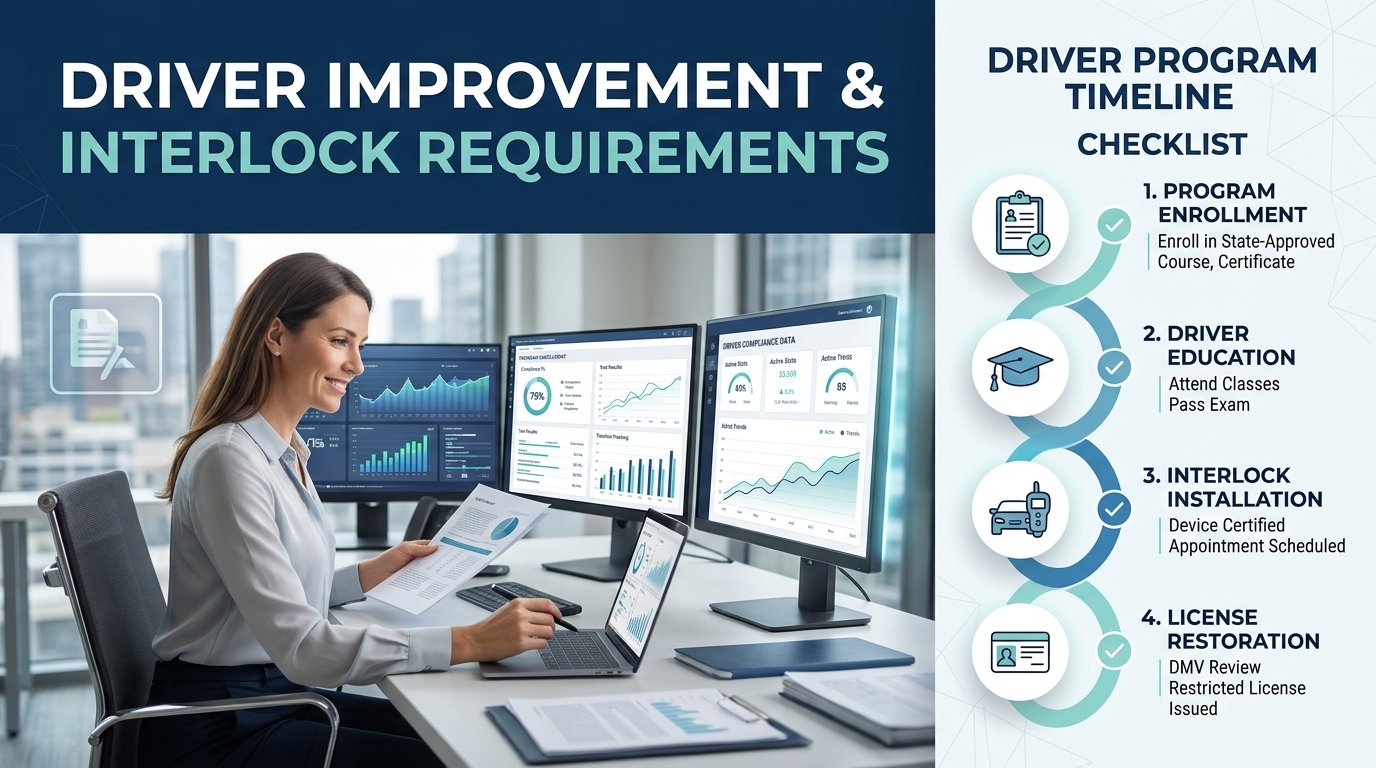
The requirement for interlock to be installed as a condition of the driver’s privilege to drive and the driver improvement/Driver Education/Alcohol Safety Action Program (ASAP) program to be completed as a condition of case disposition or license reinstatement typically occur simultaneously at the time of program enrollment in the approved driver improvement program. The program verifies the client’s enrollment in the program and the State issues the restricted license under which the interlock is installed.
In other words, the fact that interlock device installation must predate restricted license issuance and documentation is more important than it seems at first glance. Events such as a late lockout for a rolling retest, a failed startup test, tamper or circumvention attempts can occur for the logged events and there would be no case manager to monitor for and interpret such events. Intake with the driver improvement program, enrollment in the program, court or DMV paperwork to obtain a restricted license and interlock device installation are the ideal sequence of events to monitor for.
Program staff as the compliance gatekeeper
Much of the data for the reports for events is supplied by the vendor. Most of the cases are supervised by a case manager and an interpretive standard is applied by the program to the raw data to arrive at a determination of whether or not an event constitutes a violation. The client’s explanation for an event is recorded by the installer, but this explanation must be given to the case manager. Typically a single opportunity is given to the client to explain the circumstances surrounding an event on the record.
Installation logistics that affect compliance records
Check to see if a particular installer is certified with the state in which he practices by searching the current list of certified vendors on the state’s web site. A missing number or incorrect number on the authorizing document (i.e. Order or DMV authorization) is one of the reasons for rejection of certificates.
-
Confirm the vehicle is registered to the client or that an owner consent form is on file before the appointment.
-
Verify the make and model is supported, as push-button start and some hybrid systems require additional labor time.
-
Request the installation certificate in the format the issuing agency accepts, which may be electronic submission rather than a client-carried copy.
-
Schedule the first calibration appointment at the time of installation, not afterward.
Calibration intervals and missed appointments
The time frame for calibrations typically is every 30-60 days. Most programs treat a failed calibration for a clean breath sample the same as other violations of interlock compliance in that the interlock will lock up and no information will be able to be downloaded from the interlock after a download gap. Plan out the calendar from the date and time of the first service and treat each subsequent appointment with the same respect that you would for a court appearance.
Comparing the obligation types
| Element | Driver improvement or education component | Interlock component |
|---|---|---|
| Trigger | Conviction, point accumulation, or administrative referral | Court order or statutory license condition |
| Typical duration | Fixed number of sessions or weeks | Measured in months of licensed driving |
| Who monitors | Assigned case manager | Case manager, using vendor data |
| Common failure point | Missed sessions or unpaid fees | Missed calibration or unresolved lockout |
| Effect of noncompliance | Program extension or referral back to court | Suspension of restricted privileges, extension of term |
Approved providers and why the list is narrow
Virginia’s VASAP certified interlock vendors have a list of the approved models, approved service centers and how they report interlock compliance to VASAP. Efforts to comply by a driver on interlock could be wiped out by one lock and roll retest late event for example by using the services of a non-certified installer even if he or she has the same model of interlock. Before booking an appointment, clients are usually best served by working with a provider that handles VASAP ignition interlock Virginia cases day in and day out, then confirming with the state where the service center is located that it remains a certified vendor for VASAP.
The following diagram illustrates the structure of Virginia’s VASAP certified ignition interlock program. Vendor selection has been made a separate function in this diagram. In reality this would be part of the program enrollment process. The step ‘Court Reporting’ has been made outside of the local program office in this diagram. In reality the DMV, probationer’s probation office, etc. Would be the function reporting the reading for the interlock device in dispute by the driver. Individual programs and states may vary and even within a state the requirements may change often. It is best to check with the particular state agency or VASAP program office for the most up-to-date information and to verify any information. Provide a written sequence outlining all requirements with specific dates for clients to meet such as program enrollment, interlock device installation and interlock device calibrations and the earliest date the client can request release from requirements of the program.
Documentation to retain through the term
-
Installation certificate and authorization reference.
-
Every calibration receipt, including those showing no violations.
-
Written explanations submitted for any flagged event, with the date sent.
-
Proof of program fee payment and session attendance.
-
The removal authorization, which is never automatic and must be requested.
Practical guidance for advisers
So remember that all programs are different. Even within a state, programs can change. Look up the agency and the program within a state and verify all information. Create a written outline with all of the requirements listed with specific dates, including when the driver can take their first exam to seek removal from requirements.