AICOT: Meaning, Technology, Uses, Benefits, and Challenges
AICOT is a term that can refer to different technologies, organizations, and business services, depending on the context in which it appears. For people researching artificial intelligence, IT infrastructure, automation, or digital transformation, understanding aicot begins with identifying the specific organization or technology they want to learn about. One technology services business uses the name Artificial Intelligence Concepts Of Technology, while the same acronym is also associated with other applications in fields such as solar energy. These distinctions matter because similar names do not necessarily represent the same company, product, or technical system.
As businesses become more dependent on digital tools, cloud platforms, cybersecurity, and data-driven decisions, interest in technology providers and specialized solutions continues to grow. However, choosing the right solution requires more than recognizing a name. Users need to understand what a service does, which problems it can solve, how it fits into existing systems, and what limitations they should consider before making a decision.
This guide explains the meaning of AICOT, its technology-related applications, its potential benefits, the challenges associated with implementation, and practical steps for evaluating relevant solutions. It also clarifies how to distinguish between different uses of the name so readers can find information that matches their actual needs.
What Is AICOT?
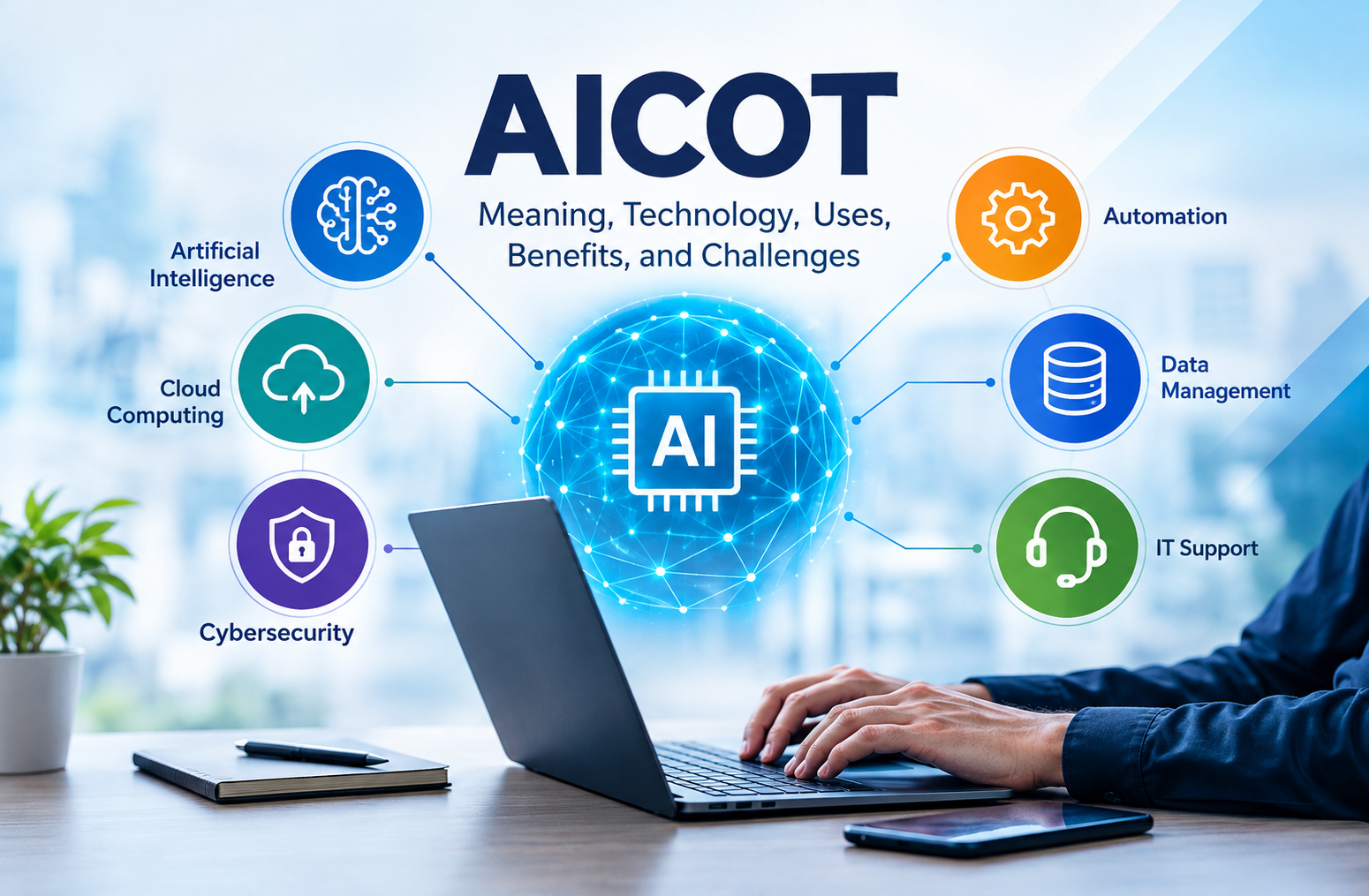
AICOT is a name used in more than one context, rather than a universally recognized term with a single definition. In the information technology sector, AICOT is used as an abbreviation for Artificial Intelligence Concepts Of Technology. The organization associated with this name describes a range of technology services covering artificial intelligence, automation, cloud computing, data management, cybersecurity, and IT support.
The broader idea behind these services is to help organizations use technology to improve business processes, manage digital infrastructure, protect information, and support customers. Depending on the particular service, this may involve implementing software, managing computer systems, analyzing business data, or improving how employees access digital tools.
It is important to separate the name of a service provider from the technologies it offers. Artificial intelligence, cloud computing, cybersecurity, and automation are established technology categories. A company may offer services in several of these areas without owning every underlying technology or developing every product itself.
Similarly, the term can appear in other industries. In solar energy, for example, OMRON uses AICOT for Anti-Islanding Control Technology, which concerns the safe operation of grid-connected solar power systems. That is a different use of the same acronym and should not be confused with a general IT services business.
Why Does the Meaning Depend on Context?
Acronyms often develop independently in different industries. Two organizations can use the same letters without sharing ownership, technology, or business activities.
The surrounding information usually provides the clearest indication of the intended meaning.
- Artificial intelligence and IT services: The term may refer to a business offering digital transformation, managed services, data analytics, and related technology solutions.
- Cloud computing and infrastructure: It may appear in discussions about servers, storage, remote access, data centers, and business continuity.
- Solar energy: It may refer to anti-islanding technology used in photovoltaic power systems.
- Automation and enterprise systems: It may appear in a broader discussion of software integration and process improvement.
Before interpreting any claim about the acronym, check the source, industry, product description, and intended audience. This simple step reduces the risk of attributing one organization’s capabilities to another.
Understanding the Technology Behind AICOT
The technology services associated with the IT-related use of the name span several connected fields. Each field solves a different problem, although businesses often combine them to create a complete digital operating environment.
Understanding these technologies individually makes it easier to assess what a particular provider can realistically deliver.
1. Artificial Intelligence
Artificial intelligence, commonly called AI, refers to computer systems designed to perform tasks that normally require human-like capabilities, such as recognizing patterns, interpreting language, classifying information, and generating predictions.
In business settings, AI can help employees process large amounts of information, identify unusual activity, summarize documents, and support decisions. Its usefulness depends on the quality of the data, the suitability of the model, and the importance of the task being automated.
For example, a customer service department might use an AI-assisted system to categorize incoming requests. Straightforward questions could receive automated responses, while complicated cases would be directed to a human employee.
This arrangement can reduce repetitive work without removing human judgment from situations that require it.
However, AI is not automatically accurate. Models may produce incorrect answers, misunderstand context, or reflect weaknesses in their training data. Organizations should establish review procedures before using AI in sensitive business processes.
2. Machine Learning and Data Analytics
Machine learning is a branch of AI in which computer systems learn patterns from data rather than relying exclusively on manually written rules.
Data analytics is the broader process of examining information to identify trends, answer questions, and support decisions. Machine learning can form part of an analytics system, but the two terms are not interchangeable.
Consider a company that wants to understand why customers stop using a service. Basic analytics could reveal cancellation rates by month, product, or customer group. A machine learning model might estimate which customers are more likely to cancel in the future.
The results can help managers investigate potential problems, but they do not establish the cause of customer behavior by themselves. Human analysis and appropriate testing remain necessary.
When evaluating a technology provider, ask how its proposed system handles incomplete data, how predictions are measured, and whether the results can be explained to the people making decisions.
3. Natural Language Processing
Natural language processing, or NLP, enables software to work with human language. Common applications include text classification, document search, translation, sentiment analysis, and conversational assistants.
Organizations that receive large volumes of emails, support tickets, contracts, or customer feedback may use NLP to organize this information more efficiently.
For instance, a support team could classify incoming messages by topic and urgency. Employees could then prioritize technical failures, billing disputes, or requests involving account access.
Language processing can save time, but performance varies by language, writing style, and context. A system trained mainly on English material may struggle with regional expressions, mixed-language messages, or specialized terminology.
Organizations should test such tools using their own real-world examples before relying on them for important decisions.
4. Cloud Computing
Cloud computing provides access to computing resources, storage, databases, and software over a network. Instead of purchasing and maintaining every server locally, a business can use infrastructure supplied through a cloud service.
This approach can make it easier to increase capacity, support remote employees, and deploy applications across different locations.
A growing business, for example, may need additional storage during busy periods. Cloud infrastructure can allow capacity to expand without requiring the company to purchase an entire new physical server environment.
Nevertheless, cloud computing does not eliminate infrastructure responsibilities. Businesses must still consider account security, access permissions, backup procedures, operating costs, data location, and service availability.
The correct choice depends on workload requirements, compliance obligations, technical expertise, and the cost of maintaining the system over time.
5. Cybersecurity
Cybersecurity involves protecting systems, networks, applications, and information from unauthorized access, disruption, theft, and misuse.
Modern organizations face threats such as phishing, stolen credentials, ransomware, insecure software, and accidental data exposure. A single weakness can affect several connected systems.
Cybersecurity services may include firewall management, security monitoring, vulnerability assessment, access control, incident response planning, and employee awareness training.
An effective security strategy does not rely on one product. It combines technical controls with clear procedures and informed employees.
For example, multi-factor authentication can reduce the risk associated with a stolen password. Regular backups can help an organization recover from certain incidents. Monitoring can identify suspicious activity that requires investigation.
No security system guarantees complete protection. The objective is to reduce risk, detect problems quickly, and limit damage when an incident occurs.
6. Automation and Enterprise Software
Business automation uses software to perform repetitive tasks according to defined rules or conditions. Enterprise resource planning systems, often called ERP systems, help organizations manage connected business activities such as inventory, purchasing, finance, and operations.
When implemented carefully, automation can reduce manual data entry and improve consistency.
Imagine a company that receives hundreds of orders each day. An integrated system could transfer order details into inventory records, generate invoices, and notify employees when stock levels fall below a set threshold.
The benefits depend on accurate data and well-designed workflows. Automating a poorly designed process can make existing mistakes happen faster and across more departments.
Businesses should therefore review their processes before introducing new software. In many cases, simplifying the workflow first delivers more value than adding complex automation.
How Businesses Can Use AICOT-Related Technology Services
The practical value of a technology provider depends on how its services address a specific operational need. Businesses should focus on measurable outcomes rather than the number of technologies mentioned in a service description.
Managed IT Services
Managed IT services involve ongoing support for computer systems, networks, applications, and other technical resources. Depending on the agreement, a provider may monitor infrastructure, troubleshoot faults, maintain software, or help manage security controls.
This model can be useful for organizations that do not have enough internal staff to handle every technical responsibility.
For example, a small company may have employees who can use business software effectively but lack the expertise to maintain network equipment or investigate complex technical failures. An external service provider can supply that expertise under an agreed support arrangement.
Before signing a contract, clarify the scope of service, support hours, response targets, escalation process, and responsibilities that remain with your own team.
Data Center Infrastructure
A data center houses computing equipment and supporting systems that allow applications and information services to operate.
Its infrastructure may include servers, networking equipment, storage devices, power protection, cooling, monitoring, and physical security.
Organizations that operate critical applications need to consider what happens when electricity fails, equipment overheats, or a network connection becomes unavailable.
A well-designed environment uses suitable redundancy, monitoring, maintenance, and recovery procedures to reduce the effect of these failures.
However, high availability is not achieved simply by purchasing expensive equipment. It requires careful system design and regular testing.
Businesses evaluating infrastructure services should ask which components have redundancy, how failures are handled, how recovery is tested, and what availability commitments are included in the contract.
Remote Access and Secure Data Sharing
Remote access allows authorized users to connect to systems or information from outside a traditional office network.
It supports distributed teams, external consultants, traveling employees, and businesses with several locations.
Secure remote access should include appropriate identity verification, limited permissions, protected connections, and monitoring. Users should receive access only to the information and functions needed for their work.
Secure data sharing also requires attention to file permissions, expiration settings, retention rules, and the handling of confidential information.
Convenience alone is not enough. An organization should confirm that its remote working arrangements meet its security requirements and that access can be removed promptly when a person’s role changes or ends.
Customer Support and Contact Centers
Customer support systems help businesses manage questions, complaints, requests, and service issues across communication channels.
Technology can improve how requests are recorded, assigned, tracked, and resolved. Automation may classify tickets, while analytics can reveal common complaints or repeated service failures.
A contact center may also integrate phone, email, messaging, and customer records to give employees a more complete view of each interaction.
These improvements are most valuable when the underlying information is reliable and employees receive proper training.
For example, an automated response may acknowledge a complaint immediately, but the customer still needs an accurate resolution. Businesses should measure the quality of the final outcome, not just the speed of the first response.
Business Intelligence and Decision Support
Business intelligence systems combine information from different sources to help managers understand operations.
A retailer might examine sales, stock levels, returns, and seasonal patterns. A service company could compare support volumes, resolution times, and customer feedback.
The main advantage is visibility. Managers can identify trends that might remain hidden in separate spreadsheets or disconnected applications.
However, dashboards can create false confidence when the underlying data is inconsistent. Before introducing a reporting platform, organizations should define key metrics and agree on how they are calculated.
If two departments use different definitions of a completed order, their reports may conflict even when both systems are functioning correctly.
A reliable analytics project therefore begins with data quality and clear business questions, not simply with attractive charts.
Key Benefits of Using Integrated Technology Solutions
Technology can improve business performance, but the value depends on implementation, employee adoption, and ongoing management.
The following benefits are possible when solutions are selected to address clearly defined needs.
Better Operational Efficiency
Integrated systems can reduce duplicate data entry, manual reporting, and repetitive administrative work.
Employees may spend less time moving information between applications and more time handling tasks that require judgment, communication, or specialist knowledge.
To determine whether efficiency has improved, establish a baseline before implementation. Measure how long the original process takes, how often errors occur, and how much staff effort is required.
Comparing these figures after deployment provides a more credible assessment than relying on general claims about productivity.
Improved Access to Information
Centralized systems can make business information easier to locate and share with authorized users.
This can improve coordination between teams, particularly when employees work in different locations.
The benefit depends on sensible permissions and accurate records. Making information available to everyone without restrictions may create privacy and security risks.
A strong system balances accessibility with the principle that people should only see information necessary for their responsibilities.
Greater Flexibility
Cloud services and modular software can help businesses adjust their technical capacity as their requirements change.
A company may add users, increase storage, or introduce a new application without rebuilding its entire infrastructure.
Flexibility should not be confused with unlimited capacity or automatic cost savings. Usage-based services can become expensive when consumption is poorly monitored.
Businesses should review expected demand, pricing tiers, data transfer charges, and exit arrangements before committing to a platform.
Stronger Security Management
Centralized security policies can make it easier to apply consistent controls across devices and applications.
For example, an organization may use centralized identity management to remove access when an employee leaves, or security monitoring to investigate unusual login activity.
These measures can reduce certain risks, but they require regular review. Outdated accounts, excessive permissions, unpatched systems, and poorly configured integrations can weaken an otherwise sound security program.
Security should be treated as an ongoing operational responsibility rather than a one-time purchase.
More Informed Decisions
Reliable data can help organizations compare performance, identify problems, and evaluate possible improvements.
A business might discover that a particular product category generates many returns or that a support team receives repeated complaints about one process.
Such findings can guide investigation and testing.
Still, data does not automatically provide the correct decision. Managers must consider context, costs, customer needs, and potential unintended consequences.
The strongest decision-making process combines accurate information with professional judgment.
Challenges and Limitations to Consider
Every technology project involves trade-offs. Understanding these limitations before implementation can prevent unnecessary spending and unrealistic expectations.
Implementation Costs
The purchase price is only one part of the total cost of a technology solution.
Businesses may also need to pay for integration, data migration, training, configuration, support, security reviews, and future upgrades.
A service that appears affordable initially may become costly if it requires extensive customization or additional subscriptions.
A better approach is to estimate the total cost over a realistic period. Include recurring fees, internal staff time, expected maintenance, and the cost of leaving the service if it no longer meets requirements.
Integration With Existing Systems
Many organizations rely on software that has accumulated over several years. Older applications may use different data formats or lack modern integration options.
Connecting a new platform to these systems can require custom development, additional testing, or changes to existing workflows.
Integration problems may lead to duplicate records, delayed updates, or inconsistent reports.
Before implementation, document the systems involved and identify how information will move between them. Test critical workflows before moving business operations to the new environment.
Data Privacy and Compliance
Technology services may process employee information, customer records, financial data, or commercially sensitive documents.
Organizations must understand where this information is stored, who can access it, how it is protected, and whether it is shared with other providers.
Requirements vary by jurisdiction and industry. Businesses should identify the legal and contractual obligations that apply to their own activities rather than assuming one general policy is sufficient.
They should also confirm how data can be exported, retained, or deleted when a service ends.
Skills and Employee Adoption
A technically capable system may fail to deliver value if employees find it difficult to use or do not understand why it was introduced.
Training should reflect actual work tasks rather than simply explain software menus.
For example, employees using an automated support system need to understand when to accept a suggested response, when to correct it, and when to escalate a case.
Organizations should gather feedback after deployment and address practical barriers that prevent people from using the system effectively.
Vendor Dependence
Relying heavily on one provider can create difficulties if prices rise, service quality declines, or business requirements change.
The risk is greater when data formats are proprietary or when applications cannot easily be transferred to another platform.
Businesses can reduce this risk by checking data export options, documenting configurations, maintaining suitable backups, and negotiating clear contract terms.
For critical systems, an exit plan should be prepared before the relationship begins.
Unclear Performance Claims
Technology marketing often emphasizes speed, savings, availability, or automation. These claims may depend on particular conditions and may not reflect every customer’s experience.
A business should request evidence relevant to its own situation.
Useful questions include:
- What specific outcome is being promised?
- How will that outcome be measured?
- What assumptions support the estimate?
- What additional costs are excluded?
- What happens if the agreed result is not achieved?
A precise scope and measurable acceptance criteria are more useful than broad promises about transformation.
How to Evaluate an AICOT-Related Service
The most effective way to evaluate a provider is to begin with the business problem rather than the technology label.
The following process can help organizations make a more informed decision.
Step 1: Define the Problem
Write down the issue that needs to be solved in plain language.
Examples include slow customer response times, frequent network interruptions, unreliable reporting, or excessive manual data entry.
Avoid defining the problem as simply needing AI or moving everything to the cloud. Those are possible approaches, not business outcomes.
Step 2: Establish a Baseline
Measure the current process before changing it.
Depending on the problem, useful measurements may include:
- Average time needed to complete a task.
- Number of errors or repeated requests.
- Frequency and duration of service interruptions.
- Cost per transaction.
- Customer satisfaction or complaint volume.
- Staff hours spent on manual work.
A baseline helps determine whether the proposed solution produces a meaningful improvement.
Step 3: Verify the Provider’s Identity
Because the same acronym can refer to unrelated entities, confirm that the provider you are researching is the one you intend to contact.
Check the official business name, relevant service pages, contact details, contractual entity, and location. For technical products, verify the manufacturer and exact product model.
Do not assume that two websites using the same acronym are operated by the same organization.
For the business using the Artificial Intelligence Concepts Of Technology name, its official website describes its technology and IT service offerings. That information is useful for understanding how the business presents its services, but independent evidence is still needed to evaluate quality, performance, or customer satisfaction.
Step 4: Match Capabilities to Requirements
Ask the provider to explain how the proposed service addresses the specific problem.
A good explanation should identify the components involved, the work required from your team, the expected result, and the limitations that may affect performance.
If you need secure remote access, for example, ask about identity controls, access policies, monitoring, and recovery procedures rather than accepting a general statement that the service is secure.
Step 5: Review Security and Data Handling
Determine which data the service will process and what safeguards will protect it.
Questions should cover access permissions, encryption where applicable, backup arrangements, incident reporting, data retention, and third-party access.
If the service uses AI, also ask whether submitted information is used to train models, whether outputs are reviewed, and what controls exist for confidential data.
The answers should be consistent with your organization’s risk level and legal responsibilities.
Step 6: Request a Small Pilot
Where practical, test the service with a limited group or noncritical workflow before committing to a wider rollout.
A pilot can reveal integration problems, usability issues, unexpected costs, and performance limitations.
Set success criteria before testing begins. Otherwise, the team may judge the project based on enthusiasm or convenience rather than measurable results.
Step 7: Calculate Total Cost of Ownership
Include setup, subscriptions, integrations, support, training, maintenance, and eventual migration.
Compare these costs with realistic benefits rather than optimistic projections.
For example, saving ten minutes on a task is not automatically a financial saving. The organization must consider how often the task occurs, whether the saved time can be used productively, and whether the service introduces additional work elsewhere.
Step 8: Confirm Support and Accountability
Establish who is responsible when something goes wrong.
The contract should explain support hours, response targets, escalation procedures, service availability commitments, and the responsibilities of both parties.
For critical systems, determine how incidents will be communicated and how recovery will be handled.
Clear accountability reduces uncertainty during implementation and after launch.
Step 9: Review Results After Deployment
Measure the same indicators used to establish the baseline.
Compare the results with the original objectives and investigate any unexpected changes.
If the project has not delivered the expected benefits, identify whether the problem lies in the technology, implementation, training, data quality, or the original assumptions.
Continuous evaluation helps organizations improve systems instead of allowing ineffective processes to become permanent.
Real-World Scenarios: Where These Technologies Can Help
The following examples illustrate possible applications of the relevant technology categories. They are practical scenarios, not claims about specific customer projects or guaranteed results from a particular provider.
Scenario 1: A Small Business With Limited IT Staff
A small business may depend on email, shared files, accounting software, and a local network but lack a dedicated IT department.
When a technical failure occurs, employees may lose access to essential information while the owner tries to find support.
A managed IT arrangement could provide monitoring, maintenance, troubleshooting, and assistance with backups.
The main benefit would be a more structured approach to technical support. However, the business should still understand which tasks are covered, which remain its responsibility, and how urgent incidents will be handled.
Scenario 2: An Online Retailer Managing Growing Order Volumes
An online retailer may receive orders through several channels while tracking stock in separate spreadsheets.
This arrangement can create duplicate records, overselling, and delays in processing refunds.
An integrated inventory and order management system could centralize key records and automate selected updates.
Before implementation, the retailer should confirm that product identifiers, stock rules, return procedures, and sales channels can be integrated correctly.
A phased rollout may be safer than changing every process at once.
Scenario 3: A Customer Support Team Handling Repetitive Questions
A support department may spend much of its time answering questions about delivery status, account access, or routine service information.
An AI-assisted system could help classify incoming requests and suggest answers based on approved documentation.
Employees would still need to review sensitive cases and correct inaccurate suggestions.
The business should track resolution quality, repeat contacts, escalation rates, and customer feedback. A faster response is useful only when it helps solve the customer’s problem.
Scenario 4: An Organization Improving Remote Work Security
A company with remote employees may need to provide access to internal applications without exposing sensitive systems unnecessarily.
A secure access design could combine multi-factor authentication, role-based permissions, managed devices, and monitoring.
The company should test the arrangement using realistic access scenarios, including lost devices and employee departures.
Remote access should be reviewed regularly because permissions that were appropriate during initial setup may become excessive as roles change.
Scenario 5: A Business Seeking Better Operational Reporting
A company may store sales figures, support records, and inventory information in separate applications.
Managers may struggle to understand why costs are increasing or why certain products frequently run out of stock.
A reporting solution could bring selected data into a consistent analytical environment.
The most important early task is to agree on definitions. For example, sales revenue, net revenue, completed orders, and returned items must be calculated consistently if departments are expected to compare results.
Only then can dashboards support reliable decisions.
Is AICOT Suitable for Every Business?
No single technology provider or combination of digital services is suitable for every organization.
A small company with basic support needs may benefit more from reliable IT maintenance and secure backups than from a complex AI implementation. A large enterprise with extensive data and specialized workflows may need advanced integration, monitoring, and analytics.
Suitability depends on several factors:
Business size: Smaller organizations may need straightforward services and predictable costs, while larger organizations may require advanced integration and customized controls.
Technical maturity: Companies with established IT teams may prefer targeted support, whereas businesses with limited internal expertise may need more comprehensive assistance.
Data sensitivity: Organizations handling confidential, financial, or regulated information require stronger governance and carefully reviewed access controls.
Budget: The solution should fit both the initial budget and the expected long-term cost.
Operational risk: Systems supporting essential business activities need dependable recovery arrangements and clearly defined support responsibilities.
Expected return: The anticipated improvement should be large enough to justify the cost, complexity, and risks of implementation.
A useful principle is to choose the simplest solution that meets the actual requirement. Complexity should be introduced only when it delivers a clear benefit.
How to Assess the Quality of a Technology Provider
A company’s service list can explain what it offers, but it cannot independently establish how well those services perform.
A careful assessment should consider evidence from several areas.
Technical Competence
Look for a clear explanation of the proposed architecture, implementation steps, and operational requirements.
Technical staff should be able to explain relevant trade-offs without relying entirely on marketing language.
Where appropriate, request documentation, demonstrations, or a limited proof of concept.
Relevant Experience
Experience is most useful when it relates to the problem being solved.
A provider that has supported similar infrastructure or business workflows may understand common implementation risks. However, general experience should not replace evidence of competence for the specific project.
Ask for relevant case studies or references where they are available and can be independently verified.
Transparency
Reliable providers should explain what their services include, what they exclude, and which results cannot be guaranteed.
They should also disclose relevant dependencies, recurring costs, and the responsibilities expected from the customer.
Unclear pricing or vague service descriptions make it harder to evaluate the actual value of a proposal.
Security and Continuity
Ask how the provider protects its own systems, manages access, responds to incidents, and supports service recovery.
The answers should reflect the importance of the systems being managed.
For a noncritical application, the requirements may be relatively simple. For a service that supports essential business operations, stronger continuity planning may be necessary.
Long-Term Support
Technology requires maintenance, updates, monitoring, and occasional redesign.
A provider’s ability to support a solution after launch may be as important as its ability to implement it.
Clarify who will handle upgrades, compatibility issues, documentation, and future changes before entering into an agreement.
Common Misunderstandings About AICOT
Several misconceptions can make research about this term unnecessarily confusing.
Misunderstanding 1: It Always Means Artificial Intelligence
Although the name is associated with artificial intelligence and technology services in one context, the same acronym is used elsewhere.
The surrounding industry and source should determine which meaning applies.
Misunderstanding 2: A Company Offering AI Uses AI for Every Service
An IT services company may provide cloud infrastructure, support, security, or data management without using machine learning in every task.
Service descriptions should be read individually. The presence of AI in a company’s broader portfolio does not mean every offering is an AI-powered product.
Misunderstanding 3: Automation Removes the Need for Human Oversight
Automation can handle repetitive tasks, but exceptions, unexpected inputs, and sensitive decisions may still require human intervention.
Organizations should define escalation rules and monitor the performance of automated workflows.
Misunderstanding 4: Cloud Services Automatically Improve Security
Cloud infrastructure can provide useful security capabilities, but the final level of protection depends on configuration, identity management, monitoring, and the division of responsibilities between the customer and provider.
A poorly configured cloud environment can still expose sensitive information.
Misunderstanding 5: A Published Capability Proves a Guaranteed Outcome
A service provider’s website may describe intended capabilities, but the actual results depend on implementation and operating conditions.
Customers should request measurable criteria and evaluate performance using evidence relevant to their own needs.
The Future of AI, Automation, and Integrated IT Services
Technology services are increasingly shaped by the need to connect information, simplify workflows, and manage digital risks.
Artificial intelligence is becoming more accessible through software platforms and business applications. Automation tools can connect systems that previously required manual work. Cloud services allow organizations to deploy applications without maintaining all their own physical infrastructure.
At the same time, these developments introduce new responsibilities.
Organizations must decide which information can be shared with AI tools, how automated decisions should be reviewed, and how to prevent unauthorized access across connected applications.
The growth of AI also makes data quality more important. Systems that depend on inaccurate, outdated, or incomplete information may produce results that appear convincing but are not reliable.
Another important development is the growing focus on interoperability. Businesses increasingly need their applications to exchange information securely without creating unnecessary dependence on one supplier.
This makes documentation, open data formats, integration testing, and clear exit arrangements valuable parts of technology planning.
The most successful organizations are unlikely to be those that adopt every new tool immediately. They will be those that identify suitable applications, test them carefully, measure results, and maintain appropriate human oversight.
For any company considering technology services associated with this name, the central question remains practical: does the proposed solution address a genuine need, and can its benefits be demonstrated?
A Practical Checklist Before Choosing a Solution
Use the following checklist when comparing a provider or evaluating a proposed technology project.
- Confirm the exact organization, product, or technology being discussed.
- Define the business problem in measurable terms.
- Establish a baseline for current costs, performance, and errors.
- Identify the systems and information that must be integrated.
- Review security, privacy, and access requirements.
- Request a detailed scope of work and pricing breakdown.
- Calculate setup costs and ongoing expenses.
- Agree on measurable success criteria.
- Test the solution on a limited scale where practical.
- Confirm support responsibilities and recovery arrangements.
- Check data export, portability, and contract termination terms.
- Review performance after implementation and make improvements.
This process helps separate a useful technology investment from a project driven mainly by marketing claims.
Frequently Asked Questions
1. What does AICOT stand for?
In the IT services context, AICOT stands for Artificial Intelligence Concepts Of Technology. The same acronym is also used in other fields, including solar energy, so its exact meaning depends on the source and subject.
2. Is AICOT an AI tool or a company?
The term can refer to an organization offering technology services or to an unrelated technology in another industry. It should not automatically be treated as the name of one universal AI application or software product.
3. What services are associated with AICOT?
The IT services business using the name describes offerings related to artificial intelligence, analytics, automation, cloud computing, cybersecurity, data center infrastructure, data management, and technical support. The availability and scope of any particular service should be verified directly.
4. How can businesses benefit from AICOT-related technology services?
Depending on the solution, businesses may improve workflow efficiency, strengthen IT management, organize data, support remote work, and gain better operational visibility. Results depend on the specific service, implementation quality, and business requirements.
5. Is AICOT suitable for small businesses?
Potentially. Small businesses may benefit from appropriate IT support, cloud services, security controls, or targeted automation. They should compare the cost and complexity of each option with their actual needs before committing to a service.
6. How should a business verify an AICOT provider?
Confirm the provider’s legal identity, official service descriptions, technical capabilities, security practices, pricing, support terms, and relevant experience. Request verifiable references or a pilot where appropriate, and avoid relying on broad marketing claims alone.
Conclusion
AICOT is best understood as a context-dependent name rather than a single technology with one universal definition. In the IT services context, it is associated with Artificial Intelligence Concepts Of Technology and a range of services involving AI, cloud computing, automation, cybersecurity, data management, and IT infrastructure. Other uses of the acronym exist in separate industries, making it important to identify the correct organization or technology before drawing conclusions.
The practical value of any related solution depends on the problem it addresses, its technical suitability, its implementation costs, and the quality of ongoing support. Businesses should evaluate security, integration, employee training, data handling, and long-term vendor dependence alongside potential efficiency gains.
A disciplined evaluation process helps organizations avoid unnecessary complexity and make decisions based on measurable outcomes. By distinguishing verified capabilities from promotional claims and matching technology to clearly defined needs, readers can develop a more accurate understanding of the term and its relevance to their own circumstances.