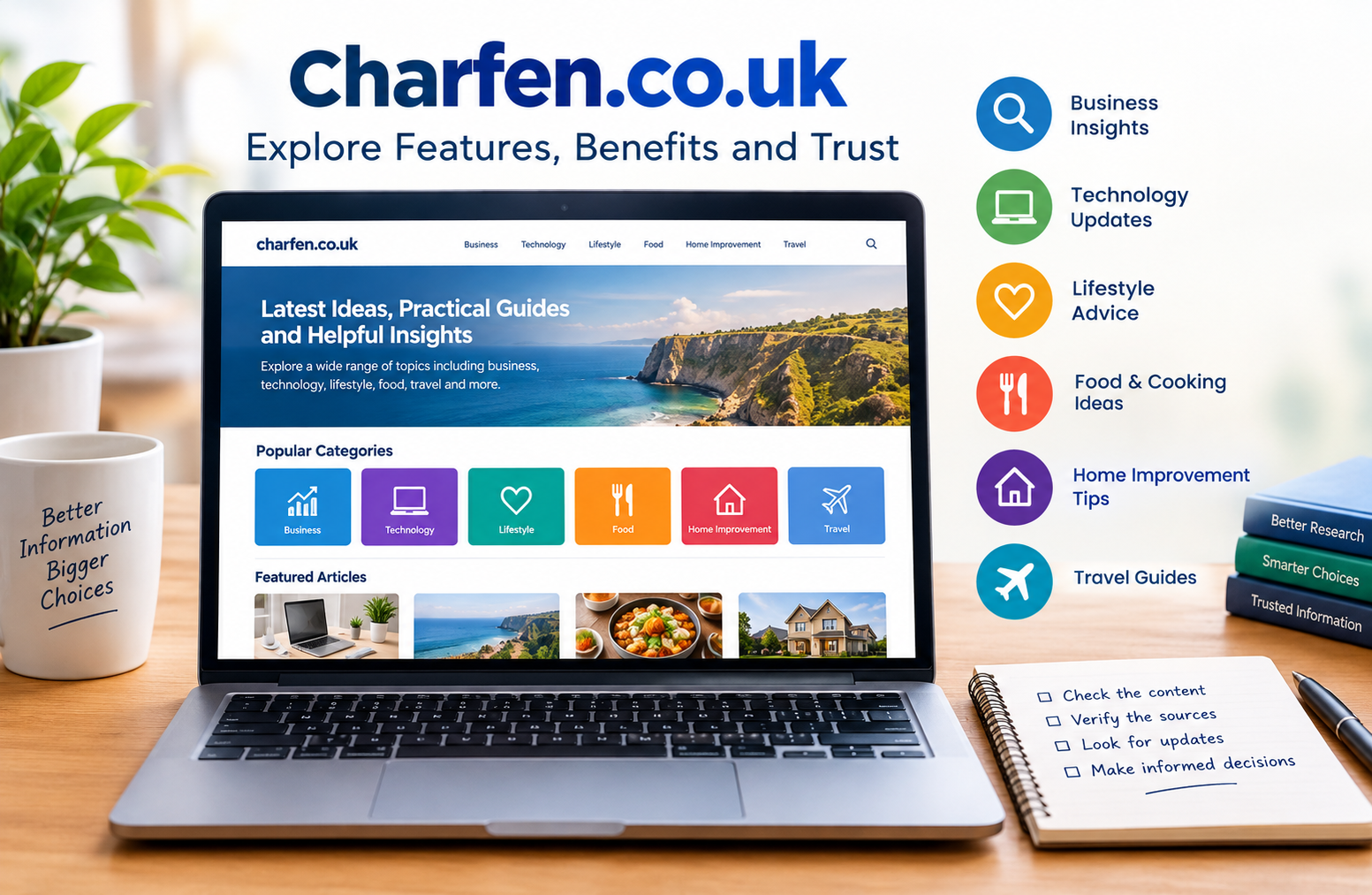
Charfen.co.uk: A Complete Guide to the Website
When people search for Charfen.co.uk, they may want to understand what the website offers, what topics it covers, how useful its content is, and whether it is connected to the business brand with a similar name. Understanding these points helps visitors decide whether the platform is relevant to their needs. The website presents itself as a source of business insights and entrepreneurial guidance, while its broader publishing categories also cover subjects such as technology, health, lifestyle, food, home improvement, and news.
CHARFEN.CO.UK
+1
In an online environment filled with blogs, specialist publications, and general information websites, knowing what a platform actually provides is important. A website’s name, domain extension, or professional appearance does not automatically establish its ownership, expertise, or reliability. Readers benefit most when they understand the website’s purpose, examine its published material, and check important claims against trustworthy sources.
This guide explores the purpose of Charfen.co.uk, its content categories, potential benefits, limitations, credibility considerations, and practical ways to use online information responsibly. It also explains why readers should distinguish between a website’s stated mission and what can be independently verified.
What Is Charfen.co.uk?
Charfen.co.uk is an online publishing website that presents information across multiple subject areas. Its public-facing About page emphasises entrepreneurship, business growth, practical strategies, and insights intended to help business owners make informed decisions. The site’s wider content, however, extends beyond business into general-interest subjects.
CHARFEN.CO.UK
+1
This combination gives the platform a broader purpose than a traditional specialist business journal. Visitors may arrive looking for professional advice and discover articles on technology, everyday lifestyle questions, or other topics.
The distinction matters because a website can publish information about a subject without being a dedicated professional service provider in that field. For example, an article about business development does not necessarily mean that the publisher offers consulting, coaching, or personalised business support.
Readers should therefore evaluate the platform according to the information and services it actually provides rather than making assumptions based on its name.
The Website’s Stated Purpose
The About page describes a mission centred on making entrepreneurial knowledge accessible and practical. It highlights expert-led insights, actionable strategies, and a community-oriented approach to business growth.
CHARFEN.CO.UK
These goals reflect common needs among entrepreneurs and small-business owners. Many people starting or managing a business want clear explanations, realistic examples, and practical methods they can apply to everyday decisions.
Useful business information can help readers explore questions such as:
- How can a small company improve its planning?
- Which activities deserve the greatest attention?
- How can business owners understand changing market conditions?
- What should managers consider before adopting new technology?
- How can teams improve communication and productivity?
The value of any resource addressing these questions depends on the quality of its explanations, the accuracy of its evidence, and how well its recommendations fit the reader’s circumstances.
A stated mission is a useful starting point, but readers should also examine individual articles to determine whether they deliver on that promise.
What Content Can Readers Find on Charfen.co.uk?
The website’s published material spans several categories, making it relevant to people with different informational needs. Its About page emphasises business, while its wider website includes a broader mix of subjects.
CHARFEN.CO.UK
+1
Business and Entrepreneurship
Business content can help readers explore planning, marketing, leadership, productivity, and organisational growth.
Entrepreneurs often face difficult decisions with limited time and resources. Clear explanations of business concepts can help them identify problems, compare possible approaches, and prepare better questions before making important commitments.
For example, a small-business owner researching marketing strategies might use an introductory article to understand the differences between organic search traffic, paid advertising, and social media promotion.
However, general guidance should not replace a financial forecast, professional legal advice, or a detailed assessment of a particular business. Every organisation operates under different conditions, and an approach that works for one company may not work for another.
Technology and Digital Trends
Technology changes how people communicate, work, shop, and manage information. Articles about digital tools can help readers understand emerging developments and consider how they might affect daily activities or professional responsibilities.
Readers may use this type of material to learn about software, online platforms, digital productivity, or technology-related business opportunities.
The most useful technology articles explain both benefits and limitations. A balanced explanation should identify practical uses, potential costs, privacy concerns, compatibility requirements, and situations where a simpler alternative may be sufficient.
Because digital products change frequently, readers should check publication dates and consult official product documentation before relying on instructions for a current application or service.
Health and Lifestyle
Health and lifestyle content may help readers understand everyday topics, develop questions for further research, and discover practical approaches to daily routines.
These subjects require particular care. A general article should not be treated as a personal diagnosis or a substitute for qualified medical advice. Readers should look for identifiable authors, relevant qualifications, reliable evidence, and clear distinctions between established findings and general suggestions.
When a health-related claim could affect treatment, medication, or personal safety, consulting a qualified healthcare professional and authoritative medical sources is the more responsible choice.
Home Improvement and Everyday Topics
Home improvement information can introduce readers to maintenance tasks, household planning, materials, design choices, and common repair considerations.
The usefulness of this content depends on how specific and accurate the instructions are. A basic decorating guide, for example, may be suitable for a straightforward project, while electrical work, structural repairs, and gas-related tasks may require licensed professionals.
Readers should consider the complexity of a task, the tools involved, and any safety requirements before following online instructions.
News and General Information
General-interest publishing can give readers an accessible introduction to current affairs, social developments, and topics outside their usual areas of interest.
However, news-related material should be assessed according to its publication date, sources, and treatment of uncertainty. An article that discusses a developing event may become outdated quickly.
Readers should distinguish factual reporting from commentary and compare important claims with original documents or reputable news organisations. This habit is particularly useful when a story contains disputed figures, predictions, or strong opinions.
Who May Benefit From Using Charfen.co.uk?
The website’s broad publishing approach may appeal to readers who prefer exploring several subjects through one online destination. Its usefulness depends on the visitor’s goals and the quality of the specific article being read.
Entrepreneurs and Small-Business Owners
People building or managing a business may find introductory material useful when exploring management, productivity, marketing, and growth.
Such content can provide a starting point for learning about unfamiliar concepts. A founder might read about customer research, for example, then conduct interviews with potential customers to test whether a proposed product solves a genuine problem.
The important step is turning general information into a question that can be tested in the real world. Rather than assuming a suggested strategy will work, a business owner can identify a measurable outcome, try a small experiment, and evaluate the result.
Students and Independent Learners
Students and self-directed learners often need accessible explanations before moving on to detailed research. A general-interest article can introduce vocabulary, outline a topic, and identify questions worth investigating.
For academic work, however, an introductory blog post may not be sufficient evidence. Students should check their institution’s requirements and use original research, recognised publications, official statistics, and primary documents when appropriate.
This approach helps prevent a common research mistake: treating an accessible explanation as if it were the original source of the information.
Professionals Exploring New Ideas
Professionals may use broad online publications to discover trends or identify ideas relevant to their work.
A marketing professional might explore a technology article, while a manager might investigate a discussion of workplace productivity. Such reading can encourage new questions and expose readers to concepts they have not previously considered.
The greatest benefit often comes from comparing ideas rather than accepting one article as definitive. Readers should consider whether the author explains the reasoning behind a recommendation and whether the evidence applies to their own industry.
General Readers Seeking Convenient Information
Not every online search requires an academic paper or a lengthy specialist report. Sometimes readers simply need a clear introduction to an unfamiliar topic.
A multi-topic website can serve this purpose when its articles are readable, appropriately sourced, and transparent about their limitations.
The key is to match the depth of the source to the importance of the decision. Casual background reading requires a different level of verification from research that could influence health, finances, legal obligations, or professional safety.
Understanding the Benefits of Charfen.co.uk
The potential value of a publishing website is not determined by the number of articles it contains. It depends on whether the information helps readers understand a subject, make better decisions, or identify a reliable next step.
There are several ways readers may benefit from exploring Charfen.co.uk.
1. Access to Different Subjects in One Place
A multi-topic website allows readers to explore different interests without restricting themselves to one narrow subject.
Someone researching entrepreneurship may also want to learn about digital tools, workplace habits, or consumer trends. Having access to different categories can make this exploration convenient.
However, convenience should not be confused with specialist expertise. A broad publishing platform may introduce a subject effectively, but a highly technical question may require a dedicated professional source.
2. Accessible Explanations of Complex Topics
Good informational writing makes unfamiliar concepts easier to understand. It explains important terms, breaks complicated processes into manageable steps, and provides examples that readers can relate to.
This is particularly helpful for people who are new to business management, digital technology, or other professional subjects.
For example, a beginner learning about business planning may first need to understand revenue, operating costs, cash flow, and customer demand. Once these concepts are clear, more advanced financial information becomes easier to evaluate.
The quality of an explanation can be judged by whether it answers the reader’s question without oversimplifying important details.
3. Support for Independent Learning
Online articles can help readers build knowledge at their own pace.
A useful learning process involves more than reading one article. Readers can compare explanations, identify unfamiliar terms, verify claims, and apply what they learn to a practical question.
This approach helps develop independent research skills and reduces dependence on a single publisher.
For business readers, it may mean testing an idea before investing money. For students, it may involve tracing a claim back to an original study. For general readers, it may simply mean checking whether a statement remains accurate.
4. Discovery of New Ideas
Cross-category publishing can introduce readers to subjects they would not otherwise explore.
An article about technology might encourage a business owner to investigate a new workflow. A discussion of productivity might prompt a reader to reconsider how daily tasks are organised.
These discoveries are most valuable when readers evaluate the ideas carefully rather than adopting every recommendation immediately.
A sensible approach is to ask three questions:
- Does the idea address a real problem?
- Is there credible evidence that the proposed solution works?
- Can it be tested safely and affordably?
These questions turn casual reading into a more useful learning process.
Is Charfen.co.uk Connected to Alex Charfen?
The similarity between the names Charfen.co.uk and Charfen.com may lead visitors to assume that the two websites belong to the same organisation. That assumption should not be made without clear evidence.
Charfen.co.uk describes its own publishing mission through business growth and entrepreneurial guidance. Separately, Charfen.com is associated with entrepreneur Alex Charfen and his business-focused work. The existence of both domains does not establish shared ownership or an official partnership.
CHARFEN.CO.UK
+1
This distinction is important because readers may use a brand name to judge credibility. If they believe a website belongs to a recognised expert, they may give its content more weight than they otherwise would.
Before attributing an article, programme, or business service to a particular individual, readers should check the following:
- Official identification: Does the website clearly name the person or organisation responsible for it?
- Direct confirmation: Does the person or organisation confirm the relationship through its own official channels?
- Consistent information: Do the contact details, descriptions, and branding support the claimed connection?
- Specific evidence: Is there a clear statement of ownership, partnership, or authorisation rather than simply a similar name?
If this evidence is missing, the responsible conclusion is that the relationship has not been established.
This does not prove that the two websites have no connection. It means that readers should not present an unverified relationship as a confirmed fact.
Is Charfen.co.uk a Business Coaching Service?
The website’s stated emphasis on entrepreneurship and business growth may make visitors wonder whether it operates as a conventional business coaching company.
There is an important difference between publishing educational content and providing a structured coaching service.
A coaching business typically explains the services it offers, the people who deliver them, the intended clients, and the process through which clients receive support. Depending on the service, it may also publish information about programmes, consultation arrangements, fees, or expected outcomes.
An informational website, by contrast, may provide articles and general guidance without offering individual coaching.
The public-facing material reviewed for Charfen.co.uk supports describing it as a content publishing platform with a business-oriented mission. That alone does not establish that it offers a particular coaching programme, paid membership, or consulting package.
CHARFEN.CO.UK
+1
Readers interested in business assistance should therefore distinguish between the educational material available on the site and any separately documented service.
Before paying for coaching or consulting, they should establish:
- Who will deliver the service.
- What the service includes and excludes.
- What the total cost will be.
- Whether the provider has relevant, verifiable experience.
- How progress will be evaluated.
- What cancellation and refund terms apply.
- Whether promised outcomes are realistic and clearly qualified.
These checks are useful for evaluating any professional service, regardless of the provider’s name.
How to Evaluate the Credibility of Charfen.co.uk
Credibility is not a single score. It is a combination of transparency, evidence, accuracy, editorial standards, and the relevance of information to the question being asked.
A website can be accessible and publish useful articles while still requiring readers to verify certain claims independently.
For this reason, charfen.co.uk should be evaluated at both the website level and the individual article level.
Check the Author’s Identity and Experience
The author’s background can help readers judge whether an article is informed by relevant knowledge.
For a business article, useful indicators might include experience in the industry, responsibility for similar projects, or a track record of explaining the subject accurately.
For a health article, relevant professional qualifications and appropriate medical review may be more important.
A byline alone is not proof of expertise. Readers should look for meaningful biographical details, relevant credentials, and evidence that the author understands the subject.
If an article does not identify its author or provide enough information to assess their background, that limitation should be considered when deciding how much weight to give the material.
Examine the Evidence Behind Important Claims
Reliable informational writing should make it possible to understand why a claim is being presented as true.
For example, an article might state that a particular management technique improves productivity. A careful reader should ask whether the statement is supported by research, documented experience, measurable results, or merely an opinion.
Evidence should be appropriate to the claim. A personal account may illustrate an experience, but it cannot automatically establish that the same result will occur in every business.
Likewise, a statistic should ideally identify its original source, publication date, and relevant context.
Readers should be particularly cautious when an article includes precise figures without explaining where they came from.
Review the Publication Date
Information can become outdated even when it was accurate when first published.
This is especially relevant to technology, business regulations, market conditions, consumer products, and current affairs.
Before following an article, check when it was published and whether it has been updated. If it refers to changing laws, product features, prices, or recent events, compare it with current primary sources.
An older article may still provide useful background, but its recommendations should not automatically be treated as current.
Read the Privacy Policy and Contact Information
A website’s privacy policy can explain what information it collects, why it collects it, how it uses that information, and how visitors may exercise relevant rights.
Readers should review the policy before submitting personal details, subscribing to communications, or using a service that requires account information.
It is also sensible to examine the contact page. Clear contact information gives visitors a route to ask questions, report problems, or request clarification.
However, the existence of a privacy policy or contact page does not independently establish the accuracy of published content or the identity of the site’s legal owner.
Those questions require separate evidence.
Distinguish Website Security From Editorial Trustworthiness
Website security and content credibility are related but different considerations.
A secure connection helps protect information transmitted between a browser and a website. It does not guarantee that an article is accurate, that its author has relevant expertise, or that every business claim is trustworthy.
Similarly, an active website is not automatically a reputable specialist publication.
Readers should consider technical security, editorial quality, transparency, and the nature of any requested transaction as separate parts of their assessment.
Compare Important Information With Primary Sources
Primary sources are often the best place to verify specific claims.
Examples include official government publications, original research papers, company documentation, regulatory guidance, and direct statements from the organisations involved.
For general guidance on evaluating online content, Google’s Search Central guidance on creating helpful, reliable, people-first content explains the importance of useful information, clear purpose, and trustworthiness.
Using primary sources helps readers move beyond repeated claims and examine the evidence directly.
Practical Steps for Using Charfen.co.uk Effectively
Readers can get more value from an informational website by approaching it with a clear purpose and a consistent method for checking important information.
Step 1: Define the Question You Want to Answer
Start with a specific question rather than browsing without a goal.
For example, instead of searching generally for business growth, identify whether you need help with customer research, budgeting, marketing, or team management.
A specific question makes it easier to decide whether an article is relevant and whether it answers your actual need.
It also reduces the risk of collecting large amounts of information without reaching a useful conclusion.
Step 2: Choose the Most Relevant Category
Use the website’s available categories to narrow your search.
If you want to understand a business concept, begin with relevant business material. If you are researching a technology issue, focus on the corresponding topic.
Category labels are useful navigation tools, but they do not guarantee that every article within a category has the same level of quality or specialist depth.
Read the article itself and assess whether it addresses your question.
Step 3: Identify the Main Claim
After reading an article, summarise its central point in one or two sentences.
Then identify the reasons the author gives for that conclusion.
This simple exercise helps distinguish the main argument from supporting examples, personal opinions, and background information.
If you cannot identify the central claim, the article may be too vague, poorly organised, or insufficiently focused on your needs.
Step 4: Verify Important Details
Choose the claims that matter most to your decision and look for reliable evidence.
For instance, if an article recommends a business tool, verify its current features, pricing, and terms through the provider’s official documentation.
If it discusses regulations, consult the relevant government or regulatory authority.
If it makes a health recommendation, compare it with established medical guidance.
You do not need to investigate every minor detail in a general-interest article. Focus your effort on information that could materially affect your decision.
Step 5: Apply the Information to Your Situation
General advice becomes more useful when translated into a practical next step.
A business owner might turn an article about customer retention into a plan to review customer feedback. A student might use an introductory explanation to identify research questions. A homeowner might create a checklist of materials and safety requirements before starting a project.
Keep the first step manageable and evaluate the result.
The goal is not to follow every recommendation. It is to determine which ideas are relevant, supported, and practical for your circumstances.
Step 6: Record Useful Sources
When researching a complex subject, keep a record of the article title, author, publication date, and supporting sources.
This makes it easier to revisit the information and identify whether it has changed.
For professional or academic work, record the original source of important statistics and quotations rather than relying exclusively on a secondary summary.
Good source management also helps prevent accidental repetition of outdated or unsupported claims.
Step 7: Reassess the Information Before Making a Major Decision
Before acting on important information, consider whether you have enough evidence and whether the advice applies to your situation.
A general article may provide a helpful starting point, but decisions involving significant financial commitments, legal obligations, health, or safety often require more specialised guidance.
When the potential consequences are substantial, seek appropriate professional advice rather than treating an online article as a complete decision-making framework.
Common Challenges Readers Should Understand
Although broad publishing websites can be convenient, readers should understand their limitations before relying on the information they provide.
Broad Coverage Can Mean Uneven Subject Expertise
A website that covers business, health, technology, lifestyle, and home improvement serves a wide range of interests. However, different subjects require different kinds of expertise.
An author who writes clearly about marketing may not have the qualifications needed to explain a complex medical issue. Readers should not assume that the publication’s general identity guarantees equal expertise across every category.
The practical lesson is to assess each article according to its subject, author, evidence, and purpose.
This is particularly important when the article offers technical instructions or makes claims that could influence an important decision.
Limited Information About Ownership
Readers may want to know who operates a website, which organisation is responsible for its editorial decisions, and how the platform is funded.
When these details are not clearly established through public information, it becomes harder to assess accountability.
The absence of readily available ownership information does not automatically mean that a website is unsafe or dishonest. It does mean that readers should avoid making unsupported assumptions about the organisation behind it.
For Charfen.co.uk, the distinction between its stated publishing mission and independently verified ownership is worth keeping in mind.
Similar Names Can Cause Confusion
A familiar name can create expectations that are not supported by the actual website.
This is relevant when readers encounter websites with similar names, branding, or subject matter. They may assume that one is an official regional version of another, even when the relationship has not been confirmed.
The best response is to verify the identity of the publisher before attributing its content, services, or claims to a particular person or company.
Some Articles May Need Additional Verification
No single publication should be treated as the final authority on every subject.
A broad article may simplify a complicated topic to make it accessible. That can be helpful for beginners, but simplification may leave out important conditions, exceptions, or technical details.
Readers should be particularly careful with:
- Financial projections and investment claims.
- Medical advice and treatment recommendations.
- Legal requirements and regulatory obligations.
- Safety instructions for technical or household tasks.
- Statistics that lack a clear source.
- Claims promising guaranteed results.
The appropriate response is not to reject all general information. It is to recognise when a question requires more evidence than an introductory article can provide.
Outdated Information Can Remain Discoverable
Search engines may continue to display older articles after the information they contain has changed.
This is common with software guides, pricing information, business trends, and current affairs. An article can remain accessible even if the product, policy, or situation it describes has changed.
Check the date, look for update notes, and verify time-sensitive claims before acting on them.
How to Judge Whether an Article Is Worth Your Time
A simple evaluation framework can help readers distinguish a useful article from one that offers little practical value.
| Evaluation factor | What to look for |
| Relevance | Does the article answer the question you searched for? |
| Accuracy | Are important claims supported by reliable evidence? |
| Author expertise | Is the author’s relevant experience or qualification explained? |
| Transparency | Are dates, sources, limitations, and affiliations clear? |
| Practical value | Does the article provide useful explanations or actionable steps? |
| Balance | Does it discuss meaningful limitations as well as benefits? |
| Freshness | Is the information current enough for your purpose? |
| Accountability | Is there a reasonable way to contact the publisher or responsible author? |
These factors work best together. A recent article may still be inaccurate, while an older article may remain valuable for explaining a stable concept.
Likewise, an article can be well written but poorly sourced. Good presentation makes information easier to understand, but it cannot replace reliable evidence.
For important decisions, readers should consider the strength of the evidence and the possible consequences of getting the answer wrong.
Charfen.co.uk Compared With Specialist Websites
A useful way to understand a broad publishing platform is to compare it with other types of online resources.
| Website type | Main purpose | Best use |
| General-interest blog | Introduce readers to different topics | Background reading and initial exploration |
| Specialist publication | Cover a particular field in greater depth | Subject-specific learning and industry analysis |
| Official government website | Publish official rules, guidance, and public information | Verifying applicable policies and requirements |
| Academic publication | Present research and scholarly analysis | Investigating evidence and research findings |
| Professional service provider | Offer specialised services or advice | Obtaining assistance tailored to a specific situation |
These categories are not mutually exclusive. A general-interest website may publish a well-researched article, and a specialist publication may occasionally produce an introductory overview.
The comparison simply highlights why the source should match the task.
If you are learning what a concept means, a clear introductory article may be enough. If you are deciding whether to invest substantial money in a business strategy, you will need stronger evidence, more context, and potentially professional advice.
What Makes an Informational Website More Useful?
The quality of an online publication is reflected in how well it helps readers understand a subject and make informed choices.
Several editorial practices can improve that experience.
Clear and Accurate Explanations
Articles should define unfamiliar terms, explain the main issue, and organise information in a logical order.
Readers should not have to work through repeated paragraphs or unnecessary jargon to find the answer to a straightforward question.
Clarity is especially important when an article discusses a complicated subject. A simple explanation should make the topic easier to understand without concealing important limitations.
Evidence That Supports the Main Argument
Strong informational content explains why its conclusions are reasonable.
Depending on the topic, this may involve research, official documents, expert commentary, documented examples, or clearly identified experience.
Evidence should support the specific claim being made. A general statistic about an industry, for example, does not automatically prove that a particular strategy will work for an individual company.
Meaningful Examples
Examples help readers connect general principles with practical situations.
A useful business article might explain how a company could test demand for a new product before committing to a large production run. The example becomes more valuable when it explains the reasoning, the limitations, and how the result would be evaluated.
Examples should be clearly identified as hypothetical when they are not based on documented events.
Honest Treatment of Uncertainty
Trustworthy writing distinguishes between confirmed facts, reasonable interpretations, and unresolved questions.
This matters because many real-world issues do not have one universal answer. Business strategies depend on market conditions, health decisions depend on individual circumstances, and technology choices depend on practical requirements.
An article that explains these limitations may be more useful than one that presents every recommendation as universally effective.
A Reader-Focused Purpose
The purpose of an informational article should be to help the reader understand or solve a problem.
Content becomes less useful when it relies on repeated keywords, exaggerated promises, or long sections that add little new information.
Readers benefit from articles that answer their questions directly, explain the reasoning behind important points, and make it easy to identify what to do next.
Frequently Asked Questions About Charfen.co.uk
1. What is Charfen.co.uk?
Charfen.co.uk is an online publishing website that presents business and entrepreneurship content alongside broader informational topics. Readers should examine individual articles to assess their relevance, accuracy, and practical value.
2. What topics does Charfen.co.uk cover?
Its website presents business-related material as part of its mission, while its broader publishing categories include technology, health, lifestyle, food, home improvement, and news. The exact subjects available may change as new articles are published.
3. Is Charfen.co.uk connected to Alex Charfen?
The similarity between the names does not establish an official connection. Readers should seek direct confirmation from the organisations involved before assuming that the two websites share ownership or operate as part of the same business.
4. Is Charfen.co.uk a business coaching platform?
Its public-facing material emphasises entrepreneurial knowledge and business growth. However, that does not independently establish that it offers a specific coaching programme or consulting service. Any such offering should be verified through clear service information.
5. Can readers trust information published on Charfen.co.uk?
The reliability of information should be assessed article by article. Check the author’s expertise, supporting evidence, publication date, and consistency with trustworthy sources. Important health, legal, financial, or safety-related claims deserve additional verification.
6. How can readers get the most value from Charfen.co.uk?
Start with a specific question, select the most relevant article, identify its main claims, and verify important details using reliable sources. Apply only the information that is relevant to your situation and seek qualified assistance when a decision requires specialised knowledge.
Conclusion
Charfen.co.uk is best understood as a multi-topic publishing website with a stated emphasis on entrepreneurship and business growth. Its wider subject coverage makes it relevant to readers exploring professional and general-interest topics, but the usefulness of any individual article depends on its accuracy, evidence, relevance, and editorial quality.
Readers should also distinguish between the website’s stated mission and independently verified facts about its ownership, services, and relationships with other organisations. In particular, the similarity between its name and that of Charfen.com should not be treated as proof of an official connection.
A careful approach to online information involves checking authorship, reviewing publication dates, tracing important claims to reliable sources, and recognising when specialist guidance is necessary. These habits help readers make better use of general-interest content without relying on a single website for every answer.
Ultimately, the most valuable way to approach Charfen.co.uk is to treat it as a potential starting point for learning, evaluate each article on its own merits, and use additional evidence whenever the subject or decision calls for greater certainty.