Washington Nationals vs Mets Match Player Stats
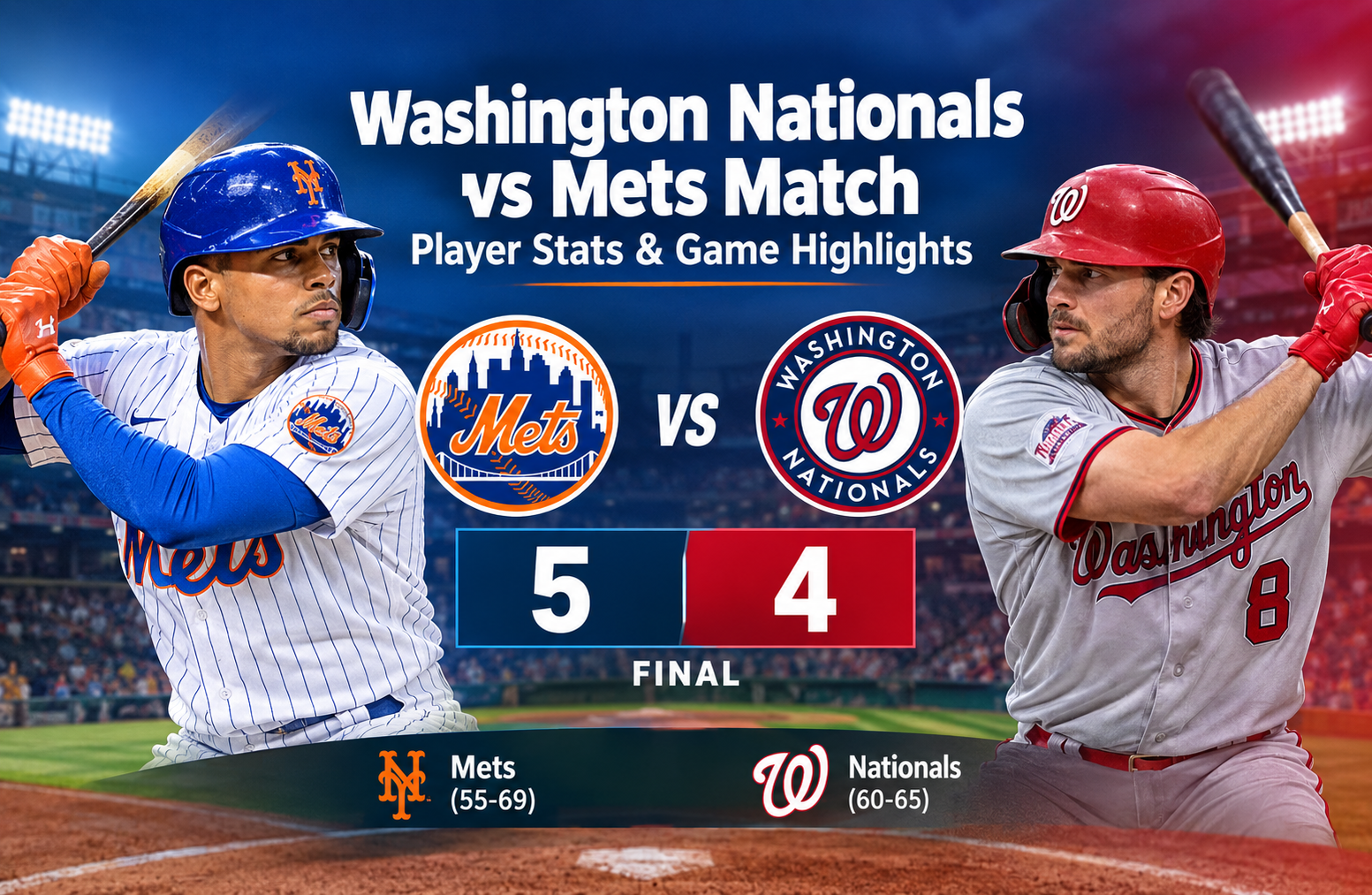
The washington nationals vs mets match player stats from August 16, 2026, tell the story of a dramatic 5-4 victory for the New York Mets at Citi Field in Queens, New York. The Mets overcame a late challenge from the Washington Nationals, with Francisco Lindor delivering the decisive ninth-inning single that brought home the winning run. Washington produced seven hits and two home runs, while New York recorded eight hits and benefited from seven walks. The result highlighted the importance of timely hitting, plate discipline, bullpen execution, and the ability to capitalize on scoring opportunities in a close Major League Baseball game.
The matchup offered several standout performances. Brady House drove in three runs with a home run for Washington, and Andrés Chaparro also went deep. For New York, Juan Young collected two hits and two RBIs, Lindor contributed two hits and the game-winning RBI, and Carson Benge hit a solo home run. The Mets ultimately won despite surrendering a 2-0 first-inning lead and falling behind 4-2 in the sixth.
This detailed breakdown examines the final score, individual batting performances, pitching statistics, inning-by-inning scoring, and the decisive moments that shaped the contest. It also explains what the numbers reveal about each team’s offensive approach and late-game execution.
Washington Nationals vs Mets Match Player Stats: Final Score and Game Overview
The Mets defeated the Nationals 5-4 in a game that remained competitive until the final inning. Both teams recorded multiple scoring threats, but New York converted its opportunities at the right time.
Final scoreboard
| Team | Runs | Hits | Errors |
| New York Mets | 5 | 8 | 0 |
| Washington Nationals | 4 | 7 | 0 |
Game details
- Date: August 16, 2026
- Venue: Citi Field
- Location: Queens, New York
- Attendance: 34,737
- Game duration: 2 hours, 54 minutes
- Final result: Mets 5, Nationals 4
- Winning pitcher: J. Yan
- Losing pitcher: Y. Cruz
- Mets starting pitcher: Sean Manaea
- Errors: Neither team committed an error
The scoreboard shows how closely contested the game was. New York finished with one more hit than Washington, and neither side gave away an unearned run through a recorded fielding error. The difference came from the way each team converted baserunners into runs and how the Mets handled the final inning.
Washington had the more productive individual home-run performance, hitting two home runs compared with New York’s one. However, the Mets scored five times by combining extra-base hits, walks, and well-timed singles.
The result is a useful reminder that home-run totals alone do not determine the winner. A team can generate considerable power and still lose if its opponent creates more scoring opportunities or delivers a key hit at the right moment.
Complete Batting Statistics for Both Teams
Team batting numbers provide the foundation for understanding the game. They reveal how often each lineup reached base, how much power it generated, and how effectively it converted opportunities into runs.
Washington Nationals batting stats
| Statistic | Washington |
| At-bats | 32 |
| Runs | 4 |
| Hits | 7 |
| Runs batted in | 4 |
| Home runs | 2 |
| Walks | 2 |
| Strikeouts | 11 |
Washington’s offense was built around power. Two home runs accounted for important portions of its scoring, with Chaparro opening the comeback in the fourth inning and House putting the Nationals ahead in the sixth.
The lineup also recorded 11 strikeouts and only two walks. Those numbers suggest a more limited path to reaching base outside of hits. Although Washington managed seven hits, it did not draw enough walks to match New York’s overall baserunner total.
The Nationals still made their opportunities count in the middle innings. House’s three-run homer transformed a 2-1 deficit into a 4-2 lead, demonstrating how one well-struck ball can change the direction of a game.
The challenge was maintaining that advantage. Washington did not add another run after the sixth inning, allowing New York to recover and take control in the ninth.
New York Mets batting stats
| Statistic | New York |
| At-bats | 31 |
| Runs | 5 |
| Hits | 8 |
| Runs batted in | 5 |
| Home runs | 1 |
| Walks | 7 |
| Strikeouts | 12 |
New York’s batting line was more balanced. The Mets collected eight hits, hit one home run, and drew seven walks. They also struck out 12 times, so their success did not come from avoiding every difficult at-bat.
The seven walks stand out. Compared with Washington’s two walks, New York had five additional free passes. Walks do not guarantee runs, but they put runners on base without requiring a hit and can force opposing pitchers to work under pressure.
That difference helped the Mets keep creating opportunities even after their early lead disappeared. The lineup combined patience with timely contact, especially in the ninth inning when consecutive extra-base and single-producing situations turned a tie into a victory.
New York also matched its five runs with five RBIs. That indicates that its recorded runs were credited to hitters through run-producing plate appearances rather than depending on unearned scoring.
What the team numbers reveal
Three differences deserve attention.
First, New York generated more baserunners through walks. The Mets’ seven walks compared with Washington’s two gave the home team more opportunities to build rallies without recording hits.
Second, Washington generated more home-run power. The Nationals hit two home runs, while the Mets hit one. Yet the extra homer did not create a winning margin because New York responded with timely production later in the game.
Third, the Mets finished with the winning hit. The difference between a tie and a victory was not the overall hit total alone. It was Lindor’s ninth-inning single after the Mets had already tied the game.
Key Washington Nationals Player Stats
Washington’s most important offensive contributions came from House and Chaparro. Their home runs supplied the team’s four runs and gave the Nationals a genuine opportunity to win on the road.
Brady House: Three RBIs and a go-ahead home run
Brady House was Washington’s leading run producer in this matchup.
| Statistic | Performance |
| Home runs | 1 |
| RBIs | 3 |
| Runs scored | 1 |
House hit a three-run home run in the sixth inning, turning Washington’s 2-1 deficit into a 4-2 lead. It was the most influential offensive play for the Nationals because it produced three runs in a single swing.
The home run demonstrated House’s ability to deliver impact contact when runners were available. Rather than scoring one run at a time, Washington suddenly moved ahead by two runs and placed the pressure on New York’s offense.
His three RBIs represented 75% of Washington’s four runs. That proportion illustrates just how central his contribution was to the team’s scoring output.
However, one player’s offensive success cannot guarantee a team victory. The Nationals needed their pitching staff to protect the lead, and the Mets eventually produced three unanswered runs after House’s homer.
Andrés Chaparro: A home run and two runs scored
Chaparro provided Washington’s first major response after New York’s fast start.
| Statistic | Performance |
| Home runs | 1 |
| RBIs | 1 |
| Runs scored | 2 |
In the fourth inning, Chaparro hit a solo home run to left field, cutting the Mets’ lead to 2-1. The swing put Washington back within one run and changed the tone of the game after New York had scored twice in the opening inning.
Chaparro also scored twice, according to the supplied player statistics. His contribution extended beyond the home run itself because getting across the plate twice made him one of Washington’s most important offensive players.
His home run also showed that Washington could respond to early pressure. Instead of allowing the Mets’ first-inning advantage to grow, the Nationals used power hitting to remain close and eventually move ahead.
Washington’s broader offensive performance
House and Chaparro supplied the home runs, but the team’s overall performance also depended on the players who reached base ahead of them.
House’s three-run homer required baserunners to be on base, making the preceding plate appearances important to the result. The supplied summary does not provide a complete individual batting line for every Nationals player, so additional hits, at-bats, or on-base figures should not be assumed.
The larger lesson is that Washington’s power was effective when it connected with runners on base. The problem was sustaining that production after taking the lead. The Nationals finished with four runs and seven hits, but they did not add to their total after the sixth inning.
Against a team capable of drawing walks and producing late hits, an offense may need to keep adding insurance runs rather than relying on a single big inning.
Key New York Mets Player Stats
The Mets’ victory came from several contributions rather than one dominant home-run performance. Young helped establish the early lead, Benge supplied power, and Lindor delivered the decisive hit.
Francisco Lindor: Two hits and the winning RBI
Francisco Lindor played a central role in New York’s victory.
| Statistic | Performance |
| Hits | 2 |
| RBIs | 1 |
| Runs scored | 1 |
Lindor helped New York establish its first-inning advantage and later delivered the decisive ninth-inning single to right field. That hit scored C. Pache and gave the Mets a 5-4 lead.
The timing made the single more important than an ordinary hit in the middle innings. With the score tied at 4-4, New York needed one more run to move ahead. Lindor delivered it before Washington could escape the inning.
His performance illustrates why batting averages and season-long totals do not tell the entire story of a single game. A player can influence a result through the timing of a hit, especially when the game is tied late.
Lindor’s two hits also gave New York a consistent offensive presence across different stages of the contest. His contribution was not limited to the final at-bat.
Juan Young: Two hits and two RBIs
Juan Young was another important contributor to the Mets’ offense.
| Statistic | Performance |
| Hits | 2 |
| RBIs | 2 |
In the first inning, Young doubled to left field and brought home A.J. Ewing and Lindor. The two-run double gave New York a 2-0 lead before Washington’s offense had found its rhythm.
Those early runs mattered because they established the first advantage of the game. Although Washington later moved ahead, the Mets’ opening production kept the contest competitive and gave the lineup an early example of how extra-base hits could generate multiple runs.
Young’s two hits and two RBIs also showed the value of spreading offensive production across the lineup. New York did not need one hitter to account for all five runs. Instead, different players contributed at key moments.
Carson Benge: Solo home run
Carson Benge delivered a timely home run in the sixth inning.
| Statistic | Performance |
| Home runs | 1 |
| RBIs | 1 |
| Runs scored | 1 |
After House’s three-run homer put Washington ahead 4-2, Benge answered with a solo home run. The hit reduced the deficit to 4-3 and immediately restored pressure on the Nationals.
The sequence was especially important. Washington had just completed a major rally and appeared to have shifted momentum. Benge’s response prevented the Mets from falling two runs behind for long.
His home run was New York’s only homer of the game, but it came at a highly useful time. Rather than simply adding to a comfortable lead, it helped keep the Mets within one run.
Francisco Alvarez: The game-tying double
Francisco Alvarez delivered the extra-base hit that made the ninth-inning comeback possible.
According to the supplied scoring summary, Alvarez doubled to bring home B. Baty, tying the score at 4-4.
That double changed the immediate objective for New York. Before the hit, the Mets needed to erase a one-run deficit. After Alvarez brought home the tying run, a single could win the game.
Lindor provided that single moments later, completing a two-step rally. Alvarez created the tie, and Lindor converted the opportunity into the winning run.
How New York’s hitters worked together
The Mets’ offensive performance was distributed across the game.
- Young’s first-inning double created an early two-run advantage.
- Benge’s sixth-inning homer limited the damage from Washington’s go-ahead rally.
- Alvarez’s ninth-inning double tied the score.
- Lindor’s ninth-inning single delivered the decisive run.
This sequence is the clearest explanation for New York’s victory. The Mets did not dominate every inning, but they continued to produce meaningful contact when the game situation demanded it.
Pitching Stats: Starters, Relievers, and the Winning Decision
Pitching performance was central to the result because neither team made an error and both offenses found ways to score. The decisive difference emerged in the final innings, when Washington could not protect its lead.
Sean Manaea’s start for the Mets
Sean Manaea started for New York and recorded the following line:
| Statistic | Performance |
| Innings pitched | 6.1 |
| Hits allowed | 6 |
| Runs allowed | 4 |
| Earned runs | 4 |
| Walks | 2 |
| Strikeouts | 7 |
| Home runs allowed | 2 |
Manaea struck out seven batters over 6.1 innings, but he also allowed four earned runs and two home runs. His outing contained both positive and negative elements.
The strikeout total indicates that he was able to finish several plate appearances without requiring a ball in play. At the same time, the two home runs were costly because they allowed Washington to score without needing to string together several consecutive hits.
House’s three-run homer was particularly damaging, turning a narrow deficit into a two-run Washington lead. Chaparro’s earlier solo shot also contributed to the Nationals’ comeback.
Manaea’s final line should therefore be read in context. He recorded more than six innings and seven strikeouts, but the four earned runs left the Mets needing a comeback from their offense and bullpen.
The supplied data do not establish every detail of his pitch count, pitch selection, or velocity. Those measures should not be inferred from the final box score alone.
J. Yan earns the win
- Yan was credited with the victory for New York.
| Statistic | Performance |
| Innings pitched | 1.2 |
| Hits allowed | 0 |
| Earned runs | 0 |
| Strikeouts | 3 |
| Walks | 0 |
| Record shown | 1-0 |
Yan’s recorded outing was highly effective. He allowed no hits or earned runs, struck out three batters, and issued no walks over 1.2 innings.
Those figures show how important it was for New York to keep Washington from extending its lead. A reliever who prevents additional baserunners can give an offense time to recover, particularly when only one or two runs separate the teams.
Yan’s performance also limited the damage that could have followed Washington’s strong sixth inning. The Mets still needed to score, but their pitching prevented the deficit from becoming more difficult to overcome.
The win is an official pitching decision, not necessarily a statement that Yan alone determined the result. Baseball’s win-loss rules depend on the game’s progression and the official scorer’s decision, while a team’s comeback usually reflects several offensive and pitching contributions.
Y. Cruz takes the loss for Washington
- Cruz was charged with the loss.
| Statistic | Performance |
| Innings pitched | 0.1 |
| Hits allowed | 3 |
| Earned runs | 2 |
| Strikeouts | 1 |
| Walks | 1 |
| Record shown | 0-1 |
Cruz’s line reflects a difficult, brief appearance. He recorded one out while allowing three hits, two earned runs, and one walk.
The timing magnified the impact. The Mets scored twice in the ninth inning, first tying the game through Alvarez’s double and then taking the lead on Lindor’s single. When a bullpen appearance occurs in a one-run game, even a short stretch of missed execution can determine the result.
The available data do not provide enough information to assign every late-inning baserunner or scoring responsibility to Cruz beyond the recorded pitching line. The safest interpretation is that his appearance coincided with the decisive rally and that the official decision credited him with the loss.
Team pitching comparison
| Statistic | Mets | Nationals |
| Innings pitched | 9.0 | 8.1 |
| Hits allowed | 7 | 8 |
| Runs allowed | 4 | 5 |
| Earned runs allowed | 4 | 5 |
| Walks allowed | 2 | 7 |
| Strikeouts | 11 | 12 |
| Home runs allowed | 2 | 1 |
The team pitching figures point to a major difference in control. New York’s pitching staff issued two walks, while Washington’s staff issued seven.
Walks can be especially damaging in a close contest because they place runners on base without requiring the opposing hitter to make contact. They can also raise pitch counts and create more opportunities for extra-base hits to score multiple runners.
Washington struck out 12 Mets, one more than New York’s pitching staff recorded against the Nationals. However, the Nationals’ higher strikeout total did not compensate for the additional walks and the late hits that decided the game.
The innings figures also need to be interpreted correctly. The Mets recorded nine full defensive innings, while Washington’s team pitching line lists 8.1 innings because the home team did not need to complete a bottom half of the ninth after taking the lead in the bottom of the inning. The supplied pitching line and the official scoring sequence should be checked together when reproducing a formal box score.
Inning-by-Inning Scoring Breakdown
The sequence of runs explains the changing momentum more clearly than the final score alone.
First inning: New York takes a 2-0 lead
Young doubled to left field, scoring A.J. Ewing and Francisco Lindor. The two-run hit gave the Mets an early advantage.
A double with runners in scoring position is valuable because it can bring multiple runners home in one swing. It also puts the hitter in scoring position, increasing the possibility of further damage in the same inning.
For Washington, the immediate task was to stop the Mets from building on that lead. The Nationals responded by gradually working their way back into the game.
Fourth inning: Chaparro cuts the deficit
Chaparro hit a solo home run to left field, making the score 2-1.
The homer provided Washington with its first run and demonstrated that the Nationals could generate offense without assembling a long rally. A home run clears the bases and scores the batter directly, regardless of whether the defense has a chance to make a play.
Although the score remained in New York’s favor, Washington had reduced the deficit to one run.
Sixth inning: Washington moves ahead, then Benge responds
House hit a three-run home run, putting Washington ahead 4-2. The swing was the most productive moment of the Nationals’ game.
Benge then hit a solo home run for New York, bringing the score to 4-3.
The back-to-back scoring developments made the sixth inning the key turning point before the ninth. Washington briefly gained a two-run advantage, but Benge’s response cut it to one and preserved the Mets’ chance to win.
This is where the difference between scoring runs and protecting a lead becomes clear. Washington had produced enough power to move ahead, yet New York answered immediately rather than allowing the momentum to remain entirely with the visitors.
Ninth inning: Alvarez ties it, Lindor wins it
The Mets entered the decisive inning trailing 4-3.
Alvarez doubled to score B. Baty, making the game 4-4. Lindor then singled to right field, bringing home C. Pache for the winning run.
The sequence required two different kinds of offensive execution. Alvarez’s double supplied the tying run, while Lindor’s single completed the comeback.
With the winning run on base, New York did not need another home run. It needed a hit into the right part of the field that allowed the runner to score.
The final score became 5-4, completing one of the most important late-game sequences in the matchup.
Why the Mets Won Despite Washington’s Two Home Runs
The Nationals’ two home runs gave them a substantial scoring advantage in terms of power production. Yet the Mets found other ways to reach base and score.
1. The Mets drew more walks
New York earned seven walks, compared with two for Washington. That five-walk difference gave the Mets more opportunities to put runners on base.
A walk is not as visually dramatic as a home run, but it can have a significant effect on a game. A team that repeatedly reaches base can force pitchers into difficult situations and create opportunities for a double or single to bring runners home.
2. New York delivered hits at critical moments
Young’s first-inning double produced two runs, Benge’s homer prevented Washington from pulling further ahead, and the ninth-inning hits tied and won the game.
The timing of these plays mattered as much as the total number of hits. New York finished with only one more hit than Washington, but its key hits arrived when they could directly change the score.
3. The Mets limited Washington’s late scoring
After House’s sixth-inning home run, the Nationals did not score again. New York’s pitching staff held the visitors at four runs while the offense worked toward a comeback.
That combination is essential in close baseball games. A team does not always need to shut down the opposing lineup from the beginning. It needs to prevent additional damage long enough to create another opportunity.
4. The Mets converted the final opportunity
The ninth-inning rally was the defining difference. Alvarez tied the score, and Lindor followed with the go-ahead single.
A game can feature many strong individual performances, but the final outcome often depends on a small number of high-leverage plate appearances. This contest was a clear example.
What the Match Stats Tell Us About Both Teams
A single game cannot establish a team’s long-term strengths or weaknesses, but the numbers support several observations about this matchup.
Washington showed dangerous power
House and Chaparro both hit home runs, and the Nationals scored four runs from seven hits. House’s three RBIs demonstrated how much damage the lineup could produce when it put runners on base ahead of a power hitter.
The limitation was that Washington did not maintain its scoring after taking the lead. A strong middle inning can put a team in position to win, but additional baserunners and insurance runs can make it harder for an opponent to recover.
New York combined patience with timely contact
The Mets’ seven walks gave the offense a way to produce pressure beyond hits alone. Young and Lindor supplied two hits each, while Benge’s home run and Alvarez’s late double contributed at key moments.
The 12 strikeouts show that New York did not dominate every plate appearance. The more useful takeaway is that the Mets were able to produce enough walks and well-timed hits to overcome those strikeouts.
Bullpen execution shaped the finish
The game remained within one run for much of the contest, making the late pitching decisions especially important. Yan’s scoreless work helped New York stay close, while Washington’s final pitching sequence ended with two Mets runs.
A bullpen’s performance should be judged in context. A relief appearance can last only a few batters, but those batters may determine whether a lead survives. The final inning demonstrated that leverage matters as much as the total number of innings pitched.
How to Read Baseball Player Stats More Accurately
For readers comparing individual performances, several statistics are more useful when considered together.
Hits and at-bats
Hits show how often a batter reached base safely through a hit, while at-bats provide context for that production. However, walks generally do not count as at-bats, which means a player can reach base several times without recording a hit.
That distinction is relevant in this game because New York drew seven walks. Looking only at hits would overlook a meaningful part of the Mets’ offensive approach.
Runs batted in
RBIs credit hitters for certain plays that bring runners home. House’s three RBIs reflected his major contribution to Washington’s scoring, while Young’s two RBIs came from the Mets’ opening double.
RBIs are useful for describing run production, but they do not measure a hitter’s entire offensive value. They depend partly on whether teammates reach base before the hitter comes to the plate.
Home runs
Home runs are direct scoring plays and can change a game immediately. Washington hit two, while New York hit one.
However, the final result demonstrates why the number of home runs should not be used alone to determine which team had the more effective offense. New York won through a combination of walks, doubles, singles, and its lone homer.
Innings pitched and earned runs
Innings pitched show how long a pitcher worked, while earned runs indicate the runs charged to the pitcher that were not the result of errors or passed balls under official scoring rules.
Manaea’s 6.1 innings and four earned runs describe a longer but challenging outing. Yan’s 1.2 scoreless innings describe a short, effective relief appearance. These performances served different purposes and should not be compared without considering their roles.
Walks and strikeouts
Strikeouts record outs made without the batter putting the ball in play, while walks put runners on base. The Mets’ pitching staff allowed two walks, and the Nationals’ staff allowed seven.
The walk difference is particularly relevant because New York’s winning rally came from a series of baserunners and hits rather than another home run. In close games, avoiding free passes can reduce the number of ways an opponent can score.
Historical Context and the Importance of Verifying Box Scores
Official box scores are the best starting point for game-specific analysis because they record the final score, player statistics, pitching decisions, and scoring sequence in a consistent format.
For this matchup, the supplied ESPN record identifies August 16, 2026, as the game date and lists the Mets as 5-4 winners. It also records the attendance at 34,737 and the game duration at 2 hours and 54 minutes.
When using a box score for reporting or research, it is important to distinguish recorded facts from interpretation. The number of hits, walks, strikeouts, and RBIs are statistical facts. Descriptions such as momentum, pressure, or clutch performance are interpretations based on the sequence and situation.
The supplied game record should also be checked carefully before publication if the article is intended to serve as a permanent historical reference. In particular, the listed series result, the next-game entry, and the pitching innings should be cross-checked against the official scoring record. A game date or summary field can occasionally be copied incorrectly, and accurate reporting requires resolving such differences rather than repeating conflicting entries.
For the official box score and play-by-play record, consult ESPN’s Mets vs. Nationals box score for August 16, 2026. The box score is the appropriate source for checking individual batting lines, pitching decisions, and the final recorded result.
Frequently Asked Questions
1. Who won the Washington Nationals vs. New York Mets game on August 16, 2026?
The New York Mets won 5-4 against the Washington Nationals at Citi Field. Francisco Lindor drove in the winning run with a ninth-inning single.
2. Which player had the most RBIs in the game?
Brady House led the Nationals with three RBIs, all associated with his three-run home run. Juan Young led the Mets with two RBIs.
3. How many home runs did the Nationals and Mets hit?
Washington hit two home runs, one by Andrés Chaparro and one by Brady House. New York hit one home run, by Carson Benge.
4. What were Sean Manaea’s pitching stats?
Sean Manaea pitched 6.1 innings, allowed six hits and four earned runs, walked two batters, struck out seven, and surrendered two home runs.
5. Who was the winning pitcher?
- Yan received the winning decision for New York. He pitched 1.2 innings, allowed no hits or earned runs, struck out three batters, and issued no walks.
6. What was the decisive play of the game?
Francisco Alvarez doubled to bring home the tying run in the ninth inning. Francisco Lindor followed with a single to right field, scoring C. Pache and giving the Mets a 5-4 lead.
Conclusion
The August 16, 2026, matchup between the Washington Nationals and New York Mets ended with a 5-4 Mets victory shaped by timely hitting and late-inning execution. Washington’s Brady House delivered a three-run homer, Andrés Chaparro added a solo shot, and the Nationals briefly moved ahead 4-2. Carson Benge’s response kept New York within reach, while Francisco Alvarez and Francisco Lindor completed the comeback in the ninth inning.
The statistical comparison shows that Washington produced more home-run power, but New York finished with one additional hit and five more walks. The Mets also received an effective relief appearance from J. Yan, who kept Washington off the scoreboard during his recorded innings. Although both teams struck out frequently, New York converted its late opportunities more effectively.
For readers examining the washington nationals vs mets match player stats, the central lesson is that a final score rarely tells the full story. Individual home runs, walks, pitching changes, and the timing of hits all contribute to the outcome. In this game, the Mets’ ability to create baserunners and produce two crucial ninth-inning hits proved decisive.