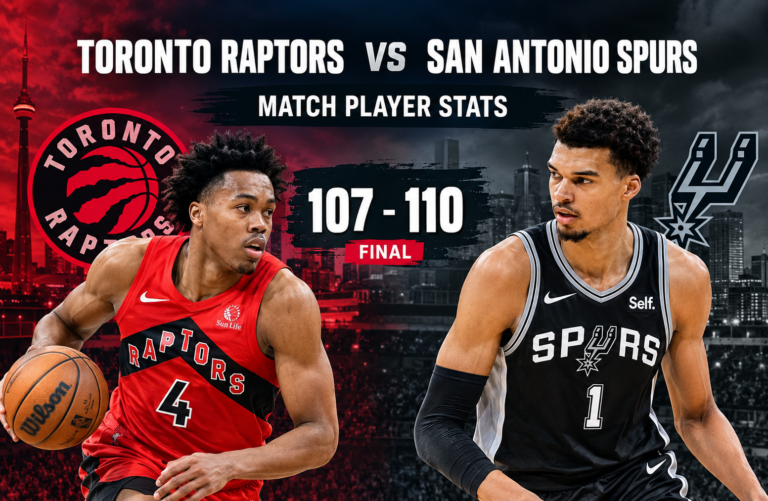
toronto raptors vs 76ers match player stats
The toronto raptors vs 76ers match player stats from February 11, 2025, tell the story of a competitive NBA game decided by execution, individual brilliance, and important contributions from both starting players and the bench. The Toronto Raptors defeated the Philadelphia 76ers 106-103 at the Wells Fargo Center in Philadelphia, earning a valuable road victory. Scottie Barnes delivered an outstanding performance with 33 points and 10 rebounds, while Immanuel Quickley added 23 points. Philadelphia received a strong performance from Joel Embiid, who recorded 27 points and 12 rebounds, but the Sixers could not overcome Toronto’s defensive pressure and more efficient shooting from the field.
This matchup was particularly interesting because both teams entered the contest looking for consistency during a challenging part of their seasons. Toronto relied on Barnes’ all-around ability, Quickley’s scoring, and contributions from its younger rotation players. Philadelphia depended heavily on Embiid’s inside presence and supporting performances from its perimeter players. Although the 76ers briefly took control during the second quarter, Toronto responded after halftime and maintained enough composure to secure the three-point win.
The final score only tells part of the story. A closer examination of individual performances, shooting percentages, rebounding numbers, turnovers, and quarter-by-quarter scoring reveals why Toronto came away victorious. It also explains how Philadelphia remained competitive despite struggling from three-point range.
Match Overview: Toronto Raptors vs Philadelphia 76ers
The February 11 meeting brought together two Eastern Conference teams with different challenges. Toronto was trying to build momentum and develop consistency, while Philadelphia was looking to improve its position after an uneven stretch of basketball.
Here are the essential details of the contest.
| Match Information | Details |
| Match | Toronto Raptors vs Philadelphia 76ers |
| Competition | NBA Regular Season |
| Date | February 11, 2025 |
| Philadelphia Local Tip-Off | 7:00 PM |
| Venue | Wells Fargo Center |
| Location | Philadelphia, Pennsylvania |
| Attendance | 19,767 |
| Final Score | Toronto Raptors 106-103 Philadelphia 76ers |
| Winning Team | Toronto Raptors |
| Losing Team | Philadelphia 76ers |
| Toronto Season Record | 17-37 |
| Philadelphia Season Record | 20-33 |
| Toronto Away Record | 5-21 |
| Philadelphia Home Record | 10-17 |
Historical venue note: The game took place at the Wells Fargo Center. The building was renamed Xfinity Mobile Arena later in 2025, so using its current name for this February game would be historically inaccurate.
Toronto entered the matchup with a 17-37 record, while Philadelphia stood at 20-33. Neither team had enjoyed the kind of season it wanted, making every opportunity to establish positive momentum important.
The Raptors had an especially difficult road record, which made this result more meaningful. Winning away from home requires discipline, particularly when facing a team with an established interior scorer such as Joel Embiid.
Philadelphia had home-court advantage and the benefit of playing in front of 19,767 spectators. Nevertheless, Toronto managed to control several important statistical categories and finished the game with the better result.
Toronto Raptors vs 76ers Match Player Stats: Complete Box Score Analysis
The most important part of this matchup was the difference between Toronto’s scoring efficiency and Philadelphia’s shooting struggles.
Toronto made 38 of its 82 field-goal attempts, finishing at approximately 46%. Philadelphia attempted nine more shots but converted only 37 of 91 attempts, resulting in a 41% field-goal percentage.
That difference was significant.
Although Philadelphia generated more shooting opportunities, it did not convert them efficiently enough to build a sustainable scoring advantage.
Complete Team Statistical Comparison
| Statistical Category | Toronto Raptors | Philadelphia 76ers |
| Points | 106 | 103 |
| Field Goals | 38/82 | 37/91 |
| Field Goal Percentage | 46% | 41% |
| Three-Pointers | 11/33 | 9/38 |
| Three-Point Percentage | 33% | 24% |
| Free Throws | 19/23 | 20/24 |
| Free Throw Percentage | 83% | 83% |
| Total Rebounds | 49 | 46 |
| Offensive Rebounds | 10 | 14 |
| Defensive Rebounds | 39 | 32 |
| Assists | 23 | 22 |
| Turnovers | 17 | 14 |
| Steals | 8 | 10 |
| Blocks | 4 | 2 |
Three statistical differences deserve particular attention.
First, Toronto shot considerably better from the field. The Raptors finished five percentage points ahead of Philadelphia in overall field-goal accuracy.
Second, the three-point shooting gap was even more noticeable. Toronto converted 11 of 33 attempts, while Philadelphia made just nine of 38. That represents a difference of approximately nine percentage points.
Third, Toronto collected 49 rebounds compared with Philadelphia’s 46. The Raptors also secured 39 defensive rebounds, helping them limit Philadelphia’s opportunities after missed shots.
Philadelphia did have some advantages. The Sixers collected more offensive rebounds, recorded more steals, and committed three fewer turnovers.
However, those advantages were not enough to compensate for their shooting inefficiency.
Quarter-by-Quarter Scoring Breakdown
The scoring pattern explains how Toronto survived Philadelphia’s second-quarter comeback and regained control after halftime.
| Quarter | Toronto Raptors | Philadelphia 76ers |
| First Quarter | 26 | 18 |
| Second Quarter | 24 | 34 |
| Third Quarter | 34 | 29 |
| Fourth Quarter | 22 | 22 |
| Final Score | 106 | 103 |
First Quarter: Toronto Establishes Early Control
Toronto started the game with a strong defensive approach and finished the opening period with a 26-18 advantage.
An eight-point lead gave the Raptors an encouraging start, particularly because they were playing on the road against a Philadelphia team featuring Joel Embiid.
Toronto’s early success came from combining scoring opportunities with defensive pressure. Rather than allowing Philadelphia to establish a comfortable offensive rhythm, the Raptors made the opening period competitive and forced the home team to work for its points.
The first-quarter advantage also helped Toronto establish an important foundation for the rest of the contest.
Second Quarter: Philadelphia Responds
Philadelphia produced its strongest scoring period in the second quarter.
The Sixers scored 34 points while limiting Toronto to 24, turning an eight-point deficit into a four-point halftime advantage.
This was an important change in momentum.
Philadelphia improved its offensive production and found ways to generate more scoring opportunities. Embiid’s interior presence remained a major factor, while the supporting rotation helped the team recover from its slow start.
Toronto, meanwhile, struggled to maintain the same level of control it had demonstrated in the opening period.
The second quarter showed why Philadelphia remained dangerous despite its overall season record. When its offense generated consistent opportunities, the team could quickly change the direction of a game.
Third Quarter: Barnes and Toronto Regain Momentum
Toronto responded effectively after halftime, scoring 34 points in the third quarter.
Philadelphia managed 29, allowing the Raptors to recover the lead and enter the final period with a narrow advantage.
Scottie Barnes was central to Toronto’s overall offensive success. His scoring, rebounding, and ability to contribute in different areas made him difficult to defend.
Immanuel Quickley also provided valuable scoring support.
The third quarter was particularly important because Toronto avoided allowing Philadelphia’s second-quarter momentum to continue. Instead, the Raptors increased their offensive production and returned to the type of basketball that had given them their early advantage.
Fourth Quarter: Both Teams Finish With 22 Points
The final period ended with both teams scoring 22 points.
Neither side produced a significant scoring advantage, making the third-quarter response especially important to the final result.
Toronto entered the fourth quarter with a small lead and managed to protect it.
Philadelphia remained within reach throughout the closing period, but its earlier shooting problems limited the team’s ability to take complete control.
Toronto’s ability to maintain its advantage demonstrated the value of its earlier scoring production.
The Raptors finished with a 106-103 victory, completing a hard-fought road performance.
Toronto Raptors Player Stats and Individual Performances
Toronto’s victory was built around several important individual contributions. Scottie Barnes was the leading scorer, but Immanuel Quickley and Gradey Dick also played meaningful roles.
The following table summarizes the available player statistics.
Complete Toronto Raptors Player Statistics
| Player | Points | Rebounds | Assists | Steals | Blocks |
| Scottie Barnes | 33 | 10 | 3 | 1 | 2 |
| Immanuel Quickley | 23 | 3 | 5 | 0 | 0 |
| Gradey Dick | 17 | 4 | 0 | 3 | 1 |
| Ochai Agbaji | 11 | 4 | 1 | 0 | 0 |
| Jamal Shead | 6 | 3 | 5 | 0 | 0 |
| Ja’Kobe Walter | 5 | 5 | 1 | 1 | 0 |
| Jonathan Mogbo | 4 | 5 | 5 | 2 | 0 |
| Orlando Robinson | 4 | 4 | 2 | 1 | 0 |
| Jamison Battle | 3 | 1 | 0 | 0 | 0 |
| Chris Boucher | 0 | 8 | 1 | 0 | 0 |
| Ulrich Chomche | 0 | 2 | 0 | 0 | 1 |
Garrett Temple did not play because of the coach’s decision.
Scottie Barnes: 33 Points and 10 Rebounds
Scottie Barnes was Toronto’s standout performer.
His statistical line included:
- 33 points
- 10 rebounds
- 3 assists
- 1 steal
- 2 blocks
Barnes delivered the type of complete performance that makes him such an important part of Toronto’s long-term plans.
His 33 points led every player in the game. Reaching double figures in rebounds also demonstrated that his contribution extended beyond scoring.
One important aspect of Barnes’ performance was his ability to influence multiple areas of the game.
His scoring gave Toronto a dependable offensive option, while his rebounding helped the Raptors compete against Philadelphia’s frontcourt. His two blocks also provided defensive value.
Barnes’ performance was particularly important because Toronto needed a reliable player who could produce without depending entirely on three-point shooting.
The 33-point total made him the clear offensive leader, but his double-double made the performance even more valuable.
From an analytical perspective, Barnes’ contribution illustrates why individual player statistics should be considered together rather than separately. A player who scores heavily while also rebounding and defending can influence a game in several ways.
Immanuel Quickley: 23 Points and Five Assists
Immanuel Quickley provided the second major scoring contribution for Toronto.
His numbers included:
- 23 points
- 3 rebounds
- 5 assists
Quickley’s scoring helped prevent Philadelphia from focusing its entire defensive approach on Barnes.
Having another player capable of producing more than 20 points is important because it creates additional offensive options.
Quickley also contributed five assists, showing that his impact was not limited to finishing possessions.
His playmaking helped Toronto distribute the ball and maintain offensive balance.
The combination of Barnes’ inside scoring and Quickley’s perimeter production gave Philadelphia two different offensive threats to manage.
This was an important element of Toronto’s winning performance.
Gradey Dick: 17 Points and Three Steals
Gradey Dick finished with 17 points, four rebounds, three steals, and one block.
His contribution was valuable on both sides of the court.
Offensively, 17 points provided another scoring option behind Barnes and Quickley. Defensively, his three steals helped Toronto create additional opportunities.
Steals are especially important in close games because they can interrupt an opponent’s offensive rhythm and create chances to score before the defense becomes organized.
Dick’s performance also demonstrated the importance of Toronto’s younger players.
A team cannot depend on one or two stars throughout an entire season. Supporting players must contribute enough to prevent opposing defenses from concentrating on the leading scorers.
Ochai Agbaji: 11 Points and Four Rebounds
Ochai Agbaji added 11 points and four rebounds.
His double-digit scoring gave Toronto another useful offensive contribution.
Agbaji’s role was particularly important in maintaining balance around the team’s leading players.
When Barnes and Quickley attracted defensive attention, other players needed to take advantage of the available opportunities.
Agbaji’s scoring helped accomplish that objective.
Although his statistical line was not as impressive as Barnes’ or Quickley’s, his contribution formed part of the collective effort behind Toronto’s victory.
Jonathan Mogbo: Five Assists and Defensive Contributions
Jonathan Mogbo recorded:
- 4 points
- 5 rebounds
- 5 assists
- 2 steals
Mogbo’s numbers highlight an important part of basketball analysis: scoring is not the only way a player can influence a result.
His five assists tied for the team high, while his five rebounds and two steals added value in other areas.
His ability to contribute as a passer was particularly useful because it gave Toronto another player capable of helping organize offensive possessions.
The two steals also demonstrated his defensive activity.
Mogbo’s performance was a good example of a supporting player contributing through several different statistical categories rather than relying on scoring alone.
Jamal Shead: Six Points and Five Assists
Jamal Shead finished with six points, three rebounds, and five assists.
His scoring was relatively modest, but his playmaking contribution was important.
Five assists from a rotation player can help maintain offensive continuity, particularly when the primary scorers are facing defensive pressure.
Shead’s contribution also gave Toronto another source of ball distribution.
Other Toronto Contributions
Several additional players helped Toronto complete its statistical effort.
- Ja’Kobe Walter scored five points and collected five rebounds.
- Orlando Robinson recorded four points, four rebounds, and two assists.
- Jamison Battle contributed three points and one rebound.
- Chris Boucher collected eight rebounds despite not scoring.
- Ulrich Chomche recorded two rebounds and one block.
Chris Boucher’s eight rebounds deserve particular attention.
Although he finished without a point, rebounding remains a valuable part of team basketball. His contribution helped Toronto maintain its overall rebounding advantage.
This is why evaluating a player’s performance only through the points column can create an incomplete picture.
Philadelphia 76ers Player Stats and Individual Performances
Philadelphia had several productive individual performances, but its overall shooting efficiency prevented the team from converting those efforts into a victory.
Joel Embiid was the leading scorer, while Jared Butler and Quentin Grimes provided important support.
Complete Philadelphia 76ers Player Statistics
| Player | Points | Rebounds | Assists | Steals | Blocks |
| Joel Embiid | 27 | 12 | 4 | 1 | 1 |
| Jared Butler | 15 | 4 | 4 | 1 | 0 |
| Quentin Grimes | 13 | 7 | 4 | 2 | 0 |
| Kelly Oubre Jr. | 12 | 7 | 3 | 2 | 1 |
| Justin Edwards | 9 | 2 | 0 | 1 | 0 |
| Guerschon Yabusele | 8 | 6 | 2 | 1 | 0 |
| Tyrese Maxey | 5 | 5 | 3 | 0 | 0 |
| Paul George | 12 | 3 | 2 | 2 | 0 |
| Ricky Council IV | 0 | 0 | 0 | 0 | 0 |
Chuma Okeke, Andre Drummond, Adem Bona, and Jeff Dowtin Jr. did not play because of the coach’s decision.
Statistical accuracy note: The supplied table lists Paul George with 14 points. The official NBA game recap reports 12 points, which is the figure used here. Player totals and team totals should be checked against the official box score before publication.
Joel Embiid: 27 Points and 12 Rebounds
Joel Embiid was Philadelphia’s leading scorer and most productive rebounder.
His statistical line included:
- 27 points
- 12 rebounds
- 4 assists
- 1 steal
- 1 block
Embiid delivered a strong individual performance despite Philadelphia’s defeat.
His 27 points demonstrated his importance to the team’s offense, while his 12 rebounds gave the Sixers a major presence on the boards.
He also contributed four assists, showing that he was involved in creating opportunities for teammates.
However, individual production does not always translate into a team victory.
Toronto found ways to remain competitive despite Embiid’s scoring. The Raptors also benefited from Philadelphia’s overall shooting problems.
An important detail from the game’s official recap was Embiid’s fourth-quarter production. He made two of six field-goal attempts in the final period and committed a turnover with Philadelphia trailing by two and 8.1 seconds remaining.
That possession was particularly significant because Philadelphia needed to preserve its final opportunity to tie or take the lead.
Instead, Toronto gained an important advantage during the closing moments.
Jared Butler: 15 Points and Four Assists
Jared Butler provided 15 points, four rebounds, and four assists.
His scoring was an important part of Philadelphia’s bench production.
When a team’s primary stars face defensive pressure, bench players must provide enough offense to maintain the team’s competitiveness.
Butler helped Philadelphia in that area.
His 15 points made him one of the team’s leading scorers, and his four assists demonstrated his ability to contribute as a playmaker.
Although Philadelphia did not win, Butler’s performance was one of the positive aspects of the team’s offensive effort.
Quentin Grimes: 13 Points and Seven Rebounds
Quentin Grimes finished with 13 points, seven rebounds, four assists, and two steals.
His performance was valuable because he contributed across several statistical categories.
The seven rebounds helped Philadelphia compete on the boards, while his four assists provided additional playmaking.
Two steals also demonstrated defensive activity.
Grimes was one of the supporting players who helped keep the Sixers competitive, particularly when the team needed production beyond Embiid.
Kelly Oubre Jr.: 12 Points and Seven Rebounds
Kelly Oubre Jr. recorded:
- 12 points
- 7 rebounds
- 3 assists
- 2 steals
- 1 block
Oubre’s contribution was balanced.
He provided scoring, rebounding, and defensive activity, making him useful in multiple areas.
His two steals were particularly valuable because Philadelphia finished with more steals than Toronto overall.
However, the Sixers needed greater offensive efficiency from the team as a whole to turn these contributions into a winning result.
Tyrese Maxey: Five Points
Tyrese Maxey finished with five points, five rebounds, and three assists.
His scoring total was one of the most surprising aspects of the matchup.
Maxey had established himself as an important offensive player for Philadelphia, making his limited scoring production especially noticeable.
The official NBA recap reported that he made just one of nine field-goal attempts, including one of seven from three-point range.
This was a major offensive limitation for Philadelphia.
A player who normally provides significant scoring pressure can change a defense’s priorities. When that player struggles, the opposing team can concentrate more attention on other offensive threats.
Toronto benefited from Maxey’s difficult shooting night.
His five rebounds and three assists still provided some value, but his scoring contribution was well below what Philadelphia needed.
Guerschon Yabusele: Eight Points and Six Rebounds
Guerschon Yabusele contributed eight points, six rebounds, two assists, and one steal.
His performance added useful depth to Philadelphia’s rotation.
Yabusele was not the leading scorer, but he helped the team in several areas.
His six rebounds were especially valuable in a game where Philadelphia finished with 46 total rebounds.
Justin Edwards: Nine Points
Justin Edwards recorded nine points, two rebounds, and one steal.
His contribution helped support Philadelphia’s scoring effort.
Although he did not reach double figures, his production provided another offensive option outside the team’s leading players.
Paul George and Other Philadelphia Players
Paul George contributed to Philadelphia’s overall effort, with the official NBA recap listing him at 12 points.
Ricky Council IV finished without points, rebounds, or assists in the supplied statistical summary.
Several other Philadelphia players did not enter the game because of coaching decisions.
The difference between the two teams was not simply that Philadelphia lacked individual talent. The Sixers had multiple players capable of contributing.
The larger problem was that their collective shooting efficiency was not strong enough to overcome Toronto’s offensive production.
The Biggest Statistical Differences That Decided the Game
A close final score often requires a deeper look at the numbers.
Toronto won by only three points, but several statistical differences explain how the Raptors created and protected their advantage.
1. Toronto Had Better Overall Shooting Efficiency
Toronto converted 46% of its field-goal attempts, compared with Philadelphia’s 41%.
Although five percentage points may appear relatively small, it can make a meaningful difference over an entire game.
Philadelphia attempted 91 shots and made 37.
Toronto attempted only 82 shots but made 38.
In other words, the Raptors made one more field goal despite taking nine fewer attempts.
That difference shows why shooting efficiency matters.
Generating attempts is important, but converting those attempts is what puts points on the scoreboard.
2. Three-Point Shooting Favored Toronto
Toronto made 11 three-pointers from 33 attempts.
Philadelphia made nine from 38 attempts.
The difference was not simply the number of successful shots. Toronto also needed fewer attempts to produce its three-point total.
Toronto’s 33% conversion rate was considerably better than Philadelphia’s 24%.
Three-point shooting can quickly influence the momentum of a basketball game because every successful attempt provides three points.
Philadelphia’s inability to convert consistently from beyond the arc limited its scoring potential.
3. Rebounding Helped Toronto Maintain Control
Toronto collected 49 rebounds, while Philadelphia recorded 46.
The Raptors also secured 39 defensive rebounds compared with Philadelphia’s 32.
This difference was particularly important because defensive rebounds help end opposing possessions.
Philadelphia collected more offensive rebounds, 14 to Toronto’s 10, but the Raptors finished with the better total.
Toronto’s defensive rebounding helped reduce the number of additional scoring opportunities available to the Sixers.
4. Philadelphia Committed Fewer Turnovers
Philadelphia recorded 14 turnovers, while Toronto committed 17.
This was an advantage for the Sixers.
Turnovers can be costly because they end possessions without guaranteeing a shot attempt.
However, Philadelphia’s lower turnover total did not produce enough additional scoring to overcome its shooting problems.
This demonstrates why a single statistical category should never be used as the only explanation for a game’s result.
5. Philadelphia Recorded More Steals
The Sixers finished with 10 steals compared with Toronto’s eight.
This indicates that Philadelphia generated more defensive takeaways.
Nevertheless, those steals did not create a large enough scoring advantage to change the outcome.
Toronto remained more efficient in its shooting and finished with the victory.
6. Free-Throw Accuracy Was Almost Identical
Both teams finished with an 83% free-throw percentage.
Toronto converted 19 of 23 attempts, while Philadelphia made 20 of 24.
Philadelphia made one additional free throw, but that advantage was not enough to overcome its weaker field-goal and three-point shooting.
Why Scottie Barnes Was the Difference-Maker
Scottie Barnes’ performance deserves a separate examination because his contribution went beyond simply leading the scoring chart.
His 33 points represented almost one-third of Toronto’s final team total.
He also recorded 10 rebounds, meaning he contributed significantly to both offensive production and possession control.
There are three reasons why his performance was particularly important.
Scoring Responsibility
Toronto needed someone capable of producing consistently against Philadelphia’s defense.
Barnes fulfilled that responsibility.
His 33 points gave the Raptors a dependable scoring foundation and reduced the pressure on the rest of the lineup.
Rebounding Contribution
Barnes collected 10 rebounds.
This helped Toronto compete against a Philadelphia frontcourt featuring Embiid.
Rebounding is often overlooked when evaluating offensive stars, but it is an important part of controlling the game.
A player who scores heavily while also collecting rebounds can influence the number of opportunities available to both teams.
Defensive Activity
Barnes also recorded one steal and two blocks.
Those numbers demonstrate that his contribution was not limited to the offensive end.
His ability to affect multiple areas of the game made him Toronto’s most influential player.
Why Joel Embiid Could Not Lead Philadelphia to Victory
Joel Embiid had an impressive individual performance, recording 27 points and 12 rebounds.
However, the result demonstrates an important principle of team basketball: individual excellence cannot always compensate for collective inefficiency.
Philadelphia needed more consistent scoring from its perimeter players.
Tyrese Maxey’s five points were a major limitation, particularly because he made only one of nine field-goal attempts.
Philadelphia also finished with a 24% three-point percentage.
These problems placed additional pressure on Embiid.
When a team’s primary offensive option is producing consistently but supporting players struggle, opposing defenses can concentrate more attention on limiting that primary option.
Philadelphia also needed better execution during the final moments.
Embiid’s late turnover was costly because the team was still close enough to challenge for the victory.
His overall performance was strong, but the Sixers needed a more complete team effort.
Bench Production: Which Team Received Better Support?
Bench production played an important role in this matchup.
Toronto received useful scoring from Gradey Dick, who finished with 17 points.
Philadelphia had a productive contribution from Jared Butler, who recorded 15 points.
Quentin Grimes also added 13 points, giving the Sixers another important offensive option.
The comparison reveals that both teams received contributions outside their leading scorers.
However, Toronto benefited from a more balanced scoring combination among its primary contributors.
Barnes scored 33 points, Quickley added 23, and Dick contributed 17.
Together, those three players accounted for 73 of Toronto’s 106 points.
Philadelphia had Embiid with 27 points, Butler with 15, Grimes with 13, and Oubre with 12.
Their combined total was 67 points.
This comparison highlights the importance of having several players capable of contributing consistently.
Toronto did not rely entirely on Barnes to generate its offense.
What the Match Revealed About Toronto’s Team Performance
The victory offered several useful observations about Toronto’s playing style and team development.
Offensive Balance Was Important
Toronto had three players score at least 17 points.
This created a more balanced offensive structure and reduced its dependence on a single player.
Barnes was the primary scorer, but Quickley and Dick helped maintain offensive pressure.
Defensive Rebounding Remained Valuable
Toronto collected 39 defensive rebounds.
This helped the team end Philadelphia’s possessions and reduced the number of second-chance opportunities available to the home team.
Younger Players Contributed
Toronto’s supporting players provided contributions across scoring, passing, and defense.
Mogbo, Shead, Walter, and Dick all had roles in the statistical picture.
These contributions were useful because developing players need opportunities to handle meaningful situations.
Road Execution Improved
Toronto entered the game with a 5-21 away record.
Winning in Philadelphia demonstrated that the team could produce an effective performance outside its home environment.
One victory did not change the overall season picture, but it provided a positive result during a difficult campaign.
What the Match Revealed About Philadelphia’s Weaknesses
The defeat highlighted several areas Philadelphia needed to improve.
Perimeter Shooting
The Sixers made only nine of 38 three-point attempts.
A 24% conversion rate made it difficult to keep pace with Toronto’s offense.
Supporting Scoring
Embiid led the team with 27 points, but Maxey contributed only five.
Philadelphia needed more consistent scoring from its perimeter players.
Late-Game Execution
The final minutes required careful possession management.
Embiid’s late turnover became particularly important because the Sixers were trailing by only two points at the time.
Defensive Rebounding
Philadelphia collected 32 defensive rebounds, seven fewer than Toronto.
The Sixers needed to do more to prevent Toronto from maintaining possession and controlling the defensive glass.
Head-to-Head Series: Raptors vs 76ers in the 2024-25 Season
The February matchup was part of a four-game regular-season series between Toronto and Philadelphia.
Toronto won all four meetings.
| Game | Result | Winner |
| October 26, 2024 | Toronto 115-107 Philadelphia | Toronto |
| February 11, 2025 | Toronto 106-103 Philadelphia | Toronto |
| March 13, 2025 | Toronto 118-105 Philadelphia | Toronto |
| March 31, 2025 | Toronto 127-109 Philadelphia | Toronto |
The February victory gave Toronto a 2-0 advantage in the season series at that point.
The Raptors later extended that advantage by winning the remaining two meetings.
This four-game record is important for understanding the broader matchup.
Toronto demonstrated that it could consistently compete against Philadelphia during that regular season, winning games through different scoring performances and team contributions.
However, a regular-season series should not automatically be treated as proof that one team is permanently superior.
Roster availability, player health, rotations, and game circumstances can change considerably between meetings.
The results simply show that Toronto had the stronger record in this particular season series.
Important Lessons From the Player Statistics
The numbers from this contest provide several useful lessons for understanding NBA basketball.
Points Do Not Tell the Whole Story
Barnes’ 33 points made him the leading scorer, but his 10 rebounds and defensive contributions made his performance even more valuable.
Similarly, Mogbo’s four points do not fully describe his impact because he also recorded five rebounds, five assists, and two steals.
Shooting Efficiency Can Decide Close Games
Toronto made more field goals despite attempting fewer shots.
That difference was one of the clearest explanations for the result.
Bench Players Can Influence Winning Performances
Gradey Dick’s 17 points and Jared Butler’s 15 points demonstrate how important supporting players can be.
A team’s depth can make a significant difference when the leading players face defensive pressure.
Turnovers Must Be Evaluated Alongside Other Categories
Philadelphia committed fewer turnovers but still lost.
This shows that protecting possession is important, but teams must also convert their offensive opportunities.
Rebounding Is More Than a Total Number
Toronto’s 39 defensive rebounds helped the team end Philadelphia’s possessions.
Philadelphia’s 14 offensive rebounds were a positive contribution, but the overall rebounding balance favored Toronto.
Frequently Asked Questions
1. Who won the Toronto Raptors vs Philadelphia 76ers game on February 11, 2025?
The Toronto Raptors defeated the Philadelphia 76ers 106-103. Toronto secured the road victory at the Wells Fargo Center in Philadelphia.
2. How many points did Scottie Barnes score against the 76ers?
Scottie Barnes scored 33 points. He also recorded 10 rebounds, three assists, one steal, and two blocks, delivering an outstanding all-around performance.
3. How many points did Joel Embiid score against Toronto?
Joel Embiid scored 27 points and collected 12 rebounds. He also recorded four assists, one steal, and one block.
4. What were Immanuel Quickley’s stats against Philadelphia?
Immanuel Quickley finished with 23 points, three rebounds, and five assists. He was Toronto’s second-leading scorer behind Scottie Barnes.
5. What was the final score by quarter?
Toronto scored 26, 24, 34, and 22 points across the four quarters. Philadelphia scored 18, 34, 29, and 22 points. The final score was Toronto 106, Philadelphia 103.
6. How many times did Toronto beat Philadelphia during the 2024-25 regular season?
Toronto won all four regular-season meetings against Philadelphia during the 2024-25 season. The Raptors won 115-107, 106-103, 118-105, and 127-109.
Conclusion
The February 11, 2025 matchup between the Toronto Raptors and Philadelphia 76ers was a closely contested game that demonstrated the importance of scoring efficiency, rebounding, and balanced team contributions.
Toronto secured a 106-103 victory despite playing on the road and entering the contest with a difficult away record. Scottie Barnes delivered the standout performance with 33 points and 10 rebounds, while Immanuel Quickley contributed 23 points and Gradey Dick added 17.
Philadelphia received an impressive individual performance from Joel Embiid, who recorded 27 points and 12 rebounds. Jared Butler, Quentin Grimes, and Kelly Oubre Jr. also contributed valuable scoring.
However, Philadelphia’s 41% field-goal percentage and 24% three-point shooting proved costly. Toronto converted its attempts more efficiently, collected 49 rebounds, and maintained enough control to protect its advantage during the final quarter.
The most important takeaway from this matchup is that individual scoring totals must be evaluated alongside team statistics. Barnes and Embiid both delivered strong performances, but Toronto received the more effective overall combination of scoring, shooting, and rebounding.
The result also completed the second of four regular-season meetings that Toronto ultimately won against Philadelphia in 2024-25. For readers examining this contest, the individual box scores and team comparisons provide a clear explanation of how the Raptors earned their three-point road victory.