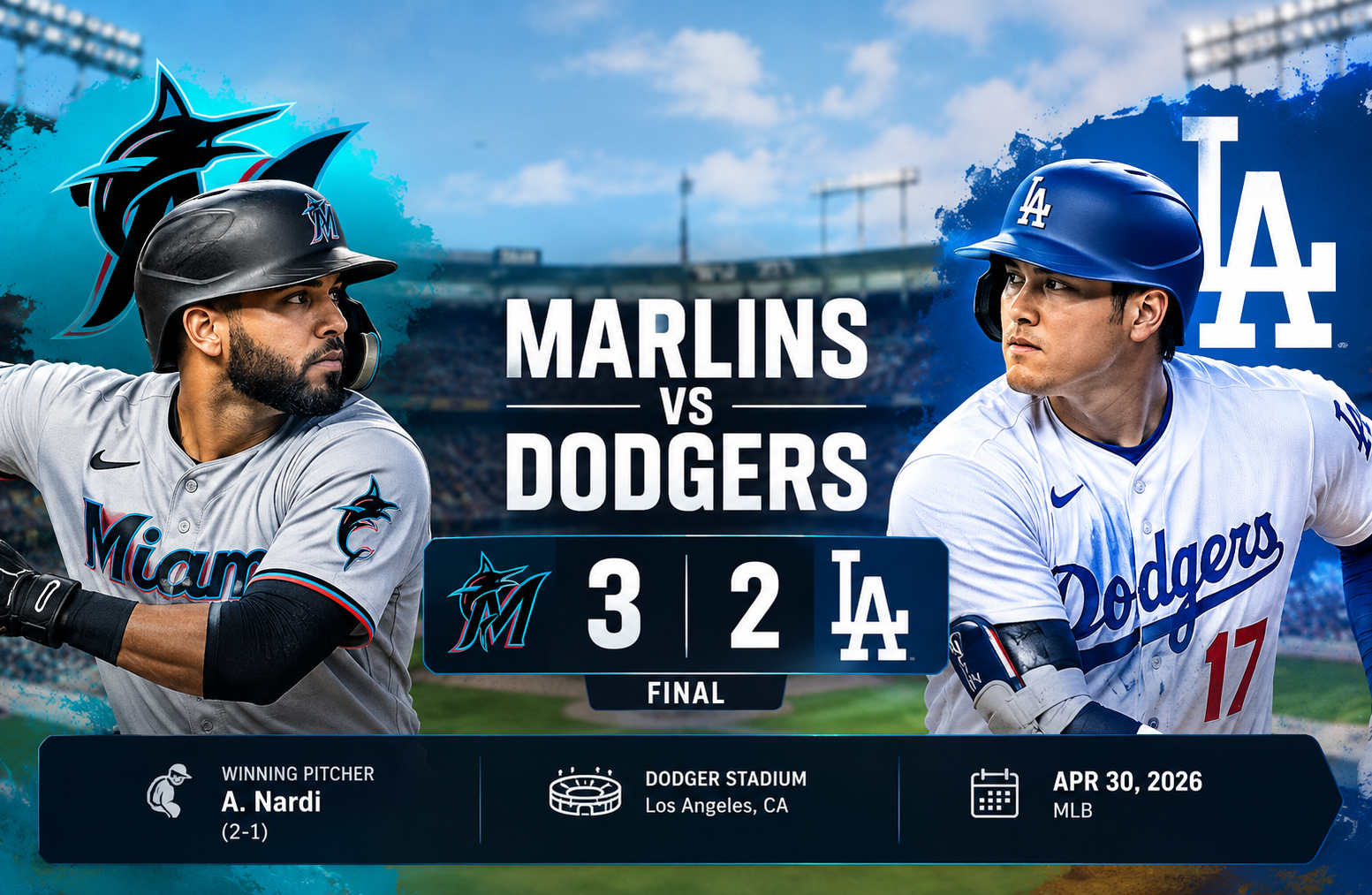
Miami Marlins vs Dodgers Match Player Stats
The miami marlins vs dodgers match player stats from April 30, 2026, tell the story of a closely contested Major League Baseball game decided by timely hitting, home-run power, and late-inning execution. The Miami Marlins defeated the Los Angeles Dodgers 3-2 at Dodger Stadium in Los Angeles, completing a 2-1 series victory. Although the Dodgers collected seven hits compared with Miami’s six, the Marlins made their offensive opportunities count, with home runs from L. Hicks and E. Ruiz and a decisive eighth-inning RBI single by J. Sanoja. Miami’s pitching staff limited Los Angeles to two runs, turning a narrow contest into a valuable road win.
This game offers an excellent example of why baseball statistics must be examined beyond the final score. Hits, walks, strikeouts, runners left on base, pitching efficiency, and situational hitting all help explain how a team wins. The Dodgers generated several opportunities but could not produce enough runs to overcome Miami’s late advantage. The Marlins, meanwhile, combined two home runs with a timely single to secure the result. The following breakdown examines the verified game data, individual performances, key scoring plays, and the statistical details that shaped the outcome.
Game Overview: Miami Marlins vs Los Angeles Dodgers
The April 30, 2026, box score records a 3-2 Miami victory, with the Marlins scoring in the second, fifth, and eighth innings. The Dodgers answered in the second and sixth innings but failed to score again. Both teams finished without a fielding error, making the difference in the game primarily a matter of offensive execution and pitching under pressure.
Game information at a glance
| Category | Match details |
| Matchup | Miami Marlins vs Los Angeles Dodgers |
| Date shown in supplied box score | April 30, 2026 |
| Venue | Dodger Stadium, Los Angeles, California |
| Final score | Marlins 3, Dodgers 2 |
| Marlins record shown | 15-16 |
| Dodgers record shown | 20-11 |
| Miami hits | 6 |
| Los Angeles hits | 7 |
| Errors | Marlins 0, Dodgers 0 |
| Winning pitcher | Andrew Nardi |
| Losing pitcher | Will Klein |
| Save | Calvin Faucher |
| Attendance | 50,555 |
| Game duration | 2 hours, 42 minutes |
| Series result | Miami won 2-1 |
There is a small date distinction worth noting for readers checking multiple baseball databases. The supplied ESPN box score labels the game April 30, while the local Los Angeles game recap published by MLB identifies the contest as April 29. This reflects a date-labeling difference across the available records, so the box-score date is retained here while the matchup itself is identified by its 3-2 final score.
The most important result was not simply that Miami won. It was how the team won. The Marlins received six innings from starting pitcher Sandy Alcantara, generated two solo home runs against Tyler Glasnow, and produced the winning run with a two-out single in the eighth. Their bullpen then protected the one-run advantage through a tense ninth inning.
For Los Angeles, the statistics reveal a different story. The Dodgers hit safely seven times and received six walks, but they scored only twice. They also went 2-for-11 with runners in scoring position and left nine runners on base. Those figures help explain why the home team could not turn its opportunities into a winning result.
Miami Marlins vs Dodgers Match Player Stats: Complete Team Comparison
The team comparison provides the clearest starting point for understanding the game. Miami recorded fewer hits but produced more runs, while Los Angeles had a slight advantage in total hits and struck out less frequently.
| Team statistic | Miami Marlins | Los Angeles Dodgers |
| Runs | 3 | 2 |
| Hits | 6 | 7 |
| Errors | 0 | 0 |
| At-bats | 31 | 31 |
| Runs batted in | 3 | 2 |
| Home runs | 2 | 0 |
| Walks | 7 | 6 |
| Strikeouts | 13 | 6 |
| Stolen bases | 2 | 1 |
| Left on base | 8 | 9 |
| Runners in scoring position | 1-for-8 | 2-for-11 |
| Double plays | 2 turned | 2 grounded into |
The figures highlight three important differences.
First, Miami’s power production made a major difference. Hicks and Ruiz both hit solo home runs, accounting for two of the Marlins’ three runs. The Dodgers did not hit a home run, so they needed to string together hits and advance runners to score.
Second, Los Angeles made more contact without converting that advantage into enough runs. Seven hits are useful, but their value depends on when they occur, whether runners are already aboard, and whether subsequent hitters can bring those runners home.
Third, Miami’s 13 strikeouts show that the offense was far from flawless. The Marlins also left eight runners on base and went 1-for-8 with runners in scoring position. Their victory therefore should not be interpreted as evidence of complete offensive dominance. Rather, they capitalized on two powerful swings and one decisive late hit.
The Dodgers’ six strikeouts indicate better contact frequency, but contact alone did not solve their scoring problem. The difference between the teams was the ability to produce runs at critical moments.
Individual Batting Statistics for Miami
Miami’s offense featured contributions from Liam Hicks, Esteury Ruiz, Xavier Edwards, Javier Sanoja, and Otto Lopez. The home runs supplied the early scoring power, while Edwards and Sanoja combined to create the winning run in the eighth inning.
The following table summarizes the principal Marlins hitters using the supplied game statistics and the available player box-score data.
| Player | AB | R | H | RBI | HR | BB | K | SB |
| Jakob Marsee | 4 | 0 | 0 | 0 | 0 | 1 | 3 | 0 |
| Kyle Stowers | 3 | 0 | 0 | 0 | 0 | 2 | 2 | 0 |
| Otto Lopez | 4 | 0 | 1 | 0 | 0 | 0 | 2 | 1 |
| Xavier Edwards | 4 | 1 | 1 | 0 | 0 | 0 | 0 | 0 |
| Liam Hicks | 2 | 1 | 1 | 1 | 1 | 2 | 0 | 0 |
| Connor Norby | 3 | 0 | 0 | 0 | 0 | 1 | 3 | 0 |
| Owen Caissie | 2 | 0 | 0 | 0 | 0 | 0 | 1 | 0 |
| Javier Sanoja | 2 | 0 | 1 | 1 | 0 | 0 | 0 | 0 |
| Graham Pauley | 3 | 0 | 0 | 0 | 0 | 1 | 1 | 0 |
| Esteury Ruiz | 4 | 1 | 2 | 1 | 1 | 0 | 1 | 1 |
| Team total | 31 | 3 | 6 | 3 | 2 | 7 | 13 | 2 |
AB means at-bats, R means runs, H means hits, RBI means runs batted in, HR means home runs, BB means walks, K means strikeouts, and SB means stolen bases.
Liam Hicks: The Early Power Spark
Liam Hicks gave Miami its first major offensive breakthrough with a solo home run in the second inning. The supplied game data lists the drive at 398 feet to right field, his seventh home run of the season.
His overall line was productive despite a small number of official at-bats. Hicks finished 1-for-2 with one run, one RBI, one home run, and two walks. That combination matters because his contribution went beyond the home run itself. He reached base multiple times and forced the Dodgers to account for him throughout his plate appearances.
Hicks’ home run also changed the game’s immediate rhythm. Before the drive, both starting pitchers had an opportunity to settle into a scoreless contest. The homer put Miami ahead and demonstrated that Glasnow’s strikeout ability would not necessarily prevent hard contact.
A home run is particularly valuable in a close game because it produces a run without requiring a sequence of hits. Hicks did not need a teammate to reach base first, and Miami did not have to rely on a runner advancing through multiple situations.
His two walks also deserve attention. Walks can increase the number of pitches a starter must throw and give the offense additional chances to create pressure. In this matchup, Glasnow struck out nine Marlins but also issued six walks, showing the tension between his swing-and-miss effectiveness and his difficulty consistently finishing plate appearances.
Esteury Ruiz: Another Home Run and a Stolen Base
Esteury Ruiz supplied Miami’s second solo home run, sending the ball 381 feet to left field in the fifth inning. The homer gave the Marlins a 2-1 lead after the Dodgers had tied the score in the second.
Ruiz finished 2-for-4 with one run, one RBI, one home run, and one stolen base. His two hits tied him for the most hits by a Miami player in the game, and his power supplied an important part of the team’s scoring total.
The fifth-inning home run was especially valuable because it restored Miami’s lead after Los Angeles had answered Hicks’ earlier homer. When a team scores and its opponent responds, the next scoring opportunity often becomes a key test of composure. Ruiz’s swing allowed Miami to regain control without needing a multi-hit rally.
His stolen base added another dimension to his performance. A stolen base can put a runner closer to scoring position, although it does not guarantee a run. Ruiz’s contribution combined power and speed, two skills that create different kinds of defensive pressure.
The important distinction is that Miami did not rely exclusively on small-ball tactics or exclusively on home runs. Ruiz demonstrated both approaches in the same game, giving the Marlins an offensive contribution that extended beyond his RBI total.
Xavier Edwards: The Setup to the Winning Run
Xavier Edwards scored the decisive run in the eighth inning. His leadoff single gave Miami a baserunner, and he eventually crossed home when Javier Sanoja reached on an infield single.
Edwards finished with one hit in four at-bats and scored once. His RBI total remained at zero because Sanoja, rather than Edwards, was credited with driving in the run.
This distinction is important when interpreting player statistics. A player can make a decisive contribution to a scoring sequence without receiving an RBI. Edwards’ job was to reach base and create an opportunity. Sanoja’s hit completed the scoring play.
The eighth inning also showed the value of baserunning and lineup depth. Miami did not need another home run to take the lead. A single, advancement, and a timely hit were enough to create the difference in a one-run game.
Edwards’ contribution therefore belongs among the most important individual performances of the contest, even though his line was less eye-catching than those of Hicks and Ruiz.
Javier Sanoja: The Decisive Eighth-Inning Hit
Javier Sanoja delivered the game’s most consequential hit when he singled in Edwards in the eighth inning to make the score 3-2.
Sanoja finished 1-for-2 with one RBI. His hit was the third and final run-producing play for Miami, and it came at a point when the contest was tied 2-2.
The situation made the hit especially valuable. A single in an early inning can create a lead that may later disappear. A go-ahead hit in the eighth leaves the opponent with fewer opportunities to respond. Los Angeles had only the bottom of the eighth and ninth innings remaining after Miami took the lead.
Sanoja’s infield single was not a home run or an extra-base hit, but its value cannot be judged by distance alone. Baseball statistics become more meaningful when considered in context. A hit that brings home the go-ahead run late in a tied game can have greater immediate importance than a single with no runners aboard.
The play also highlighted Miami’s ability to produce runs through different methods. Hicks and Ruiz supplied power; Edwards reached base; Sanoja supplied the decisive contact.
Otto Lopez and the Supporting Hitters
Otto Lopez finished with one hit and one stolen base. He did not score or drive in a run, but his speed contributed to Miami’s ability to apply pressure on the bases.
Other Marlins hitters had more difficult afternoons. Marsee went hitless with three strikeouts, while Stowers and Norby also struck out multiple times. Pauley did not record a hit but reached base on a walk.
Those individual lines explain why the team total of 13 strikeouts should not be overlooked. Miami’s three runs were enough to win, but several plate appearances ended without a hit. The offense succeeded because its most important contributions arrived at the right moments, not because every hitter performed well.
This is a useful reminder for readers evaluating player performance. A game can feature a winning team whose offense still has clear areas for improvement. Miami won, but its inability to convert more baserunners into runs suggests that the result was closer than the final score alone might imply.
Los Angeles Dodgers Batting Statistics
The Dodgers recorded seven hits, one more than Miami, but finished with only two runs. Alex Call and Dalton Rushing accounted for the two RBIs, while Max Muncy and Kyle Tucker recorded doubles.
| Player | AB | R | H | RBI | HR | BB | K | SB |
| Shohei Ohtani | 2 | 0 | 0 | 0 | 0 | 3 | 1 | 1 |
| Freddie Freeman | 5 | 0 | 0 | 0 | 0 | 0 | 0 | 0 |
| Andy Pages | 4 | 0 | 1 | 0 | 0 | 0 | 2 | 0 |
| Kyle Tucker | 3 | 1 | 1 | 0 | 0 | 1 | 1 | 0 |
| Max Muncy | 3 | 1 | 1 | 0 | 0 | 0 | 0 | 0 |
| Will Smith | 1 | 0 | 0 | 0 | 0 | 0 | 0 | 0 |
| Dalton Rushing | 3 | 0 | 1 | 1 | 0 | 0 | 1 | 0 |
| Miguel Rojas | 1 | 0 | 0 | 0 | 0 | 0 | 0 | 0 |
| Hyeseong Kim | 3 | 0 | 1 | 0 | 0 | 1 | 0 | 0 |
| Alex Call | 3 | 0 | 1 | 1 | 0 | 1 | 1 | 0 |
| Alex Freeland | 3 | 0 | 1 | 0 | 0 | 0 | 0 | 0 |
| Team total | 31 | 2 | 7 | 2 | 0 | 6 | 6 | 1 |
Alex Call: The Second-Inning Response
Alex Call helped the Dodgers answer Miami’s early lead. In the second inning, he reached on an infield single that scored Max Muncy, tying the game at 1-1.
Call finished with one hit, one RBI, one walk, and one strikeout in three at-bats. His RBI represented one of Los Angeles’ two runs, and his contribution demonstrated that the Dodgers could respond when Miami scored first.
The importance of Call’s hit lies in the timing. Hicks had given Miami a lead with a solo homer, but Call’s single prevented that advantage from lasting beyond the same inning. In a low-scoring game, answering a run quickly can keep a team from falling into a difficult position.
Call also drew a walk, giving him another way to reach base. Although his overall production did not match the impact of Miami’s late scoring sequence, he was one of the Dodgers’ more effective contributors in the game.
Dalton Rushing: The Sixth-Inning RBI
Dalton Rushing drove in the Dodgers’ second run with a single to right field in the sixth inning. His hit scored Kyle Tucker and tied the game at 2-2.
Rushing finished 1-for-3 with one RBI and one strikeout. His RBI was particularly significant because it erased the lead created by Ruiz’s fifth-inning home run.
At that stage, the Dodgers had done enough to keep the game even. Their challenge was to produce another run before Miami could regain the lead. That additional scoring opportunity never became a third run.
Rushing’s hit illustrates why an RBI total should be read alongside the game situation. His single was valuable because it tied the score, but the Dodgers still needed a later contribution to move ahead.
Kyle Tucker and Max Muncy: Extra-Base Contact
Tucker and Muncy each recorded a double. Tucker scored the Dodgers’ second-inning run sequence’s later scoring contribution when Rushing singled in the sixth, while Muncy scored on Call’s second-inning infield single.
Both players helped create opportunities through extra-base contact. A double puts a runner in scoring position immediately, reducing the number of additional events needed to bring that runner home.
Yet the Dodgers’ overall scoring remained limited. Their doubles were useful, but the team could not combine them with enough subsequent hits to build a larger lead. This is the central difference between creating offensive opportunities and converting those opportunities into runs.
Shohei Ohtani and Freddie Freeman
Ohtani finished without a hit, but he drew three walks and stole a base. That line shows why a hitless performance is not necessarily an unproductive one. Reaching base three times through walks gave him opportunities to affect the game, and his stolen base demonstrated additional running value.
Freeman, by contrast, went 0-for-5 and grounded into two double plays. The two double plays were especially damaging because they ended potential rallies and removed baserunners without producing runs.
The figures should be viewed as a single-game performance rather than a broad judgment about either player’s overall ability. A box score describes what happened in one contest. It cannot, on its own, establish a player’s longer-term form or predict what will happen in future games.
Starting Pitcher Comparison: Sandy Alcantara vs Tyler Glasnow
The starting pitchers played a major role in keeping the contest close. Sandy Alcantara worked six innings for Miami, while Tyler Glasnow pitched 5⅔ innings for Los Angeles. Both starters allowed two earned runs, but their methods differed.
| Pitching statistic | Sandy Alcantara | Tyler Glasnow |
| Innings pitched | 6.0 | 5.2 |
| Hits allowed | 7 | 3 |
| Runs allowed | 2 | 2 |
| Earned runs | 2 | 2 |
| Walks | 2 | 6 |
| Strikeouts | 4 | 9 |
| Home runs allowed | 0 | 2 |
| Total pitches | 104 | 92 |
| Strikes | 73 | 56 |
| Game score | 52 | 58 |
| ERA listed in supplied data | 3.04 | 2.56 |
Pitching notation 5.2 means five innings and two outs in the sixth inning, not 5.2 decimal innings. The supplied ERA figures are retained as provided and should be distinguished from season totals calculated after the game.
Sandy Alcantara: Six Innings That Kept Miami in the Game
Alcantara allowed seven hits and two earned runs over six innings. He struck out four batters, walked two, and did not surrender a home run. He threw 104 pitches, 73 of which were strikes.
The most important part of Alcantara’s outing was that he limited the damage. Seven hits might look concerning in isolation, but a pitcher can allow several hits and still deliver a useful start if those hits do not turn into a large number of runs.
Alcantara also avoided the home-run damage that Glasnow experienced. Both Dodgers runs came through sequences involving baserunners and singles rather than home runs. That meant Miami could continue competing without having to recover from a multi-run homer.
His 104 pitches over six innings indicate that the Dodgers made him work. He was not overwhelmingly efficient, and his four strikeouts show that he did not dominate hitters through strikeouts alone. Nevertheless, six innings of two-run baseball gave Miami a realistic chance to win.
For evaluating this start, three figures deserve the most attention:
- Six innings pitched: Alcantara covered a substantial portion of the game.
- Two earned runs allowed: He kept the Dodgers’ scoring within reach.
- Zero home runs allowed: He prevented Los Angeles from producing a quick, multi-run scoring swing.
These numbers describe a competitive outing rather than a flawless one. Alcantara allowed traffic on the bases, but the damage remained limited.
Tyler Glasnow: Nine Strikeouts, Two Costly Home Runs
Glasnow recorded nine strikeouts in 5⅔ innings, allowing three hits, two earned runs, and six walks. His 92 pitches included 56 strikes.
His performance illustrates why strikeouts are only one part of pitching analysis. Glasnow generated more strikeouts than Alcantara and allowed fewer hits, yet both starters gave up two earned runs.
The two hits that left the yard were particularly costly. Hicks homered in the second inning, and Ruiz homered in the fifth. Both were solo shots, so neither produced a multi-run rally. However, each homer directly affected the score, leaving Glasnow with little margin for error.
The six walks were another important factor. Walks create baserunners without requiring the hitter to put the ball in play. They can also increase pitch counts, extend innings, and create additional pressure on the defense.
Glasnow’s 92-pitch total was lower than Alcantara’s 104, even though he recorded fewer outs. The difference reflects the fact that pitching efficiency cannot be evaluated through pitch count alone. Glasnow missed bats successfully, but he also allowed frequent free passes and surrendered two home runs.
His outing was therefore mixed: excellent strikeout production, limited hits allowed, but costly mistakes in the form of home runs and walks.
Why the Two Starting Performances Were Closer Than They Looked
A simple comparison might favor Glasnow because he recorded nine strikeouts and allowed only three hits. A broader evaluation must also account for the six walks and two home runs.
Alcantara allowed more hits, but he completed six innings without giving up a home run. Each starter allowed two earned runs, so the scoreboard does not show a clear advantage for either one in terms of runs surrendered.
The key distinction was how each pitcher allowed those runs. Miami scored twice through home runs, while Los Angeles relied on singles and baserunners. Home runs can be especially damaging because they guarantee that the hitter scores and do not depend on what the next batter does.
Neither starter produced a dominant, shutout-level performance. Both gave their teams a chance to win, and the final result was decided by the offenses and relief pitchers who followed them.
Bullpen Statistics: The Difference in the Final Three Innings
The starting pitchers kept the game close, but the relief performances helped determine the winner. Miami’s bullpen did not allow a run after Alcantara departed, while the Dodgers’ relief corps surrendered the go-ahead run in the eighth.
| Pitcher | Team | IP | H | R | ER | BB | K | Result |
| Andrew Nardi | Miami | 1.0 | 0 | 0 | 0 | 1 | 1 | Win |
| Jason King | Miami | 1.0 | 0 | 0 | 0 | 0 | 1 | Hold |
| Calvin Faucher | Miami | 1.0 | 0 | 0 | 0 | 3 | 0 | Save |
| Anthony Vesia | Los Angeles | 0.1 | 0 | 0 | 0 | 0 | 0 | No decision |
| Will Klein | Los Angeles | 2.0 | 3 | 1 | 1 | 1 | 3 | Loss |
| Kyle Hurt | Los Angeles | 1.0 | 0 | 0 | 0 | 0 | 1 | No decision |
Andrew Nardi Earns the Win
Nardi pitched a scoreless seventh inning, allowing no hits while recording one strikeout and one walk. His work earned him the win, improving his listed record to 2-1.
Nardi’s inning was important because it prevented the Dodgers from taking advantage of a tied game. With the score at 2-2, any run could have changed the strategy for the final innings.
His performance was not entirely free of baserunners because he issued a walk, but he did not allow that runner to score. In relief appearances, the ability to strand runners is often just as important as preventing hits.
Jason King Keeps Los Angeles Off the Board
King worked a scoreless eighth inning, recording one strikeout without allowing a hit or a walk. That clean inning preserved the possibility of Miami taking the lead and gave the offense an opportunity to decide the game.
The value of a scoreless relief inning becomes particularly clear in a tied contest. Had Los Angeles scored in the eighth, Miami would have entered the ninth needing to recover from a deficit rather than protecting a lead.
King’s contribution did not produce a win or a save in the supplied statistics, but it helped bridge the game from Alcantara’s start to Faucher’s final inning.
Will Klein Takes the Loss
Klein allowed three hits and one earned run over two innings, striking out three and walking one. The run charged to him was the decisive score in the eighth inning.
The official loss does not mean Klein pitched poorly in every respect. Three strikeouts in two innings represent useful relief work, and he did not allow a home run. However, the sequence that produced the go-ahead run determined the result.
Klein’s outing illustrates how a relief pitcher can record several successful outs yet still be charged with a loss. The timing of the runs allowed matters because the pitcher who gives up the decisive run is often responsible for the losing decision, subject to the official scoring rules.
Calvin Faucher’s Difficult but Successful Save
Faucher was credited with the save after pitching a scoreless ninth inning. He allowed no hits and no earned runs, but he issued three walks and recorded no strikeouts.
That is an unusual combination for a successful closing appearance. Faucher did not overpower the Dodgers, and the three walks created substantial pressure. Yet he prevented any of those baserunners from crossing home.
A save does not require a perfect inning. It requires the reliever to preserve the lead under the applicable save conditions. Faucher accomplished that task, although the walks show that the inning was much more tense than the final line of zero runs allowed might suggest.
The broader bullpen lesson is that results and process should be evaluated together. Miami’s relief pitchers produced three scoreless innings, but Faucher’s control issues nearly made the finish more complicated.
Inning-by-Inning Scoring Breakdown
The scoring sequence explains how a game with only five total runs remained competitive from beginning to end.
| Inning | Miami Marlins | Los Angeles Dodgers | Score |
| 1st | 0 | 0 | 0-0 |
| 2nd | 1 | 1 | 1-1 |
| 3rd | 0 | 0 | 1-1 |
| 4th | 0 | 0 | 1-1 |
| 5th | 1 | 0 | 2-1 Miami |
| 6th | 0 | 1 | 2-2 |
| 7th | 0 | 0 | 2-2 |
| 8th | 1 | 0 | 3-2 Miami |
| 9th | 0 | 0 | 3-2 Miami |
| Final | 3 | 2 | Miami wins |
Second Inning: Hicks and Call Trade Runs
Hicks opened the scoring with a solo home run to right field. The Dodgers responded when Call reached on an infield single that brought home Muncy.
The inning established the pattern that defined the game: Miami used a home run, while Los Angeles scored through a sequence of baserunners and contact. Neither team gained a lasting advantage.
Fifth Inning: Ruiz Restores Miami’s Lead
Ruiz homered to left field, putting Miami ahead 2-1. The drive was the second solo homer allowed by Glasnow and gave the Marlins another lead to defend.
The run was significant because it came after two scoreless innings. Miami had been unable to extend its advantage in the third and fourth, but Ruiz’s home run provided a direct way to score without needing multiple hits in the same inning.
Sixth Inning: Rushing Ties the Game
The Dodgers answered when Rushing singled to right field, scoring Tucker and making the score 2-2.
This was Los Angeles’ second successful response to a Miami scoring play. The Dodgers had avoided falling behind for long, and the game returned to a tie heading into the later innings.
At this point, neither side had established control. The final three innings would determine which team could turn one more opportunity into a lead.
Eighth Inning: Sanoja Delivers the Decisive Run
Edwards singled to begin Miami’s scoring sequence, and Sanoja later reached on an infield single that brought him home. The run gave Miami a 3-2 lead.
This was the decisive moment because the Marlins had only three outs remaining to defend their advantage once the bottom of the ninth began. The Dodgers could still tie or win the game, but they needed to score against Miami’s bullpen.
Sanoja’s hit was not spectacular in distance or exit velocity, at least not according to the supplied data. Its value came from the score, inning, and baserunner situation. In a one-run game, that context is essential.
Ninth Inning: Miami Protects the Lead
The Dodgers did not score in the ninth, and Faucher recorded the save. His three walks made the inning uncomfortable, but Los Angeles could not turn those opportunities into a run.
The final score remained 3-2, completing Miami’s victory and confirming that the eighth-inning run had been enough.
For readers who want to verify the game narrative, the official MLB game recap provides additional context about Miami’s series victory and the key performances.
Key Statistical Insights Behind Miami’s Victory
The individual box scores become more useful when the numbers are connected to specific game situations. Several statistics explain why Miami won despite having fewer hits.
1. Home Runs Created Two of Miami’s Three Runs
Miami scored three runs, and two came directly from solo home runs. Hicks and Ruiz supplied the power, giving the Marlins two separate scoring advantages without needing to collect multiple hits in either inning.
The Dodgers did not hit a home run. Their two runs came from singles, meaning their offense depended more heavily on getting runners aboard and producing another productive plate appearance.
This difference did not automatically make Miami the better offensive team overall. It did, however, give the Marlins a direct way to score in a game where both starting pitchers limited rallies.
2. The Dodgers Had More Hits but Fewer Runs
Los Angeles recorded seven hits to Miami’s six. On the surface, that suggests a slight offensive advantage for the Dodgers. Yet the team with more hits lost because total hits do not account for when those hits occurred.
A single with the bases empty may create a future opportunity. A single with a runner on third can produce an immediate run. A double can place a runner in scoring position, but that runner still needs someone to bring him home.
The Dodgers’ seven hits were not enough to create a third run. Miami’s six hits included two home runs and the decisive eighth-inning single.
3. Situational Hitting Favored Miami at the Decisive Moment
Miami went 1-for-8 with runners in scoring position, while Los Angeles went 2-for-11. These numbers require careful interpretation.
The Dodgers actually had the higher rate of success in those situations, approximately 18.2% compared with Miami’s 12.5%. Therefore, it would be inaccurate to claim that Miami had better overall situational hitting according to this particular measure.
The Marlins instead succeeded in a crucial late-game moment. Sanoja’s eighth-inning hit scored Edwards and created the lead that Miami protected. A team can win a close game even when its overall rate of hitting with runners in scoring position is lower than its opponent’s.
This is an important analytical distinction: the game outcome reflects every scoring play, not just one aggregate statistic.
4. Walks Created Opportunities for Both Teams
Miami drew seven walks, while Los Angeles drew six. Both teams therefore had ways to reach base without recording hits.
Glasnow’s six walks stand out because they accompanied his nine strikeouts. He was effective at missing bats, but he also allowed several free baserunners. That combination can produce a high-variance outing, with excellent individual pitches mixed with plate appearances that extend innings.
Faucher’s three ninth-inning walks provide another example. He completed a scoreless inning, but the walks made his save more difficult.
Walks are valuable because they create baserunners. Their practical impact depends on what follows, including extra-base hits, productive outs, defensive execution, and the ability to avoid leaving runners stranded.
5. Defensive Execution Helped Keep the Score Low
Neither team committed an error. Miami also turned two double plays, helping limit the Dodgers’ opportunities.
The supplied data credits Freeman with grounding into two double plays. These plays mattered because they erased baserunners and reduced the number of hitters who could come to the plate with scoring opportunities still alive.
A clean fielding record does not mean that every defensive play was routine or that defense alone decided the game. It does mean that the official error column did not add extra baserunners through misplays.
In a contest decided by one run, avoiding defensive mistakes is valuable because even one additional baserunner can change an inning’s possibilities.
Baserunning and Defensive Details
Baserunning contributed to the contest without becoming the main source of scoring.
Miami recorded two stolen bases, one by Ruiz and one by Lopez. The Dodgers recorded one stolen base by Ohtani. These plays helped runners advance, but none directly accounted for the decisive run in the way that Sanoja’s single did.
Stolen bases should be evaluated alongside the game situation. Advancing from first to second can make a single more likely to produce a run, but a successful steal does not guarantee that the runner will score. The following hitter still has to reach base or produce a productive out.
The Marlins also benefited from turning two double plays. Those defensive plays reduced the Dodgers’ ability to build multi-run innings and helped preserve Alcantara’s work.
The ninth inning demonstrated another side of defense and pitching. Faucher issued three walks but allowed no hits or runs. The Marlins ultimately completed the save without an error being charged to either team.
The larger lesson is that narrow baseball victories often emerge from several small advantages rather than a single overwhelming statistical performance. Miami received power from its hitters, six innings from its starter, scoreless relief work, and enough defensive execution to preserve a one-run lead.
What the Result Meant for the Three-Game Series
Miami’s victory completed a 2-1 series win over Los Angeles. According to the supplied series results, the Dodgers won the opener 5-4 on April 28, the Marlins won 2-1 in the next game, and Miami secured the final contest 3-2.
| Game | Result | Winner |
| Game 1 | Dodgers 5, Marlins 4 | Los Angeles |
| Game 2 | Marlins 2, Dodgers 1 | Miami |
| Game 3 | Marlins 3, Dodgers 2 | Miami |
| Series total | Miami won two of three | Miami |
The series featured three close games, with the final two decided by one run. That pattern highlights how small differences in late-inning execution can determine an entire series.
Miami’s ability to respond after losing the opener was particularly important. Rather than allowing the first defeat to define the series, the Marlins won the next two contests and finished with a series victory on the road.
For the Dodgers, the result showed that generating hits and baserunners does not always translate into a series win. Their offense produced opportunities, but Miami limited the scoring and made the most of the opportunities that mattered most.
The series result should not be treated as proof that Miami was categorically the stronger team in every respect. Three games provide a limited sample, and the margins were narrow. The more defensible conclusion is that Miami executed better in the decisive moments of the final two games.
How to Interpret Baseball Player Statistics Correctly
For readers who regularly examine box scores, a few practical principles can make player comparisons more accurate.
Start with the role of the statistic. Hits measure how often batters record hits, but they do not measure the total value of every plate appearance. Walks, home runs, extra-base hits, and outs all affect the scoring process in different ways.
Separate individual performance from team outcomes. Glasnow’s nine strikeouts were an impressive component of his outing, but his six walks and two home runs also mattered. Likewise, Faucher earned a save despite issuing three walks.
Consider the inning and score. Sanoja’s eighth-inning RBI single changed a tied game into a Miami lead. Its importance came from the game situation, not simply from the fact that it was a single.
Avoid drawing season-long conclusions from one game. A player going hitless in one contest does not establish that he is struggling overall. Similarly, two home runs in a game do not prove that a hitter has permanently improved. Longer-term evaluation requires multiple games and a broader range of statistics.
Check the source and date. Baseball databases can display game dates differently, especially when coverage and local dates cross time zones. When comparing box scores, use the matchup, final score, and game details to make sure the records refer to the same contest.
These principles help turn a list of numbers into a more reliable explanation of what happened on the field.
Frequently Asked Questions
1. What was the final score of the Miami Marlins vs Dodgers game on April 30, 2026?
The Miami Marlins defeated the Los Angeles Dodgers 3-2. Miami recorded six hits and no errors, while Los Angeles recorded seven hits and no errors. The Marlins scored the winning run in the eighth inning on Javier Sanoja’s RBI single.
2. Which Miami Marlins players hit home runs against the Dodgers?
Liam Hicks and Esteury Ruiz each hit a solo home run. Hicks hit a 398-foot drive to right field in the second inning, while Ruiz hit a 381-foot drive to left field in the fifth. Their home runs accounted for two of Miami’s three runs.
3. Who was the winning pitcher in the Marlins vs Dodgers game?
Andrew Nardi earned the win for Miami, improving his listed record to 2-1. He pitched one scoreless inning, allowed no hits, recorded one strikeout, and issued one walk. Calvin Faucher earned the save, while Will Klein was charged with the loss for Los Angeles.
4. How did Sandy Alcantara and Tyler Glasnow perform?
Alcantara pitched six innings, allowing seven hits and two earned runs with four strikeouts and two walks. Glasnow pitched 5⅔ innings, allowing three hits and two earned runs with nine strikeouts and six walks. Both starters allowed two earned runs, but Glasnow surrendered two solo home runs.
5. Who drove in the winning run for Miami?
Javier Sanoja drove in Xavier Edwards with an infield single in the eighth inning. The hit broke the 2-2 tie and gave Miami a 3-2 lead. The Marlins maintained that advantage through the ninth inning.
6. How many hits did the Marlins and Dodgers record?
The Marlins recorded six hits, including two home runs. The Dodgers recorded seven hits, including doubles by Max Muncy and Kyle Tucker. Despite having one more hit, Los Angeles finished with one fewer run.
Conclusion
The miami marlins vs dodgers match player stats reveal how a close baseball game can be decided by a handful of important moments rather than a clear statistical advantage across every category. Miami won 3-2 despite recording fewer hits and striking out more often than Los Angeles.
Liam Hicks and Esteury Ruiz supplied the power with solo home runs, while Javier Sanoja delivered the decisive RBI single in the eighth inning. Sandy Alcantara kept the Marlins competitive through six innings, and Andrew Nardi, Jason King, and Calvin Faucher helped preserve the lead with scoreless relief appearances.
The Dodgers produced seven hits and six walks but could not turn their opportunities into enough runs. Their two double plays and nine runners left on base further illustrate the difficulty of converting baserunners into scoring production. Glasnow’s nine strikeouts were a bright spot, although his six walks and two home runs proved costly.
Ultimately, Miami’s 3-2 victory completed a 2-1 series win at Dodger Stadium. The game demonstrates why effective baseball analysis considers the full box score, including pitching, power, baserunning, situational hitting, and late-inning execution, rather than relying on hits or strikeouts alone.