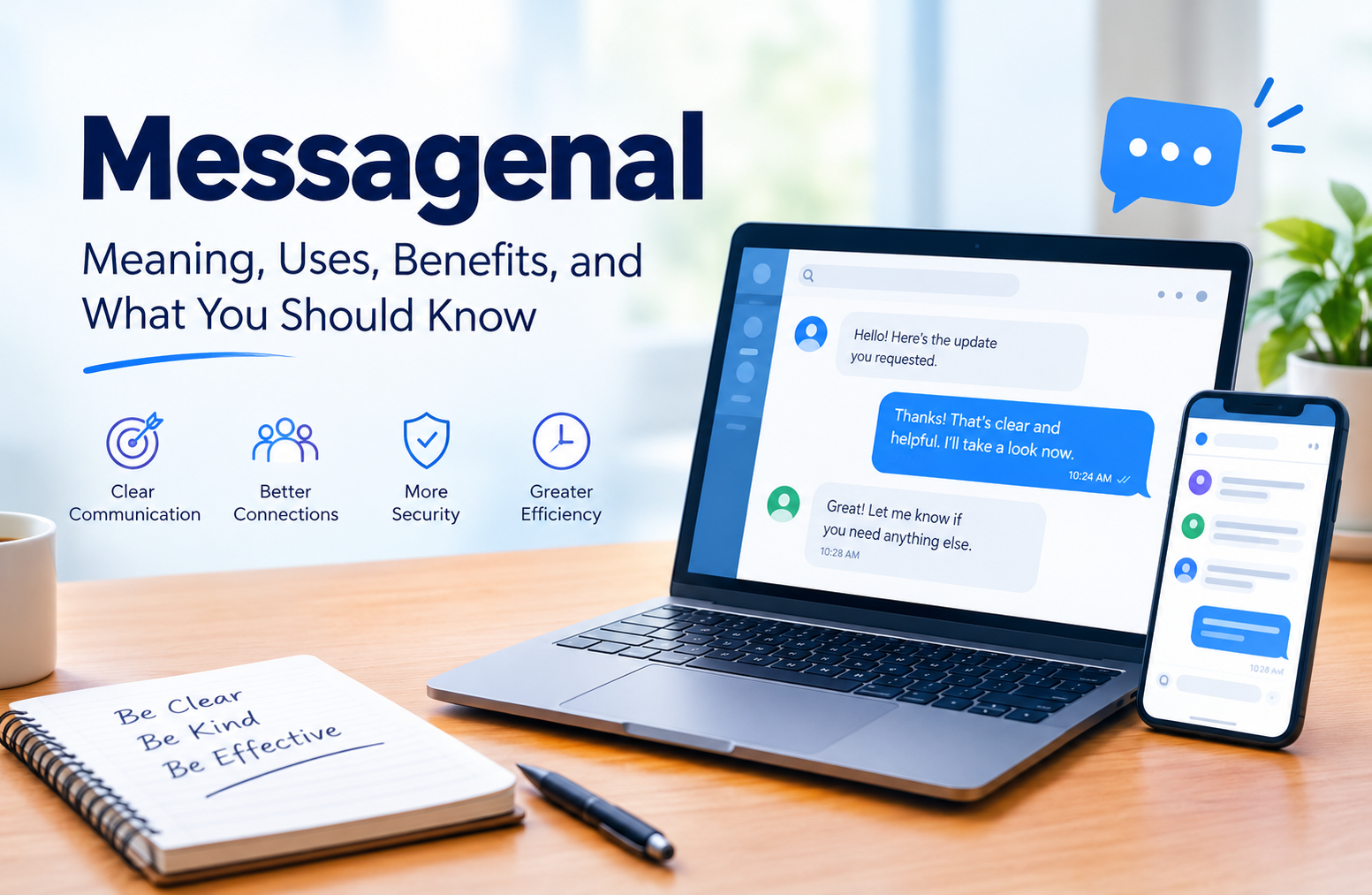
Messagenal: Meaning, Uses, Benefits, and What You Should Know
The term messagenal has started appearing in online searches related to digital communication, messaging habits, and clear information sharing. If you have encountered this unusual word, you may be wondering what it means, whether it refers to a messaging application, and how it relates to everyday communication. The important point is that the term does not yet have one universally accepted definition. Its current online use is most often associated with purposeful, clear, and audience-focused messaging, although some websites also connect it with digital communication tools. Understanding this distinction helps you separate useful communication principles from claims that have not been independently verified.
What Is Messagenal?
Messagenal is an emerging online term commonly associated with intentional digital communication. In its most practical interpretation, it describes an approach to sending messages that prioritizes clarity, purpose, context, and the needs of the person receiving the information.
The idea is simple: sending a message is not the same as communicating successfully. A person can send an email, publish a social media post, or write a workplace chat message in seconds, yet the recipient may still misunderstand its purpose. Effective communication requires the sender to consider what the other person needs to know and whether the message provides enough information to be understood correctly.
For example, consider a colleague who receives the message, “Please review this document.”
The request may seem clear to the sender, but the recipient could have several questions. Which part of the document needs attention? Is the sender looking for spelling corrections, factual verification, or approval? When is the review due?
A more useful message would identify the document, explain the requested review, and mention a deadline when necessary. This reduces confusion and makes the next step easier.
This is the central practical idea associated with messagenal: communication should be designed around understanding rather than simply delivering information.
However, it is important to recognize that the word itself is not a widely established academic term. There is no single authoritative definition that confirms it as a formal communication theory, technical standard, or recognized software category. Its usefulness therefore depends on the communication principles it represents, not on assuming that it describes a formally established system.
What Does Messagenal Mean?
The meaning of messagenal is best understood by examining the qualities that current online explanations commonly associate with it.
These qualities include:
- Purpose: Knowing why a message needs to be sent.
- Clarity: Expressing information in language the intended reader can understand.
- Context: Providing the background needed to interpret the message correctly.
- Audience awareness: Considering the recipient’s knowledge, responsibilities, and expectations.
- Empathy: Recognizing how wording and tone may affect the person receiving the message.
- Actionability: Making the requested response or next step clear when action is required.
- Efficiency: Communicating the necessary information without adding avoidable complexity.
These are established communication principles, even though their association with this particular word is relatively new and not formally standardized.
The Difference Between Sending a Message and Communicating Effectively
Sending a message is a technical or physical action. Effective communication is the result of transferring meaning in a way that allows the recipient to understand the information.
Imagine a manager sending a team member the following message:
“Finish the report soon.”
The recipient knows that a report is required, but the instruction leaves several details open to interpretation. The word “soon” could mean within an hour, before the end of the day, or sometime during the week.
A clearer alternative would be:
“Please finish the monthly sales report by 2 p.m. today and include the updated figures from the finance spreadsheet.”
The second message gives the recipient a defined task, deadline, and source of information.
The difference is not the number of words. It is the quality of the information. A short message can be effective when the context is already understood, while a longer message can still fail if it hides the main point.
Is Messagenal a Communication Theory?
There is insufficient evidence to describe messagenal as a formally recognized academic communication theory. The available online descriptions do not establish one accepted definition, a documented research history, or a recognized professional body responsible for maintaining the concept.
This distinction matters because a new label does not automatically represent a new scientific discovery.
Audience awareness, plain language, active listening, and clear instructions have been important parts of communication for many years. The term may provide a convenient way to discuss these ideas together, but readers should not confuse that convenience with formal academic recognition.
The most responsible interpretation is to treat it as an emerging label associated with purposeful digital communication while evaluating individual claims on their evidence.
How Messagenal Works in Everyday Communication
A practical approach to this concept begins before a person writes a message and continues until the recipient has enough information to respond appropriately.
1. Identify the Purpose
Start by deciding what the message needs to accomplish.
Are you sharing information, requesting approval, explaining a problem, asking a question, or confirming an arrangement? Each purpose calls for a different structure.
For instance, an informational update should make the key facts easy to find. A request should explain what is needed and when. A sensitive personal message may require more attention to tone and emotional context.
When the purpose is unclear to the sender, the resulting message often becomes unnecessarily long or confusing.
2. Understand the Audience
The same information may need different wording depending on who receives it.
A technical explanation intended for an experienced developer can include specialized terms. A similar explanation for a customer with limited technical knowledge should use simpler language and explain unfamiliar concepts.
Audience awareness also includes practical circumstances. A person reading a quick message on a mobile phone may benefit from a concise opening and clearly separated details. Someone reviewing a formal proposal may need a fuller explanation and supporting evidence.
The objective is not to assume what every reader knows. It is to provide enough information for the intended audience to understand the message.
3. Supply the Necessary Context
Context explains why information matters.
A message such as “The meeting has changed” is incomplete if the recipient does not know which meeting is involved or when it will take place.
A better version identifies the meeting and states the new time. If the change affects preparation, attendance, or another deadline, those details should also be included.
Context is especially important in remote teams, where people may not share the same conversations, schedules, or background information.
4. Use Direct and Understandable Language
Clear wording helps reduce the effort required to interpret a message.
Instead of writing, “It would be appreciated if the relevant changes could potentially be incorporated at your earliest convenience,” a sender could write, “Please add the requested changes by Friday.”
The second version is more direct without being rude.
Useful techniques include using familiar words, keeping sentences focused, explaining necessary technical terms, and placing important information near the beginning.
5. Choose an Appropriate Tone
Tone affects how people interpret written communication because readers cannot always hear the sender’s voice or see facial expressions.
A short response such as “Fine” may be perfectly neutral in one situation but appear dismissive in another. Similarly, a direct instruction can sound unnecessarily harsh if it lacks a polite opening or explanation.
Appropriate tone does not mean making every message overly friendly. Professional messages can be direct, and personal messages can be brief. The goal is to make the wording suitable for the relationship, subject, and situation.
6. Make the Next Step Clear
When a message requires action, the recipient should understand what to do.
A useful request usually identifies the task, the person responsible, and the deadline when one applies. It should also mention any information or decision needed before the task can begin.
Not every message needs a formal instruction. A simple greeting or confirmation may require no response at all. The important point is to avoid leaving necessary actions unclear.
7. Check Understanding
Communication is not always complete when a message is sent.
For complicated tasks, important decisions, or sensitive matters, the sender may need to confirm that the recipient has understood the information. This can be done through a summary, a follow-up question, or a request for confirmation.
For example, after explaining a project deadline, a manager might ask the team member to confirm the delivery date and the main requirements.
This step helps identify misunderstandings before they become larger problems.
The Main Benefits of Messagenal
The practical benefits associated with this communication approach come from established principles of clear writing and thoughtful information sharing. The results will depend on the situation, the audience, and how consistently those principles are applied.
Reduced Misunderstandings
Messages that contain clear instructions and enough context give recipients fewer reasons to guess.
This can be valuable when discussing deadlines, sharing project requirements, coordinating appointments, or explaining changes to a process. A small amount of additional clarity at the beginning may prevent repeated questions later.
For example, a delivery update that includes the order reference, revised delivery date, and available next steps is more useful than a vague statement that the delivery has been delayed.
Better Workplace Communication
Workplace communication often involves several people with different responsibilities. When messages lack context, employees may spend time requesting clarification or correcting avoidable errors.
Clear communication helps people understand their tasks, recognize priorities, and coordinate their work.
This is particularly useful for remote teams, where colleagues cannot always resolve confusion through an immediate conversation.
More Efficient Use of Time
Writing a clear message may take slightly longer than sending a vague one, but it can reduce the need for repeated explanations.
Consider the difference between sending five short messages to explain a task and sending one organized message that includes the objective, requirements, deadline, and relevant document.
The second approach is not automatically better in every situation. Quick exchanges can be appropriate when people already share the necessary context. However, when several details must be communicated, organizing them in advance can make the process more efficient.
Improved Customer Experience
Customers generally want to understand what is happening, what a business needs from them, and what they should expect next.
A useful customer support response explains the issue in plain language, provides relevant information, and identifies the available solution or next step.
For example, instead of replying, “Your request is being processed,” a support representative could explain which stage the request has reached and whether the customer needs to provide anything else.
Businesses should only make promises they can fulfill. Clear communication loses value when it creates unrealistic expectations.
Stronger Professional Relationships
Consistent, respectful communication can help build trust between colleagues, clients, and business partners.
People are more likely to work effectively together when expectations are understandable and concerns can be discussed without unnecessary hostility.
This does not mean every disagreement can be solved through better wording. Conflicting interests, limited resources, and organizational problems may require other solutions. Clear communication simply gives people a better foundation for addressing those issues.
More Accessible Information
Simple language can make information easier to use for people with different levels of experience, different educational backgrounds, or limited familiarity with a subject.
Accessibility also involves presentation. Descriptive headings, short paragraphs, meaningful labels, and clear instructions help readers locate information without searching through a dense block of text.
For digital content, these practices can support readers using mobile devices or assistive technologies, although technical accessibility requirements may involve additional measures.
Practical Applications of Messagenal
The principles associated with this term can be applied across many forms of communication. Their exact implementation depends on the medium and the expectations of the audience.
Workplace Emails
Email is useful for communicating detailed information, documenting decisions, and sharing material that recipients may need to revisit.
A well-organized email should make its purpose clear near the beginning. Supporting details can follow in a logical order, while any requested action or deadline should be easy to identify.
For example, an email requesting approval for a proposal might include:
- A subject line that identifies the proposal.
- A brief explanation of the decision required.
- The main reasons supporting the recommendation.
- A link or attachment containing relevant details.
- A clear date by which approval is needed.
This structure helps the recipient understand the request without having to reconstruct its purpose from several paragraphs.
Team Chats and Instant Messaging
Workplace chat tools are designed for quick exchanges, but speed can encourage incomplete instructions.
A message such as “Can you update it?” may work if the sender and recipient are discussing the same document. It is less effective when the conversation contains several projects or files.
A stronger message names the item and explains the requested change.
Teams can also establish simple communication rules. For example, urgent requests might identify the deadline, while non-urgent updates can be shared without expecting an immediate reply.
These rules should reflect the team’s actual needs rather than create unnecessary procedures.
Customer Service
Customer support messages need to balance accuracy, clarity, and empathy.
When a customer reports a problem, a useful response should acknowledge the concern, explain what is known, and provide realistic next steps. If the issue has not been resolved, the representative should avoid implying otherwise.
For example, a customer who cannot access an account may need a brief explanation of the recovery process, a link to the official recovery page, and instructions about what to do if the process fails.
Sensitive information should be handled through approved channels. A clear message should never encourage customers to share passwords, authentication codes, or other unnecessary confidential details.
Education and Online Learning
Teachers and students rely on digital messages to share assignments, clarify instructions, and coordinate deadlines.
An assignment announcement is more useful when it specifies the task, submission method, due date, and assessment requirements. Students should not have to search through several unrelated messages to determine what is expected.
Students can apply the same principle when asking questions. Rather than writing, “I don’t understand the homework,” they can identify the question, explain which part is confusing, and describe what they have tried.
This gives the teacher enough context to provide a more focused answer.
Marketing and Business Communication
Marketing messages need to explain value without misleading the audience.
A clear product message identifies what is being offered, who may benefit, and what limitations or conditions apply. It avoids exaggerated promises and makes important terms easy to find.
For example, an advertisement for a subscription service should distinguish between a free trial and a paid plan, explain when billing begins, and avoid hiding cancellation conditions in unclear wording.
Businesses should also respect consent and communication preferences. Relevant, useful messages are generally more appropriate than repeated unsolicited promotions.
Personal Messages and Family Communication
Personal conversations can be especially sensitive because the recipient may interpret short messages through the history of the relationship.
When discussing a concern, it can help to describe the specific situation and explain how it affected you rather than making broad accusations.
For example, “I was worried when the plans changed and I didn’t hear from you” communicates a specific concern more constructively than “You never tell me anything.”
This approach does not guarantee agreement, but it can make the conversation easier to understand and respond to.
Not every personal conversation needs carefully structured writing. Familiarity, humor, shared experiences, and informal expressions are valuable parts of human communication. The goal is to choose wording that fits the relationship rather than make every interaction sound like a business email.
Messagenal and Digital Communication Technology
The term is sometimes presented online as if it refers to a messaging platform that combines different channels, team collaboration, or file sharing. These descriptions should be treated cautiously because the available evidence does not establish one widely recognized software product with a verified set of features under this name.
It is useful to distinguish a communication approach from an actual application.
A communication approach describes how people create, deliver, and interpret messages. A software product is a specific tool with identifiable developers, documented features, terms of service, privacy practices, and support channels.
A website using a particular name does not, by itself, establish that a reliable application exists.
What to Look for in a Messaging Tool
If you are searching for software that can help manage digital conversations, evaluate the actual product rather than relying on a name or marketing description.
Important factors include:
Supported channels: Check whether the service genuinely supports the email, chat, social media, or other channels you use.
Security and privacy: Read the privacy policy and determine what information the service collects, how it uses that information, and whether it shares data with other parties.
Account protection: Look for appropriate account security options, such as multifactor authentication where available.
Access controls: For team accounts, confirm whether administrators can control permissions and remove access when an employee leaves.
Data retention: Understand how long messages and attachments are stored and whether you can export or delete them.
Reliability: Check the quality of documentation, customer support, service status information, and available user feedback.
Costs and limitations: Review subscription charges, usage limits, renewal terms, and any restrictions on the features you need.
These checks help you compare real products on evidence rather than assume that a particular name guarantees specific capabilities.
Is Messagenal Safe to Use?
The answer depends on what you mean by the term.
If you are referring to the general practice of writing clearer digital messages, safety depends on the content you share, the recipients, and the communication channel.
If you are referring to a particular website, application, or service using this name, its safety cannot be established from the name alone.
Before creating an account or sharing information, verify the exact website address and look for credible evidence about the operator. Read the privacy policy and terms, check whether the service has identifiable support channels, and examine independent reviews carefully.
Be particularly cautious if a website:
- Requests passwords for unrelated services.
- Asks you to provide one-time authentication codes.
- Requires payment before explaining what the service does.
- Makes broad security promises without supporting details.
- Uses confusing billing terms or makes cancellation difficult.
- Encourages you to download unfamiliar files or browser extensions.
- Requests permissions that do not appear necessary for its stated purpose.
A padlock icon in a browser indicates an encrypted connection, not that the business operating the website is trustworthy.
Avoid entering sensitive personal, financial, or account information until you have verified the service. If a product’s identity and ownership cannot be established, choosing a well-documented alternative is a sensible precaution.
Protecting Your Privacy in Digital Conversations
Good communication practices should include responsible information sharing.
Before sending a message, consider whether the recipient needs every detail you plan to include. Avoid sharing private documents, account credentials, financial information, or personal data with people who do not need access.
For workplace and customer communications, use approved tools and follow the relevant organizational policies. For personal conversations, verify unexpected requests through another trusted channel when necessary.
Privacy also requires care with attachments and links. A message may be clear and well written yet still expose someone to harm if it directs them to a fraudulent website or includes confidential material accidentally.
The practical lesson is that clarity and security should work together.
Common Challenges and Limitations
Although the principles associated with messagenal are useful, they are not a complete solution to every communication problem.
The Meaning Is Not Standardized
Different websites use the word in different ways. Some describe a communication philosophy, while others associate it with messaging technology.
Without an accepted definition, readers may interpret the same term differently. This makes it important to explain what a writer means when using it.
It is more accurate to describe the current usage carefully than to present an emerging label as a universally recognized standard.
Clear Messages Still Need Human Judgment
A message can be grammatically correct and still be inappropriate for the situation.
A sensitive personal issue may require a phone call or face-to-face conversation. A complicated disagreement may need questions and discussion rather than a long written explanation.
Written communication is useful, but it cannot always replace the emotional cues and immediate feedback available in other forms of conversation.
Too Much Detail Can Be Counterproductive
Adding context is helpful only when the details serve a purpose.
If every simple request becomes a lengthy explanation, recipients may struggle to identify the important information. The best message includes enough detail to support understanding without overwhelming the reader.
A practical test is to ask whether each sentence helps the recipient understand the issue, make a decision, or take the next step.
Cultural and Language Differences Matter
People from different backgrounds may interpret politeness, directness, humor, and silence differently.
A phrase that sounds normal in one workplace may seem abrupt in another. Similarly, idioms and slang can confuse readers who are communicating in a second language.
Using plain language and avoiding unnecessary ambiguity can help, but cultural awareness still requires attention to the people involved.
Digital Overload Cannot Be Solved by Wording Alone
Even well-written messages can become difficult to manage when employees receive too many notifications across multiple platforms.
Organizations may need to reduce unnecessary communication, clarify which channels are used for different purposes, and establish realistic expectations about response times.
Improving individual messages is helpful, but the larger communication system also matters.
How to Apply Messagenal Principles Step by Step
You do not need special software, a formal certification, or a complicated process to put these ideas into practice. Start with the messages you send most often and improve them gradually.
Step 1: Write the Main Point First
Before adding background information, state the central purpose of the message.
For example:
“We need approval for the revised budget by Thursday.”
This opening gives the recipient a clear starting point. The following paragraphs can explain the reasons for the request and provide supporting information.
Step 2: Add Only the Context That Matters
Include details that help the reader understand the request.
If the budget is changing because supplier costs have increased, explain that. If the recipient needs to review a specific document, identify it.
Avoid adding unrelated history that does not affect the decision or action.
Step 3: Replace Vague Instructions
Review words such as “soon,” “later,” “better,” and “fix it” when precision is important.
Replace them with specific instructions, measurable requirements, or defined dates where appropriate.
For instance, “Send the revised document by 11 a.m. on Monday” is more useful than “Send it early next week.”
Specificity should reflect genuine requirements. Do not invent a deadline simply to make a message appear more organized.
Step 4: Check Tone and Accuracy
Read the message from the recipient’s perspective.
Could a phrase sound unnecessarily hostile? Is a key fact missing? Does the message promise something that has not been confirmed?
For important communications, check names, dates, figures, attachments, and links before sending.
Step 5: Make the Required Response Clear
If you need a decision, explain what the recipient should decide. If you need feedback, identify the part that requires review. Also if no reply is necessary, avoid implying that one is expected.
This small adjustment can reduce uncertainty and unnecessary follow-up messages.
Step 6: Learn From Repeated Questions
If recipients regularly ask the same questions, the original messages may be missing important information.
Look for recurring gaps in instructions, onboarding emails, support responses, and project updates. Improve the standard wording or documentation instead of repeatedly answering the same question from scratch.
Step 7: Review the Outcome
For important communications, consider whether the recipient understood the message and completed the intended action.
If a task was misunderstood, determine whether the problem came from unclear wording, missing information, conflicting expectations, or another cause.
This is more useful than assuming every communication failure results from poor writing. Sometimes the real issue is an unclear process or a decision that has not been made.
Messagenal Compared With Traditional Digital Messaging
The difference is best understood as a difference in emphasis rather than a completely separate technology.
Traditional digital messaging describes the broad practice of exchanging information through tools such as email, text messages, and online chat. The interpretation of messagenal found in recent online explanations places additional emphasis on the purpose and quality of the communication.
| Aspect | General digital messaging | Messagenal-style approach |
| Main focus | Sending and receiving information | Making the intended meaning clear |
| Message structure | Depends on the sender and situation | Organized around purpose and context |
| Audience awareness | May be informal or assumed | Considered before writing |
| Tone | Varies by relationship and channel | Chosen with the recipient in mind |
| Requested action | May be implied | Made explicit when necessary |
| Technology | Uses digital communication tools | Does not require a specific application |
| Formal status | Broad, established category | Emerging term without a standardized definition |
This comparison should not be interpreted as evidence that messagenal is a formally separate communication discipline. It is a practical way to describe an intentional approach to familiar messaging activities.
The Role of Artificial Intelligence in Clear Messaging
Artificial intelligence tools can help people draft, shorten, translate, or reorganize digital messages. They may be useful when a person needs to explain a complex subject in simpler language or adapt the tone of a professional email.
For example, a user could ask an AI assistant to turn a long project update into a concise summary with separate sections for completed tasks, outstanding issues, and deadlines.
However, AI-generated wording still requires human review.
A system may misunderstand the context, omit an important qualification, invent a detail, or produce language that sounds confident without being accurate. These risks are especially important in legal, medical, financial, employment, and other sensitive communications.
A responsible workflow is to provide only the information necessary for the task, review the draft for factual accuracy, and remove private information that should not be shared with the tool.
AI can support clearer communication, but the sender remains responsible for the final message and its consequences.
How to Evaluate Information About Messagenal Online
Because the term has no single established definition, checking sources is especially important.
When reading an article about it, ask the following questions:
- Does the article explain what the term means without making unsupported claims?
- Does it distinguish a communication concept from a software product?
- Does it identify reliable sources for claims about history, ownership, or technical features?
- Does it explain the practical limitations of the idea?
- Does it make exaggerated promises about security, productivity, or business results?
- Does it provide useful examples that readers can apply in real situations?
Be careful with articles that repeat the same broad definition without explaining how the idea works. A useful resource should give readers enough information to assess the claim and apply the relevant principles independently.
For guidance on writing for public audiences, the National Institutes of Health’s Clear Communication resources offer a more established foundation for making information understandable.
The same critical approach applies to websites that claim to offer a messaging product under this name. Look for verifiable product documentation, clear ownership information, and credible independent evidence before relying on those claims.
Frequently Asked Questions About Messagenal
1. What is messagenal?
Messagenal is an emerging online term commonly associated with clear, purposeful, and audience-aware digital communication. It does not currently have one universally accepted formal definition.
2. Is messagenal a real word?
The term appears in online content, but it is not a widely established English word with a standardized meaning. Its exact origin and formal status remain unclear.
3. Is messagenal a messaging app?
A recognized messaging application with a verified feature set under this name has not been firmly established by the available evidence. Check the identity and documentation of any specific service before using it.
4. What are the main benefits of messagenal?
The communication principles associated with it can help reduce misunderstandings, clarify responsibilities, improve customer support, and make written instructions easier to follow.
5. Is messagenal safe to use?
Safety depends on whether the term refers to a communication practice or a particular online service. Before using a website or application, verify its operator, privacy policy, security practices, and reputation.
6. How can I use messagenal in everyday life?
Start by identifying your message’s purpose, considering the recipient, providing necessary context, using direct language, and making the next step clear when action is required.
Conclusion
Messagenal is best approached as an emerging online term associated with intentional, clear, and audience-focused digital communication. Although its precise origin and formal definition remain uncertain, the underlying principles offer practical value in everyday conversations, workplace emails, customer support, education, and business communication.
The key distinction is between the name and the practices behind it. Clear language, relevant context, appropriate tone, and understandable instructions have long been important parts of effective communication. They do not require a new application or a formally recognized framework to be useful.
At the same time, claims about a specific product, official platform, or established theory should be supported by credible evidence. Evaluating those claims carefully helps readers avoid confusion and make informed decisions.
Ultimately, effective digital communication is not measured by the number of messages sent or the speed at which they arrive. It is measured by whether people understand the information, know what it means, and can respond appropriately.